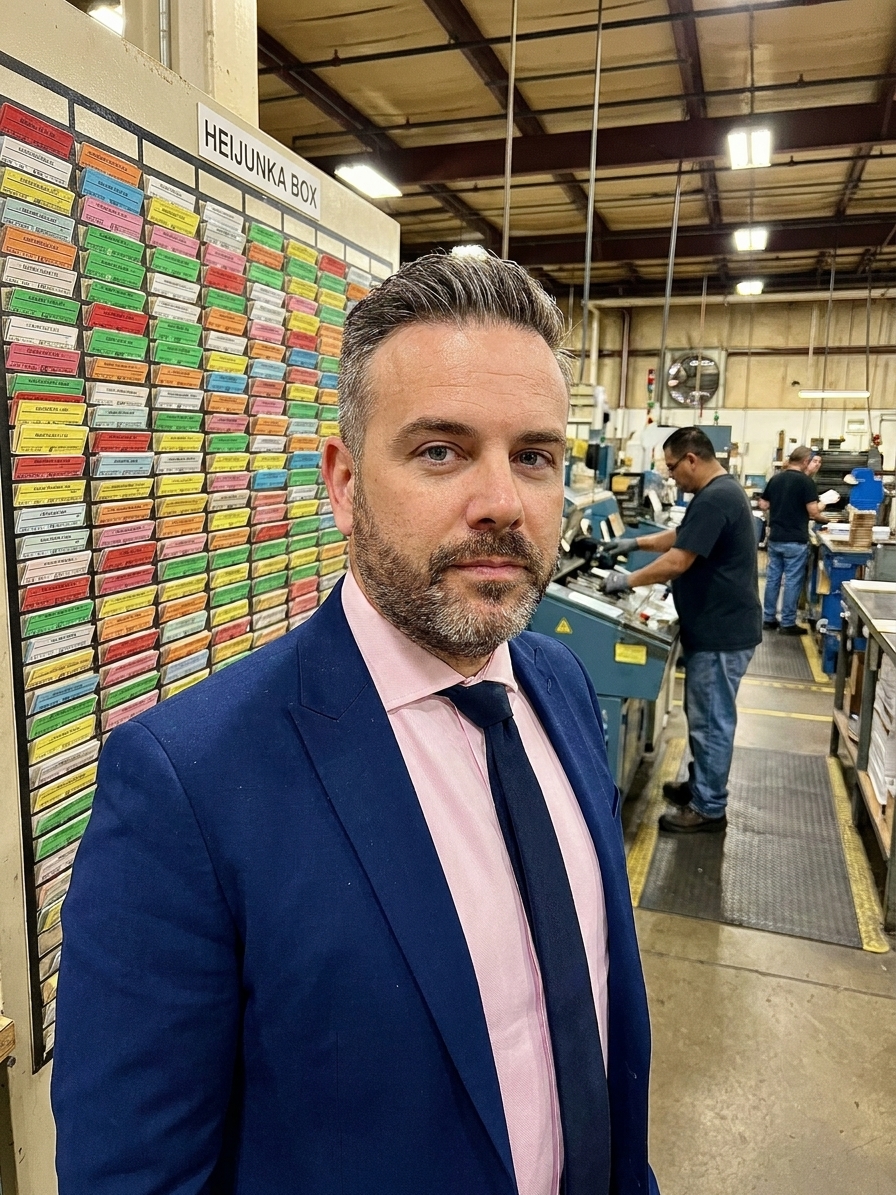
Heijunka is the lean practice of production leveling: smoothing volume and mix so every shift looks roughly the same. Instead of building 800 units Monday and 200 Tuesday, you build approximately 650 each day. Instead of running Product A all morning and Product B all afternoon, you interleave them in small batches. The arithmetic is simple. The execution is brutal.
The logic is elegant. Levelled production levels demand on suppliers, equipment, and quality systems. Inventory buffers shrink. Changeovers happen in small increments. Problems surface immediately because there is no surge volume to hide behind. Toyota built its entire production system on this rhythm. Uneven production (mura) creates strain, strain creates waste (muda), and waste creates overburden (muri).
I have audited dozens of plants claiming to use heijunka. Almost none actually do. They have the visual board on the wall, but the shop floor tells a different story. The gap between the planned schedule and actual production is where the real operational costs hide.
The Decay Cycle: From Implementation to Wall Art
Here is what happens when a plant adopts heijunka without the necessary foundations. The lean team builds a heijunka box: a grid showing scheduled quantities for each product across each time slot. Colour-coded cards slot into compartments. Management tours the line, nods approvingly, and photographs it for the next board presentation.
Then a key customer calls with a rush order. The levelled schedule says to build a mix of Products A, B, C, and D this week. The customer does not care about your heijunka box. The sales VP does not care about your heijunka box. The plant manager, choosing between satisfying a major account and maintaining production smoothing, makes the only rational decision: he discards the schedule.
By Wednesday the line runs nothing but Product A. The SMED changeover scheduled for Tuesday still has not happened. The materials team ordered components based on the levelled schedule, so there is a surplus of B and C parts and a critical shortage of A parts. Expedites go out. Premium freight piles up. Quality suffers because rushed production means skipped PFMEA checks.
Friday arrives. The rush order ships. The heijunka box remains on the wall, full of cards that bear no resemblance to what actually happened on the floor. Nobody updates it. It has become wall art.
The Structural Prerequisites Most Plants Lack
The failure of heijunka is not a lack of commitment. It is a failure of prerequisites. True production leveling demands five conditions that are extraordinarily difficult to achieve. Most companies try to implement the tool before building the foundation it rests on.
Condition one is demand stability. Heijunka assumes demand is reasonably predictable. Most companies operate in environments where demand swings 30 to 50 percent month to month, where customers change orders without notice. You cannot level production when the ground is shaking. Yet plants try anyway, creating a levelled schedule on Monday that is obsolete by Tuesday.
Condition two is short changeover times. To produce a levelled mix, you must switch between products frequently. That requires changeovers measured in minutes, not hours. If your changeover from Product A to B takes four hours, you cannot economically interleave them. You will build a day of A, change over for four hours, then build a day of B. That is batch production with a leveling label.
Condition three is supplier capability. Heijunka levels the signals you send to your supply chain. If you suddenly start ordering smaller quantities more frequently, your supplier must handle that. Most cannot. They have optimised their own production around your lumpy demand pattern. When you smooth it, you create chaos in their system and they push back.
Condition four is workforce flexibility. A levelled schedule with frequent product changes requires multi-skilled operators. If your workforce is specialised to specific stations and products, leveling the mix means idling people or retraining them. Most companies do neither. They keep running what the specialist is good at, schedule be damned.
Condition five is management discipline. Heijunka requires management to accept that production will sometimes be lower than it could be, because the schedule prioritises smoothness over maximum output. When the CEO demands why Line 4 ran at 78 percent capacity when it could have run at 92, the plant manager folds. The schedule is abandoned for short-term throughput.
Quantifying the Hidden Operational Costs
A partially functioning heijunka system is worse than no system because it creates the illusion of control. The board on the wall says you are building a balanced mix. Actual production data says you are building whatever the loudest customer demanded. This divergence directly impacts quality investigations and root cause analysis.
When a defect spike occurs on Product B, the 8D investigation starts from the assumption that production ran as scheduled. But it did not. The actual production pattern was chaotic, and the true root cause is buried in the gap between plan and reality. You end up investigating a phantom process while the real deviation goes uncorrected.
Measuring Heijunka Schedule Attainment
The damage extends to your supply chain metrics. You promised suppliers a steady, predictable pull based on the levelled schedule. When you revert to crisis ordering, you burn the trust and flexibility you spent years building. Supplier PPAP cycles and capacity reservations are all disrupted, leading to long-term cost penalties that never appear on the rush order's P&L.
The True Cost: Organisational Cynicism
The most damaging outcome of a failed heijunka implementation is not the wasted effort or the premium freight. It is the learned indifference it creates across the organisation.
When operators watch a leveling system get implemented, celebrated, and abandoned within a year, they learn that management initiatives are not to be taken seriously. They learn that the next lean tool will follow the same pattern. They learn to wait it out.
When you later try to implement SMED or standardised work, you are fighting organisational memory, not process resistance.
This cynicism is more costly than any production imbalance. The cultural damage undermines every future continuous improvement effort. Employees correctly perceive the disconnect between the executive enthusiasm for lean certifications and the daily reality of meeting shipment quotas at any cost.
Pragmatic Alternatives to Full Leveling
If your organisation lacks the prerequisites for heijunka, there are pragmatic alternatives that deliver operational stability without requiring a complete TPS transformation. These approaches accept the reality of demand volatility while still capturing the benefits of predictability.
Segment your demand using a runner-repeater-stranger model. Stable runner products with predictable volume get levelled. Medium-volume repeaters get batched on a fixed, standardised cycle. Low-volume strangers get built strictly to order. This provides leveling where it is feasible and responsiveness where it is necessary, without forcing the entire plant into a rhythm it cannot sustain.
If you cannot level the product mix, level the pace. Establish a takt time for each product family and run at that steady pace within each block. Even if you build Product A all Monday and Product B all Tuesday, running each at a disciplined pace delivers most of the workforce stability and quality benefits of full heijunka. The key is eliminating the micro-stoppages and uneven operator workflow within the block.
Approaches to Production Stability
Full Heijunka (Premature)
- Attempts to level all products simultaneously
- Requires system-wide SMED and demand stability
- Collapses under the first major customer escalation
- Generates misleading quality and production data
Pragmatic Leveling
- Levels only high-volume runner products
- Uses fixed freeze windows to protect execution
- Establishes takt time to maintain operator pace
- Quantifies trade-offs of schedule disruptions
Establish a schedule freeze window. Rather than a perpetually levelled schedule, lock the plan for a fixed period, such as two weeks. During the freeze, the shop floor gets the stability needed to execute properly. The chaos gets pushed to the edge of the window, where it can be managed by planners rather than disrupting operators mid-shift.
Building the Interdependent Foundation
Heijunka's failure pattern is not unique. It mirrors kanban systems that become push systems, SMED programs that never reduce changeover times, and 5S implementations that devolve into periodic cleaning campaigns. The tool is adopted without the foundation, celebrated without the discipline, and abandoned without the lesson.
Lean tools are an interdependent system, not an a la carte menu. Heijunka requires SMED. SMED requires standardised work. Standardised work requires visual management. Visual management requires a problem-solving culture. A problem-solving culture requires management that values systemic learning over short-term expediency. You cannot pick the tools you like and ignore the hard ones.
Production leveling asks the factory to produce less than it could, to invest in changeovers that seem wasteful, and to hold buffers that finance departments question. It demands systemic maturity. Until those foundations are built, the heijunka box on your wall will remain an expensive, time-consuming decoration that makes the organisation worse, not better.