Manufacturing leaders love the idea of smooth, predictable
production. Who wouldn’t? Instead of chaotic fire-fighting, you get a
calm factory that produces exactly what customers need, when they need
it, at a rhythm anyone can follow. That promise has a name: Heijunka, or
production leveling. And like every powerful lean tool, it has been
adopted, misunderstood, distorted, and quietly abandoned by more
organizations than will ever admit it.
I have spent over two decades walking through factories that claim to
practice Heijunka. Most of them don’t. What they practice is a rough
approximation that looks good on a PowerPoint slide and falls apart the
moment a real customer order arrives. The leveling boxes on their walls
are relics — colorful but empty, like traffic lights at an intersection
where everyone drives through red.
This article is about what Heijunka actually means, why so many
implementations collapse, and what it takes to make production leveling
work in a real plant with real constraints.
What Heijunka Actually Is
Heijunka is the practice of leveling production both by volume and by
product mix over a given time period. Instead of building large batches
of one product followed by large batches of another, you create a
repeating sequence of smaller batches that smooths the flow and matches
average customer demand.
Toyota developed this concept as part of its Toyota Production
System, and it sits at the intersection of two other ideas you probably
know: takt time (the rhythm of customer demand) and pull systems
(producing only what the next process actually consumes). Heijunka is
the bridge that connects them. Without leveling, even the best kanban
system becomes a tool for moving chaos from one department to
another.
The core mechanism is deceptively simple. Suppose your customer
orders 100 units of Product A, 50 of Product B, and 50 of Product C per
day. A traditional approach would run all of Product A first, then
switch to B, then switch to C. That minimizes changeovers but creates
massive inventory for A while C customers wait. Heijunka says: run a
repeating cycle of A-A-B-A-C (or similar) throughout the day, so every
product appears regularly and inventory stays low.
This requires something most plants find deeply uncomfortable: short
changeovers, stable demand signals, and the discipline to stick to the
plan when someone panics.
The Heijunka Box: Tool or
Trophy?
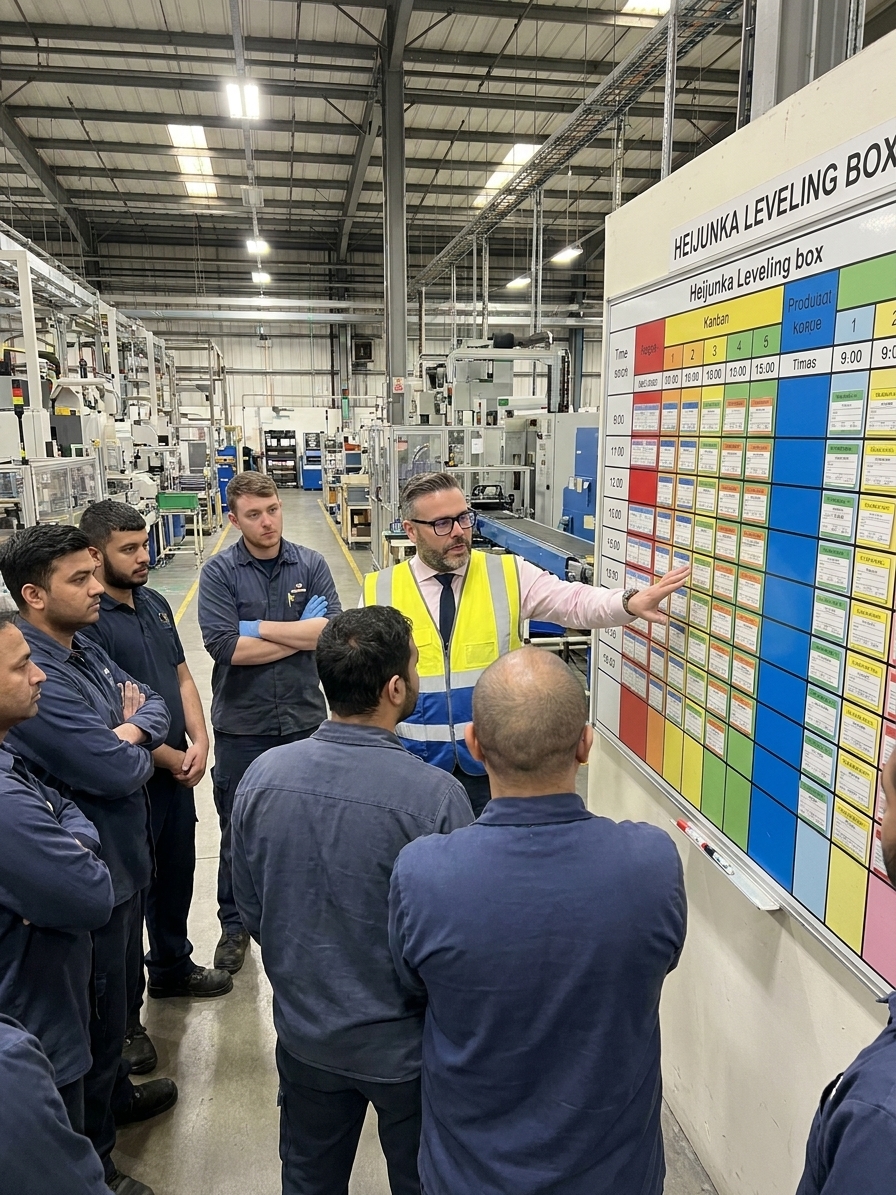
The iconic symbol of production leveling is the Heijunka box — a
physical grid of slots representing time intervals and product types.
Each slot contains kanban cards that define what to build in that
period. Operators pull cards in sequence, and the visual board shows
whether you’re ahead, behind, or on track.
In plants where Heijunka works, the box is alive. Cards move
constantly. Supervisors glance at it. Operators adjust based on what
they see. The box is a working tool, not a decoration.
In plants where Heijunka has failed — which is most of them — the box
sits on a wall collecting dust. It was built during a lean
implementation blitz, photographed for the company newsletter, and then
ignored when reality refused to cooperate with the plan. The cards
inside are weeks old. Nobody remembers what the columns mean. The row
labels correspond to products that were discontinued two revisions
ago.
This is the first symptom of failure: the leveling tool becomes a
museum exhibit. And once the tool is dead, the practice it represents is
dead too — even if the term “Heijunka” still appears in the annual
quality report.
Why
Leveling Collapses: Five Patterns I See Repeatedly
Having diagnosed Heijunka failures across automotive, electronics,
food processing, and medical device plants, I can tell you that the
causes are remarkably consistent. Here are the five most common
patterns.
1. Demand Volatility
That Nobody Manage
Heijunka requires a reasonably stable demand signal to design the
repeating cycle. But in many plants, customer demand swings by 40-60%
week to week. When confronted with this, the response is usually: “We
can’t level because demand isn’t level.”
This is a half-truth. Demand is rarely as volatile as it appears.
What’s volatile is the order pattern — distorted by batch ordering from
distributors, internal sales incentives that push volume at month-end,
and lack of communication between sales and production. Some of this can
be smoothed. But it requires effort upstream in the supply chain, and
many plants never try. They just point at the demand chart and say
“impossible.”
2.
Changeover Times That Make Small Batches Unaffordable
Leveling means producing in smaller batches with more frequent
changeovers. If your changeover takes four hours, that’s a brutal tax.
You lose capacity every time you switch.
The answer is SMED — Single-Minute Exchange of Die. But SMED is hard,
sustained work, and many organizations give up after initial gains. They
get changeovers from four hours to two and call it done. At two hours,
small-batch leveled production is still economically painful. So they
revert to large-batch production, and Heijunka dies.
The plants that make Heijunka work are the ones that pushed SMED from
four hours to twenty minutes. That’s where the math starts working.
3. The
“Special Order” Exception That Becomes the Rule
Every plant has special orders. A key customer needs something
expedited. A new product launch requires trial runs. A VIP client
requests a one-time variation. These exceptions are real, and a mature
Heijunka system can absorb them — perhaps 10-15% of capacity reserved
for variability.
But in practice, the exception pipeline grows. Sales starts promising
custom runs to win deals. Engineering schedules changeovers for “quick”
prototype builds that take all day. Within months, exceptions consume
40% or more of available time, and the leveled schedule exists only on
paper.
This is a governance failure, not a technical one. Nobody has the
authority to say “no” or push the special order into the normal planning
cycle. Without that authority, exceptions eat the system.
4.
Supplier Unreliability That Forces Buffer Inventory
Leveling production means you need materials to arrive predictably.
If your suppliers can’t deliver on time or in the right quantities,
you’ll build a buffer of incoming inventory to protect yourself — which
undermines the waste reduction that Heijunka is supposed to deliver.
I’ve seen plants where the incoming warehouse grew larger after
implementing Heijunka, not smaller. They leveled their own production
but couldn’t level their supply chain, so they absorbed all the
variability in raw material stock. The net effect was zero improvement
in total inventory and a lot of added complexity.
5. Metrics That Reward
Batch Thinking
This is the silent killer. The production manager’s bonus is tied to
equipment utilization. The finance team measures cost per unit, which
favors long runs with minimal setup. The planning department is scored
on on-time delivery, which they protect by building ahead.
Heijunka optimizes for total system performance — minimum total
inventory, maximum flexibility, stable flow. But individual departments
are measured on local metrics that contradict those goals. When the
metrics fight the method, the metrics win every time.
What Working Heijunka Looks
Like
In contrast to the failures, I’ve seen a handful of plants where
production leveling genuinely works. They share certain
characteristics:
Changeover capability is treated as a core competence, not a
project. Teams practice setup reduction continuously. Operators
are trained on quick-changeover techniques. Engineering designs tooling
and fixtures that minimize adjustment. In these plants, changing over a
line in under 15 minutes is normal — expected, even.
The schedule is sacred within defined limits.
Production follows the Heijunka plan. Exceptions require approval from a
cross-functional team, not just a sales rep with a loud voice. There’s a
clear rule: if the exception breaks the cycle, it goes into next week’s
plan unless it’s a genuine emergency.
Demand is actively managed upstream. Sales and
operations planning (S&OP) is not a monthly ritual — it’s a weekly
cadence where demand signals are reviewed, adjusted, and communicated.
Sales understands that wildly oscillating orders create manufacturing
cost, and there are incentives to smooth the pattern.
Suppliers are partners, not adversaries. When a
supplier can’t meet the leveled delivery schedule, the response isn’t a
penalty — it’s a conversation about what’s causing the instability and
how to fix it. Long-term contracts provide stability in exchange for
reliable delivery.
Metrics support flow, not just efficiency. These
plants measure total lead time, inventory turns, schedule adherence, and
changeover time as primary KPIs. Equipment utilization is tracked but
not optimized at the expense of flexibility.
The
Relationship Between Heijunka and Other Lean Tools
Production leveling doesn’t exist in isolation. It’s the foundation
that makes several other lean practices viable. Understanding these
connections helps explain why partial implementations fail.
| Lean Practice | Requires Heijunka Because |
|---|---|
| Kanban (pull system) | Pull systems assume a repeating rhythm. Without leveled production, kanban cards circulate erratically, and the system generates false signals. |
| Standard Work | Standard work assumes a stable production sequence. If the mix and volume shift daily, standardized work becomes theoretical. |
| JIT (Just-in-Time) | JIT means delivering the right part at the right time in the right quantity. Without leveling, “right time” is a moving target that nobody can hit consistently. |
| Continuous Improvement | Kaizen thrives on stability. Leveling creates the baseline conditions that make problems visible and improvement measurable. |
When plants abandon Heijunka, they usually don’t realize they’ve also
undermined kanban, standard work, and continuous improvement. The
symptoms show up elsewhere — kanban doesn’t work, standard work isn’t
followed, improvement stalls — but the root cause traces back to the
missing foundation.
A Practical
Assessment: Is Your Heijunka Real?
If you’re reading this and wondering whether your organization’s
production leveling is genuine or theater, here are six diagnostic
questions:
-
When was the last time someone physically updated the
Heijunka box or schedule? If the answer is “I’m not sure” or
“during the last audit,” your system is decorative. -
What percentage of your production time follows the
leveled plan versus exceptions? Below 70% adherence means the
plan is fiction. Above 85% means it’s real. -
How long is your average changeover? If it
exceeds 30 minutes for simple tooling changes, you don’t have the
technical capability to level effectively. -
Does your S&OP process actively smooth demand, or
does it just pass customer orders through? If production
receives whatever sales receives, with no buffering or negotiation,
you’re not leveling — you’re reacting. -
Are your inventory metrics improving after implementing
Heijunka? If total inventory (raw + WIP + finished) hasn’t
decreased within six months, the system isn’t delivering its core
benefit. -
Can an operator on the floor explain the current
production cycle? If the people building product can’t describe
the leveled sequence, it doesn’t exist in any meaningful sense.
Building
(or Rebuilding) Production Leveling the Right Way
For organizations that want to implement Heijunka properly — or
rescue a failed implementation — here is a pragmatic sequence I
recommend based on what works in practice.
Start with changeover reduction. Before you design a
leveled schedule, invest in SMED. Get changeovers under 30 minutes for
the product family you want to level. Without this, every small-batch
cycle bleeds capacity and the economics will push you back to large
batches.
Pick one product family, not the whole plant.
Heijunka is easier to implement in a contained environment. Choose a
product family with relatively stable demand, manageable complexity, and
a team that’s open to experimentation. Prove the concept before
scaling.
Establish the repeatable cycle. Calculate the takt
time for the family. Design a sequence that produces the right mix at
the right rhythm. Test it for a week. Adjust. Test again. The cycle will
evolve — that’s normal.
Build governance around exceptions. Define what
constitutes a legitimate exception, who approves it, and how it affects
the schedule. Make the rules visible. Enforce them. This is where most
implementations need the most organizational courage.
Measure total system performance, not local
efficiency. Track total inventory, lead time, schedule
adherence, and customer service level. Resist the pull of utilization
metrics that reward large-batch behavior.
Engage suppliers early. Once internal leveling is
stable, extend the conversation upstream. Share the production rhythm
with key suppliers. Ask what would help them deliver more consistently.
Co-design a supply pattern that works for both sides.
The Deeper Insight
Heijunka is not really about schedules or boxes or kanban cards. It’s
about discipline and trust. Discipline to follow a plan when it feels
easier to react. Trust that the plan was built with real data and real
cross-functional input. Both of these are cultural qualities, not
technical ones.
The plants where Heijunka works didn’t get there by buying better
scheduling software or hiring a lean consultant for a three-month
engagement. They got there by years of consistent practice, honest
measurement, and leadership that valued system-level performance over
short-term local optimization.
If your organization is struggling with production leveling, the
answer is probably not a new tool. It’s an honest conversation about
whether you have the foundational conditions — short changeovers, stable
demand signals, aligned metrics, and cross-functional discipline — that
make leveling possible. And if you don’t, that’s where the work
begins.
Peter Stasko is a Quality Architect with over 25
years of experience in manufacturing quality, lean implementation, and
production system design. He has led Heijunka implementations across
automotive, electronics, and industrial equipment plants — some
successful, some educational. He writes about the gap between lean
theory and factory reality.