Production leveling — Heijunka — is supposed to be the heartbeat of a
lean manufacturing system. The idea is deceptively simple: instead of
building large batches of one product type and then switching to
another, you mix small quantities of different products in a repeating
pattern. You level both the volume and the variety of production so that
every day, every shift, every hour looks roughly the same. This creates
a steady pull on your supply chain, smooths out the boom-and-bust cycles
that exhaust your people and your machines, and makes problems visible
because there is no flood of inventory to hide them behind.
It is one of the most powerful concepts in the Toyota Production
System. It is also one of the most widely misunderstood, misapplied, and
quietly abandoned practices in modern manufacturing.
Here is what typically happens: an organization hears about Heijunka
at a conference or reads about it in a lean book. A consultant is
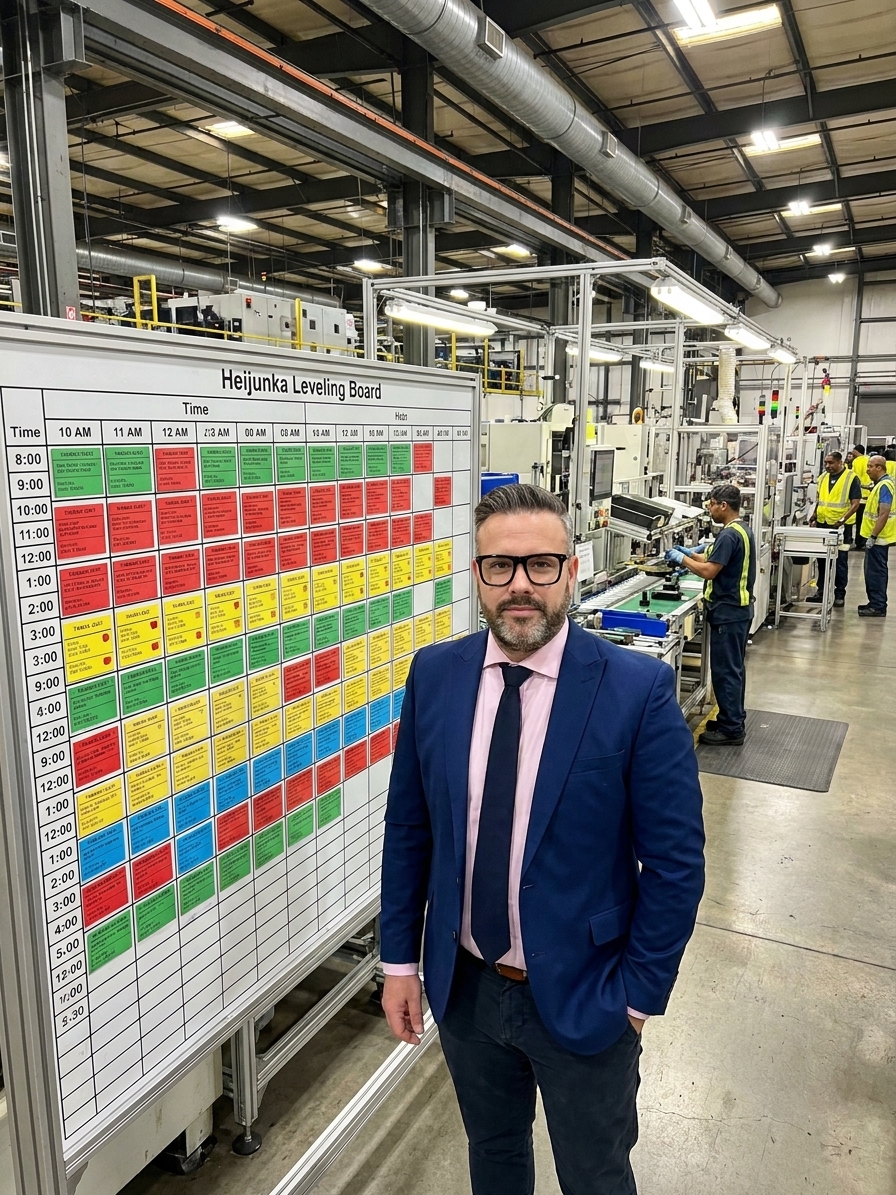
brought in. A Heijunka box is built — a physical board with rows
representing products and columns representing time increments, with
kanban cards placed in the slots to create a leveled schedule. The team
trains on it. Photographs are taken. The board looks beautiful. And
within six months, the cards are outdated, the schedule is being
overridden daily by the production planning department, and the Heijunka
box has become a piece of wall art that nobody touches.
What went wrong? Let’s break it down.
The
Fundamental Misunderstanding: Heijunka Is Not a Scheduling Tool
Most organizations treat Heijunka as a scheduling technique — a way
to arrange production orders to look smoother on a Gantt chart. This is
a fundamental category error. Heijunka is not a scheduling tool. It is a
system design philosophy that demands your entire production system be
capable of mixed-model production at a moment’s notice.
This means your changeovers must be fast enough that switching
between products doesn’t destroy capacity. Your suppliers must be able
to deliver frequently in small quantities. Your operators must be
cross-trained to handle different products without relearning the work
each time. Your quality must be stable enough that you can run any
product on any day without a spike in defects. And your equipment must
be reliable enough that you don’t need long runs of a single product to
“make up for” the downtime you’re expecting.
When organizations skip this foundational work and jump straight to
the scheduling board, they are essentially trying to paste a lean
technique on top of a system that cannot support it. The result is
predictable: the leveled schedule creates chaos on the shop floor
because the system underneath it is not designed for leveling.
Changeovers take too long. Suppliers can’t deliver in small batches.
Operators aren’t trained on all products. So the schedule gets
overridden — first occasionally, then constantly, then formally — and
Heijunka is declared “not suitable for our operation.”
It was never going to be suitable. Not because the concept doesn’t
apply, but because the prerequisites were never built.
The Volume
Problem: Leveling What You Cannot Predict
The second major failure mode is demand variability. Heijunka assumes
that you can identify a relatively stable pattern in customer demand and
then level your production to meet it. But what happens when demand is
genuinely unpredictable? What happens when a major customer places an
order that dwarfs your normal daily volume? What happens when a seasonal
spike hits and your leveled schedule calls for producing 200 units a day
when you need 2,000?
The purist answer is that you should level to average demand over a
period — say, a month — and build a small buffer of finished goods
inventory to absorb the variability. This is correct in principle. In
practice, most organizations struggle with the discipline this requires.
Building a buffer means deliberately producing units you don’t need
today so you can meet demand tomorrow. To a traditional manufacturing
manager trained to minimize inventory at all costs, this feels wrong. To
a finance department measured on working capital, it looks like
waste.
So the buffer is never built, and when demand spikes, the
organization abandons leveling and reverts to batch production. The
lesson learned is that “Heijunka doesn’t work in a high-mix,
variable-demand environment.” The actual lesson is that Heijunka
requires deliberate inventory strategy as a shock absorber, and the
organization was unwilling to make that investment.
There are absolutely environments where Heijunka in its purest form
is extremely difficult — highly engineered-to-order products, very
low-volume manufacturing, prototype shops. But the vast majority of
operations that claim this excuse are producing repetitive products at
volumes that could be leveled if the system were designed for it.
The
Variety Problem: When Mixed-Model Production Exposes Every Weakness
Leveling variety — not just volume — is where most organizations hit
the wall. In a traditional batch operation, you run Product A for three
days, then Product B for two days, then Product C for one day. Each
product runs long enough that the system stabilizes. Changeovers happen
infrequently. Quality issues get sorted out within the run. Operators
get into a rhythm.
Mixed-model production destroys all of this. If you are running
Product A, then Product B, then Product C, then back to Product A — all
within a single shift — then every weakness in your system is exposed
simultaneously. Your changeover time, which was tolerable when it
happened once a week, becomes unbearable when it happens four times a
shift. Your tooling, which was “good enough” for long runs, reveals that
it can’t maintain tolerance across rapid switches. Your operators, who
knew Product A inside and out but were fuzzy on Product C, now need to
be competent in all of them. Your material flow, which worked when you
staged a week’s worth of components for one product, becomes a nightmare
of kitting and replenishment.
This is not a failure of Heijunka. This is Heijunka doing exactly
what it is designed to do: making your problems visible so you are
forced to fix them. The organization that responds to this visibility by
investing in SMED (Single-Minute Exchange of Die), cross-training,
poke-yoke, and supplier development is the organization that benefits
from leveling. The organization that responds by abandoning the leveled
schedule and going back to batches is the organization that was looking
for a shortcut and didn’t find one.
The
Management Problem: Leveling Requires a Different Mental Model
Perhaps the deepest reason Heijunka fails is that it requires a
fundamentally different way of thinking about production management —
and most managers are not willing or able to make that shift.
In traditional production management, the goal is to maximize the
utilization of every resource, especially expensive equipment. If your
injection molding machine costs $500,000, you run it as much as
possible. Idle time is waste. Long runs are efficient. Changeovers are
lost production time to be minimized through scheduling, not through
process improvement.
In a Heijunka system, the goal is to produce exactly what the
customer needs, exactly when they need it, in a steady rhythm that
stresses the system as little as possible. This sometimes means letting
an expensive machine sit idle so that you can produce the right product
at the right time rather than the wrong product efficiently. It
sometimes means deliberately accepting lower utilization on individual
machines to achieve higher overall system performance. It means
measuring success not by how busy each resource is, but by how smoothly
the entire value stream flows.
This mental shift is enormous, and it is usually underestimated.
Managers who have spent their entire careers being rewarded for high
utilization and low unit cost will not naturally embrace a philosophy
that tells them to deliberately underutilize their equipment in service
of system-level smoothness. Without strong leadership commitment and a
willingness to change the measurement system — not just the scheduling
system — Heijunka will be subverted by well-meaning managers who are
optimizing for the metrics they have always been measured on.
The Supply
Chain Problem: You Cannot Level Alone
A Heijunka system is only as stable as the supply chain that feeds
it. If you have leveled your production beautifully but your suppliers
are still shipping in massive monthly batches, you have simply moved the
volatility upstream. Your factory looks smooth; your warehouse is
drowning.
True production leveling requires leveled material flow from
suppliers — frequent deliveries in small quantities, matched to your
consumption pattern. This means your suppliers need to be geographically
close enough to make frequent delivery economical, or you need a
logistics partner who can consolidate and milk-run deliveries from
multiple suppliers. It means your suppliers need to be stable enough in
their own processes that they can handle small, frequent orders without
charging a premium. It means you need to share your production schedule
with your supply base so they can plan their own leveling.
Most organizations are not willing to invest in this level of
supplier development. They treat suppliers as interchangeable vendors to
be squeezed on price, not as partners to be developed. And so the
leveling stops at the factory door, and the waste is simply pushed into
the supply chain, where it is invisible to the internal metrics but very
real in the form of excess inventory, expediting costs, and quality
surprises.
How to
Actually Implement Heijunka (If You Are Serious)
If you have read this far and are still committed to making
production leveling work, here is what it actually takes:
Start with the prerequisites. Before you build a
Heijunka box, invest in SMED until your changeovers are under 10
minutes. Cross-train your operators until any operator can run any
product. Stabilize your quality until your defect rate is low enough
that you can run any product on any day without a quality crisis.
Implement total productive maintenance until your equipment is reliable
enough that you don’t need buffer stock to protect against
breakdowns.
Understand your demand pattern. Analyze your actual
customer demand over the past 12-24 months. Look for patterns —
seasonality, weekly cycles, product mix ratios. Identify the products
that are truly predictable and can be leveled from those that are
genuinely sporadic. You may need to segment your products: level the
predictable ones and handle the sporadic ones separately.
Build a buffer strategy. Decide deliberately how
much finished goods inventory you will hold as a shock absorber. This is
not waste — it is the price of leveling. Size the buffer based on demand
variability, not on arbitrary accounting rules. Review and adjust it
regularly.
Start with one cell or one line. Do not try to level
the entire factory at once. Pick a pilot line — ideally one with
relatively stable demand, manageable complexity, and a team that is open
to the experiment. Level that line. Learn from the problems that
surface. Fix them. Then expand.
Change the measurement system. If you continue to
measure individual machine utilization, overtime reduction, and unit
cost, your managers will revert to batch production. Instead, measure
schedule adherence (are you producing what the Heijunka box says to
produce?), end-to-end lead time, total inventory in the value stream,
and customer service level. Reward smoothness, not heroics.
Engage your supply chain. Share your leveled
schedule with key suppliers. Work with them to increase delivery
frequency. Help them improve their own processes. Treat supplier
development as a strategic investment, not a cost center.
Be patient and persistent. Heijunka is not a
three-month project. It is a multi-year journey of systematically
eliminating the problems that leveling exposes. There will be setbacks.
There will be days when the batch approach looks tempting. Leadership
commitment is what keeps the organization on track when the going gets
hard.
The Quiet Truth About Why
It Matters
Here is the thing about Heijunka that most practitioners never
articulate: the leveled schedule itself is not the point. The point is
the organizational capability you build while trying to achieve it.
Every prerequisite you invest in — fast changeovers, cross-trained
operators, reliable equipment, stable quality, responsive suppliers —
makes your organization more capable, more flexible, more resilient.
Even if your Heijunka box is never perfect, even if you never achieve
the textbook leveled schedule, the work you do trying to get there
transforms your operation. You become an organization that can switch
products without trauma, that doesn’t hide behind inventory, that sees
its problems and fixes them instead of burying them under a mountain of
work-in-process.
That is the real value of Heijunka. Not the board. Not the cards. Not
the schedule. The capability. The organization you become in the process
of pursuing it.
And that is why organizations that abandon Heijunka after a
half-hearted attempt are missing something important. They are not just
abandoning a scheduling technique. They are abandoning the opportunity
to become the kind of organization that can thrive in a world of
increasing variety, shrinking lead times, and relentless customer
expectations.
The chaos you learned to justify is not inevitable. It is a symptom
of a system that was never designed for smoothness. Heijunka is the
design principle that points the way out — but only if you have the
courage to follow where it leads.
About the Author: Peter Stasko is a Quality
Architect with over 25 years of experience in manufacturing quality,
lean transformation, and production system design. He has implemented
production leveling, quality management systems, and continuous
improvement programs across automotive, electronics, and industrial
manufacturing environments throughout Europe and North America.