The leadership team returns from a strategic off-site with a glossy mission statement. Six months later, that document is buried under a stack of 8D reports and PPAP submissions. The shop floor never heard the strategic priorities, middle management interpreted them in a dozen different directions, and the quality department kept fighting fires. This is not a failure of strategy. It is a failure of deployment.
This deployment failure is one of the most expensive, invisible problems in modern manufacturing. Strategy exists at the executive level while execution happens at the operational level. The translation between the two is either nonexistent or catastrophically distorted. Goals handed down without structured dialogue produce misaligned daily actions, wasted resources, and inevitable quality escapes.
Hoshin Kanri was built to solve this exact disconnect. Developed in post-war Japan and refined by companies like Toyota and Bridgestone, it is a management system that ensures every level of the organization moves in the same direction. The English translation "Policy Deployment" captures the mechanics but loses the philosophical discipline. Hoshin Kanri is a mechanism for taking a few critical priorities and embedding them into the daily management system.
The Telephone Game of Corporate Strategy
To appreciate what Hoshin Kanri does, examine how strategy typically flows through a manufacturing company without a systematic deployment method. The executive team sets a strategic priority: reduce customer complaints by forty percent this year. This target gets passed to the VP of Operations, who interprets it as improving final inspection catch rates.
The VP passes it to the Plant Manager, who interprets it as adding more inspectors to the final line. The Quality Manager interprets it as increasing sampling frequency. The Shift Supervisor interprets it as stopping the line for any questionable characteristic. By the time the strategic priority reaches the Gemba, the original intent is unrecognizable.
The CEO wanted to reduce customer complaints. The shift supervisor is stopping the line so frequently that OEE plummets and deliveries are late. Customer complaints actually increase due to missed shipments. Nobody in the chain can explain how the original goal got so badly mangled. This is the telephone game, and it happens in every organization lacking a rigorous deployment framework.
Dual-Level PDCA: Strategy Meets Daily Management
Hoshin Kanri operates on a principle many organizations resist: fewer priorities, pursued more rigorously. The system is built around three to five breakthrough objectives per year. The logic is brutal: if everything is a priority, nothing is. These are not incremental improvements; they are step-change priorities requiring focused resources and cross-functional coordination.
The process applies the Plan-Do-Check-Act cycle at two levels simultaneously. At the strategic level, leadership identifies the three to five breakthrough objectives required to move toward the long-term vision. These objectives are broken down into annual targets with specific measures and allocated resources.

Simultaneously, every department runs its own daily PDCA cycle for routine processes like production scheduling, calibration routines, and supplier management. The genius of Hoshin Kanri is that these two levels are explicitly connected. The daily management system feeds data upward into the strategic review, while strategic priorities dictate daily resource allocation. The gap between strategy and operations is engineered out of the system.
The Hoshin Kanri Alignment Structure
- Strategic Level (3-5 Year Vision)Executive ownership; defines the breakthrough direction.
- Annual Breakthrough Objectives3-5 priorities with specific metrics and allocated resources.
- Cross-Functional CatchballNegotiation and translation of targets into viable action plans.
- Daily Management (Standard Work)Process control, OEE tracking, and Cpk monitoring.
Catchball: The Structured Dialogue That Prevents Distortion
If one element separates Hoshin Kanri from standard goal-setting, it is catchball. Catchball is a structured dialogue between levels of management where strategic priorities are proposed, challenged, and refined. The name comes from playing catch: leadership throws an idea out, middle management catches it, examines its operational viability, adds specifics, and throws it back.
In practice, the CEO proposes reducing warranty claims by thirty percent. The VP of Engineering catches it and pushes back: the target is achievable only if the company invests in accelerated validation testing, which will delay two product launches. The CEO modifies the target based on this operational reality. The dialogue continues until a realistic, agreed-upon target emerges.
In most companies, goals are cascaded downward with minimal upward input. The result is targets that are either impossible or deliberately lowballed. Catchball corrects both errors by forcing negotiation. It requires senior leaders to admit their targets might be unrealistic and requires middle managers to push back. It demands organizational trust and psychological safety.
The X-Matrix: Strategy on a Single A3
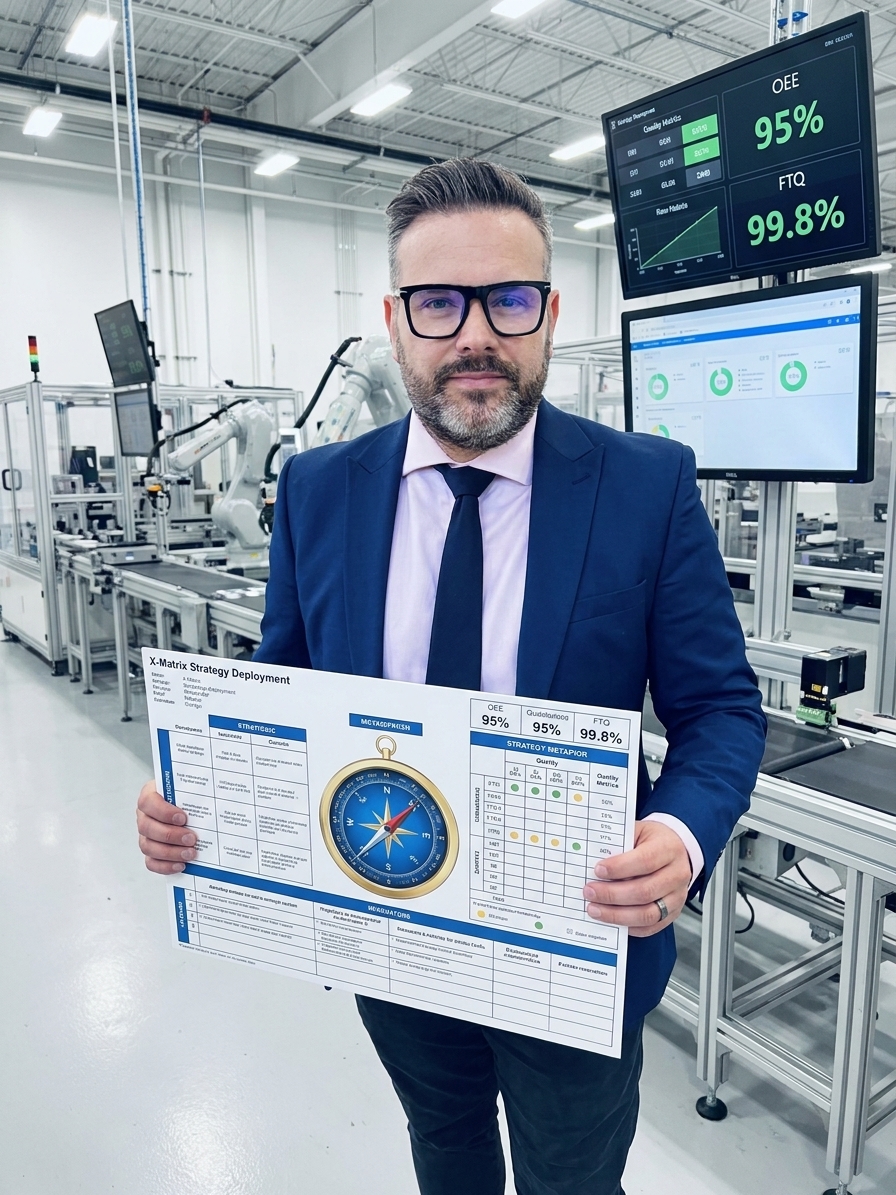
The most practical tool in the Hoshin Kanri toolkit is the X-Matrix, or Hoshin Planning Matrix. It captures the entire strategy deployment on a single A3-sized document shaped like an X. The four quadrants force leadership to explicitly link daily actions to long-term goals, exposing any disconnects immediately.
| Quadrant | Content | Purpose |
|---|---|---|
| South | Long-term objectives | Defines the 3-5 year strategic vision. |
| West | Annual priorities | This year's 3-5 breakthrough goals. |
| North | Targets and metrics | Specific, measurable performance indicators. |
| East | Action plans | Resource allocation and project ownership. |
The intersections between quadrants show the relationships: which annual objectives support which long-term goals, and which action plans deliver which targets. When a strategic objective has no corresponding annual target, the gap is visible. When an action plan doesn't connect to any strategic priority, it becomes obvious that resources are being wasted on non-value-added work.
The X-Matrix is a thinking tool, not a reporting form. The value is not in the finished document; it is in the debate that produces it. When a leadership team fills out an X-Matrix together, they confront contradictions, resolve conflicts over resources, and make explicit trade-offs that would otherwise remain unspoken in functional silos.
If everything is a priority, nothing is. Hoshin Kanri provides the discipline to say no.
Forensic Reviews: Where Most Implementations Fail
The most common failure mode in Hoshin Kanri is not in the planning phase. It is in the review phase. Organizations that excel at setting ambitious targets often collapse when it comes to honestly evaluating whether those targets are being met. Monthly reviews devolve into status updates, creating an illusion of control without the substance of corrective action.
Hoshin Kanri demands rigorous, structured reviews. Each breakthrough objective is reviewed against its measures using A3 reports and statistical evidence. The review asks three questions: Are we on track? If not, why not? What are we going to do about it? Progress is assessed using hard data, not anecdotes or optimism.
The critical discipline lies in root cause analysis. The review process must not accept vague explanations. "The supplier had quality issues" is not a root cause. Hoshin Kanri reviews demand the same rigor as a formal 8D investigation: evidence-based analysis, verified root causes, and assigned corrective actions with specific owners and deadlines.
What Hoshin Kanri Looks Like on the Shop Floor
I have audited plants that set a target to reduce customer PPM (parts per million defective) to 50, only to finish the year at 180. The problem was rarely the target itself. The failure was that the quality department owned the PPM target, but the variables controlling it—incoming material quality, machine capability, operator training—were distributed across six different departments with conflicting priorities.
Applying Hoshin Kanri meant elevating PPM reduction to a company-level objective sponsored by the CEO. The catchball process immediately exposed the functional roadblocks. Purchasing needed the authority to reject non-conforming material without production overriding them for schedule. Manufacturing needed maintenance to respond to out-of-tolerance conditions within a strict timeframe, not when a technician became available.
The X-Matrix translated these negotiations into interconnected action plans. Monthly reviews kept the focus on systemic fixes. When incoming material quality stalled, the review revealed that Engineering had changed a specification without communicating it to the supplier. The problem was corrected in weeks. By year-end, customer PPM dropped from 180 to 35. The organization finally aligned its resources around a single, measurable objective.
Building the Discipline to Execute
Organizations that succeed with Hoshin Kanri share specific traits. They limit their focus to three to five breakthrough objectives, refusing to dilute their resources. They treat the X-Matrix as a tool for strategic debate, not as an administrative form to be delegated to a staff assistant. They maintain rigorous review cycles that focus on systemic root causes rather than assigning individual blame.
Conversely, failure follows predictable patterns. Skipping the catchball process guarantees the return of the corporate telephone game. Disconnecting strategic PDCA from daily management creates a system that looks good on paper but changes nothing on the shop floor. Implementing the mechanics without building a culture of psychological safety produces reluctant compliance, not genuine commitment.
Hoshin Kanri is a discipline, not a temporary project. It takes two to three years for the cycle of direction, deployment, review, and adjustment to become embedded in an organization's operational rhythm. Most companies abandon the practice during the difficult first year, just before the alignment begins to generate measurable quality and efficiency gains. The ability to align an entire organization around its most critical priorities is a survival skill, and the structure provided by Hoshin Kanri is one of the most reliable methods to build it.