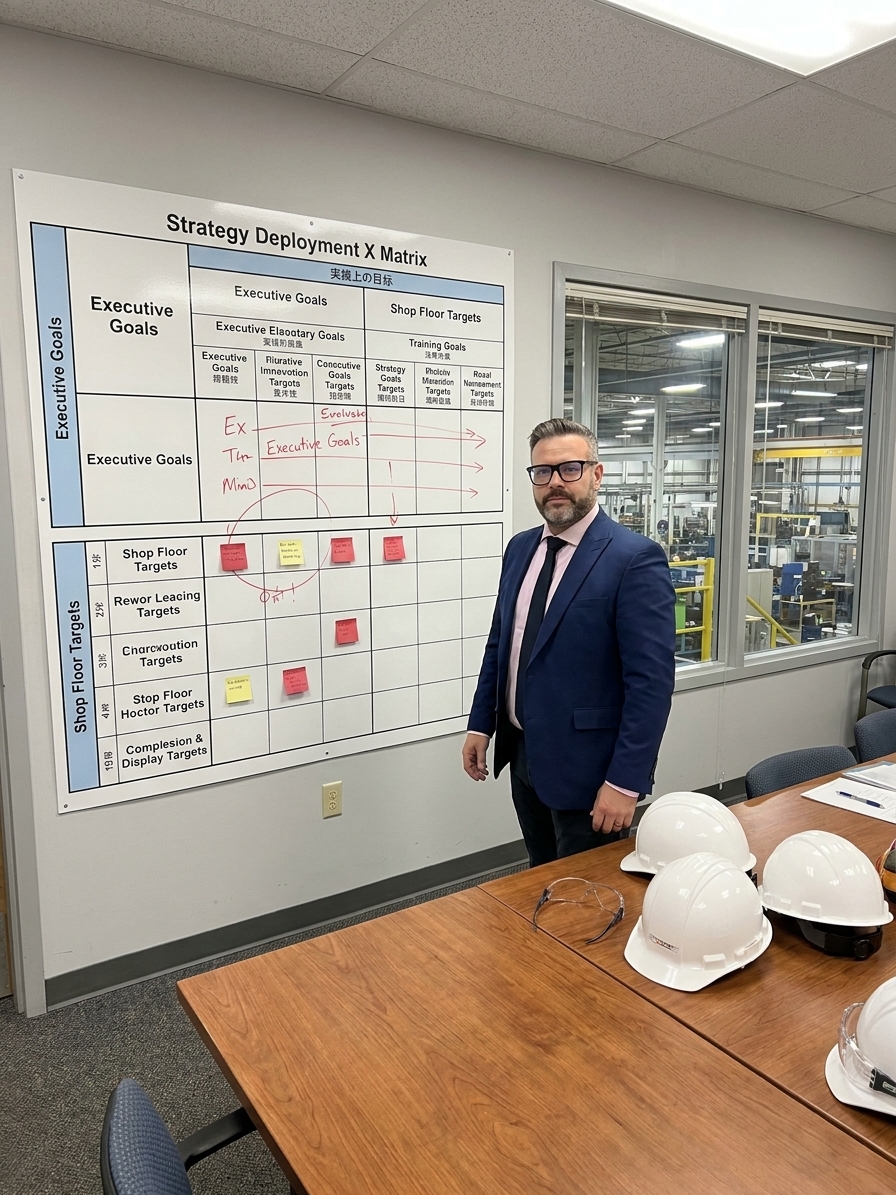
Hoshin Kanri fails predictably. The leadership team locks itself in a conference room for two days and emerges with a strategic plan. The plan features a mission statement, five pillars, seven goals, forty-three initiatives, and a polished X matrix. Six months later, someone finds the binder in a drawer. The breakthrough objectives sit at thirty percent completion, and the metrics were quietly redefined to make even that look achievable.
I have audited plants where the Hoshin catchball matrix was treated as a graphic design exercise rather than an operational contract. The feedback from the shop floor was filed under 'noted' and ignored. When policy deployment becomes an administrative task owned by the quality department, the cascade breaks. The organisation optimises the documentation instead of the operational reality.
Policy deployment should force a structured conversation. Direction flows down, and operational reality flows up. When it works, the executive suite understands the production constraints, and the operator on the line understands the three-year plan. When it fails, you get a binder on a shelf.
The X Matrix Demands Strategic Exclusion
Hoshin Kanri translates to 'compass management.' It forces leadership to connect three things on a single page: long-term breakthrough objectives, annual improvement priorities, and the specific top-level projects required to achieve them. The X matrix is not the deliverable. The dialogue required to build it is the deliverable.
You start at the top with three to five strategic priorities. Then you engage in catchball. Leadership tosses the strategic direction to the next level down. That level refines the direction, adds operational detail, and tosses it back up. Each iteration tightens the alignment between intent and execution. Each round surfaces the capacity constraints and trade-offs that executives miss in isolation.
The discipline of this process is in what it excludes. You do not get to declare that everything is important. You choose three to five priorities that matter more than the rest, and you explicitly de-prioritise the rest. If you cannot choose, you do not have a strategy. You have a wish list. This failure to choose is the root cause of the binder phenomenon.
In practice, middle management cannot stomach this exclusion. Instead of narrowing focus, each department adds its own metrics to the cascade. The accumulation of these departmental KPIs guarantees that the strategy collapses under its own weight before it ever reaches the value stream.
How the KPI Cascade Becomes KPI Accumulation

The breakthrough objective is supposed to cascade through every level. The CEO sets five priorities. Each VP adds departmental KPIs. Each manager adds team KPIs. By the time the cascade reaches the production line, the operator is staring at a visual management board with forty metrics. Half of these were invented by supervisors trying to look proactive during the last IATF 16949 management review.
The operator has no way to distinguish signal from noise. Neither does the shift supervisor. When everything is measured as a priority, nothing is a priority. This directly contradicts the mechanism of Hoshin Kanri, which was designed to reduce the number of variables so the organisation could focus its finite improvement energy.
This accumulation turns the cascade into an exercise in defensibility. Managers add metrics to protect their silos, not to advance the breakthrough objective. The X matrix becomes a political document rather than a deployment tool, and the connection to daily operational execution is severed completely.
The Hoshin Cascade: Intent vs Reality
What teams do
- Every department adds its own local metrics
- The operator gets forty numbers to track
- Signal is buried in defensive noise
- Catchball becomes a one-way management broadcast
What works
- Only three to five priorities are allowed on the matrix
- Lower levels define how they support the top priorities
- Non-strategic work is explicitly de-prioritised
- Targets are negotiated based on actual floor capacity
The Monthly Review Turns into Defensive Reporting
Hoshin Kanri requires a structured monthly review. The purpose is to surface gaps between the plan and the actual result early enough to act. The review must ask what needs to change and where resources need to shift. It is a course-correction mechanism, not a variance reporting exercise.
In reality, the monthly review degrades into a status meeting. Green means on track. Yellow means behind, but with a theoretical plan. Red is so politically toxic that nobody reports it honestly until the audit or the customer escape forces the issue. People spend eighty percent of the meeting explaining why the numbers are what they are, rather than deciding what to do differently.
If a target is missed, the response is rarely strategic. Managers typically apply more effort to the same failing approach, quietly adjust the target so it becomes achievable, or redefine the metric to capture something more favourable. This is how organisations hit ninety-five percent of their targets every year while simultaneously losing market share.
A functional review process forces the termination of failing initiatives. If your review meetings have never resulted in stopping a project and reallocating its resources, you do not have a management review. You have a monitoring loop. Monitoring without intervention is useless.
The Mechanics of Failed Catchball
Catchball is the most misunderstood element of policy deployment. It requires a genuine negotiation. Leadership proposes a direction. The next level down examines it against operational reality. They assess capacity constraints, PFMEA findings, and machine capability. Then they push back, and the strategy is refined.
What generally happens is that leadership throws the ball, and nobody throws it back. The catchball session becomes a briefing where the director presents the annual priorities and asks for input. The room stays silent because pushing back is a career-limiting move. Feedback is framed as 'we support this direction' instead of exposing the impossible targets.
Without psychological safety and operational honesty, catchball is just a one-way broadcast with a feedback form nobody fills out.
I have seen operators nod along during these sessions while knowing the OEE targets are mathematically impossible given the current machine availability. When the floor knows the numbers are wrong, and leadership refuses to hear it, the deployment is dead on arrival. The matrix will be printed, the KPIs will be tracked, but no actual improvement will occur.
The consequence is a fake consensus. Management claims alignment, and the shop floor ignores the directive. The gap between the documented strategy and the actual standard work widens until the next year's offsite, where the same impossible targets are rewritten with slightly different language.
Diagnostic Indicators of a Dead Deployment
If your X matrix lists more than seven priorities, you have a comprehensive list, not a strategy. Comprehensive lists dilute improvement effort across so many fronts that no single breakthrough objective receives the critical mass of resources required to succeed.
Walk your shop floor and ask five operators to name the company's top three strategic priorities. If you get five different answers, or blank stares, your cascade has failed. The information never reached the point of execution. The problem is not a lack of communication; it is a lack of clarity caused by an overloaded matrix.
Institutionalised gaps are another indicator. If 'improve first-pass yield' is a breakthrough objective for the third year in a row, and the target is still the same ninety-five percent you set three years ago, you have not made progress. You have simply normalised the failure.
Thresholds for a Functional Hoshin Process
Restarting the Operational Conversation
If your deployment is a binder exercise, the solution is not better software or a redesigned matrix. The solution is to restart the conversation. Cut your current priorities in half. Whatever is on your X matrix today, remove half of them for this fiscal year. The remaining priorities get the full force of your engineering and quality resources. The removed ones get nothing.
People will object to the cuts. That friction is evidence that the exercise is working. Choosing what not to do is the core act of strategy. As part of this reset, kill an underperforming initiative immediately. Find a project that has been limping along at thirty percent completion for six months, terminate it, and publicly reallocate its resources to a surviving priority.
Change the core question of your management review. Stop asking 'are we on track?' Start asking 'what have we learned?' The first question produces defensive reporting and manipulated data. The second question produces genuine reflection and surfaces the underlying constraints.
You will know the shift is working when people start bringing problems to the review voluntarily. The matrix is not the strategy. It is simply a mechanism that creates visibility for the conversation. When the organisation treats that conversation as the actual deliverable, Hoshin Kanri stops being a binder and starts being a compass.