The executive team spends three days at a resort and emerges with a strategy map. Five pillars, twelve initiatives, forty-seven supporting objectives. The document is printed on foam boards and mounted in every hallway. The CEO sends an all-hands email. Department heads translate the strategy into PowerPoint decks. Then nothing happens.
Six months later, a line supervisor asked about strategic priorities will shrug. The foam boards are yellowed, corners curling. The strategy exists nowhere except in a binder on a shelf. This is what happens when Hoshin Kanri fails, and it fails far more often than it succeeds because organisations adopt the vocabulary without submitting to the discipline the methodology actually demands.
Hoshin Kanri—sometimes called Policy Deployment or Strategy Deployment—is a systematic methodology for aligning an organisation around a small number of breakthrough objectives. The term comes from Japanese: hoshin meaning compass, kanri meaning management. Developed during post-war Japanese industrial reconstruction and refined by Toyota, Bridgestone, and Komatsu, it was brought to Western attention in the 1980s as part of the broader Lean management transfer.
The core idea is direct. Rather than diffusing effort across dozens of objectives, leadership identifies three to five breakthrough goals. These cascade through the organisation via catchball, where each level receives and refines the objectives. Progress is reviewed through a disciplined cadence of audits and adjustments. The entire process is designed to build organisational capability, not just deliver quarterly results. In most implementations, almost none of this actually happens.
The Anatomy of a Failed Hoshin Process
The failure patterns are remarkably consistent across organisations I have audited and worked inside. The first is priority inflation. The methodology calls for three to five breakthrough objectives. Most organisations cannot resist seven, twelve, or twenty. Everything seems important, every executive wants their initiative included, and saying no feels political. When everything is a strategic priority, nothing is. The process becomes an annual budgeting exercise dressed in strategic language.
The second failure is the absence of genuine catchball. Catchball is what distinguishes strategy deployment from strategy dictation. Leadership throws the strategic direction down, and the next level discusses it, refines it, pushes back, adds detail, and throws it back up. This repeats until there is real consensus. In practice, most companies skip this entirely. They send objectives down as a memo. There is no dialogue, no refinement, no ownership. The targets land fully formed, disconnected from operational reality.
The third failure is disconnection from daily management. Hoshin Kanri is supposed to connect directly to daily work through a process called Nichijo Kanri. Breakthrough objectives should appear in the metrics people track, the meetings they attend, the decisions they make. Instead, most organisations run Hoshin as a parallel system with separate reviews, metrics, and meetings that exist alongside the real work without touching it. People compartmentalise: strategy talk for the quarterly review, actual work every other day.
The fourth failure is review as reporting rather than learning. The monthly or quarterly Hoshin review is supposed to be a structured problem-solving session embedded with PDCA discipline: What did we plan? What did we do? What did we learn? What will we change? In practice, these reviews devolve into status reporting. Green, yellow, red. Mitigations listed. Nobody brings failures. Nobody asks why. The review becomes a performance, and the organisation misses the developmental purpose entirely.
What Genuine Hoshin Kanri Looks Like
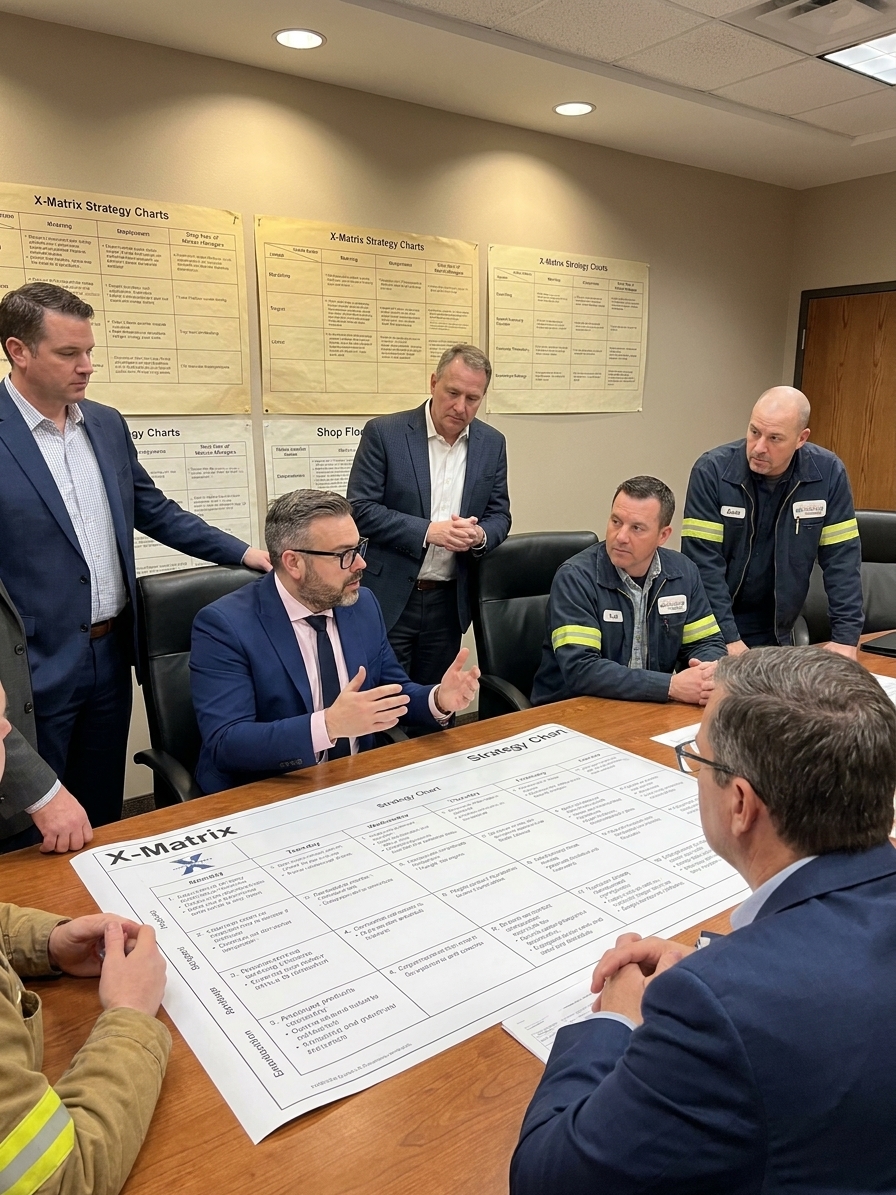
When Hoshin Kanri works, it looks fundamentally different from the theatre described above. At the centre of the process is the Hoshin X-Matrix, also known as the Strategy Deployment Matrix. It is a deliberately single-page document that forces clarity. The left side lists three to five breakthrough objectives. The bottom lists strategic priorities supporting those objectives. The right side lists improvement targets with metrics and timelines. The top lists responsibility assignments.

The intersections between quadrants show the relationships: which priorities support which objectives, which targets measure which priorities, who is responsible for which targets. The X-Matrix is not a document. It is a conversation tool designed to be used in catchball sessions, marked up, debated, revised, and ultimately agreed upon by the people who will execute it. If it has not changed in three months, nobody is using it.
In organisations that do this well, catchball is not a formality. It is a genuine negotiation. Leadership says they need to reduce lead time by 40 percent. Operations responds that they can achieve 25 percent with current resources, and for 40 percent they need capital approval for a new line plus an engineering commitment to reduce changeover complexity. Leadership goes back, considers the trade-offs, and either adjusts the target or commits the resources.
Theatre vs. Discipline in Hoshin Reviews
Annual theatre
- Status colours presented, failures hidden
- Objectives dictated in a single memo
- Strategy reviewed annually, then shelved
- Parallel system disconnected from daily work
Genuine discipline
- Root causes investigated, PDCA applied each cycle
- Targets negotiated through real catchball dialogue
- Monthly reviews drive continuous adjustment
- Breakthrough goals visible on the shop floor daily
The Leadership Demands Hoshin Imposes
Hoshin Kanri demands something from leadership that most executive teams are not willing to give. It demands focus. Three to five priorities means saying no to everything else, and that is politically difficult. It demands vulnerability. Real catchball means admitting you do not have all the answers and being willing to have your assumptions challenged by people three levels below you in the hierarchy.
It demands discipline. A monthly PDCA review sustained over three years requires a consistency of attention that most executive teams find difficult to maintain amid quarterly earnings pressure and competitive surprises. And it demands patience. Building organisational capability through strategy deployment takes years, not quarters. The methodology is not a programme you launch. It is a management system you commit to.
Toyota did not become excellent at Hoshin Kanri because they adopted the tool. They became excellent because the tool is embedded in a management culture that values alignment, learning, and systematic improvement as core leadership responsibilities. The tool without the culture produces nothing. The culture without the tool still produces more than most organisations achieve.
Connecting Hoshin to Daily Management
The breakthrough objectives from the Hoshin process must appear on the shop floor, in the office, in the laboratory—wherever work happens. They show up in visual management boards, in team huddles, in individual performance objectives. A machine operator knows their changeover time target connects to the company lead-time breakthrough goal. A quality engineer knows their defect reduction work connects to the customer experience priority.
I have audited plants where the connection between strategic intent and daily execution was genuinely visible at every level, and I have audited far more where it was not. The difference is never the sophistication of the X-Matrix template. The difference is whether the daily management system is designed to make the strategic objectives unavoidable. When the Hoshin metrics appear on the same board as the OEE figures, the scrap rate, and the safety incidents, alignment stops being theoretical.
In a mature Hoshin process, the monthly review is the most valuable meeting in the organisation. It is not a status report. Each review follows PDCA rigorously. Failures are examined without blame. Root causes are investigated using 8D or A3 methodology. Adjustments are documented and tracked. Over two, three, four years, the organisation develops a capability it did not have before: the ability to identify, plan, and execute strategic change systematically.
The annual cycle itself is the final failure mode when misapplied. Hoshin Kanri was designed as a continuous, iterative process with an annual planning cadence. Many organisations treat it as a purely annual event that produces a document and is then forgotten. There is no mid-year adjustment, no response to changing market conditions. The strategy is set in stone in January and becomes increasingly irrelevant by July.
A Practical Path Forward
If you are leading a quality or operations function and considering Hoshin Kanri, or trying to revive a failed implementation, several principles are non-negotiable based on what I have seen work and fail across multi-site manufacturing organisations. Start small. Do not try to deploy strategy across the entire organisation in year one. Pick one breakthrough objective. Run the process honestly—real catchball, real reviews, real adjustments—for a full year.
Limit your priorities ruthlessly. Three is ideal. Five is the maximum. If you have more than five, you have a wish list, not priorities. The discipline of choosing is itself a strategic act. It forces leadership to have the difficult conversations about what matters most. Train your leaders in PDCA before you deploy Hoshin. If your management team cannot run a disciplined Plan-Do-Check-Act cycle on a single process problem, they cannot run one at the strategic level.
Deploying One Breakthrough Objective in Year One
- 01Select one objectiveChoose a breakthrough goal with measurable impact on competitive position
- 02Run genuine catchballNegotiate targets between leadership and operations until real commitment exists
- 03Connect to daily managementPlace the objective's metrics on visual boards alongside operational KPIs
- 04Monthly PDCA reviewInvestigate failures, document root causes, adjust approach without blame
- 05Assess and expandEvaluate what worked in your culture, then add the next breakthrough objective
Make the X-Matrix a living document. Do not laminate it. Do not print it on foam board. Print it on paper. Mark it up. Revise it. Use it in every review. Be honest about whether your organisation is ready. Hoshin Kanri is not a tool you can overlay on a command-and-control culture and expect to work. It requires a culture of openness, learning, and genuine respect for people at every level. If that culture does not exist, build it first.
The Competitive Advantage of Disciplined Deployment
Hoshin Kanri is one of the most powerful management methodologies ever developed for aligning organisations around strategic priorities. It has been proven over decades in some of the world's most successful companies. It has been misunderstood, diluted, and abandoned by far more organisations than have ever made it work.
The difference between success and failure is not the tool. It is whether the organisation does the patient work of genuine alignment.
The difference between success and failure is not the consultant, the software platform, the X-Matrix template, or the training programme. The difference is whether the organisation—starting at the top—is willing to do the hard, unglamorous, patient work of genuine alignment. Real priorities, real dialogue, real reviews, real learning. Year after year.
If you are not ready for that commitment, do not start. The wall posters are expensive and the binder on the shelf will not transform your organisation. But if you are willing to strip away the theatre and do the actual work, Hoshin Kanri can transform not just your strategic results but your organisation's fundamental capability to improve systematically. That capability is the only competitive advantage that lasts.