Quality departments in manufacturing plants often confuse activity with effectiveness. Teams calibrate tools, update FMEA libraries, and scramble to answer customer complaints. Yet their core defect rates remain entirely static year over year. They operate in a permanent state of firefighting, solving individual problems just fast enough to prevent the next escalation but never addressing the systemic mechanisms driving the failures.
This reactive mode is a direct consequence of skipping structured methodology in favour of ad hoc troubleshooting. I have audited plants where every single engineer prided themselves on rapid response times, while completely ignoring the fact that the same defects appeared every quarter. Without a formalized improvement loop, solutions are guesses, and any temporary reduction in scrap is accidental rather than engineered.
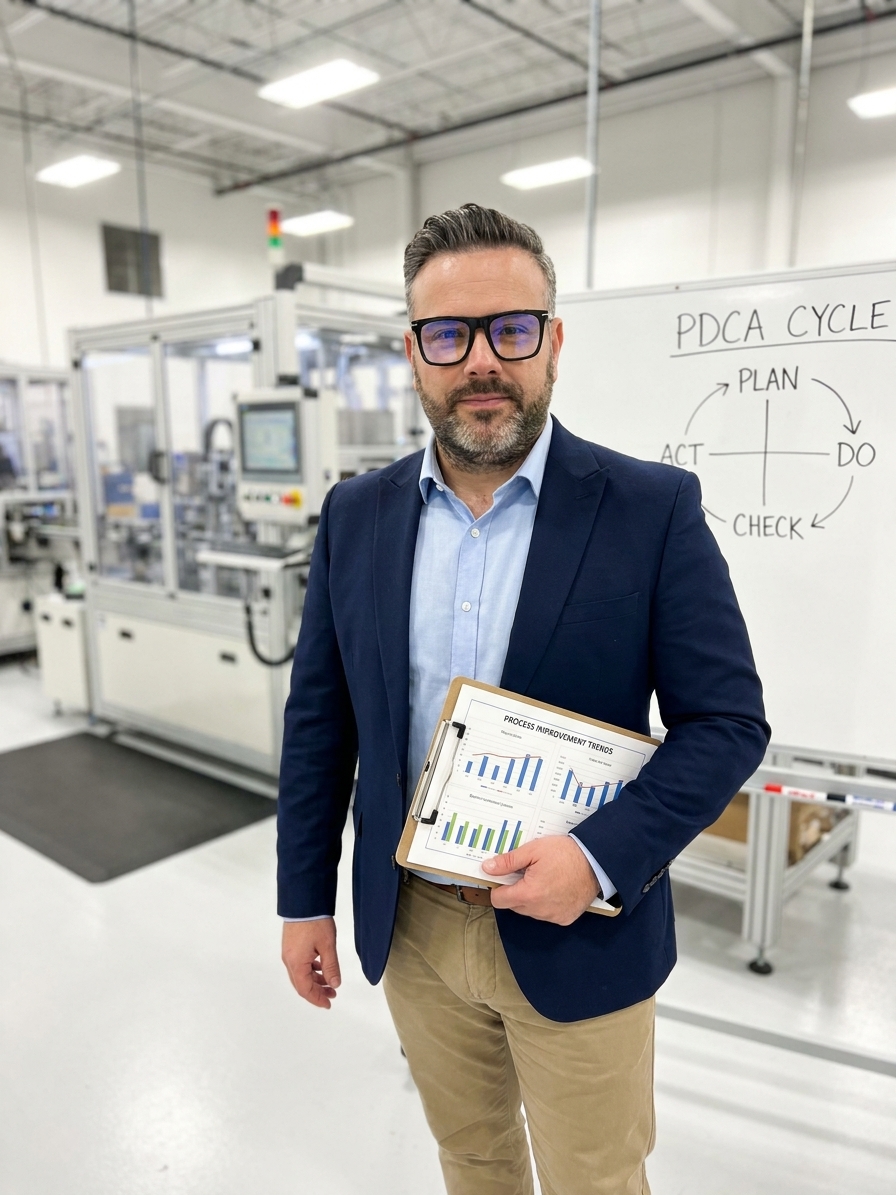
The Plan-Do-Check-Act (PDCA) cycle, originally championed by W. Edwards Deming, remains the most reliable framework for breaking this pattern. It is fundamentally a discipline of controlled iteration. Success depends less on the elegance of the four steps and entirely on the mathematical rigour applied to variable control and data verification at each phase.
The Plan Phase: Establishing Evidence Before Action
The Plan phase is routinely bypassed because it produces no immediate physical output. Management perceives time spent mapping processes and reviewing shift logs as downtime. This mindset guarantees failure. Without a documented baseline, there is no hypothesis to test and no mechanism to verify. Planning requires defining exactly what is known versus what is merely suspected about the failure mode.
Consider a persistent weld porosity defect on an automotive bracket assembly. A team tackling this must collect empirical data before adjusting any equipment. They must log the specific shift, the joint geometry, and the defect dimensions. Only after compiling this evidence can they formulate a specific, testable hypothesis rather than relying on an engineer's intuition about gas flow rates.
In the automotive example, the evidence revealed a clear pattern. Porosity clusters consistently appeared on left-side welds during third-shift operations. Data pointed toward aluminum spatter buildup in the Station 7 gas nozzle during extended, uninterrupted cycles. The resulting plan was highly specific: replace the nozzle every four hours on third shift and measure the outcome.

The Do Phase: Enforcing Single-Variable Control
The Do phase is where technical discipline overrides organizational urgency. Teams instinctively want to solve the problem in one sweeping intervention. They will attempt to simultaneously change the nozzle, modify the welding sequence, adjust gas flow rates, and retrain operators. This scattergun approach destroys the validity of the experiment and guarantees the results will be uninterpretable.
Effective PDCA demands single-variable testing. If you change five parameters simultaneously and the defect rate drops, you cannot identify which change actually drove the improvement. Worse, if the defect rate increases, you cannot tell if one positive change was masked by four negative ones. You must isolate the variable and execute the plan exactly as designed.
In practice, this means executing one change and collecting data over a predetermined timeframe. For the bracket assembly, operators replaced the nozzle every four hours and changed nothing else. The training took minutes. The initial results were significant but not total—porosity dropped from 4.2% to 2.1% over two weeks. The goal of the Do phase is controlled learning, not instant perfection.
PDCA Discipline vs. Firefighting Instincts
What teams do
- Change five variables simultaneously to fix the issue faster
- Declare victory when the immediate defect rate temporarily drops
- Modify parameters based on engineering intuition and urgency
- Stop the experiment early to implement the assumed solution globally
What works
- Isolate a single variable and hold all others strictly constant
- Measure the specific impact over a predetermined, fixed timeframe
- Test a documented hypothesis built on baseline data and evidence
- Accept partial improvement as valid learning for the next cycle
The Check Phase: Honest Verification of Predictions
Checking does not mean verifying that the solution worked. It means examining exactly what happened and explicitly comparing the results against the initial prediction. Most organizations abandon the PDCA cycle here. If the result is positive, they celebrate, declare victory, and halt the investigation. If the result is negative, they blame the plan and scrap the methodology entirely without extracting any learned data.
Honest checking requires answering three strict questions. First, did the target metric actually decrease? Second, did it decrease for the exact reason predicted in the Plan phase? Third, is the problem fully resolved, or does the current state still fall outside customer specifications? Answering these demands strict adherence to the data over emotional relief.
In the weld porosity case, the data confirmed the nozzle replacement helped, reducing the defect rate to an average of 2.45%. However, the data also revealed a secondary effect: porosity was notably worse on Monday nights than on Thursday nights, pointing to an unaccounted cold-start condition. The cycle was not a failure because it did not hit zero; it was a success because it quantified a new variable.
PDCA doesn’t promise miracles or instant perfection. It promises engineered understanding through data.
The Act Phase: Standardization and Sequencing
Acting on the findings means making an institutional decision based on data, not declaring a project closed. When a controlled experiment yields a quantifiable improvement, even a partial one, that specific change must be locked into the standard work instructions immediately. In this phase, the 42% reduction in porosity was codified into the third-shift operating procedures to prevent regression.
Acting also requires identifying the next bottleneck and launching the subsequent iteration. The data indicated a startup condition anomaly, so the team immediately designed a new PDCA cycle to investigate cold-start welding parameters. If the initial experiment had shown zero improvement, the correct action would have been to abandon the hypothesis entirely and pivot, rather than forcing a failing solution.
The power of PDCA is not found in isolated events but in the momentum of sequential cycles. The end of one cycle simply establishes the baseline for the next. By the end of the fourth iteration—spanning several months of disciplined effort—the porosity rate was driven down to 0.8%, safely below the 1.5% customer specification. The improvement was structural and sustained because it addressed root mechanisms.
Sequential PDCA Execution for Defect Reduction
- 01Cycle 1: Nozzle ReplacementAddressed spatter buildup, reducing porosity from 4.2% to 2.45%.
- 02Cycle 2: Cold-Start ParametersInvestigated the Monday-night startup anomaly identified during Check.
- 03Cycle 3: Gas Pre-Flow TimingOptimized shielding coverage based on baseline data from Cycle 2.
- 04Cycle 4: Technique VariationStandardized operator handling, driving final defect rate to 0.8%.
The Mathematics of Compounding Iteration
Most organizations abandon PDCA because a single cycle rarely produces a dramatic, headline-ready transformation. A 15% improvement in a specific failure mode feels marginal in a quarterly review. However, the mathematical reality of PDCA is that these improvements compound. Each cycle establishes a new, lower baseline for the next iteration.
If each cycle reduces a target metric by 15%, the cumulative impact after five cycles is not a flat 75% reduction. The compounding effect drives the defect rate down by more than half. After twenty disciplined iterations, the theoretical reduction approaches near-total elimination. The metric improves because the team's engineering understanding of the process variables deepens with every data point collected.
This compounding effect scales from the individual workstation to enterprise-level strategy deployment (Hoshin Kanri). At the floor level, cycles last hours or days. At the departmental level, they last weeks. At the organizational level, they map to quarters. The scale changes, but the requirement for evidence over assumption remains identical.
Cultural Shift from Reactive to Evidence-Based
The ultimate output of rigorous PDCA is not a defect rate; it is a cultural transformation within the engineering team. Reactive organizations value speed and certainty. Quality engineers are rewarded for how rapidly they respond to line-down situations. In a PDCA environment, the value system shifts toward curiosity and evidence, penalizing undocumented guesses.
This shift manifests directly in operational language. Teams stop saying, "I think the problem is the gas flow," and begin stating, "The data suggests gas flow is a contributing factor; let us isolate and test it." The language of certainty is replaced by the language of hypothesis and verification. This prevents the false confidence that leads to repeating the same ineffective fixes.
Implementing this standard does not require a corporate mandate or new software. It requires selecting a single persistent defect, establishing a baseline, and enforcing the discipline to change only one variable at a time. The methodology survives because it aligns strictly with how engineering actually functions—incrementally, iteratively, and through verified learning.