A Tier 2 automotive supplier recently shipped 400 injection-moulded connector housings with a 12-millimetre crack running along the seam. The defect was on the most visible surface of the part. Every piece had passed 100% visual inspection.
The inspector was a twelve-year veteran recognised as one of the sharpest on the floor. When the Quality Manager pulled her into the lab and showed her a returned part, she was genuinely confused. She had not been distracted, fatigued, or rushing to hit a production target. She simply had not seen the crack.
This is inattentional blindness. The human brain processes roughly eleven million bits of sensory information per second, but conscious awareness handles only about fifty bits. The brain filters the rest automatically. In a quality inspection context, that filtering system discards critical visual data — including visible, obvious defects — before it reaches conscious awareness.
The Neurological Mechanism Behind the Miss
Inattentional blindness is a documented phenomenon in cognitive psychology. The eyes function perfectly. The information hits the retina, travels through the optic nerve, and arrives at the visual cortex. But between the visual cortex and conscious awareness, the brain discards it because attentional resources are allocated elsewhere.
The classic demonstration of this is the invisible gorilla experiment. Viewers watch people passing basketballs and count the passes. Half of all viewers never see a person in a gorilla suit walk through the middle of the scene. The gorilla is large, central, and on screen for nine seconds. But the viewer's brain has allocated its limited attention to the counting task and filtered out anything that does not match the expected pattern.
This is not a design flaw. It is the fundamental architecture of human cognition. The brain filters based on predictions. If an inspector has checked ten thousand parts without seeing a crack, the visual system begins to actively suppress signals matching that crack pattern. Experience can actually increase vulnerability to inattentional blindness because the brain builds stronger predictive priors.

Why Retraining Fails as a Corrective Action
Most organisations treat inspection escapes as carelessness. The standard response is to retrain the inspector, issue a corrective action, and add admonishments to be more careful. This fails because inattentional blindness is not a training problem. You cannot train someone out of a structural neurological limitation any more than you can train them to see ultraviolet light.
The inspector who misses the crack did not see it and fail to report it. They genuinely did not see it. The visual information was discarded by attentional processes before it reached conscious awareness. The 8D corrective action of "retrained operator" that appears on countless quality reports addresses the wrong root cause.
Adding a second inspector can make the problem worse. If both inspectors know someone else is also checking, diffusion of responsibility sets in. Each inspector's brain reduces its attentional allocation because it assumes the other person will catch what is missed. The result is a false sense of redundancy.
The path forward is to stop fighting human nature and engineer around it. Automated inspection, poka-yoke design, and environmental controls address the actual failure mode. Training remains necessary for defining defect categories, but it must never serve as the sole safeguard against visible escapes.
Shop-Floor Conditions That Amplify the Effect
Inattentional blindness does not operate in a vacuum. It interacts with real-world manufacturing conditions, and the combination is multiplicative. An inspector checking eight to twelve visual criteria under time pressure, in a noisy environment, with supervisors asking about throughput, is operating in a state of maximum attentional depletion.
Task load is the primary amplifier. Every additional inspection characteristic consumes attentional bandwidth. An inspector looking for five specific defect categories will miss defects from a sixth category, even if that defect is staring them in the face. Adding inspection targets does not improve detection — it degrades it.
Factors Degrading Visual Inspection Performance
Time pressure makes the filtering more aggressive. Cutting inspection time by thirty percent does not simply mean covering less ground. It forces the brain to clamp down harder on what it lets through. The miss rate does not scale linearly with time reduction — it accelerates because the attentional threshold tightens under load.
Engineering Controls That Disrupt the Filter
If you cannot eliminate inattentional blindness through human effort, you must design around it. The goal is to reduce reliance on sustained conscious attention for critical defect detection and to build physical or automated systems that catch what the brain filters out.
Designing Visual Inspection for Human Limitations
- 01Automate critical characteristicsDeploy machine vision for defects that must not escape. Automated systems do not suffer attentional depletion.
- 02Implement poka-yokeUse physical gauges, templates, and go/no-go fixtures to convert visual judgement into binary confirmation.
- 03Limit inspection targetsSplit inspection across stations. Fewer criteria per inspector preserves residual capacity for detecting anomalies.
- 04Rotate and segment shiftsBreak inspection into 45-60 minute blocks with different tasks. Rotate inspectors between products to reset predictive models.
- 05Seed defect probesIntroduce known defects periodically to measure actual detection rates and prevent the brain's confidence that all parts are good.
Defect probes are particularly effective because they address the expectation problem directly. When a known cracked part enters the inspection stream unexpectedly, the inspector's brain is forced to update its predictive model. The probe measures the real detection rate — not the assumed one — and keeps the visual system from suppressing anomaly signals.
You cannot train someone out of inattentional blindness any more than you can train them to see ultraviolet light.
Environmental Design as a Quality Control
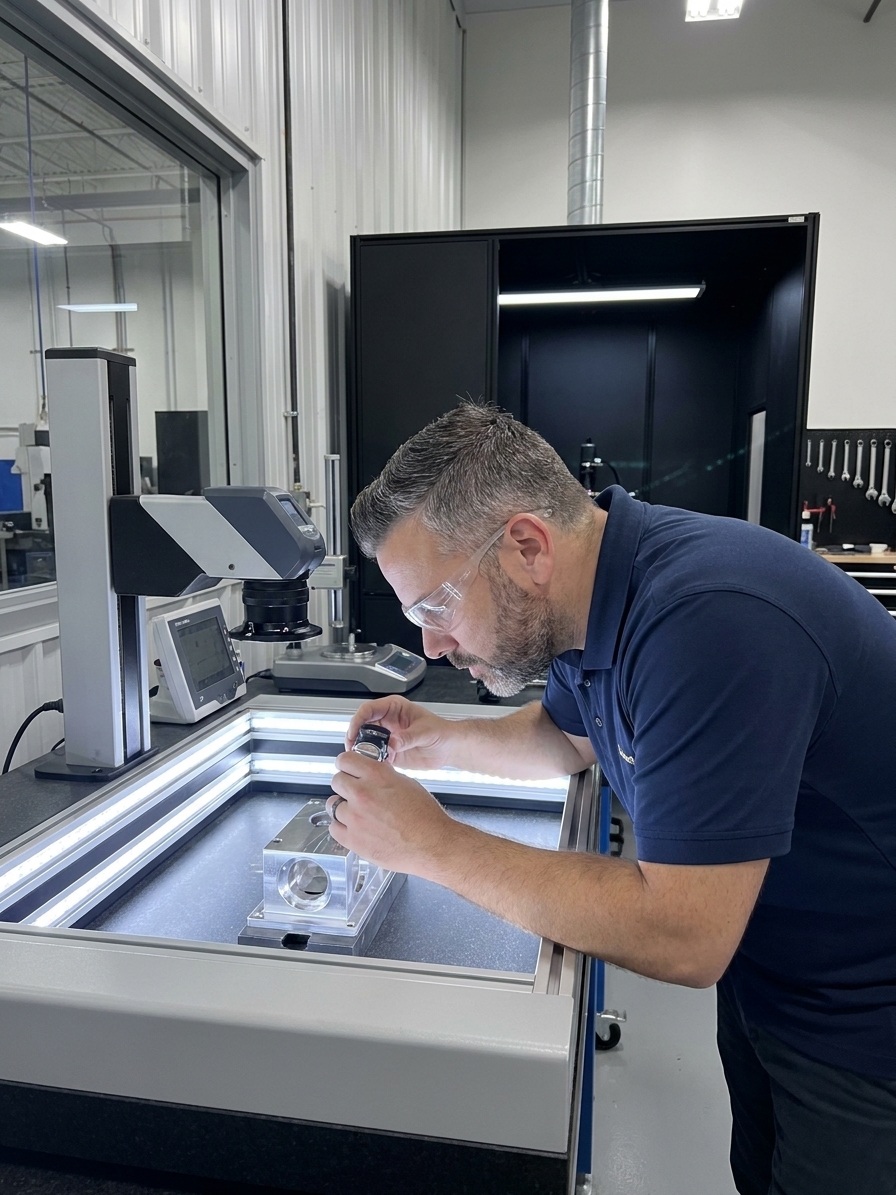
Lighting, background colour, part presentation angle, and viewing distance directly affect the attentional system. A dark background under a focused LED array makes a seam crack physically easier to detect, but it also changes how the brain prioritises that visual information. High-contrast presentation reduces the attentional resources required for detection.
In the connector housing case, the Quality Manager did not retrain the inspector. She had the engineering team redesign the inspection fixture so the crack-prone seam was presented at eye level under focused LED lighting against a dark background. She implemented 90-minute rotation schedules and seeded the line with cracked parts twice per shift.
Within three weeks, the detection rate for seam cracks rose from roughly seventy percent to above ninety-five percent. The improvement came from system design, not from asking inspectors to concentrate harder. When you remove the neurological barrier, detection improves automatically.
This approach has broader application. I have audited plants where inspectors work eight-hour shifts checking twelve visual criteria at a single station under fluorescent overhead lighting, with production supervisors asking about throughput. These stations are designed for failure. The control plan says 100% inspection, but the conditions guarantee that the actual detection rate is far lower than anyone believes.
The Leadership Parallel
The same neurological mechanism that causes inspectors to miss visible defects causes quality leaders to miss systemic problems. You review the same dashboard, track the same IATF 16949 KPIs, and audit the same VDA 6.3 process elements. Your brain builds a predictive model of what normal looks like. When a subtle shift occurs — a creeping increase in customer returns, a new supplier failure mode — your attentional system suppresses the signal.
This is why external auditors find issues that internal teams walked past for months. Fresh eyes carry different predictive models. Cross-functional reviews catch problems that single-function reviews miss because each function brings a different attentional set to the data.
The corrective action is the same at the leadership level as it is at the inspection station: design for it. Rotate review responsibilities. Bring in outside perspectives. Change the format of your quality reviews periodically so your brain does not settle into a fixed pattern of what matters. The gorilla is always walking through your factory. Your quality system must be engineered to see it.
Name inattentional blindness explicitly in your training. Tell your inspectors about the gorilla experiment. Let them understand that missing a visible defect does not make them incompetent — it makes them human. This shifts the culture from blame to system design, which is where measurable improvement in inspection effectiveness actually lives.