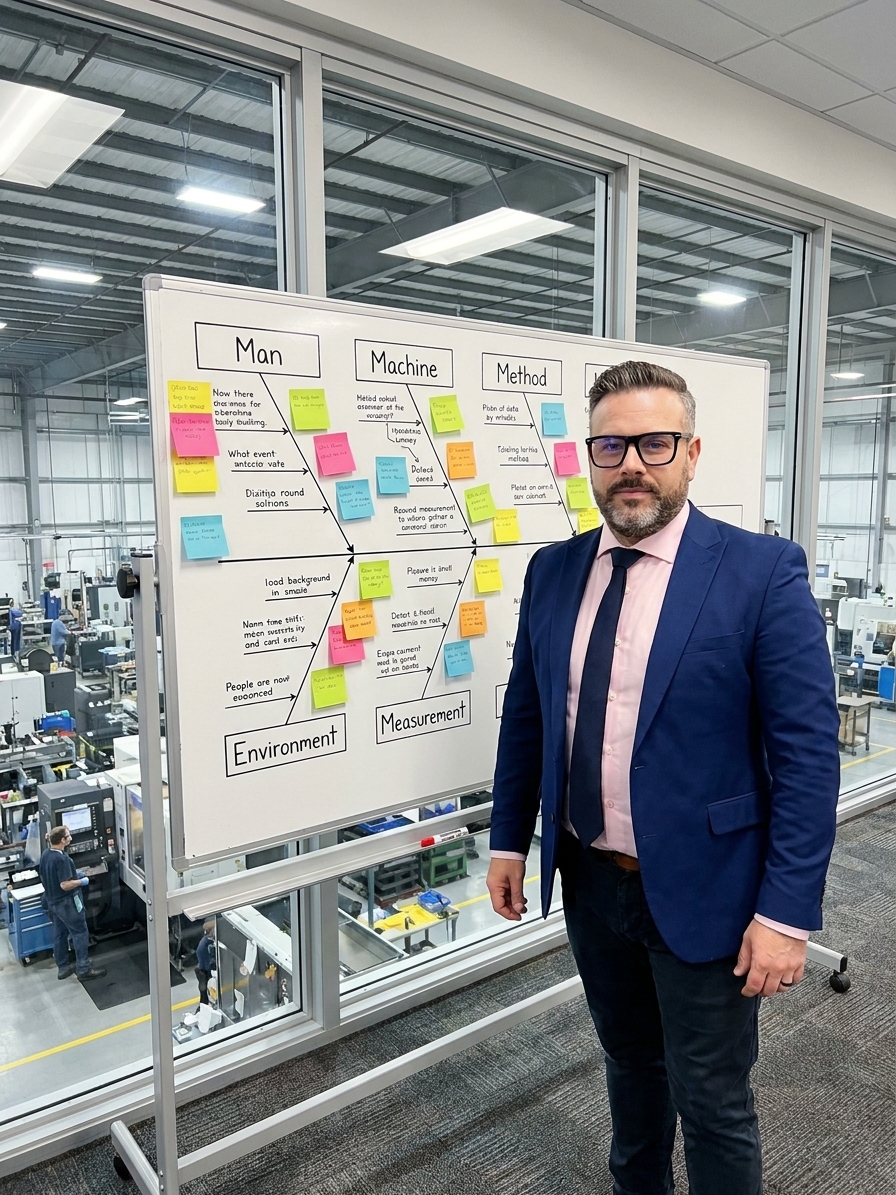
You’ve seen it a hundred times. A problem surfaces — a defect rate
spikes, a customer complaint escalates, a critical dimension drifts out
of specification — and someone says, “Let’s do a fishbone.” The room
gathers. A whiteboard gets claimed. Someone draws a long horizontal
arrow pointing to a box that says “Defect Rate.” Six branches extend
from the spine: Man, Machine, Method, Material, Measurement,
Environment. People call out ideas. Sticky notes go up. The diagram
fills. Everyone nods, takes a photo with their phone, and walks away
feeling productive.
And then nothing happens.
The fishbone sits on the whiteboard for two weeks until someone
erases it to make room for the next meeting’s unrelated presentation.
The sticky notes fall off and end up in the trash. The photo stays on
someone’s phone, never opened again. The problem that triggered the
exercise? It either resolved itself (in which case the fishbone gets
credit it didn’t deserve), or it persisted (in which case the fishbone
gets blamed for being “just theory”). Either way, no root cause was
identified. No corrective action was implemented. No process was
improved. The Ishikawa diagram — one of the most powerful structured
thinking tools in quality management — became what it always becomes
when organizations treat it as an endpoint rather than a starting point:
a ritual.
The Tool
That Was Built for Thinking, Not for Drawing
Kaoru Ishikawa didn’t invent the diagram so that teams could decorate
whiteboards. He built it to solve a specific problem: human beings are
terrible at structured causal reasoning. When faced with a complex
defect or failure, our brains want to jump to the first plausible
explanation and stop. We see a scratch on a part and blame the operator.
We see a dimension out of tolerance and blame the machine. We see a
delayed shipment and blame the supplier. The fishbone was designed to
force us past that initial jump — to systematically explore multiple
causal categories, to dig deeper than surface symptoms, and to ensure
that the team’s collective knowledge was captured before the search for
root causes began.
The 6Ms — Man, Machine, Method, Material, Measurement, Environment
(sometimes Mother Nature) — aren’t arbitrary categories. They represent
the six fundamental dimensions of variation in any manufacturing
process. Every defect, every failure, every deviation from specification
has causal roots in at least one of these categories. The genius of
Ishikawa’s framework is that it gives teams a shared structure for
investigation, preventing the common failure mode where the loudest
voice in the room determines which causal path gets explored while all
others are ignored.
But here’s the critical point that most practitioners miss: the
fishbone diagram is not a root cause analysis tool. It is a
cause enumeration and categorization tool. It maps the
territory of possible causes. It does not identify which cause is the
actual cause. That distinction — between mapping possibilities and
confirming the real root cause — is where nearly every fishbone exercise
goes wrong.
How the Fishbone
Dies: A Forensic Analysis
Let’s walk through the typical lifecycle of an Ishikawa diagram in a
manufacturing environment, and identify exactly where it breaks
down.
Phase 1: Enthusiasm. The problem is fresh. People
are motivated. The team gathers, and the facilitator (usually a quality
engineer who got voluntold) draws the fishbone skeleton. This phase is
genuinely useful — the energy is high, people are engaged, and the
structured categories prevent the discussion from devolving into random
brainstorming. Potential causes get identified across all six
categories, and for about thirty minutes, it feels like real
problem-solving is happening.
Phase 2: Inflation. As the diagram grows, a subtle
shift occurs. The goal stops being “find the root cause” and starts
being “fill in all six branches with at least four or five items each.”
Teams start padding the diagram with causes they know are irrelevant
just to make the fishbone look comprehensive. “Operator fatigue” goes
under Man — not because anyone has evidence of fatigue, but because
every fishbone needs something under Man. “Temperature variation” goes
under Environment — not because anyone has checked the HVAC logs, but
because Environment shouldn’t be empty. The diagram becomes a creativity
exercise rather than an investigation.
Phase 3: Paralysis. The fishbone is now enormous.
Forty, fifty, sixty potential causes spread across six categories. And
this is where the team freezes. Because the unspoken assumption was that
drawing the fishbone would somehow reveal the root cause — that the act
of categorization would surface the answer. It doesn’t. Now the team is
staring at a wall of possibilities with no methodology for narrowing
them down. Someone suggests “let’s prioritize these” and another meeting
gets scheduled. That meeting either doesn’t happen, or it becomes a
voting exercise where people rank causes by gut feel rather than by
data.
Phase 4: Abandonment. The prioritized list, if it
gets made, leads to a few shallow investigations. Someone checks whether
the machine was due for calibration (it was, it got calibrated, problem
persists). Someone asks the operator if anything changed (no, nothing
changed, same as always). The deeper causes — the ones that would
require actual data collection, designed experiments, or uncomfortable
conversations about process design — never get investigated because
they’re harder than the diagram was. The fishbone gets filed in the
corrective action report as evidence that “root cause analysis was
performed.” The problem continues.
The Six
Ways Organizations Misuse the Ishikawa Diagram
After years of observing fishbone exercises across manufacturing
environments, the failure patterns cluster into six recognizable
modes:
1. The Decoration Mode. The fishbone is drawn to
satisfy a corrective action requirement. A customer demands an 8D
report. Step 3 (Root Cause) needs content. The team draws a fishbone,
takes a photo, pastes it into the report, and submits it. No causes were
investigated. No experiments were run. The diagram exists as a
compliance artifact — proof that the quality team “did something.” The
customer accepts it because their own quality team does the same thing,
and the cycle of performative analysis continues.
2. The Blame Mode. The fishbone starts objectively
enough, but the cultural gravity of the organization pulls every causal
path toward “operator error.” The Man branch fills up with causes like
“lack of training,” “insufficient attention to detail,” “failure to
follow procedure.” The other branches get token entries. The exercise
concludes that the operator needs retraining and the procedure needs to
be reinforced. The structural causes — the ones hiding in Machine,
Method, and Material — are never investigated because investigating them
would mean admitting that the system, not the person, is broken. This is
the fishbone as organizational defense mechanism: the diagram looks
thorough, but its conclusions were predetermined by the culture.
3. The Brainstorming Substitute Mode. Some teams use
the fishbone as a generic brainstorming tool for any problem — customer
complaints, delivery issues, employee turnover, lunch menu
dissatisfaction. The 6Ms get stretched beyond their useful domain, and
the categories become meaningless. “Method” gets applied to HR policies.
“Material” gets applied to software bugs. The structural rigor that
makes the fishbone valuable in manufacturing process analysis gets
diluted into a generic mind map that generates no actionable
insight.
4. The One-and-Done Mode. The fishbone is drawn
once, the potential causes are listed, and the team picks the “most
likely” one without any verification. No data is collected. No
hypotheses are tested. No 5 Whys are conducted on the candidate causes.
The fishbone replaced root cause analysis instead of feeding into it.
This is perhaps the most dangerous misuse, because the team genuinely
believes they performed rigorous analysis. They have a diagram to prove
it. But a list of unverified possibilities is not an analysis — it’s a
guess with visual aids.
5. The Museum Exhibit Mode. The fishbone gets drawn,
printed on large-format paper, laminated, and mounted on the wall of the
conference room or the gemba board. It becomes a permanent fixture — a
testament to the time the team did root cause analysis on that one
problem three years ago. New employees walk past it daily. Nobody reads
it. Nobody updates it. Nobody connects it to current performance. The
diagram has been elevated from a working tool to a historical artifact,
and its only function is to signal to visitors that the facility “does
quality.”
6. The Complexity Trap Mode. The team takes the
fishbone seriously — perhaps too seriously. They build cascading levels
of sub-causes, creating a multi-layered causal tree that maps every
conceivable contributor to the problem. The diagram becomes unreadable.
Branches overlap. The same cause appears in three different categories.
The team spends more time debating whether “fixture wear” belongs under
Machine or Method than they spend actually investigating fixture wear.
The analysis achieves exhaustion without achieving clarity.
What a Real
Ishikawa Investigation Looks Like
When the fishbone is used as designed — as the starting
point of a structured investigation, not the ending point of a
meeting — it looks fundamentally different from the patterns described
above.
Step 1: Define the problem precisely. Not “quality
is bad” or “we have scrap.” A specific, measurable problem statement:
“Part number ABC-123, CNC operation 20, bore diameter 25.00 +0.05/-0.00
mm, measured 25.08 mm on 12% of parts produced between June 3 and June
17, affecting 340 units.” The fishbone arrow points to a real problem,
not a vague concern.
Step 2: Enumerate causes with evidence. Each cause
written on the fishbone should come with a question: “What data do we
have that suggests this is contributing?” If the answer is “none,” the
cause goes on the diagram with a question mark — it’s a hypothesis, not
a finding. This prevents the inflation problem and keeps the team honest
about what they know versus what they’re guessing.
Step 3: Narrow with data, not with votes. For each
candidate cause, define what evidence would confirm or eliminate it. “If
operator fatigue is the cause, we’d expect defects to increase in the
last two hours of the shift. Let’s check the defect data by time of
day.” “If tool wear is the cause, we’d expect a correlation between tool
age and defect rate. Let’s pull the tooling logs.” This is where most
teams stop — but this is where the actual analysis begins. The fishbone
has given you the menu of suspects; now you need to interrogate them
individually.
Step 4: Apply deeper tools to the surviving
candidates. Once the data has narrowed the field from fifty
candidate causes to three or four plausible ones, bring out the 5 Whys,
the designed experiments, the capability studies, the MSA. The fishbone
told you where to look; these tools tell you what you’ll find. A
fishbone that identifies “machine setup variation” as a likely cause
leads to a multi-vari study that confirms setup as the dominant source
of variation, which leads to a 5 Whys that reveals that the setup
procedure doesn’t specify torque values for the fixture clamps, which
leads to a corrective action that actually fixes the problem. That’s the
pipeline. The fishbone is the first step, not the only step.
Step 5: Verify the fix addresses the confirmed
cause. Once a root cause is identified and a corrective action
is implemented, go back to the fishbone. Does the action address the
specific branch and sub-cause that was confirmed? Or does it address a
different branch — the one that was easier to fix? It’s remarkable how
often a fishbone identifies Machine as the problem category and the
corrective action addresses Method (retraining the operator) because
retraining is cheaper than retooling. The fishbone should serve as a
check: if your fix doesn’t map to your confirmed root cause, you haven’t
fixed the problem. You’ve documented it.
The
Relationship Between the Fishbone and Other Quality Tools
The Ishikawa diagram doesn’t exist in isolation. It’s part of a
toolkit, and understanding how it connects to the other tools is
essential for using it effectively.
The fishbone feeds naturally into 5 Whys analysis:
each terminal branch of the fishbone — each identified potential cause —
is a candidate for a 5 Whys drill-down. “Tool wear” on the Machine
branch becomes: Why is the tool wearing prematurely? Because the cutting
speed was increased. Why was it increased? Because the previous cycle
time was too slow to meet demand. Why was cycle time a constraint?
Because the line was scheduled for 2,000 units with only one machine
available. Why only one machine? Because the second machine has been
down for maintenance for six weeks. Why six weeks? Because the spare
part is on backorder due to a supplier consolidation. The fishbone gave
you “tool wear” as a starting point; the 5 Whys took you to a
procurement decision made eighteen months ago that is the actual root
cause of your defect problem.
The fishbone also connects to FMEA: each potential
cause identified on the fishbone should be cross-referenced with the
process FMEA. If the cause appears in the FMEA with a high RPN, it was a
known risk that was not adequately mitigated. If it doesn’t appear in
the FMEA at all, the FMEA has a gap. This cross-reference strengthens
both documents and ensures that the lessons from the fishbone
investigation feed back into the preventive analysis for future
processes.
And the fishbone connects to Pareto analysis: before
drawing the fishbone, a Pareto chart of defect types or failure modes
can help the team focus on the vital few problems rather than spreading
their causal investigation across every issue simultaneously. The Pareto
chart tells you which problem deserves a fishbone; the fishbone tells
you which causes deserve deeper investigation; the deeper tools tell you
which cause is real; the corrective action fixes it. Each tool has a
role. Using any one tool for the entire job is like trying to build a
house with only a hammer.
When Not to Use a Fishbone
Not every problem needs an Ishikawa diagram. The fishbone is most
valuable when:
- The problem has multiple potential causal categories and the team
needs structure to explore them systematically - The team is cross-functional and needs a shared framework to
contribute knowledge from different domains - The problem is chronic and recurring, suggesting that previous
single-cause analyses missed something
The fishbone is not valuable when:
- The root cause is already known or strongly suspected (go directly
to verification) - The problem is simple and has an obvious single cause (a 5 Whys is
faster and sufficient) - The team doesn’t have the time, data, or authority to investigate
the candidate causes (drawing the fishbone will only create
frustration) - The problem is novel and the team lacks the domain knowledge to
populate the categories meaningfully (you’ll get a fishbone full of
guesses)
Knowing when not to use a tool is as important as knowing how to use
it. The Ishikawa diagram is a powerful starting point for complex,
multi-factor investigations. It is a waste of everyone’s time for simple
problems with obvious causes.
The Cultural Dimension
Ultimately, the failure of the Ishikawa diagram in most organizations
is not a tool failure — it’s a cultural failure. The diagram fails
because the organization doesn’t value investigation. It values closure.
The customer wants the 8D report by Friday. The plant manager wants the
defect rate down by Monday. The quality engineer wants to close the
corrective action before the audit. Nobody has the patience for a
structured investigation that might take three weeks, require data
collection across multiple shifts, and conclude that the root cause is a
capital investment decision that no one wants to hear about.
In this environment, the fishbone becomes what every quality tool
becomes when the organization doesn’t actually want to solve problems: a
ceremony. A document. A photo in a report. Evidence that the quality
system is functioning, even though the quality system is doing
everything except functioning.
Kaoru Ishikawa understood this. He didn’t just invent a diagram — he
advocated for a culture of quality circles, of frontline worker
empowerment, of organizations that gave their people the time and the
tools and the authority to actually investigate problems rather than
document them. The fishbone was designed for a culture that believed in
finding root causes. In a culture that believes in closing tickets, no
diagram in the world will help.
The organizations that get value from Ishikawa diagrams are the ones
that treat the diagram as the beginning of an investigation, not the end
of a meeting. They’re the ones that assign owners to each candidate
cause, that collect data before drawing conclusions, that are willing to
follow the evidence even when it leads somewhere uncomfortable. They’re
the ones that understand a fishbone with sixty causes and zero confirmed
root causes is a failure, not a success.
If your fishbone exercises consistently produce diagrams but not
corrective actions, the problem isn’t the diagram. The problem is that
your organization has decided that looking like it’s solving problems is
more important than solving them. And no quality tool — no matter how
elegantly designed, no matter how decades-proven — can overcome that
decision.
The fishbone is a map. It shows you where the causes might be. But a
map is useless if nobody is willing to make the journey.
Peter Stasko is a Quality Architect with over 25
years of experience in manufacturing quality management, process
improvement, and corrective action systems. He has implemented and
audited quality systems across automotive, electronics, and precision
machining industries, and has spent decades watching organizations
misuse quality tools in ways that would make Kaoru Ishikawa weep. He
writes about quality management at iaec.online to help practitioners
distinguish between performing quality and achieving it.