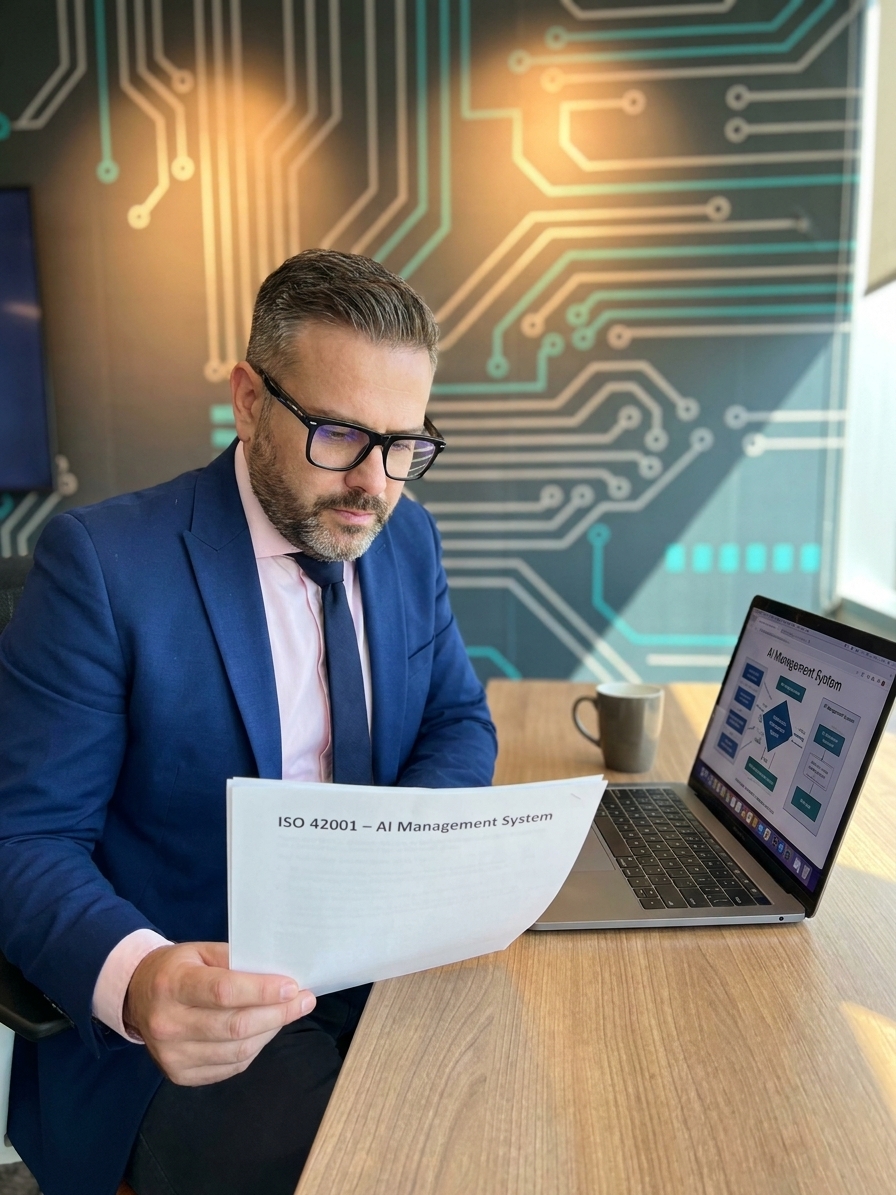
ISO/IEC 42001 is the first management system standard for artificial intelligence. It is built on the exact same Annex SL and Plan-Do-Check-Act structure as ISO 9001 and AS9100. If you manage a Quality Management System (QMS), the architecture is already in your head. What changes is the asset under control: instead of a welding robot or a machining centre, you are governing probabilistic models that degrade silently over time.
AI systems fail differently than deterministic equipment. A vision inspection model validated at 96% accuracy in January can drift to 89% by July because the input data shifted. You will not catch this with an annual internal audit. ISO 42001 forces us to apply rigorous performance monitoring and data governance to these models, closing the operational gap that exists when engineering teams deploy machine learning without QMS oversight.
During my time at a major aerospace manufacturer, I saw firsthand how fast AI deployments outpace governance. We deployed AI for automated inspection on composite materials. The model passed initial validation because its false-negative rate was better than human inspectors. But without a management system demanding continuous monitoring, drift goes unchecked until a major escape forces a containment action.
Uncovering Your Hidden AI Inventory
Clause 4 requires you to understand the context of your AI systems. The primary failure mode here is invisible AI. In modern manufacturing environments, AI is embedded heavily in commercial software. ERP platforms deploy predictive analytics, MES systems use anomaly detection, and logistics tools rely on automated decision algorithms. These are rarely flagged in standard IT procurement assessments.
If you do not know where your AI operates, you cannot manage it. Quality managers must build a comprehensive AI inventory. This means auditing software licenses, querying IT and operations directors, and mapping automated decision logic. Document the purpose, data sources, system owner, and criticality of each application. An incomplete inventory will immediately invalidate your certification audit.
At Norgren, mapping the inventory uncovered 11 tools with active machine learning capabilities that nobody had documented. The inventory took three months to finalise. It was tedious, data-intensive work, but it formed the foundation for our entire risk assessment strategy. You cannot optimise OEE or ensure process safety if you do not have visibility over the algorithms controlling your workflows.

Risk Assessment and Dual-Inspection Controls
Clause 6 merges risk-based thinking with AI deployment. Standard PFMEA templates fall short here because AI risks are dynamic. You must evaluate how input data variations affect the model output. A risk assessment must include data poisoning vulnerabilities, model bias, and the operational impact of drift.
Consider an automated visual inspection system. A false-negative rate of 3.2% on material defects might outperform a human inspector, passing initial validation. But ISO 42001 requires you to calculate the impact of that 3.2% on flight safety and downstream processes. If the escape of a critical defect compromises end-user safety, standard acceptance criteria are insufficient.
The corrective action is a dual-inspection protocol. Use the AI for the first pass to isolate potential anomalies, followed by mandatory human verification of all flagged areas. At a major aerospace manufacturer, this protocol eliminated defects escaping to final assembly with only a 12% increase in inspection cycle time. The risk assessment forced an operational redesign that balanced throughput with absolute safety.
Competence, Training, and System Controls
Clause 7 demands specific competence and awareness. Your quality team does not need to write machine learning code, but they must evaluate outputs critically. Training must cover confidence scores, algorithmic bias, and drift indicators. When a model returns a 98% confidence score, your inspectors must understand what data that percentage is actually based on.
Clause 8 operational controls require documented specifications for every AI tool. These specs must outline the intended purpose, training data parameters, performance metrics, known limitations, and override procedures. A four-page specification document per system is standard. This documentation makes your controls auditable and provides a baseline for performance reviews.
Traditional Process Control vs AI Governance
Traditional Process Control
- Failure is deterministic and visible
- Corrected via mechanical adjustment
- Annual validation is often sufficient
- Risk modelled via standard PFMEA
AI Governance (ISO 42001)
- Failure is probabilistic and silent
- Corrected via model retraining
- Requires continuous drift monitoring
- Risk modelled via dynamic data assessment
Performance Evaluation and Model Drift
Clause 9 requires ongoing monitoring, measurement, and analysis. AI models degrade because real-world data diverges from training data. If you only validate the model during initial deployment, you are managing a point in time, not a living process. ISO 42001 mandates continuous tracking of accuracy, precision, recall, and false positive rates.
At a major aerospace manufacturer, we implemented monthly AI performance reviews. Every active system generated a one-page dashboard tracking drift indicators and comparing current performance against baseline metrics. If accuracy dropped below the established threshold, it triggered an automatic 8D corrective action. This mechanism prevents silent degradation from impacting product quality.
Internal audits must also adapt to this reality. Auditors need to review the trigger logs and verify that drift thresholds are actively enforced by operations. They must trace a failed model prediction from the algorithm output through the human override mechanism to the final quality record. Without this end-to-end traceability, your AI management system lacks integrity.
AI Performance Monitoring Thresholds
Managing Corrective Actions for Nonconformities
Clause 10 focuses on continual improvement, but AI nonconformities demand a new skill set. If a CNC machine produces a bad part, you calibrate the tool or adjust the feed rate. When an AI vision system misses a critical defect, the root cause is often buried in the training data or the decision threshold. Standard mechanical root cause analysis tools will not find it.
Corrective action for AI requires interrogating the training data, not just the machine parameters.
You might need to source new data, retrain the model, or adjust the confidence threshold required to pass a part. Documenting these actions within an 8D framework forces data science teams to speak the language of quality management. The containment action might be reverting to manual inspection while the engineering team debugs the algorithm.
This integration is where quality managers provide immense value. Data scientists focus on optimising models for speed and accuracy, but they rarely consider the systemic impact on production flow and safety. By applying standard quality assurance principles to machine learning pipelines, you ensure that innovation does not outpace governance.
Implementation Pathway for Existing QMS
Organisations certified to ISO 9001 or IATF 16949 already possess 60-70% of the required infrastructure. Do not build a parallel management system. Integrate AI controls into your existing procedures, risk assessments, and management reviews. Extend your current document control system to cover AI specifications and validation records.
Start with a rigorous gap assessment against ISO 42001 clauses. Map your current PPAP, MSA, and control plan frameworks to see where they intersect with AI deployment. AI tools used in critical manufacturing processes will require the same level of rigorous validation as any new equipment installation. The transition should leverage your existing quality manual.
Run an internal audit specifically targeting AI management before engaging a certification body. This dry run will expose where your team lacks the competence to evaluate algorithmic outputs. Closing these gaps ensures that when the external auditor arrives, your AI systems are fully documented, monitored, and integrated into the wider quality ecosystem.