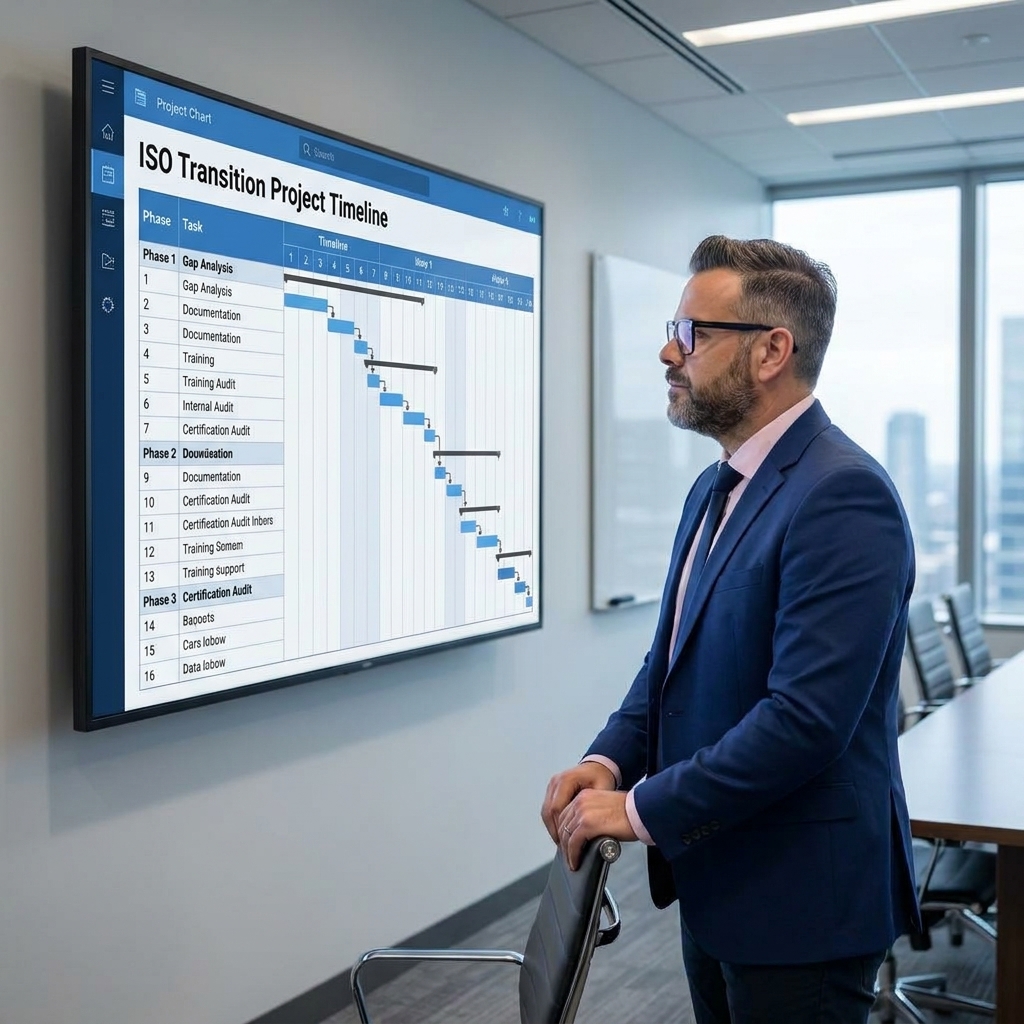
During the ISO 9001:2015 transition, I watched a plant lose its certification because management treated the three-year window as an abundance of time. They started twelve months before the deadline, assuming that was sufficient. Then a key engineer resigned, the certification body couldn’t schedule the audit, and two major nonconformities from the first attempt required lengthy corrective action. The recertification audit couldn’t be booked before expiry.
The financial impact was immediate. The plant faced suspension from three major customer preferred-supplier lists. They paid a premium for a full re-certification rather than a standard transition audit, and the reputational damage took two years to resolve. The root cause was administrative complacency: they started too late and failed to manage the migration as a formal, resourced project.
ISO 9001:2026 will follow the same transition rules. A standard three-year window will be granted from the publication date. That window is an illusion. If your transition project is not chartered, budgeted, and actively running within the first six months of publication, you are already operating on borrowed time.
The Mechanics of the Transition Window
During the official transition period, both the old and new editions of the standard are valid. Your certification body can conduct a transition audit during a scheduled surveillance or recertification audit, or as a separate special audit. Once the deadline passes, the previous edition is formally withdrawn. Any certification to the old standard becomes invalid, instantly terminating your ISO 9001 credentials.
The three-year allowance degrades rapidly due to external constraints. Certification bodies must update their own accreditation processes and train their auditors on the new text. Transition audits are rarely available until six to nine months after publication. Your effective migration window is therefore closer to two and a half years, before accounting for internal delays.
The second year is heavily congested. As the deadline approaches, certification bodies become overbooked. Audit slots in the final year are scarce and command premium pricing. Organizations that wait until Year 2 to begin planning routinely discover they cannot secure an audit slot until Year 3, compressing their implementation timeline to a dangerous degree.
Transition Window Reality Check
Year 1: Preparation and Gap Analysis
Year 1 establishes the factual baseline for your migration. In Quarter 1, secure executive commitment, budget approval, and formally appoint a transition project manager. This is typically the quality manager, but they must be given dedicated time and authority. Assemble a cross-functional steering committee covering operations, supply chain, IT, and HR to ensure the system is evaluated from every functional angle.
By the end of Quarter 2, you must complete a comprehensive gap analysis. Map your current processes against the 2026 requirements and score the maturity of each significant change area. Prioritize identified gaps and assign clear ownership. Present this transition plan, complete with a 25% budget contingency, to the executive steering committee for formal authorization to proceed.

Quarters 3 and 4 focus on foundation implementation. Evaluate your digital QMS infrastructure against the new requirements; if software upgrades are necessary, begin vendor selection immediately, as enterprise implementations take six to nine months. Update your risk register and strategic context analysis to reflect any new 2026 requirements, particularly regarding supply chain depth and organizational knowledge.
Complete foundational documentation updates by Month 12. Revise the quality policy, tier-1 procedures, and document control structures to align with 2026 terminology. Implement enhanced supplier monitoring processes, map critical supply chains to Tier-2, and formalize protocols for capturing tacit knowledge and succession planning for critical quality roles.
Year 2: Implementation and Verification
Year 2 translates planning into operational reality. In Quarter 5, deliver targeted training on all updated processes. Verify competence through practical demonstration and updated skills matrices, not simply by recording training attendance. Deploy new digital tools, migrate quality data, and validate system integrity before rolling updated procedures out to the production floor.
Quarter 6 requires a full internal audit cycle against ISO 9001:2026. Use updated checklists that explicitly test the new requirements. Identify nonconformities and begin corrective actions immediately. Follow this with a formal management review that incorporates transition progress data, ensuring leadership is actively engaged in directing the remaining actions before external auditors arrive.
Quarter 7 is dedicated to readiness preparation. Commission a full mock audit from an experienced external auditor. Simulate the certification process completely, from the opening meeting to document review and process tours. Compile a master evidence package organized by clause, and prepare distinct audit trails for multiple representative products or processes.
Quarterly Milestone Path to Certification
- 01Q1: Project LaunchCharter project, brief leadership, and secure transition budget.
- 02Q2: Detailed Gap AnalysisMap processes to new requirements, classify gaps, assign owners.
- 03Q3: Foundation ImplementationAssess digital systems, update strategic context and risk register.
- 04Q4: Core DocumentationRevise quality manual, tier-1 procedures, and supplier agreements.
- 05Q5-Q6: Deployment & Internal AuditTrain staff, deploy systems, and execute full internal audit cycle.
- 06Q7-Q8: Mock Audit & CertificationConduct external mock audit, close findings, and execute transition audit.
Quarter 8 secures the certification. Confirm the audit scope with your certification body and finalize logistics. Complete the Stage 1 documentation review and the Stage 2 transition audit. Address any findings immediately and close minor nonconformities within the agreed timeframe. By Month 24, your organization should be fully certified, leaving Year 3 untouched.
The Value of a Year 3 Buffer
If you execute the 24-month plan accurately, Year 3 serves as a strategic buffer. This buffer is essential risk management. Things will go wrong. Key personnel leave, audit findings require more corrective action than anticipated, and administrative scheduling slips. A one-year buffer absorbs these operational shocks without endangering your certification status.
Organizations that finish early avoid the deadline rush entirely. As the transition window closes, certification bodies become overwhelmed with desperate, last-minute requests from non-compliant firms. Audit slots become scarce, expensive, and sometimes unavailable. Early finishers bypass this bottleneck, securing premium auditor attention while competitors scramble for survival.
Use Year 3 to mature your implementation. Move the organization from basic compliance to genuine improvement. Refine the processes you deployed in Year 2 based on actual production feedback. This phase shifts the quality system from a newly audited project back into a stable, operational baseline, driving the continuous improvement mandated by the standard.
The cost of a part-time transition is always higher than the cost of a dedicated one.
Critical Success Factors and Resourcing
Visible executive sponsorship is the primary determinant of success. The managing director must publicly commit to the transition, allocate budget without protracted negotiation, and actively participate in management reviews. Without this authority backing the project, the transition will compete for resources against production targets and lose momentum.
Assign dedicated project management. ISO transitions fail when treated as supplementary work for an already overburdened quality manager. The cost of delays and emergency rework will always exceed the cost of dedicated focus. Furthermore, engage your certification body early, ideally before the standard is published, to negotiate your audit slot well in advance.
For a mid-sized manufacturing organization of 200 to 1,000 employees, expect external costs for consulting, training, and a mock audit to range from €25,000 to €60,000. Certification body fees will add another €8,000 to €15,000. If a new digital QMS is required, software and implementation can push the total investment to between €50,000 and €150,000 depending on complexity.
Internal resourcing requires a similar level of commitment. Budget 0.5 to 1.0 full-time equivalent (FTE) for project management over an 18 to 24-month period. Cross-functional team members will need to dedicate 5 to 15 percent of their time, and you must allocate 200 to 400 total hours for formal documentation updates to meet the new standard's structural demands.
Immediate Actions for Leadership
If your transition planning has not begun, action is required this week. Obtain the latest available draft or final text of ISO 9001:2026. Brief your executive leadership team in a focused, 30-minute session on the incoming requirements, the mandatory three-year window, and the specific operational risks of starting late.
Contact your certification body immediately. Understand their specific transition timeline, their administrative requirements, and their auditor availability for the next 24 months. Securing your preferred audit window early is a critical advantage that costs nothing but prevents immense scheduling friction later.
Every month of delay eliminates a month of operational buffer. Organizations that transition smoothly are the ones that start early, plan systematically, and execute with dedicated resources. Those that struggle rely on improvisation and hope. Treat the ISO 9001:2026 migration as the critical infrastructure project it is.