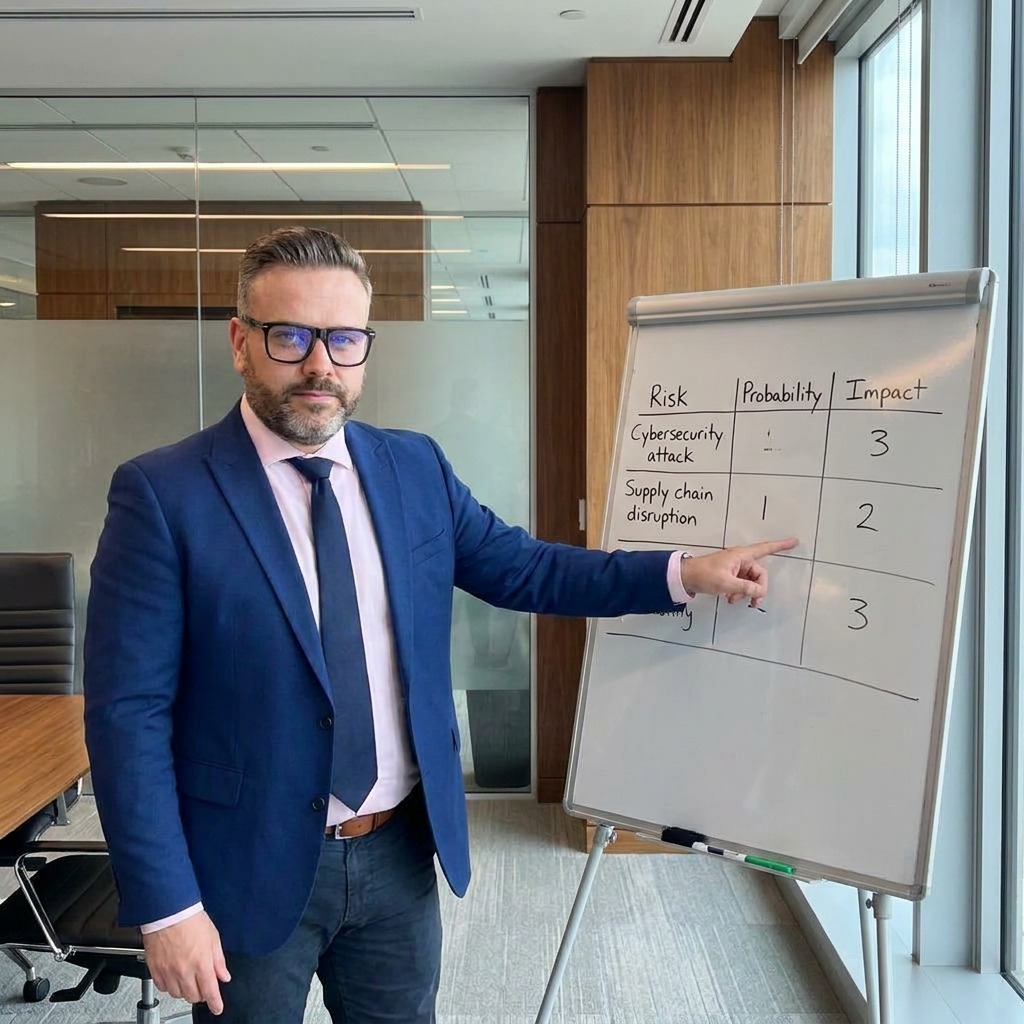
I recently audited a manufacturing plant that maintained a 94-row risk register. It was colour-coded, meticulously formatted, and completely ignored. The production manager could not name the top three risks in his department, while the quality manager admitted she only opened the file the week before a certification audit. This document, created by an external consultant during their ISO 9001:2015 transition, existed solely to satisfy an auditor.
This scenario illustrates the systemic failure of how most organisations interpret risk-based thinking. They treat risk as a standalone compliance checklist rather than a core operational mechanism. The upcoming ISO 9001:2026 revision explicitly targets this failure. The standard pushes manufacturers away from static risk registers and toward demonstrable, continuous risk management embedded directly into daily operations.
The 2015 standard introduced risk-based thinking to replace preventive action, deliberately leaving methodology undefined. Some organisations built mature, integrated risk cultures; most simply built a spreadsheet and forgot about it. The 2026 update does not mandate specific methodologies like ISO 31000 or FMEA, but it drastically tightens expectations across four operational dimensions: depth, integration, monitoring, and organisational knowledge.
Depth and Evaluation: Forcing Actionable Analysis
The 2015 clause asked organisations to determine risks and opportunities. The 2026 revision demands that you identify, analyse, and evaluate risks at a depth sufficient to drive specific action. Writing 'supply chain disruption' on a risk register no longer suffices. You must specify the exact vulnerability, such as a single-source dependency for a critical raw material in a geopolitically unstable region.
Auditors will expect to see consistent evaluation criteria—typically probability, severity, and detectability. Without defined thresholds, every risk carries equal weight, which means no risk is a priority. Your system must translate abstract threats into quantifiable metrics that dictate precise operational responses and resource allocation.
At SNOP, I implemented a three-tier risk evaluation framework to manage quality across our 900-employee greenfield plant. We classified risks as Red, Amber, or Green based on probability and impact. A Red risk demanded an immediate mitigation plan with a mandatory monthly review cycle. Amber risks required action within 90 days. This single-page framework drove more operational discipline than any complex, consultant-built register.
| Risk Level | Probability & Impact | Required Action & Review Frequency |
|---|---|---|
| Red | High/Medium probability; Severe/Major impact | Immediate mitigation plan; mandatory monthly review |
| Amber | Medium probability; Moderate impact | Mitigation plan required within 90 days; quarterly review |
| Green | Low probability; Minor/Moderate impact | Active monitoring; annual review cycle |
Integration into Daily Operational Decisions
In 2015, companies considered risk when initially planning the quality management system. The 2026 update demands demonstrable evidence that risk-based thinking actively influences daily operational decisions. Auditors are no longer accepting a standalone risk register; they are hunting for risk logic embedded directly into engineering change orders, supplier approvals, and production scheduling records.
When you change a critical process step, your change management record must show an assessment of newly introduced quality risks before implementation. When you release a production schedule, it must account for personnel changes on critical operations or new product introductions. If an 8D investigation closes a nonconformity, the documentation must show whether the root cause introduces broader systemic risks to other product lines.
This level of integration requires quality teams to stop owning the risk process in isolation. Risk management must become a structural input for engineering, procurement, and production planning. The auditor wants to see cross-functional risk assessments documented in the actual operational records where the work happens, proving that the organisation acts on the risks it identifies.
Systematic Monitoring and Triggered Reviews
The 2026 standard requires systematic, documented risk monitoring connected directly to management review. Critical risks require monthly assessment; significant risks require quarterly review. Most importantly, specific operational events must trigger automatic risk evaluations. You cannot wait for an annual management review to assess the impact of a major supply chain shift or a critical machine failure.
Mandatory triggers for risk reassessment include new product introductions, significant process changes, and systemic customer complaints. External triggers like regulatory updates from the FAA or EASA, geopolitical shifts, and raw material shortages also demand immediate review. If your risk register looks identical before and after a major disruption, your monitoring system has failed.
Furthermore, the standard demands effectiveness measurement. If you implemented a mitigation plan three months ago, you must measure whether the actual risk level decreased. Too many facilities track the completion of mitigation tasks—like 'training provided'—without verifying whether the intervention actually reduced the probability or severity of the threat. Tracking completion without measuring effectiveness is pure theatre.
The Risk Event Log: Closing the Knowledge Loop
ISO 9001:2026 explicitly connects risk management to organisational knowledge. When an identified risk materialises into an actual nonconformity or plant shutdown, the resulting root cause investigation must feed back into your QMS. Lessons learned from these events must actively update the risk register, creating a closed-loop learning system rather than a static repository.
A risk identified and never reviewed is worse than no risk management at all; it breeds documented false confidence.
At a major aerospace manufacturer, we operationalised this requirement using a simple 'risk event log'. Every time a projected risk materialised, we logged the event, triggered an immediate 8D investigation, and fed the findings back into our central risk register. Over two years, this log became our most valuable quality knowledge asset, actively preventing repeat failures across different production lines.
A Practical Framework for Risk Governance
Transitioning to the 2026 risk requirements requires a structured, time-bound governance model. I implement a three-tier cadence with clients to ensure risk management remains active without becoming a bureaucratic burden. This framework replaces the static annual review with continuous, focused evaluation cycles that drive tangible operational corrections.
Three-Tier Risk Review Cadence
- 01Monthly Working Session (15 min)Quality team reviews new risks, mitigation statuses, and recent risk events to ensure immediate corrective actions.
- 02Quarterly Leadership Review (60 min)Leadership evaluates top 10 risks, mitigation effectiveness, and emerging internal or external threats.
- 03Annual Risk Assessment (Half Day)Cross-functional workshop to reassess all risks, validate criteria, and align the register with strategic objectives.
The monthly session focuses purely on action items and immediate operational roadblocks. The quarterly review forces leadership to examine mitigation effectiveness and emerging trends. The annual half-day workshop is a facilitated, cross-functional event—not a solo exercise for the quality manager—designed to align the risk profile with strategic business objectives and capital investment plans.
Common Failures in Risk Implementation
The most frequent failure mode is the 'Everything Is a Risk' trap. When a plant registers 200 separate risks, leadership cannot identify operational priorities. A functional register should contain 15 to 25 actively managed, high-impact risks. If you try to track every minor operational detail, the system collapses under its own weight and people stop reading it.
The 'Set and Forget' syndrome is equally dangerous. A risk identified and never reviewed creates documented false confidence. Every single entry on the register requires a designated owner and a strict review date. Similarly, teams suffer from the 'Mitigation Illusion'—writing 'training will be provided' does not reduce risk. Only verified, effective training demonstrated on the shop floor actually reduces risk.
Finally, risk management fails when it is treated purely as a quality department function. If risk discussions happen exclusively among quality engineers, the risks are merely being documented, not managed. IATF 16949 and AS9100 demand cross-functional involvement. Production, engineering, and procurement leaders must own the operational risks within their respective domains.
Risk Management as a Competitive Advantage
ISO 9001:2026 forces risk management to evolve from a documentation exercise into a core business capability. Organisations with mature risk frameworks respond faster to supply chain disruptions because they have already mapped their critical vulnerabilities. They make better capital investment decisions because they accurately understand the risk-reward trade-offs of new technologies.
These organisations also recover faster from quality escapes. When a critical nonconformity occurs, their crisis response is pre-planned, resources are pre-allocated, and alternative suppliers are already vetted. They do not waste valuable production days conducting theoretical risk assessments in the middle of an actual crisis.
The transition to ISO 9001:2026 is an opportunity to strip the bureaucracy out of your QMS. Build a risk system that production managers actually use. Ensure your risk register drives daily operational decisions, connects directly to organisational knowledge, and creates genuine resilience. Quality risk management is not a compliance cost; it is a structural competitive advantage.