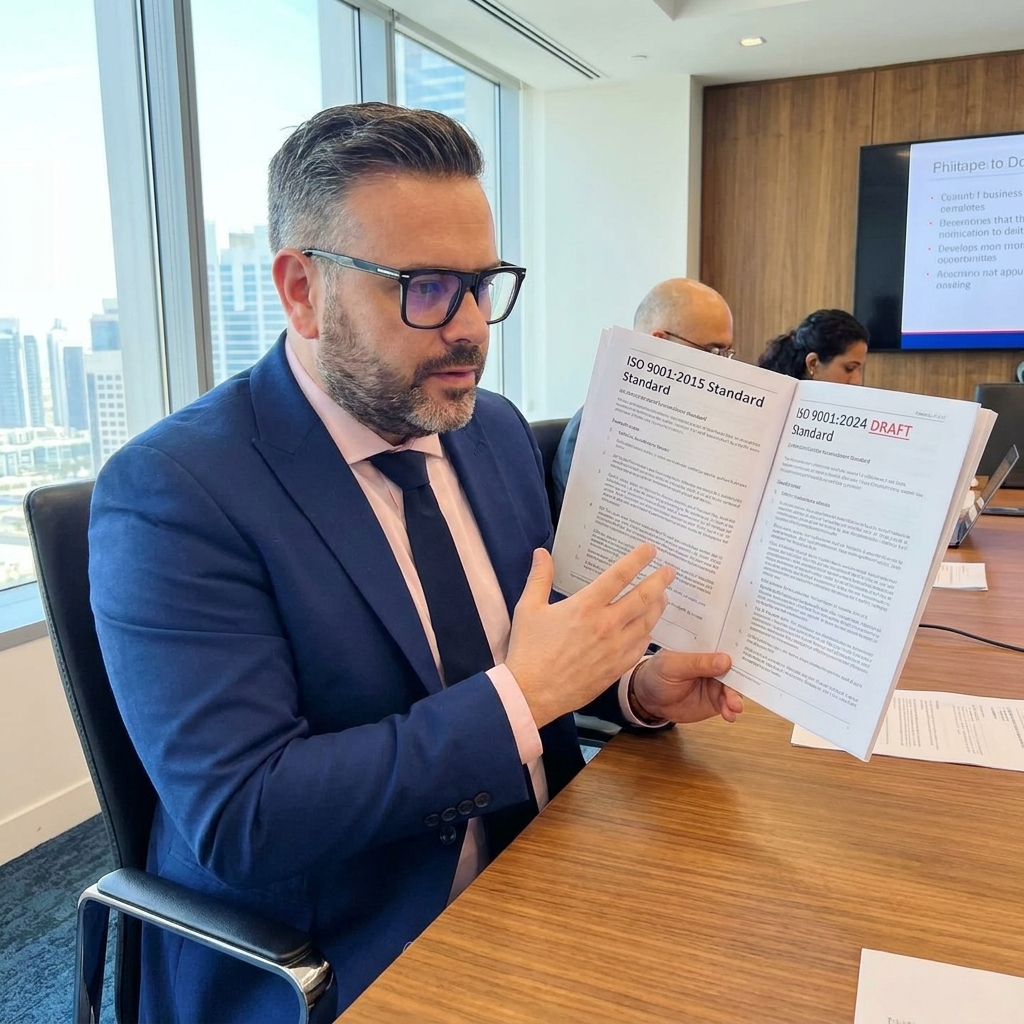
ISO 9001:2026 retains the Annex SL skeleton, the ten-clause structure, and the Plan-Do-Check-Act logic of the 2015 edition. What changes is the depth of specific requirements. The ISO/TC 176 committee has shifted the standard's orientation from a compliance mindset to a performance mindset. Auditors will no longer verify simply that a procedure exists; they will examine whether that procedure produces measurable quality outcomes.
The revision introduces fourteen significant requirement-level changes across seven clauses, alongside four new concepts and nine updated defined terms. Clause 4 (context), Clause 7 (resources and documented information), and Clause 8.4 (supply chain) absorb the heaviest structural updates. Clauses 1, 2, and 3 remain functionally unchanged, although Clause 3 terminology definitions have been updated to reflect the new concepts.
Organisations certified to ISO 9001:2015 will not need to rebuild their management systems. They will need to upgrade their control mechanisms, deepen their risk evaluations, and connect their quality objectives to executive dashboards. The transition demands targeted engineering work, not a structural rewrite. The following sections map the changes clause by clause and define the work required to close the gaps.
Climate and Context Evaluation (Clause 4.1 and 4.2)
Clause 4.1 previously required organisations to determine external and internal issues relevant to their strategic direction. The 2026 update makes climate change a mandatory, explicit consideration within this context analysis. The standard does not mandate specific climate actions or carbon reduction targets. It requires organisations to evaluate climate-related factors, document the assessment, and determine whether these factors are relevant to the QMS.
For manufacturing operations, this means mapping climate risks to supply chain logistics and infrastructure. A facility relying on maritime shipping must assess the impact of low water levels on inland waterways. An aerospace assembly plant must evaluate energy cost volatility under emerging carbon regulations. The requirement forces a documented evaluation of operational resilience against climate variables.
I facilitated a context analysis workshop with an automotive supplier that initially dismissed the requirement. We mapped their raw material supply chain and discovered a critical dependency on a single logistics corridor highly vulnerable to seasonal flooding. Evaluating climate risk in a context analysis is a supply chain resilience exercise. The effort required is low: a structured workshop with leadership yields a compliant, documented evaluation.
Digital QMS Infrastructure and Document Control (Clause 7)
Clause 7.1.1 now requires organisations to consciously design and maintain their digital QMS infrastructure. The standard expects data management systems, digital documentation platforms, and IT infrastructure to be treated as controlled quality resources. If your quality records reside on a legacy shared drive with a manual naming convention, this clause invalidates that architecture. You must implement access controls, version history, and automated audit trails.

Clause 7.5 strengthens the requirements for documented information, specifically targeting electronic records. Auditors will trace user permissions to verify that unauthorised personnel cannot alter quality data. They will request disaster recovery logs and demand evidence of systematic data backups. If your current system relies on spreadsheets emailed between departments, the transition will require a dedicated technology upgrade.
The scope of Clause 7.1.6 on organisational knowledge has also expanded. The 2015 requirement was largely interpreted as keeping standard operating procedures updated. The 2026 edition mandates proactive knowledge capture. Organisations must systematically harvest tacit operator knowledge, document lessons learned from 8D corrective actions, and structure cross-functional knowledge transfer to survive personnel turnover.
Supply Chain Transparency and Sub-Tier Control (Clause 8.4)
Clause 8.4 generates the highest transition workload. The 2015 requirement asked organisations to control externally provided processes based on their impact on conformity. The 2026 edition demands visibility and risk management down the supply chain. The annual supplier self-assessment questionnaire is no longer sufficient evidence of control. Organisations must monitor real-time performance data and map sub-tier dependencies for critical components.
Building Tiered Supplier Visibility
- 01Risk-based segmentationTier suppliers by criticality, assigning the highest control levels to single-source providers.
- 02Performance data monitoringTrack on-time delivery, defect rates, and 8D closure times instead of annual compliance scores.
- 03Sub-tier mappingMap the components from critical Tier 1 suppliers down to their raw material sources.
- 04Active supplier developmentInitiate joint process improvement projects to build capability and stabilise the supply base.
A Tier 1 automotive supplier I advise lost their primary raw material source when a sub-tier manufacturer three links down the chain suffered a catastrophic fire. Nobody in the value chain had mapped beyond Tier 1. The recovery took four months and cost millions in expedited logistics. ISO 9001:2026 requires the supply chain visibility that would have identified this single-source vulnerability during the risk assessment phase.
This clause also links supplier risk directly to the overarching QMS risk register. When a supplier's delivery performance degrades, the resulting risk to your production lines must be logged, evaluated, and mitigated through the systematic risk management process defined in Clause 6.1. Supply chain management is no longer a transactional procurement task; it is a core quality engineering function.
Risk Management Maturation and Leadership Accountability (Clauses 5 and 6)
Clause 6.1 elevates risk management from a theoretical concept to a demonstrable process. The 2015 standard introduced risk-based thinking, which organisations often satisfied by conducting a basic FMEA or a SWOT analysis. The 2026 edition demands a defined risk methodology applied systematically across all QMS processes. Risk registers must be living documents, reviewed regularly, and directly connected to strategic planning.
Clause 5.1 increases the specificity around leadership engagement. Top management must integrate quality objectives into core business strategy. A chief executive signing the quality policy once a year no longer satisfies the requirement. Auditors will examine board reports for quality metrics. They will interview top management to verify active participation in management reviews and to confirm that quality data influenced budget allocations.
The 2026 standard demands a systematic risk register connected to operational decisions, not a theoretical exercise filed before the audit.
Quality objectives must be resourced, tracked, and reviewed by leadership. If quality is perceived strictly as the quality department's responsibility, passing a transition audit will require a fundamental cultural shift. Leadership must demonstrate accountability for the effectiveness of the management system by directing corrective actions and allocating capital based on quality performance data.
Operational Control and Analysis Updates (Clauses 8 and 9)
Several smaller requirement updates directly affect shop-floor execution. Clause 8.5.1 strengthens first-piece inspection requirements and adds validation rules for digital measurement systems. Clause 8.5.6 forces a broadening of change management protocols. Any engineering change order must now include an impact assessment on the entire supply chain, not just internal tooling or routing adjustments. Change control boards must verify supplier capacity before approving deviations.
Shift in Internal Audit and Data Analysis
ISO 9001:2015 Expectations
- Month-over-month tabular comparisons for quality trends
- Internal audits focused on procedural conformance
- Auditor competence based on process knowledge
- Root cause analysis accepting operator error as a valid conclusion
ISO 9001:2026 Expectations
- Trend analysis using appropriate statistical methods
- Internal audits measuring the effectiveness of processes
- Auditor competence expanded to include digital system auditing
- Root cause analysis drilling past human error into systemic causes
Clause 9.1.3 raises the bar for data analytics. Quality departments relying on month-over-month comparisons in spreadsheets will fail to meet the new analysis expectations. The standard requires appropriate statistical methods for trend analysis. Process capability studies, statistical process control charts, and ANOVA must be applied to demonstrate that the organisation actually understands its process variation.
Clause 9.2 expands internal auditor competence requirements to include digital system auditing. Auditors must be able to trace data integrity through complex software architectures. Furthermore, Clause 10.2 explicitly bans operator error as an acceptable root cause in corrective action documentation. Investigators must now identify the systemic reasons—the lack of poka-yoke, inadequate training, or poor lighting—that allowed the operator to make the error.
Transition Priorities and Resource Allocation
Transitioning to ISO 9001:2026 requires organisations to apply resources where the risk of nonconformance is highest. The fourteen changes vary widely in complexity and impact. Upgrading supply chain visibility under Clause 8.4 will consume the majority of engineering and procurement resources for most manufacturing firms. Conversely, updating the climate context analysis under Clause 4.1 requires minimal investment.
Leadership teams must define a clear transition timeline that addresses the high-impact clauses first. Risk methodology, organisational knowledge capture, and sub-tier supplier mapping demand immediate project management. Document control upgrades and statistical analysis improvements require targeted training programmes. Internal audit checklists must be rewritten to test process effectiveness rather than simply verifying document presence.
The ISO 9001:2026 revision preserves the architecture of the standard while demanding a higher calibre of quality engineering. Start with supply chain mapping and risk management. Build robust digital infrastructure. Force leadership to engage with the data. Transitioning successfully means proving that your management system does not just conform to the standard, but actively drives measurable quality outcomes.