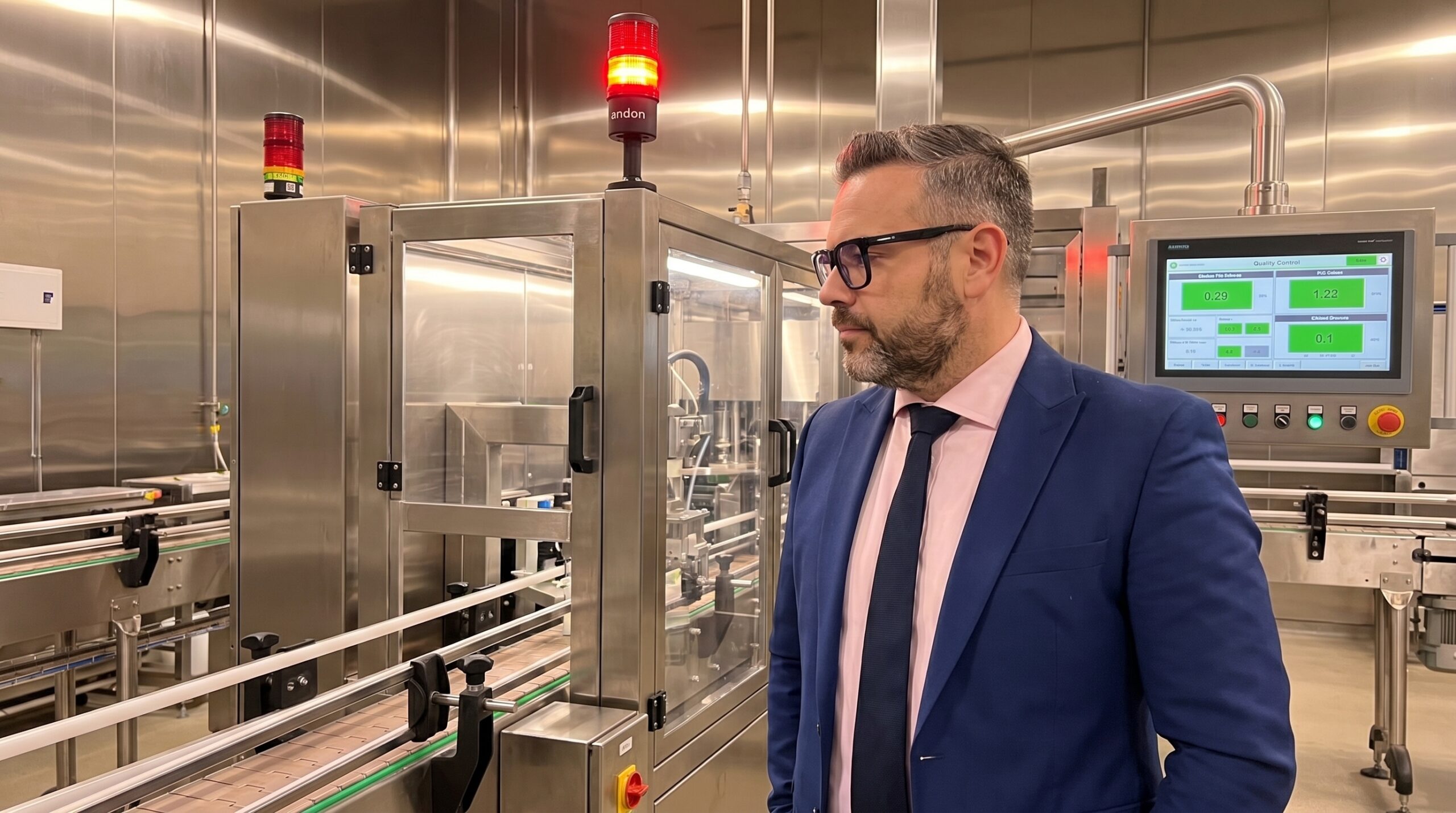
I was standing on an automotive connector line watching an operator pack finished parts. Everything looked routine until I spotted a unit with a sheared-off contact in the box of good parts. I found another. And another. It took five minutes to trace the defects back to the source. At a cycle time of three pieces per second, over two hundred defective units had already moved downstream.
When I asked the operator about the inspection frequency, the answer was a confident 'every hour'. An hour is an eternity in high-volume manufacturing. Hourly detection is not quality control; it is mass scrap generation. That plant was operating on the assumption that human vigilance could match machine speed. It cannot.
This is where Jidoka separates itself from standard automation. It changes the fundamental rule of production. Instead of waiting for an end-of-line inspector to catch a defect, the system itself refuses to create one. It builds the inspection into the process cycle and gives the machine the authority to halt production.
The Origin and Mechanics of Autonomous Quality
Jidoka is one of the two foundational pillars of the Toyota Production System, alongside Just-in-Time. Where JIT dictates flow and timing, Jidoka dictates integrity. The concept originates with Sakichi Toyoda’s 1896 automatic loom, which stopped instantly the moment a thread broke. Before this, looms continued weaving defective fabric until an operator noticed the failure.
The translation often used is 'automation with a human touch'. The Japanese characters literally translate to self-working, but the script includes an added radical for 'human'. The intent is autonomous operation infused with human intelligence. It is not merely automated processing. It is automation equipped with the logic to know exactly when it should cease processing.
This logic relies on four sequential steps. The mechanism must detect an anomaly, halt production, prompt immediate correction, and trigger a preventative action. If any link in this chain fails, the system collapses into standard reactive manufacturing where defects are managed rather than prevented.
The Four-Step Jidoka Sequence
- 011. Detect AnomalyA mechanical, optical, or software sensor identifies a deviation from the standard without human intervention.
- 022. Halt ProductionThe machine or line stops immediately. A visual and audible signal alerts the floor to the exact location of the failure.
- 033. Correct on SiteA technician or operator resolves the immediate issue, such as clearing a jam or replacing a worn tool, before restarting.
- 044. Institute CountermeasureThe team identifies the root cause and modifies the standard work or equipment to prevent recurrence.
Overcoming the Cultural Resistance to Stopping the Line
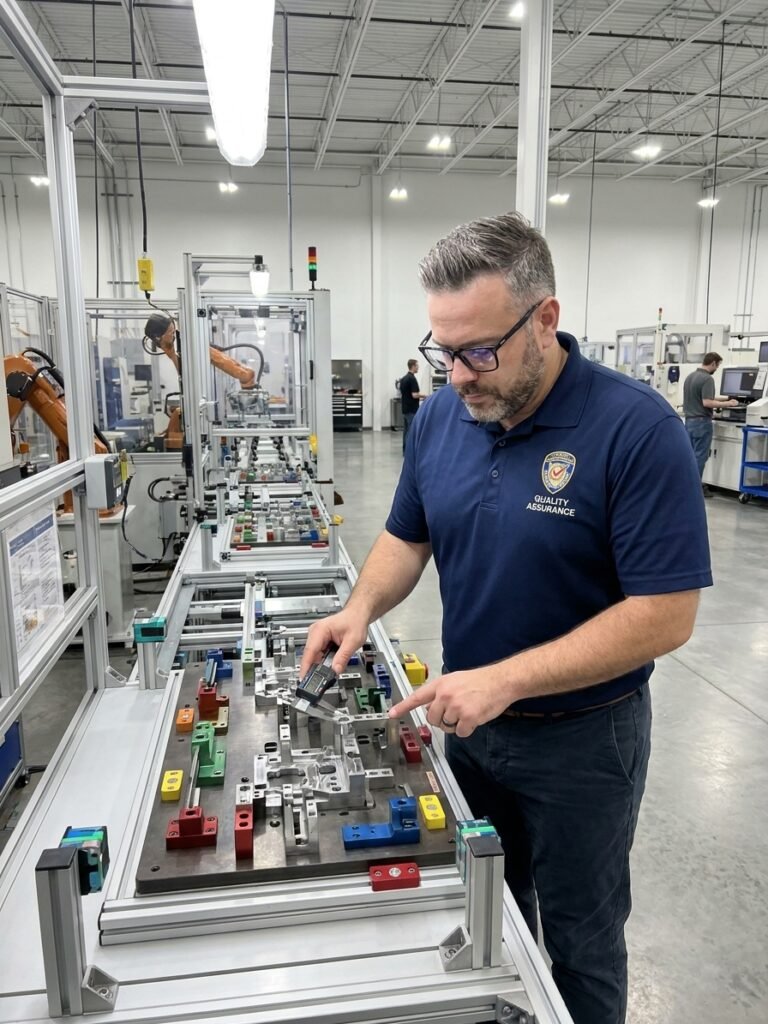
The most significant barrier to Jidoka is managerial fear of downtime. Plants measure Overall Equipment Effectiveness (OEE), shift output, and machine uptime. When management bonuses tie directly to these metrics, operators will not pull the Andon cord or press the stop button. They will let small defects pass to protect the numbers.
You overcome this by restructuring the math. Do not just measure the cost of the stoppage; measure the cost of the escaped defects. I have audited plants where operators ignored minor machine faults to save fifteen minutes of downtime per shift. Those same faults generated thousands of euros in scrap, rework, and customer warranty claims per day. The stoppage is always cheaper.
This requires a visible cultural shift. In a true Jidoka environment, stopping the line is a commendable act. When an operator triggers a halt, the shift supervisor responds immediately to assist, not to reprimand. Hidden problems are fatal to lean operations. Visible problems are solvable.
Selecting Detection Mechanisms for Critical Control Points
Jidoka does not require massive capital investment or complex Industry 4.0 architecture. It requires identifying where defects originate and installing a reliable barrier. You do not need a sensor on every operation. Use your Process FMEA to identify the highest Risk Priority Number (RPN) failure modes where detection is currently manual.
Once you map the risk, you must define the exact parameters of normal. If the system monitors torque, what is the acceptable window? If it checks part presence, what is the geometric limit? A sensor cannot identify a defect if the programmable logic controller lacks a precise definition of a good part.
Select the simplest mechanism that reliably catches the deviation. I have implemented sophisticated vision systems, but some of the most effective Jidoka devices I have seen are mechanical limit switches, physical poka-yoke pins, and basic photoelectric sensors. Complexity introduces its own maintenance requirements and failure modes.
| Mechanism Type | Ideal Application | Operational Constraint |
|---|---|---|
| Mechanical Switch / Pin | Checking physical part presence or orientation | Subject to physical wear; requires periodic replacement |
| Optical / Vision System | Surface defects, missing components, label verification | Requires clean lenses and controlled lighting environments |
| Pressure / Flow Transducer | Leak testing, fluid delivery, clamping force verification | Requires precise calibration to filter out ambient vibration |
| Software Parameter Limit | Cycle time deviations, servo torque spikes, temperature ranges | Demands tight integration with machine PLC and data logging |
Measuring the Impact on Process Capability and Cost
When you install autonomous quality control, the metrics shift rapidly. Returning to the automotive connector plant, we installed a camera system that inspected every single contact in two hundred milliseconds. If the optical system detected a shear, the machine halted, triggered a red beacon, and forced operator intervention before the next cycle.
Automation without autonomous quality is just a faster way to produce scrap.
The operational results were direct and measurable. Because defects were intercepted at the source, the internal scrap rate dropped from 2.3% to 0.04%. Customer complaints related to that specific operation dropped to near zero. Crucially, overall equipment effectiveness increased, proving that eliminating defects at the source actually improves throughput.
Connector Line Jidoka Implementation (3-Month Data)
Human Intelligence Versus Monotonous Inspection
There is a counter-argument that Jidoka and advanced automation eliminate the need for skilled operators. The reality is the exact opposite. Jidoka automates the monotonous, repetitive task of visual inspection. By removing the human from the role of a passive monitor, you elevate them to the role of a process engineer.
When the machine stops, it requires a human to troubleshoot, analyse the root cause, and execute a repair. The machine does the tedious work of identifying the anomaly. The human does the complex work of ensuring it does not happen again. This is the core of the 'human touch' in the original Japanese translation.
Modern IoT sensors and machine learning algorithms can predict tool wear before a defect occurs. This predictive maintenance is the natural evolution of Toyoda's original loom. However, the principle remains absolute. You build intelligence into the process, not at the final inspection gate.
Designing the Immediate Response Protocol
A stopped machine is only useful if the response is immediate. If operators halt the line and wait twenty minutes for a maintenance technician, you have merely traded scrap for idle time. The response protocol must be engineered with the same rigor as the detection mechanism.
Define the escalation path before the system goes live. When the red light activates, who walks to the station? What is the maximum allowable response time? How is the intervention documented in the 8D or corrective action system? Without a structured response, operators will bypass the sensors to keep the line running.
Train your operators on the specific parameters the machine monitors. They must understand why the sensor triggered and how to clear the fault safely. Jidoka fails when operators view the stoppage as an annoyance rather than a critical quality signal. Training transforms the system from an alarm into a diagnostic tool.
Stopping the line is not a manufacturing failure. Producing defective parts and shipping them to a customer is the failure. Implementing Jidoka is the commitment to intercept the defect at the exact moment it occurs, armed with the context needed to eliminate it permanently.