You can automate a process to produce defective parts ten times faster than your best operator ever could. Speed without intelligence is catastrophe with a higher throughput rate. Yet organisations spend billions automating motion while entirely neglecting to automate judgment.
Jidoka destroys this illusion. It is the second pillar of the Toyota Production System alongside Just-In-Time, and it may be the most misunderstood concept in modern manufacturing. Ask practitioners about Jidoka and you receive a vague gesture about stopping the line or autonomation. The word confuses people because it blends automation with autonomy. That confusion is exactly the point.
The concept originates from Sakichi Toyoda's automatic loom in 1896. Before that invention, a loom operator had to watch the machine constantly. If a thread broke, the loom kept weaving yards of defective fabric before anyone noticed. The operator was babysitting, not adding value. Toyoda built a mechanism that detected a broken thread and stopped the loom automatically.
The Four-Step Mechanism of Jidoka
The machine could distinguish between normal operation and an abnormal condition. It could judge, act on that judgment without human intervention, and by stopping, signal that something needed attention. This is Jidoka: not automation that removes the human, but automation that gives the process a conscience.
The principle has four components, and every one matters. The process must detect the abnormality through a mechanical, electronic, or procedural mechanism. It must stop immediately. It must fix or correct the immediate condition. And it must investigate the root cause and implement a permanent countermeasure.
Most organisations that claim to practice Jidoka manage the first step, maybe the second, and almost never the fourth. They detect, stop, and restart. The defect repeats tomorrow because nobody asked why it happened today. The restart becomes the goal rather than the investigation, and the cycle perpetuates itself across every shift.
The Four-Step Jidoka Cycle
- 01DetectProcess recognises abnormality via sensor, operator, or poka-yoke device
- 02StopProduction halts immediately. No delay, no flag-for-later review
- 03FixImmediate condition is corrected and contained at the source
- 04CountermeasureRoot cause investigated and eliminated to prevent recurrence
The Culture of Stopping
Here is where Jidoka becomes uncomfortable for most organisations. The principle requires something that runs against every instinct in traditional management. It requires that stopping production is celebrated, not punished.
When a line stops in most plants, the supervisor's blood pressure rises. The plant manager wants to know why. The operations dashboard turns red. Someone looks for someone to blame. The overriding objective becomes restart as fast as possible, not understand what went wrong. This is the exact opposite of Jidoka.

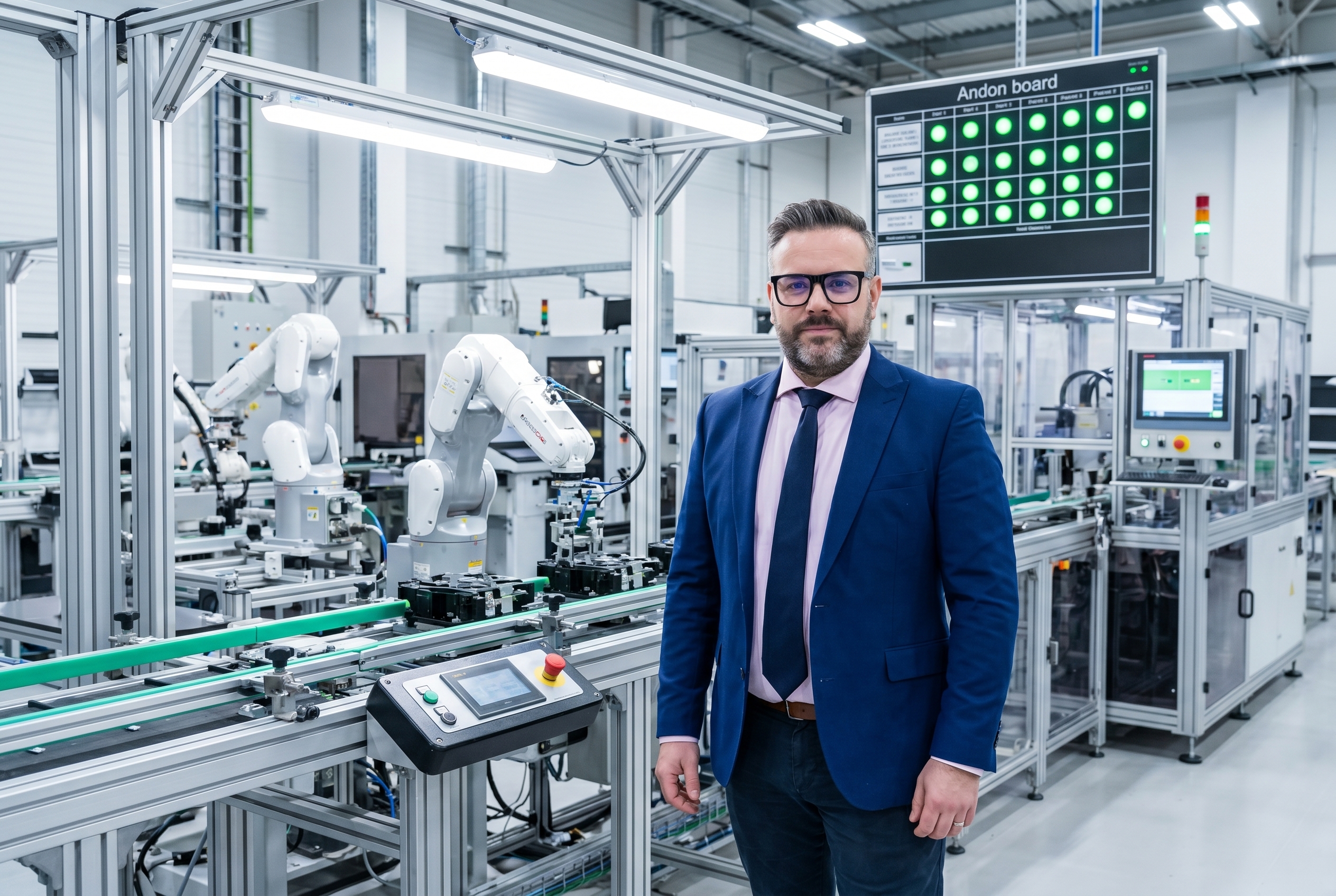
In a Jidoka culture, every stop is the process telling you something you did not know. The machine or operator detected an abnormality and contained it before it could compound downstream or reach a customer. The cost of that stop is a fraction of the cost of shipping the defect. Toyota gave every worker an Andon cord that allowed any operator to stop the entire line. When it was pulled, a team leader responded within seconds to help, not to chastise.
Jidoka without psychological safety is theatre. The Andon cord exists, but nobody pulls it. I have audited plants where operators told me they would never stop the line because the last person who did received a lecture about efficiency in front of the team. The equipment was capable. The culture was not.
The Mathematics of Containment
Jidoka is not just a philosophy. It is an economic strategy, and the mathematics support it relentlessly. Consider a defect that occurs at Station 12 in a 30-station production line.
Without Jidoka, that defect travels through Stations 13 through 30, accumulating processing cost, material cost, and handling at every step. If discovered at final inspection, the total waste includes all raw material, all labour from every station, all energy and machine time consumed, inspection time, rework or scrap cost, and potential customer impact if the defect escapes.
In most manufacturing environments, the cost of a defect increases by an order of magnitude at each stage of the value chain. A defect caught at the source costs one unit. Caught at assembly, ten units. Caught at final test, one hundred units. Caught at the customer, one thousand units. Jidoka attacks the left side of that exponential curve.
The Rule of Ten: Defect Cost Escalation
Levels of Detection Maturity
Jidoka operates on a spectrum, and understanding where your organisation sits is critical. Most plants want to jump straight to intelligent systems without building the human foundation underneath them.
At the base level, human Jidoka means an operator detects an abnormality and stops the process. No technology is required. It demands training operators to recognise defects, empowering them to act, and building a response system that supports their decisions. Trust and training are the only infrastructure.
Assisted Jidoka adds visual or audible signals — lights, buzzers, poka-yoke devices — that help the operator detect abnormalities more reliably. The human still decides, but the system makes the decision faster and more consistent. Automated Jidoka means the machine itself detects and stops. Sensors, vision systems, and SPC algorithms built into the equipment remove human judgment from detection entirely.
Intelligent Jidoka is where Industry 4.0 intersects with lean manufacturing. The system detects, stops, diagnoses the root cause, recommends a countermeasure, and adapts its detection parameters based on what it learned. Machine learning algorithms recognise subtle patterns in process data and predict failures before they happen. Most organisations buy this technology and deploy it on top of a culture where operators are still afraid to speak up.
Why Organisations Resist Jidoka
The efficiency trap is the first barrier. Most organisations measure utilisation — how busy their machines and people are. Jidoka requires idle capacity. If every machine runs at maximum capacity, there is no slack to absorb stops, investigate root causes, or implement countermeasures.
The volume addiction compounds the problem. Stopping the line reduces today's output. The manager who stops for a root cause investigation goes home with fewer units produced. The manager who pushes through ships more product today and deals with defects tomorrow. In most performance review systems, tomorrow's defects are tomorrow's problem.
The line that never stops is the line with the most hidden defects. A culture that punishes stops gets exactly the reporting it demands.
The blame reflex destroys the practice. When a line stops, the immediate question in most organisations is who caused this, not what caused this. Jidoka requires shifting from individual blame to systemic understanding. This is a leadership behaviour change, not a process change, and leadership behaviour changes are the hardest kind.
The technology shortcut finishes the job. It is easier to buy a vision system than to change a culture. Organisations invest in automated detection while their operators remain silent. The technology catches some defects. The culture lets others pass through to the customer.
Implementing Jidoka: A Practical Roadmap
Phase one is making abnormalities visible. Before you can stop for defects, you have to see them. Define what normal looks like at every station. Create visual standards — photos, samples, measurement criteria — that make the difference between acceptable and unacceptable immediately obvious to any operator on any shift.
Phase two is empowering the stop. Create a mechanism, physical or procedural, that allows anyone to halt the process when they detect an abnormality. Andon cords, stop buttons, digital alerts. More importantly, create the social permission to use them. Track stop frequency as a health metric, not a failure metric.
Phase three is building the response system. A stop without a rapid response is just downtime. Establish a support structure where a qualified person responds to every stop within 60 to 90 seconds. The responder's job is not to restart the line. It is to understand the abnormality, contain it, and initiate the investigation.
Phase four is driving root cause analysis. Every stop generates data. Track the reasons, frequencies, and patterns. Use structured problem-solving — Five Whys, Ishikawa, 8D, A3 — to identify and eliminate root causes. The goal is not a better stop mechanism. The goal is making stops unnecessary by eliminating the conditions that cause them.
Phase five is automating detection. Only after the first four phases are stable should you invest in automated detection technology. By this point, you understand your defect patterns, your response protocols are tested, and your root cause analysis capability is mature. The technology amplifies a system that already works.