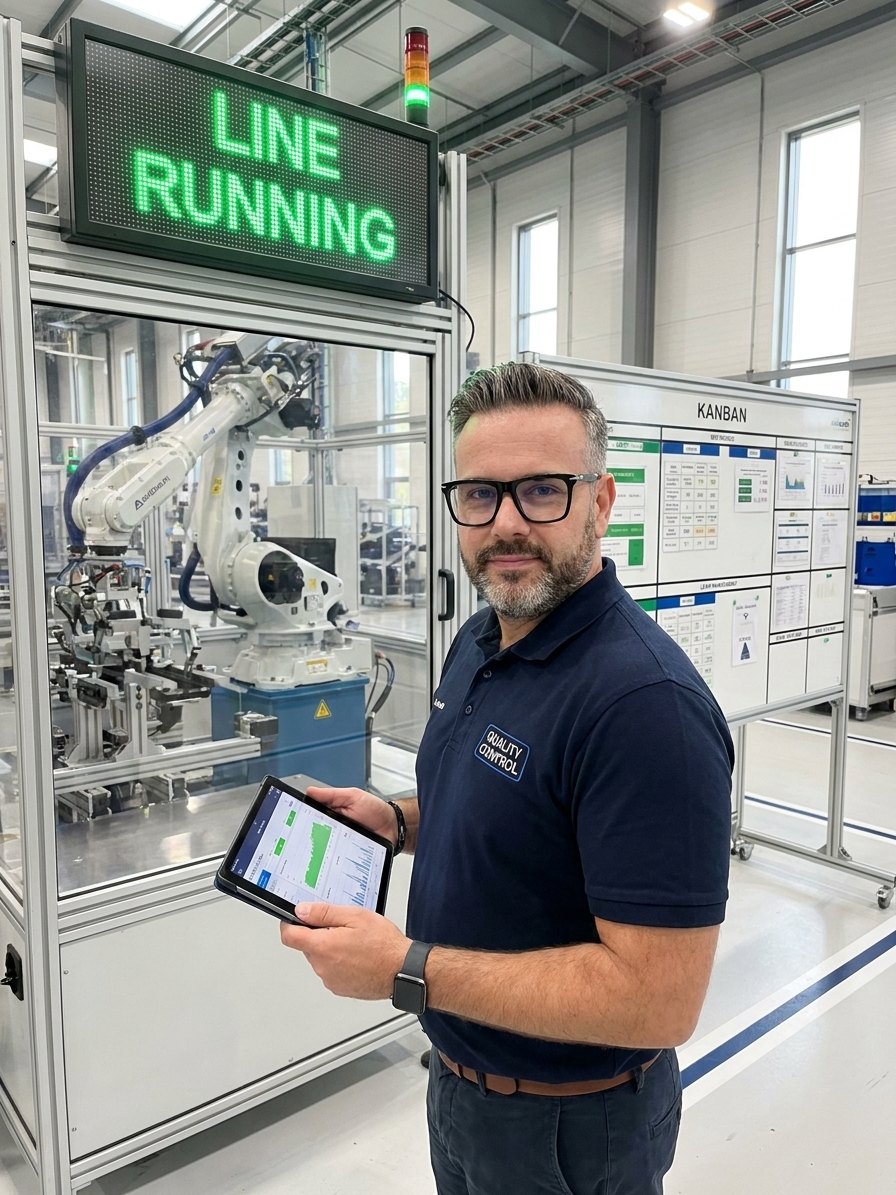
In 1896, Sakichi Toyoda observed an automatic loom churning out defective fabric. A broken thread went unnoticed, and the machine continued weaving, turning expensive raw material into worthless scrap. Toyoda solved this by installing a simple mechanical lever. When a thread broke, the lever dropped, immediately halting the loom. The machine itself refused to manufacture defects.
He called this mechanism Jidoka. It became the second pillar of the Toyota Production System, rivalling Just-in-Time in its impact on modern manufacturing. Yet, over a century later, most industrial operations still fail to grasp its core mechanism. They rely on downstream inspections to catch defects rather than stopping the process the moment an abnormality occurs.
Every second a process continues after a defect initiates, you are compounding the cost of that failure. You waste raw material, consume labour, and add complexity to your downstream containment efforts. I have audited plants that discover critical non-conformances at final inspection, then attempt to trace the root cause back through days of production. The evidence is stale, the batch is quarantined, and the solution is complex. Jidoka eliminates this gap between occurrence and detection.
The Technical and Human Dimensions
Jidoka translates awkwardly to English, often rendered as "autonomation"—machines with the autonomous ability to judge quality. This translation captures only half the discipline. True Jidoka demands two interdependent dimensions: a technical mechanism for detection and a human mechanism for problem-solving.
The technical dimension requires equipping every process with devices that detect abnormalities and halt production instantly. A press stops when a sensor flags a misalignment. An assembly station locks out if torque specifications are not met within tolerance. The process polices itself, removing the reliance on superhuman vigilance.
The human dimension dictates what happens next. When the line halts, an operator or team leader must investigate the root cause and implement a permanent countermeasure. The stop is not the solution; the stop is the signal. The solution is the disciplined thinking that happens during the interruption.
Remove either dimension and the system fails. Without automatic detection, you depend entirely on human attention—the most overestimated quality control mechanism in existence. Without human problem-solving after the stop, you simply pause production without ever reducing your defect rate. The synergy lies in machines that detect and humans who think.
The Mechanics of Stopping the Line
Jidoka is a discipline built on four sequential steps. The first is detecting the abnormality. A process must recognize when a parameter drifts outside acceptable limits. This detection does not require sophisticated technology. A simple physical fixture that prevents incorrect assembly, or a limit switch that catches 100 percent of misalignments, is highly effective.
Organizations routinely fail here by over-investing in complex machine vision systems that catch only 95 percent of defects. They miss the fundamental question: does our detection work every single time without exception? A simple poka-yoke device is often more reliable than an under-calibrated artificial intelligence monitoring system.
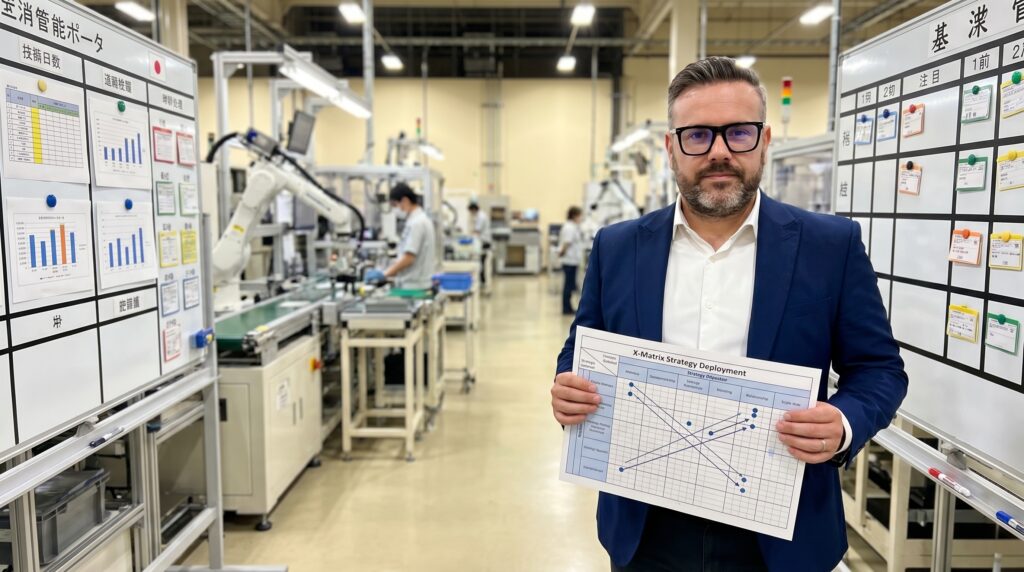
The second step is stopping the process immediately. When an abnormality is detected, production halts. Not at the end of the cycle. Not after the shift finishes. Now. This is where most operations actively resist implementation. Managers argue against stopping the line for minor disruptions, citing output targets and delivery deadlines.
The Four-Step Jidoka Discipline
- 01Detect AbnormalitySensors or physical fixtures identify a deviation from standard work.
- 02Stop ProcessProduction halts immediately before defective output can propagate.
- 03Contain and FixTeam leader responds within seconds to assess and restore flow safely.
- 04Eliminate Root CauseInvestigation and permanent countermeasure prevent recurrence entirely.
These objections reveal a fundamental misunderstanding of manufacturing economics. You are already paying to stop the line; you just pay later when the costs are higher. Pushing a known defect downstream obscures the root cause and contaminates the data. Stopping early is cheaper because it isolates the failure mode at its exact point of origin.
Overcoming the Production Pressure Illusion
The most persistent objection I encounter during IATF 16949 audits is the production pressure illusion: "We cannot afford to halt production." This belief thrives in accounting systems that meticulously measure the cost of an idle machine but completely ignore the compounded cost of passing a defect downstream.
Calculate the true cost of a non-conformance that escapes detection. You incur direct scrap costs, wasted labour hours, and the expense of 100 percent sorting a suspect batch. If the defect reaches the customer, you face warranty claims, logistics reversal, and potentially lost contracts. Compare this to stopping the line for three minutes to fix the problem at the source. The arithmetic is never close.
Then there is the control problem. Jidoka distributes the authority to halt production to the operators closest to the work. Many managers find this terrifying. They fear operators will abuse the power and paralyse the facility. In practice, the opposite is true. Workers are extraordinarily reluctant to stop production because they have been trained, implicitly or explicitly, that stopping is a failure.
You must reframe the stop from a sign of weakness to a demonstration of strength. An operator who pulls the Andon cord is actively protecting the company's margin. An operator who lets a defect pass quietly is the actual liability. The bill for that quiet failure simply arrives later, attached to a customer complaint rather than a localized Andon pull.
Jidoka as a Problem-Solving Culture
Implementing steps one and two—detection and stopping—without step four reduces Jidoka to an expensive disruption. The fourth step, eliminating the root cause, is what separates genuine continuous improvement from reactive firefighting. It requires a deep cultural commitment to structured problem-solving.
Jidoka Implementation: Common vs Effective
What standard teams do
- Install sensors to detect abnormalities and halt machinery.
- Reward operators for achieving high output with minimal stops.
- Reset the machine quickly and log the downtime for accounting.
- Schedule root cause investigations only when external audits demand it.
What effective teams do
- Install sensors to detect abnormalities and halt machinery.
- Reward operators for accurately pulling the Andon cord.
- Execute immediate containment and allocate time for a 5 Whys analysis.
- Track root cause closure rates weekly to ensure permanent fixes.
If every minute of an operator's shift is scheduled strictly for output, there is no capacity for the thinking Jidoka demands. Organizations must explicitly allocate time for investigation. When a stop occurs, the first words from a supervisor must establish psychological safety, acknowledging the detection rather than questioning the interruption.
Problems must be made entirely visible. Defect data should be displayed publicly on Andon boards, updated in real time. Leadership reviews must focus heavily on what failed and how the countermeasure is progressing. Organizations that manage their metrics by hiding bad news make Jidoka culturally impossible to execute.
The stop is not the solution. The stop is the signal. The solution is the disciplined thinking that happens during the interruption.
Measuring What Actually Matters
Standard quality metrics often fail to capture Jidoka effectiveness. Tracking overall scrap rates hides the immediate response capability of your lines. To understand if your implementation works, you must measure first-time stop rate. This tracks the percentage of abnormalities halted at the exact point of occurrence, before any defective output propagates.
If your first-time stop rate sits below 90 percent, your detection systems have critical gaps. You must also measure response time. At Toyota, the target for a team leader to arrive at a halted station is under 30 seconds. If your response time stretches to 15 minutes, the cost of the stop becomes intolerable, and operators will naturally resist pulling the cord again.
Key Jidoka Performance Indicators
Finally, you must track root cause closure rate and stop frequency trends. If you are stopping but not permanently fixing, you are merely disrupting production. As effective countermeasures take hold, the frequency of stops for any specific failure mode must trend downward. This reduction proves that your defect rate is genuinely decreasing, not just being suppressed by operators.
Scaling Beyond the Factory Floor
The principles of Jidoka extend far beyond discrete manufacturing. In software development, automated testing pipelines that fail a build when code breaks standard parameters practice Jidoka. The build halts, the team investigates, the bug is fixed, and the system refuses to deploy broken functionality.
In administrative and engineering processes, approval workflows that automatically reject incomplete submissions serve the exact same function. The form returns to the applicant immediately, the data is corrected, and the process continues with accurate information. No defective data passes downstream to corrupt the final product or database.
Sakichi Toyoda proved that you do not need advanced artificial intelligence to build quality into a process. You need a physical mechanism that refuses to produce bad output, paired with a human response that permanently eliminates the failure mode. The discipline scales from a 19th-century loom to modern aerospace assembly lines because the fundamental truth remains identical: defects are signals to improve, not inevitable costs of production.