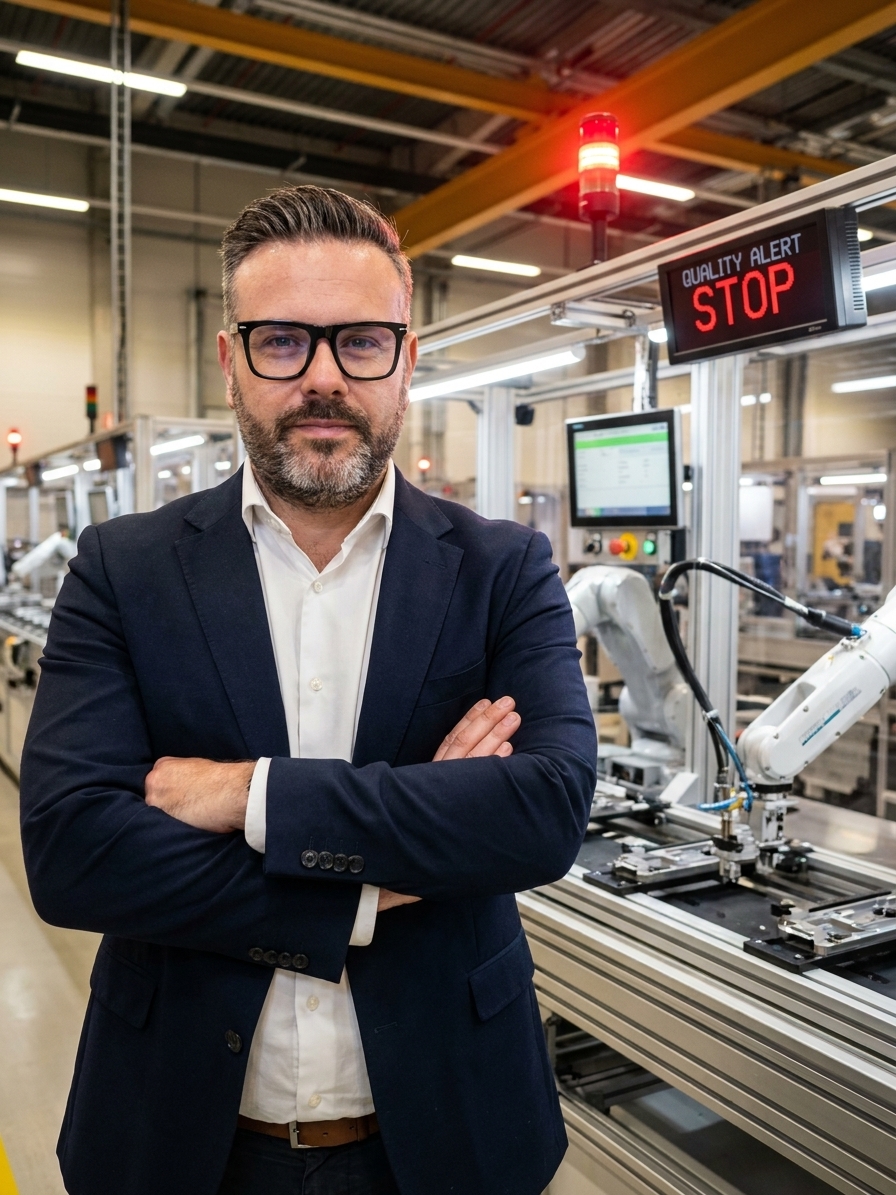
A Tier 1 automotive supplier produced 14,000 defective door panels before anyone stopped the line. The automated vision system caught the first bad part at 6:47 AM, flagged it, and logged it. The shift supervisor saw the alert. The operator noticed the dimensional variation. The quality technician observed the trend on the SPC chart.
By the time a customer complaint triggered an investigation, rework costs had exceeded €280,000. Every person who could have halted production had a reason not to. The supervisor was covering a missing team leader and feared missing the schedule. The operator assumed the next station would catch it. The technician filed a report but lacked the authority to act.
Fourteen thousand defects. Zero line stops. The system detected the problem perfectly. It was never designed to act on what it detected. This is the core failure mode I see in plants that have invested heavily in inspection technology but still bleed quality costs: they have built detection, not Jidoka.
What Jidoka Actually Requires
Jidoka is one of the two pillars of the Toyota Production System, alongside Just-In-Time. It is often translated as automation with a human touch. That translation is technically accurate but functionally useless. It describes the technology rather than the mechanism.
The concept originated with Sakichi Toyoda in 1896, who invented a loom that automatically stopped when a thread broke. Before this, a broken thread meant the loom kept weaving defective fabric. Toyoda's design was absolute: when the thread breaks, the machine stops. The defective condition cannot propagate. The problem becomes immediately visible.
This principle evolved into a four-step sequence that defines Jidoka in a modern manufacturing environment. The sequence is rigid. Detection without stopping is just monitoring. Stopping without fixing is just disruption. Fixing without investigating is just firefighting. All four steps, in order, constitute autonomation.
The Four-Step Jidoka Sequence
- 01Detect the AbnormalitySensors or operators identify a deviation from the standard operating condition.
- 02Stop the ProcessThe line halts immediately. The defective condition cannot move downstream.
- 03Fix the Immediate ProblemTriage at the gemba to contain the defect and safely restart the process.
- 04Investigate Root CauseApply structured problem-solving to prevent recurrence permanently.
Why Organizations Resist Stopping
The resistance to Jidoka is rarely intellectual. Most quality professionals know about Toyota's andon cords. The resistance is structural, cultural, and economic. Every minute a line stops, it produces zero output. In plants measured strictly on OEE and utilization, a line stop is a visible failure that triggers meetings and invites management scrutiny.
The cost of stopping is immediate and quantifiable. The cost of not stopping—the defects that propagate downstream—is delayed, hidden, and quietly absorbed into rework budgets. The supplier that produced 14,000 defective panels tracked line stops as a key performance indicator. Their target was zero stops. The unspoken message to the floor was clear: halting production is a failure, passing defects is invisible.
Authority structures compound the problem. In many organizations, the authority to halt production is reserved for senior managers. The people closest to the work—the ones who first detect abnormalities—have the least authority to act. The operator sees the defect, calls the team leader, who calls the supervisor, who calls the engineer. By the time someone with authority halts the line, hundreds of defective units have propagated.
The Cost of Normalized Deviance
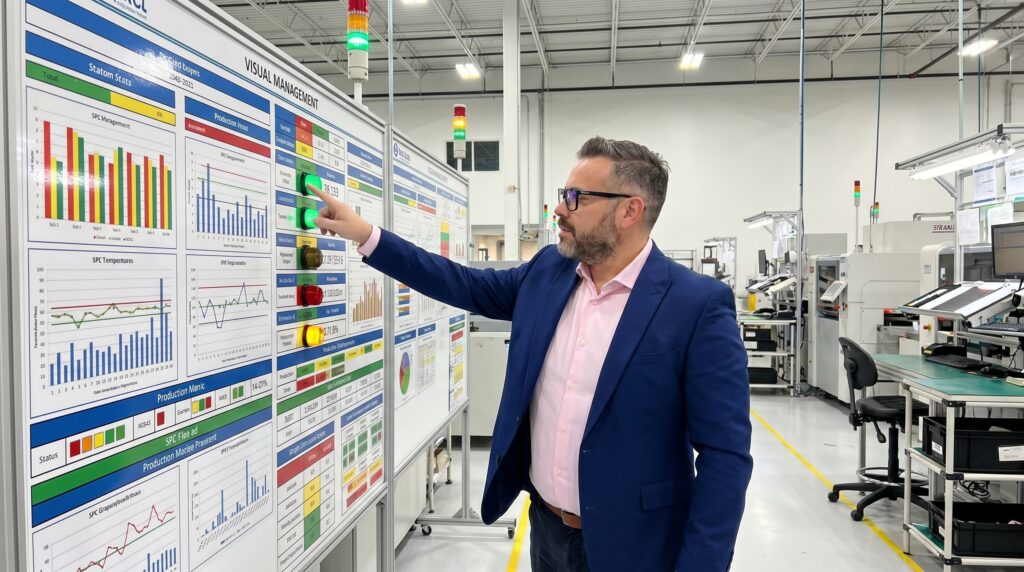
Organizations that pass defects downstream pay for it in ways they rarely track. A defect caught at the source costs one unit to fix. A defect caught at final inspection costs ten times as much. A defect caught by the customer costs a hundred times more, before accounting for the reputational damage and the engineering hours required for an 8D corrective action.
Beyond the immediate multiplication cost, allowing defects to propagate obscures the root cause. By the time defective parts reach downstream processes, they have been mixed with conforming parts, handled by multiple operators, and processed through additional operations. The evidence is contaminated. The trail goes cold. Root cause analysis becomes archaeology rather than science.
The most insidious cost is the normalization of deviance. When lines do not stop for defects, the organization gradually recalibrates its definition of normal. What was once clearly defective becomes borderline acceptable. What was borderline becomes standard. The tolerance drifts not because the specifications changed, but because the organization's willingness to enforce them deteriorated.
Automated detection without automated stopping is just expensive monitoring. The action must follow the data.
Defining Abnormalities at the Gemba
Implementing Jidoka requires defining exactly what conditions warrant a line stop. You cannot stop for everything, and you cannot stop for nothing. This is not a top-down engineering exercise. The most effective abnormality definitions come directly from the operators who run the process.
In plants I have audited, I consistently find that operators already know what a bad part looks, sounds, and feels like long before a sensor catches it. The sound of a press cycling too slowly, the colour of a weld shifting, the feel of a part not seating properly—these are high-fidelity detection signals. Your job is to capture this tacit knowledge and convert it into explicit standards.
Build a visual guide for each station. Left column: normal conditions with reference photos. Right column: abnormal conditions that mandate a stop. Laminate it, mount it at eye level, and update it whenever a new failure mode emerges. The operator must be able to glance at the reference and know instantly whether they have the authority—and the obligation—to halt production.
Building the Stop Mechanism and the Response
The mechanism for stopping must be immediate, accessible, and unambiguous. Physical andon cords or buttons at every station. Software interlocks that automatically halt equipment when sensors detect out-of-spec conditions. Clear visual signals—lights and alarms—that announce the stop to the entire area. Toyota's standard is that a team leader arrives at the station within seconds of an andon pull. Their opening question is always: how can I help?
If pulling the cord results in public shaming, collective punishment, or even a disapproving look from a supervisor, the cord will never get pulled. The organization must celebrate stops. False alarms are not a failure of the system; they are a calibration tool. Every false alarm is a coaching opportunity to refine the operator's judgment and tighten the abnormality criteria.
When the line stops, the immediate priority is triage, not root cause analysis. Contain the defect. Clear the abnormal condition. Restart the process. The root cause investigation happens after the line is running again. This requires a structured rapid-response process: 5 Whys at the gemba immediately, an Ishikawa or fault-tree analysis within 24 hours, and a verified countermeasure within one week.
| Detection Point | Relative Cost | Primary Failure Mode |
|---|---|---|
| Source Station | 1x | Immediate containment and adjustment |
| Downstream Operation | 3-5x | Rework labour, lost throughput |
| Final Inspection | 10x | Batch sorting, scrap, containment |
| Customer Receipt | 100x+ | 8D investigation, returns, reputational damage |
The Productivity Paradox of Stopping
Stopping the line to fix defects actually increases sustainable throughput over time. The time saved by not producing, reworking, sorting, and scrapping defective parts more than compensates for the time spent stopping and fixing the process. Toyota's lines stop far more frequently than their competitors'. Toyota's productivity and cost metrics consistently outperform those same competitors.
The door panel supplier ran for 14,000 parts without a stop. Their effective throughput that day—after deducting rework, sorting, scrap, 8D investigation, corrective action implementation, and the second shift needed to recover lost volume—was significantly lower than if they had stopped at the first defect and spent an hour fixing the root cause.
Jidoka is not the enemy of productivity. It is the precondition for it. The most powerful quality system in the world is not the one that catches every defect. It is the one that makes it structurally impossible for a defect to survive past the station where it was born. Building that system requires technology, but it demands a cultural mandate to stop.
The Economic Case for the Line Stop