A production line losing 35 percent of its capacity to unstructured changeovers requires immediate intervention, not a six-month Gantt chart. The conventional approach to chronic manufacturing problems involves chartering a committee, scheduling weekly status meetings, and slowly losing momentum as team members rotate or priorities shift. By the end of the quarter, you are left with a slide deck of recommendations that operators never saw and which address a problem that has already evolved. Meanwhile, the actual OEE remains stagnant, customer delivery slots are missed, and the cost of non-quality compounds quietly in the background.
The Kaizen Blitz methodology collapses this timeline. It gathers a cross-functional team for five days of completely isolated, focused work directly at the point of execution. On Monday, you define the problem with hard data gathered from the Gemba. On Friday, you walk away with an implemented, tested, and measured countermeasure. You produce no abstract recommendations, only operational changes verified on the running line.
Do not mistake the speed for haste. A Rapid Improvement Event (RIE) is a highly disciplined mechanism governed by strict preparation, mandated authority, and rigorous standardisation. In my experience auditing and restructuring ISO 9001 and IATF 16949 systems across automotive plants, the difference between organisations that improve and those that administrate is execution speed. Five days of one hundred percent focus yields exponentially more than six months of ten percent effort.
Establishing the Baseline Through Direct Observation
Consider an assembly line producing precision metal assemblies for an OEM, staffed by eighteen operators across three shifts. The line was suffocating under an OEE of 52 percent. The primary culprits were prolonged variant changeovers averaging 47 minutes, micro-stoppages driven by material starvation, and entirely unstandardised work where every shift performed the same operation differently. Management had spent three months applying classic project management. The result was a beautifully maintained tracker of 47 tasks, of which exactly seven were completed.
When a Kaizen Blitz was chartered, Day One was dedicated exclusively to dismantling assumptions through direct observation. Twelve people—operators, maintenance technicians, logistics planners, quality engineers, and the shift manager—converged on the line. There were no spectators; every participant was given a specific data-gathering mandate. We did not consult historical MES reports, because system data rarely captures the reality of the floor.
Teams of three physically mapped the flow. They drew the material route from receiving to dispatch, tracked how instructions reached operators, and timed operator movement with a stopwatch. The resulting Spaghetti Diagram revealed that the operator at Station 3 walked over four kilometres per shift simply to retrieve missing components and tools. When the team timed the actual changeovers with handheld timers, the real average was 53 minutes, not the 47 minutes claimed in the system records. The gap was driven by unrecorded time spent hunting for material.
Isolating Root Causes Over Symptoms
By Tuesday morning, the Blitz team possessed a clearer picture of the process constraints than any external consultant could deliver in weeks. Raw observation, however, is not a solution. The day was dedicated to aggressive root cause analysis using standard quality tools. We stripped away the noise using the 5 Whys methodology directly on the 53-minute changeover.
The team traced the delay to the exchange of 12 tooling jaws, which lacked universal configuration because they were designed five years prior for a single product variant. An Ishikawa diagram further structured the micro-stoppages, categorising causes into material, method, people, and environment. The most critical insight came when the team mapped the value stream and calculated that parts spent 68 percent of total lead time waiting in queues or on racks. Value was added for only 7 percent of the time.
MES Records vs. Gemba Reality
What the system reported
- Average changeover of 47 minutes
- Material logistics functioning per plan
- Standard work documented and followed
- OEE driven primarily by machine reliability
What Gemba observation revealed
- Verified changeover of 53 minutes minimum
- Operators walking 4 km per shift for parts
- Three different methods across three shifts
- OEE suppressed by unmeasured waiting time
Designing Targeted Countermeasures
Wednesday focused on generating solutions, but within a rigid framework of immediate feasibility. The goal was structured creativity, not abstract brainstorming. The team divided into four sub-groups, each targeting a specific failure mode identified during Tuesday's analysis. Their mandate was to design countermeasures that were eighty percent perfect and implementable within forty-eight hours.
The changeover group applied SMED principles. They identified that nine of the twelve required jaws could be converted from internal operations—requiring the machine to stop—to external operations prepared during the cycle. They designed a pre-staging table and implemented colour-coding for the jaws. The material flow group eliminated the 4-kilometre walks by designing a Mizusumashi route, establishing a pull-system delivery via a water-spider operator at fixed intervals.
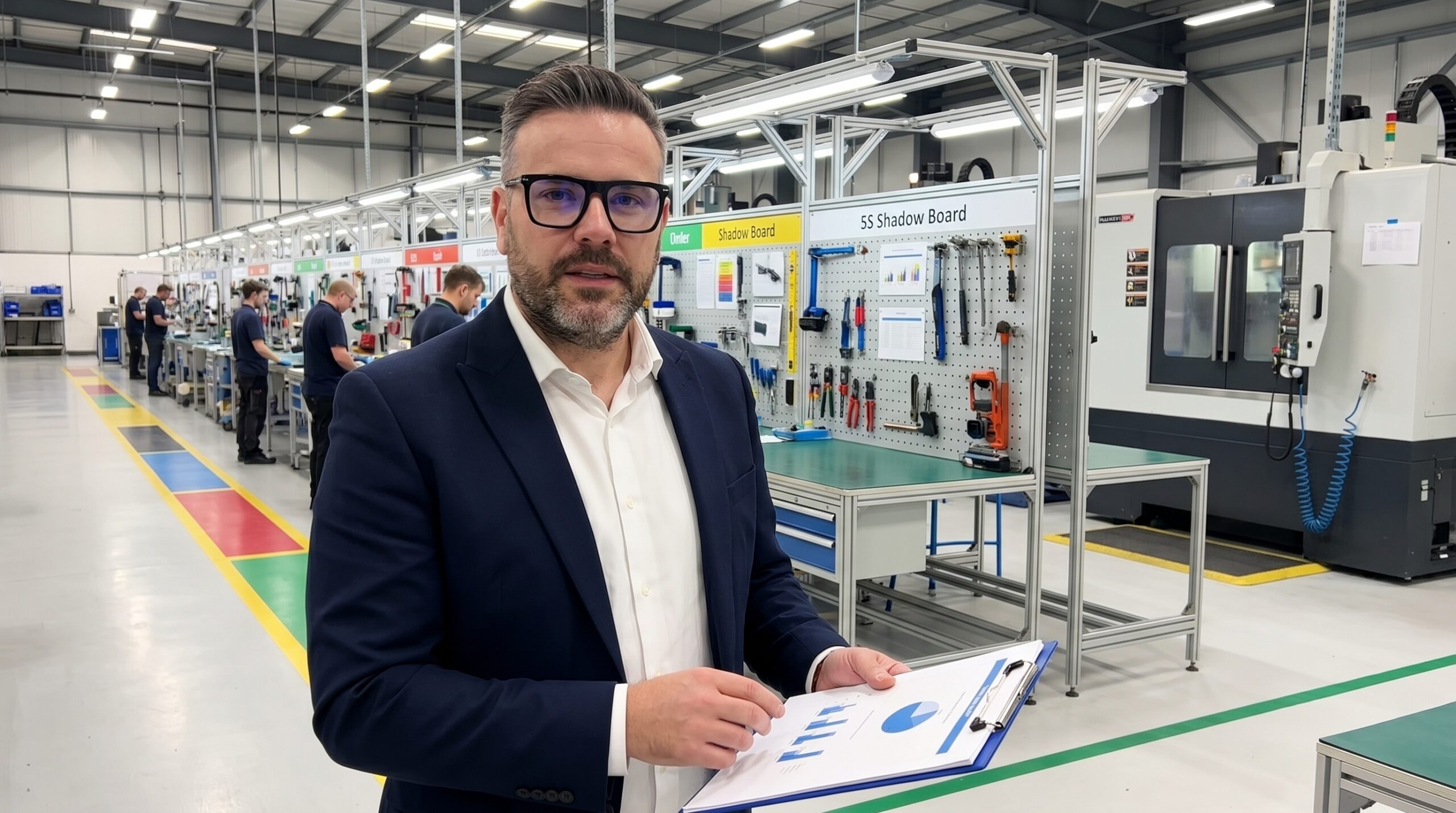
Standardisation and layout groups established visual shadow boards for tools and relocated inventory zones adjacent to the line. Every proposal required a clear resource list and an estimated impact. By the end of the day, the event sponsor approved the final designs. No solution required capital expenditure beyond minor fabrication using existing plant materials. The focus remained strictly on process optimisation rather than hardware upgrades.
Executing on the Live Production Line
Thursday is where conventional improvement projects typically die, producing only a presentation. In a Kaizen Blitz, Thursday is execution day. The team physically rebuilt the architecture of the line. Maintenance fabricated the pre-staging table overnight from surplus racks. Shadow boards were cut from high-density foam and mounted. Floor routes for the water-spider were taped out, and visual work instructions were laminated and posted at every station.
By afternoon, they initiated live production testing. The transition was deliberately chaotic. The first three cycles were slower than the baseline, as operators navigated the new standard work. However, by the sixth cycle, the changeover time dropped below 25 minutes. Testing in real conditions, with actual operators and unbuffered material flow, immediately highlighted configuration errors that would never have surfaced in a simulation.
Experiment in real conditions. Laboratory environments will not tell you if a solution works; only actual production reveals actual problems.
Locking in Gains Through Standardisation
Friday dictates whether the intervention survives the following week. Raw improvements mean nothing without formalised standard work. The team documented the newly validated procedures and integrated them directly into the plant’s quality management system. They established a Kamishibai board for daily verification of standard adherence and defined clear audit checkpoints to measure sustainability.
The immediate Friday metrics validated the effort. Changeover times stabilised at 22 minutes, trending toward the 18-minute target. Micro-stoppages dropped by 73 percent due to the structured material routes. Operator travel was slashed from 4.2 kilometres to 0.8 kilometres per shift. OEE jumped from 52 percent to 61 percent, with a clear trajectory for further growth as proficiency increased.
The Five-Day Blitz Cycle
- 01Day 1: DiagnoseDirect Gemba observation and empirical data collection on the floor.
- 02Day 2: AnalyseApply Ishikawa and 5 Whys to isolate verified root causes.
- 03Day 3: DesignEngineer 80-percent solutions feasible for immediate deployment.
- 04Day 4: ImplementExecute physical changes and test during live production runs.
- 05Day 5: StandardiseUpdate standard work, establish KPIs, and present results.
When to Deploy a Kaizen Blitz
A Kaizen Blitz is not a universal remedy. Deploying it in the wrong context wastes critical resources and damages the credibility of operational excellence programmes. It is highly effective when a problem is clearly bounded, physically located, and solvable by the front-line team without major capital investment. It is ideal for eliminating established waste in routing, layout, or changeover procedures on a specific work cell.
Do not use this methodology for strategic architectural changes or complex product design failures. If the organisation lacks the basic discipline to maintain 5S or standard work, a Blitz will collapse. You cannot implement rapid continuous improvement in an environment that has no baseline standard to improve from. Ensure the prerequisite stability exists before disrupting the daily rhythm.
Sustaining the gains requires a rigid 30-60-90 day follow-up plan. Daily audits during the first thirty days ensure operators do not revert to old habits. At sixty days, management must review KPI trends and lock in final process adjustments. By ninety days, the changes must be formally audited and integrated into the overarching IATF 16949 or ISO 9001 documentation. Without this governance, the improvements will erode completely.
The ultimate objective is cultural transformation. When operators see their ideas implemented and tested within forty-eight hours, their willingness to engage escalates. The organisation shifts from managing decline to actively hunting waste. For Line C-47, the three-month post-audit revealed an OEE of 71 percent and changeovers stabilised at 16 minutes. The team was independently organising micro-improvements, proving the true value of the Blitz: building a workforce that solves problems without waiting for management intervention.