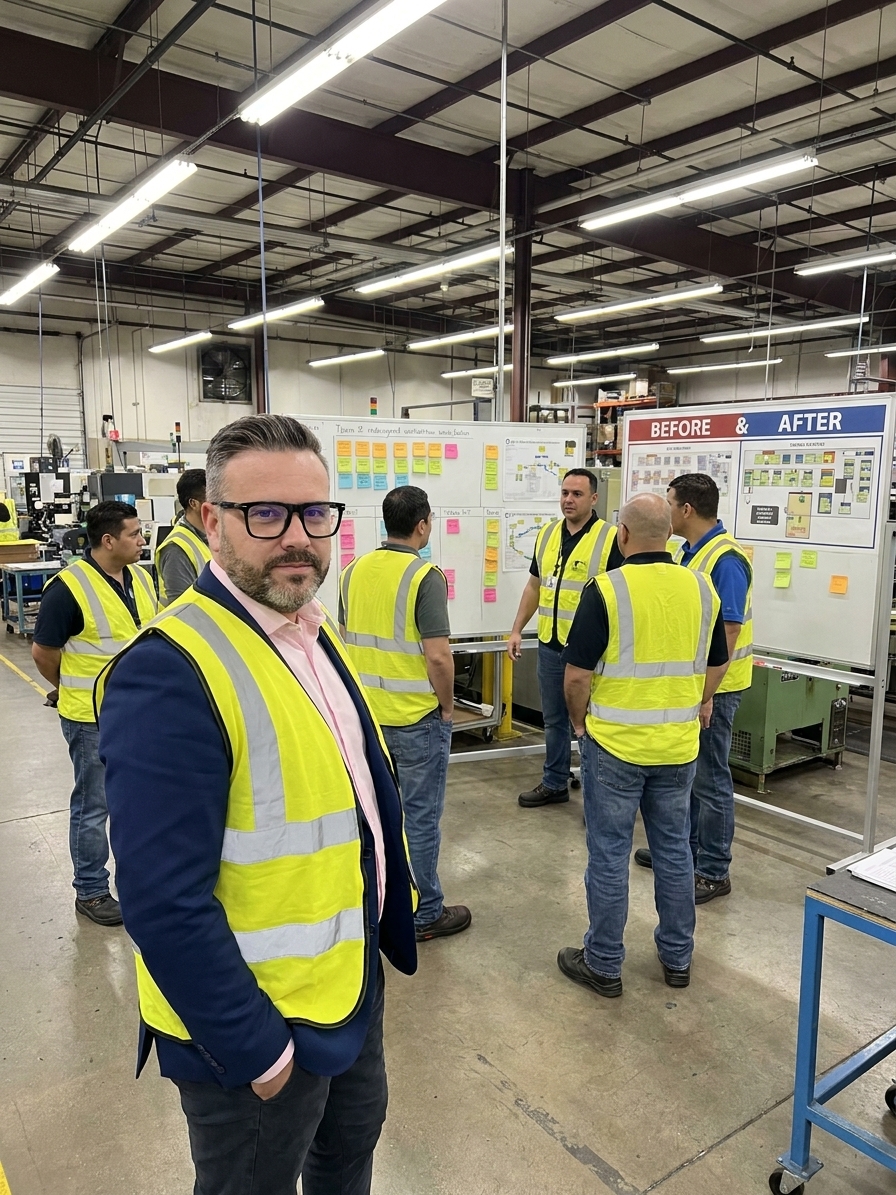
A kaizen event is designed as the shock troops of a lean transformation. You pull a cross-functional team for three to five days, give them a broken process, and expect a redesigned cell, reduced waste, and a team that went from skeptical to evangelical. That is the promise. That is the story your lean office tells at conferences.
Here is what actually happens in most organisations. Monday is lost to icebreakers and a gemba walk where everyone nods politely at things they already knew. Tuesday is value stream mapping of a process someone mapped six months ago. Wednesday is brainstorming with sticky notes and dot voting that produces the same list generated at the last event.
Thursday is frantic implementation. The team rushes to move equipment, build fixtures, and draft standard work before the Friday report-out. Friday is a presentation to leadership featuring before-and-after photos, a declaration of victory, and cake. Then the operators who were not on the team return, do not understand the new setup, and within two weeks everything reverts to its original state.
The standard work document is pinned to a board nobody reads. The new fixture breaks and nobody fixes it. Six months later, someone walks the floor and finds the process exactly as it was before the event. The kaizen event did not fail. The event was never the point. The management system that should have sustained the changes does not exist.
The Event as a Substitute for the System
Organisations fall in love with kaizen events because they are visible, measurable, and produce immediate results. A vice president can walk through a cell on Thursday and see that it looks different from Monday. That visual proof is powerful and seductive. It is also the core problem. A kaizen event is one tool within a continuous improvement system, not the system itself.
When organisations use events as their primary improvement mechanism, predictable pathologies emerge. Event theatre takes over. The team knows leadership will visit on Friday, so they optimise for the presentation rather than the process. Improvements are chosen for their visual impact. A messy shelving unit gets reorganised because it photographs well. A deeply broken changeover process is ignored because fixing it requires six weeks, not four days.
Each event also generates an improvement debt. Action items that cannot be completed during the week go on a 30-day list. These tasks are assigned to people who were not at the event, do not understand the context, and already have full-time jobs. The 30-day list becomes a 60-day list, and then a list that is never completed. Over a year, you accumulate hundreds of incomplete actions. Nobody tracks them, nobody closes them, and the debt grows until someone replaces the lean programme with a new initiative.
Even when an event produces genuine improvements, there is no mechanism to hold the gains. Standard work is written but not followed. Visual controls are installed but not maintained. The process drifts back because the management system was never built. There are no daily layer process audits, no hourly tracking boards, no escalation rules. The event is a sprint. Sustainability requires a different discipline entirely.

Selection Bias and the Wrong Targets
Ask your lean office how they choose which processes get a kaizen event. In most organisations, the answer is some combination of executive preference, logistical convenience, and visual mess. This is selection bias, and it destroys the value of the event programme before it starts. The correct way to select a target is to start with the constraint, the bottleneck resource that limits your entire system throughput.
Theory of Constraints, articulated by Goldratt decades ago, dictates this principle. If you improve a non-bottleneck process, you do not increase output. You increase local efficiency at the cost of global performance. You build more work in progress in front of the bottleneck and add cost without adding throughput. Kaizen event selection rarely starts with constraint analysis. It starts with politics and visibility.
The result is a portfolio of events that collectively produce no measurable improvement in the metrics that matter: on-time delivery, cost per unit, and quality escapes at the customer. Worse, organisations often choose targets where improvement is easy rather than where it is valuable. A cell running at 85% OEE gets the event because the team can push it to 92% and claim a win. The cell running at 40% OEE is ignored because pushing it to 50% would be messier and harder to present.
| Selection Driver | What the Team Optimises | Impact on the System |
|---|---|---|
| Visual mess | Shelving reorganisation and 5S | Improved aesthetics, zero throughput gain |
| Executive interest | High-visibility cell improvements | Localised gains that starve the bottleneck |
| Ease of change | Cells already performing well | Inflated metrics, ignored constraints |
Excluding the Process Experts
A typical kaizen team includes a facilitator, a few engineers, and a quality person. If you are lucky, one or two operators from the line are included. The operators who run the process daily are structurally underrepresented. Management often excludes them deliberately, worrying they will resist change. Other times, production pressures simply will not allow pulling key operators off a running line.
This exclusion creates a predictable disaster. The team designs a new process on a whiteboard, validates it with cardboard and tape, and declares it ready. The operators return on Monday to find their workstation redesigned, their tools moved, and their sequence changed without their input. They were never asked what problems they actually experience. They were never consulted on whether the new flow makes sense.
The operators do what any competent professional does when someone reorganises their workspace without asking: they ignore it. Not out of malice, but out of self-preservation. They know the new fixture cannot hold tolerance on thicker material. They know the new sequence puts a critical quality check after the point where the defect is already buried. The event team blames the operators for resisting change, and the process reverts.
I have audited plants where standard work was completely decoupled from operator reality. The engineers designed an elegant flow that ignored fundamental material variability. When the operators deviated to actually hit their quality targets, the deviation was flagged as non-compliance during the process audit. The root cause was not operator defiance. It was a team designing in a vacuum.
The Facilitator Trap and Improper Methodology
Every event needs a facilitator to guide structured problem-solving. In mature organisations, this role is filled by an experienced practitioner bringing deep improvement methodology. In most organisations, the facilitator is the lean office. That lean office is frequently one person who took a short certification course and was handed a binder of templates. They are now responsible for facilitating events across a factory they barely understand.
The critique is structural. You cannot facilitate improvement in a process you do not understand. A good facilitator can guide methodology, but without deep process knowledge on the team, the event produces superficial changes. The tools get applied. You get 5S, standard work, and visual management. But the root causes go untouched because nobody in the room has the authority or knowledge to address them.
When the lean office runs every event, improvement becomes something done TO a department, not IN it.
This creates a culture of dependency. Managers abdicate responsibility for improvement. They treat it as a specialist function rather than a daily management requirement. They put in a request for an event and wait. The idea that improvement is part of every supervisor's daily job, tracked through layered process audits and tier meetings, never takes root. The problem-solving capability of the line organisation atrophies.
The Metrics That Lie
Every event ends with a report-out featuring impressive metrics. Cycle time reduced by a third, floor space freed, walking distance cut. These numbers are almost always real on Friday afternoon. The redesigned cell is running with the best operator, the brand-new fixture is working perfectly, and there is zero variability in the incoming material.
Monday is different. The second operator calls in sick. The fixture designed Thursday afternoon cracks under repeated use. The new material lot behaves differently and the standard work does not account for it. The cycle time creeps back. The work in progress rebuilds. The Friday metrics are a snapshot under ideal conditions. The Monday reality is a process under normal statistical variation.
Report-Out vs. Reality
Friday Report-Out
- Best operator running the newly designed cell
- Prototype fixture functioning without wear
- Standard incoming material characteristics
- Zero interruptions for ancillary tasks
Monday Reality
- Substitute operator unfamiliar with the flow
- Rapidly constructed fixture breaking down
- New material lot with different tolerances
- Full shift responsibilities and distractions
Organisations report the snapshot and ignore the video. Over twelve months, they accumulate a spreadsheet suggesting massive productivity gains that remain invisible in the profit and loss statement. This is not deliberate deception. It is systemic self-deception. Nobody goes back to verify sustained results at 30, 60, and 90 days. Verification would expose the reversion, and exposure would threaten the programme.
Without verification, the gap between the reported savings and the actual factory output widens. Leadership loses confidence in the lean initiative, not realising the initiative was never given a mechanism to survive contact with the real world. Verification requires discipline. It means returning to the cell with a stopwatch and a capability study, not a clipboard for a visual audit.
Building the Sustaining System
Real kaizen does not require a five-day event. It looks like a thousand small improvements made daily by the people who do the work. An operator notices a tool is missing and builds a shadow board. A maintenance technician notices a bearing running hot and adjusts the preventative maintenance schedule. A team leader rewrites a confusing step in the standard work. These improvements stick because the people who made them solve real problems.
This requires a management system that enables daily improvement. It requires leaders who coach rather than direct, standard work owned by the operators, and layered audits that verify compliance daily. It requires a suggestion process that actually responds, and visual controls that are maintained by the area, not imposed by a central function. When finding a problem is celebrated rather than hidden, the culture shifts.
Kaizen events still have their place. For a well-defined problem with a clear scope that requires cross-functional expertise, an event is the right tool. But the event must be preceded by rigorous problem definition, driven by data. You must define the problem as losing throughput to changeover time on a specific machine, not vaguely wanting to improve a cell. It must include the people who run the process, and it must be followed by a sustaining system.
If you run kaizen events, ask one diagnostic question. Of all the improvements made in events over the past two years, what percentage are still in place and still delivering results today? If the answer is less than 80%, you do not have a kaizen event problem. You have a management system problem. Stop running events. Start building the system that sustains the changes.
Sustaining the Gains
Building a sustaining system is harder and slower than running a blitz. It does not photograph as well as a Friday report-out. But in three years, you will have an organisation that improves itself continuously. That is what actual transformation looks like. The focus must shift from the intensity of the event to the discipline of the everyday management system.
The ultimate measure of a lean transformation is not the number of events completed or the savings claimed on a spreadsheet. It is the capability of your front-line leaders to solve problems independently. When a supervisor identifies a deviation, initiates containment, and drives root cause analysis without waiting for a specialist, the system is working. That capability is built through daily coaching, structured tier meetings, and rigorous follow-up.