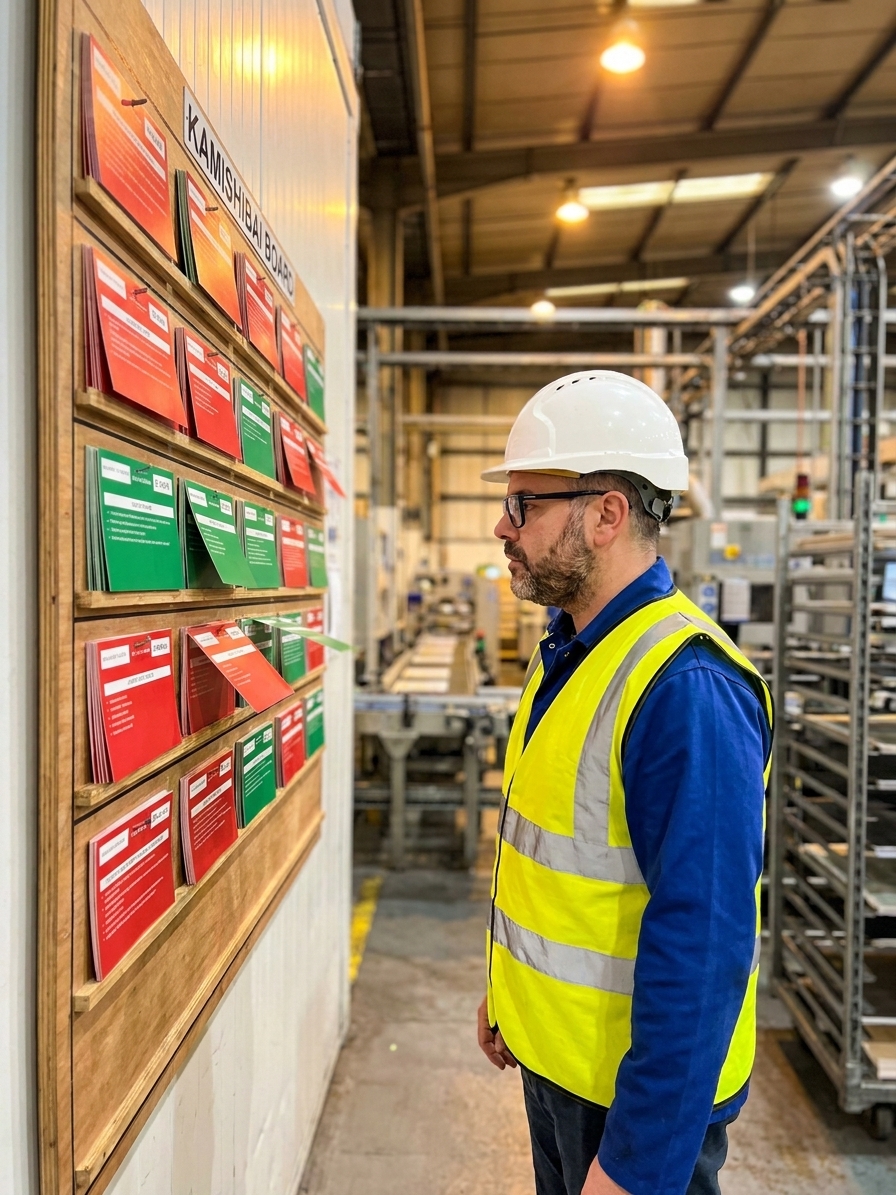
You built the board. You printed the cards, assigned the tier structure, and trained the shift leaders. For three weeks, the system was exactly what the textbooks promised: leaders on the floor, verifying standards, finding gaps. Then the daily checks slipped to weekly. The green and red markers froze in place. The board became wall furniture that someone dusts during the annual 5S audit.
I have audited plants where the Kamishibai board sits ten metres from a process running with an expired calibration sticker. The card covering that exact station was green. The leader had walked past it that morning, flipped the card, and moved on. This is the most common terminal state for a visual management system: the appearance of oversight without the substance of verification.
Toyota adapted Kamishibai from a Japanese storytelling tradition into a leadership tool. A board displays cards for specific audit points. Leaders select cards, go to the corresponding floor area, and verify the standard against reality. A red side signals an unverified or failing condition; a green side confirms compliance. The mechanism forces structured conversations at the point of execution.
Confusing the Card With the Audit
The board is not an audit system. It is a prompt. The audit happens in the leader's interaction with the process. A card reading "Verify torque wrench calibration" is not an instruction to confirm the tool's existence. It requires the leader to pick up the wrench, check the sticker date, ask the operator when they last verified torque, and review the last three torque logs for drift.
When leaders treat the card as a checkbox, verification collapses into a drive-by. They flip the card green because they see a wrench on the bench. They have verified the presence of equipment, not the quality of the process. The audit must go beyond confirming that a standard exists. It must verify that the standard is actively sustaining the process outcome.
The randomness of card selection matters. If a leader audits the same five points every Tuesday, operators adapt. The inspection route becomes a predictable parade. The areas outside the known route degrade quietly. Effective Kamishibai requires unpredictable sampling across the process to expose the true baseline of operational discipline.

Removing Leadership Authority From the Floor
Kamishibai is a leadership tool, not a technician's task. When you delegate floor walks to a junior engineer who lacks the authority to allocate resources or change a standard, you strip the system of its power. The leader is present specifically because they can act on findings immediately. They can ask questions, authorize rework, or trigger an 8D investigation on the spot.
A technician who finds a nonconformance through Kamishibai must log it, route it through supervision, and wait for a response. By the time the report reaches someone with authority, the production context is gone. The operator has moved to the next job. The drift that caused the failure has either self-corrected or compounded. The response becomes bureaucratic rather than immediate.
The presence of a decision-maker on the floor sends a signal that the standard matters. When the only person checking is someone who cannot enforce change, operators learn that the check itself is low-priority. Leadership presence is the mechanism that converts a visual prompt into genuine process control.
Operating Compliance Theatre Instead of Learning
When Kamishibai is framed as a compliance check, the dynamic turns adversarial. The leader becomes an inspector looking for defects; the operator becomes a suspect. The green card means the operator passed. The red card means they failed. This framing guarantees that operators will hide problems to avoid blame.
Toyota's approach inverts this logic. Kamishibai is a learning tool. The leader is not checking on the operator; the leader is checking on the system. If an operator is not following the standard work, the leader's question is not "why are you failing?" The question is "what about our system makes this standard difficult to follow?"
The standard itself might be wrong. The PFMEA might have missed a failure mode. The tools specified in the control plan might not be available at the point of use. Engineering might have changed the process without updating the standard work instructions. Kamishibai surfaces these systemic gaps so leadership can fix them. When the system fosters learning, operators share problems freely.
When Kamishibai becomes compliance theatre, operators hide problems. When it is a learning tool, they share them.
Failing to Define Verification Criteria
Ambiguous verification criteria destroy audit consistency. A card reading "Check 5S compliance" means whatever the individual leader decides it means on that particular day. One leader accepts bins roughly in position; another demands every tool in its shadow board outline. You have not established a standard. You have established a personality test that produces meaningless data.
Every card needs an unambiguous verification criterion. Instead of "verify documentation," the card must specify the requirement: "Confirm the last three shift handover logs contain all six required fields with no blanks." Instead of "check work area," specify "Confirm all three shadow board positions are occupied by the correct calibrated tool and all tools are free of debris."
If the card author cannot define what a pass looks like, the card is not ready for the board. Vague criteria guarantee that leaders will interpret the standard differently across shifts. This variance makes it impossible to track process discipline over time, which defeats the purpose of the system entirely.
Vague Prompts vs. Verifiable Criteria
Vague prompt
- Check 5S compliance in the assembly area.
- Verify documentation is complete.
- Ensure tools are properly stored.
- Check that safety standards are met.
Verifiable criterion
- Confirm all three shadow board positions hold the correct calibrated tool.
- Confirm the last three shift logs contain all six required fields with no blanks.
- Confirm all torque wrenches have calibration stickers dated within 12 months.
- Confirm operators are wearing safety glasses and the E-stop guard is down.
Ignoring the Escalation Logic
A Kamishibai system without escalation is a suggestion box. When a card turns red, it must trigger a chain of events. The leader investigates immediately at the point of detection. If the issue cannot be fixed on the spot, it receives an owner, a root-cause analysis, and a target resolution date within the shift.
If the issue is systemic, it escalates to the next tier within 24 hours. The next-tier leader verifies the fix and checks adjacent areas for similar failures. Without this chain, red cards accumulate on the board. Accumulated red cards are a visible monument to organisational paralysis. They teach operators that management identifies problems but lacks the discipline to solve them.
This is the critical failure point. When red cards sit unanswered for days, the signal degrades. Operators stop reporting issues through any channel because they have observed the outcome: nothing happens. The visual board, intended to demonstrate management's commitment to quality, becomes proof of its indifference. Trust corrodes faster from visible inaction than from having no system at all.
Kamishibai Red-Card Escalation Sequence
- 01Immediate detectionLeader investigates the nonconformance at the point of work, not at a desk.
- 02Shift-level loggingIf unresolvable on the spot, assign owner and target resolution date within the shift.
- 0324-hour escalationSystemic issues move to the next leadership tier for root-cause analysis.
- 04Adjacent-area verificationNext-tier leader confirms the fix and audits neighbouring processes for the same failure.
Rebuilding the System for Sustained Value
Start with eight to ten cards on your most critical process, not sixty cards covering the entire plant. Define the verification criteria rigidly. Schedule the walks and protect that time with the same priority you give a customer audit. If the manager's walk gets bumped every time a supplier calls, it will always get bumped. The walk will never happen.
Train leaders to audit for understanding, not just to inspect for defects. When a leader turns a card, the verification is the starting point, not the endpoint. They must ask the operator to walk them through the task. They must ask what makes the job difficult. The card generates a conversation that reveals whether the control plan is actually protecting the customer.
Review the system itself monthly. If a card has never turned red in six months, the verification criterion is likely too easy. If a card turns red every week, you have a systemic process failure that requires a permanent corrective action, not another flipped card. Track the red cards, measure the closure rate, and hold leaders accountable for the walks they signed up to execute.
If your board has been on the wall for six months and has never turned red, your audits are meaningless. The value of Kamishibai is not in the green cards confirming what you already assumed. The value is in the red cards that surface the failures your standard management reviews missed. A board with zero red cards is the strongest possible indicator that your leaders are walking past problems.