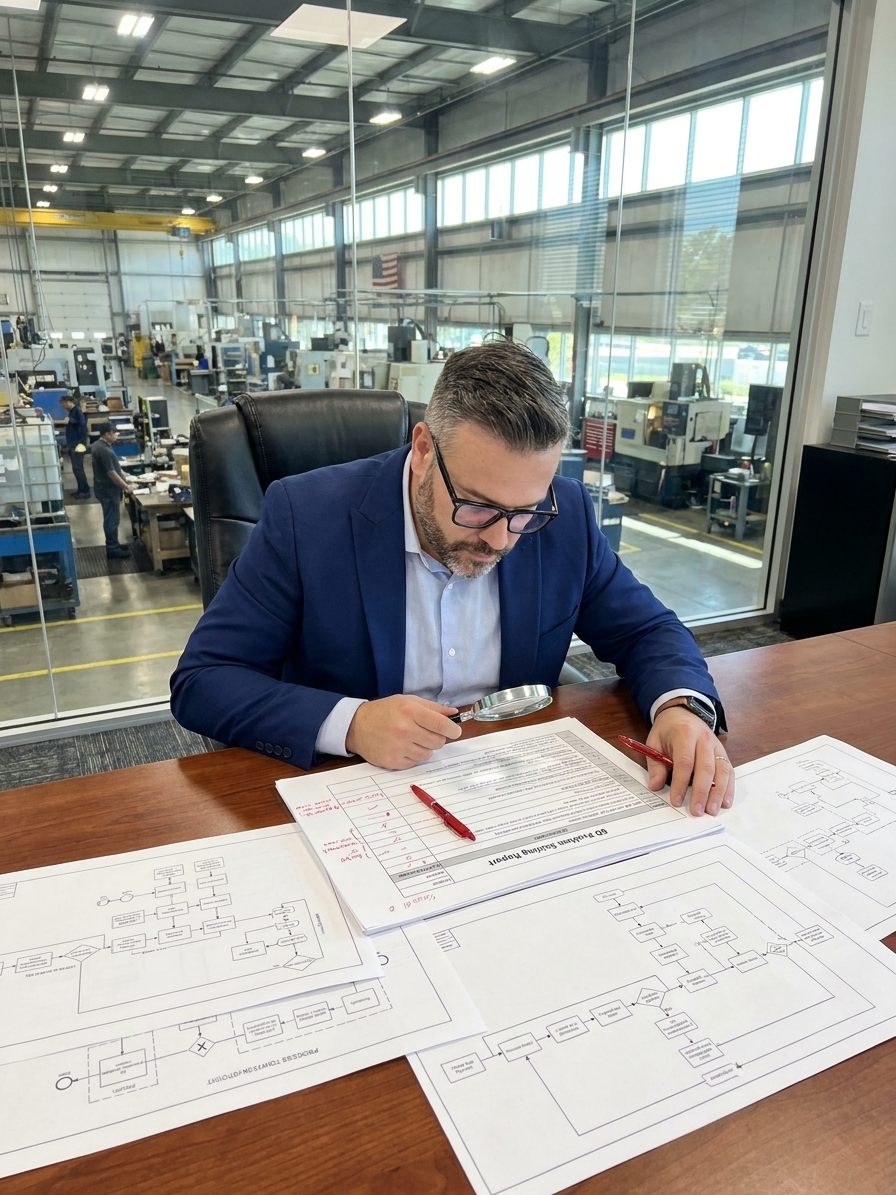
A customer complaint lands on your desk Friday afternoon. A field return, a PPM spike, maybe a line-down situation at their plant. Your quality system swings into motion: someone opens an 8D report, assigns a team lead, sets a due date for the first three disciplines by Monday. The containment goes out, usually a sorting action or a retroactive 100% inspection.
Then the document sits. D4 — Root Cause Analysis — is where the energy dies. Someone types 'operator error' into the form. A fishbone gets drawn during a thirty-minute meeting where half the participants are on their laptops. Five Whys gets truncated to three because the team thinks they already have the answer. The corrective action? Retrain the operator and update the work instruction.
Six months later, the same defect surfaces. Different shift, different part number, same root cause that nobody actually identified. The 8D was closed, the customer was satisfied, and the database shows it as effectively resolved. This is the Eight Disciplines methodology reduced to its most common form: a fourteen-page template that generates paperwork instead of knowledge.
What 8D Was Built to Do
Ford Motor Company formalized the 8D process in the 1980s, though its roots trace back to military standard procedures from the post-war era. The genius of the original design was its sequence. Each discipline built on the previous one, creating a logical chain from problem recognition through systemic prevention. It was never meant to be a form. It was a thinking framework that forced teams to slow down at exactly the points where human nature wants to rush.
The methodology works when every discipline receives genuine effort. It fails when organizations treat it as a documentation requirement rather than an investigation process. The framework demands analytical patience, cross-functional input, and evidence at every stage. Where those elements are present, 8D remains the most robust problem-solving structure in industrial quality management.
The eight disciplines are deceptively simple, but each contains a specific failure mode that organizations fall into when they treat the methodology as a compliance exercise rather than an investigation.
| Discipline | Purpose | Where It Usually Breaks |
|---|---|---|
| D1: Form a Team | Cross-functional expertise | Becomes one quality engineer working alone with a signature list |
| D2: Describe the Problem | Precise, data-backed definition | Vague statements like 'parts are bad' with no 5W2H rigour |
| D3: Interim Containment | Protect the customer immediately | Treated as the permanent solution instead of a temporary bandage |
| D4: Root Cause Analysis | Find why, not what | 'Operator error' typed into a box with no supporting evidence |
| D5: Develop Corrective Actions | Address the proven root cause | Jump straight from D3 containment to D6 implementation |
| D6: Implement and Validate | Prove the fix works with data | 'Implemented on date' with zero validation data or capability studies |
| D7: Prevent Recurrence | Systemic changes across processes | Skipped entirely or reduced to a generic FMEA update note |
| D8: Recognize the Team | Close out and capture learning | Template filed, nobody debriefed, no horizontal deployment |
D1 Through D3: Where Complacency Begins
Most 8D reports I review start with a team composition that looks like a quality department solo project. One engineer's name appears on every discipline. A production supervisor gets mentioned in D1 to satisfy the cross-functional requirement, but their actual contribution is a signature at the bottom of the form. A real team means people who bring different knowledge: the operator who runs the process daily, the tooling engineer who understands mechanical interactions, the materials specialist who knows incoming variation.
When you form a team of one, you have already limited your root cause search to what that one person knows. Problem description in D2 is where I see the most damage. 'Customer reported burrs on stamped parts' is a problem statement. It is also useless. A proper D2 defines the defect with 5W2H precision: what specifically is the defect, where is it located on the part and in the process, when was it first detected, who identified it, how many parts are affected, and how is it being measured.

Without that specificity, your containment action in D3 is already a guess. You are sorting parts, but you do not really know what you are sorting for. D3 — interim containment — is the discipline most frequently confused with a solution. Containment exists to stop defective product from reaching the customer while you investigate. Adding 100% sorting to your process is not a corrective action. It is an admission that your process cannot produce conforming parts reliably.
If your D3 action stays in place for six months, it is no longer interim. It has become your de facto process, and you have simply accepted a lower-yield operation as normal. I have seen plants where the 100% inspection station from a 2019 containment action is still running three years later, staffed by two operators per shift, with no plan to remove it. That is not problem solving. That is institutionalised failure.
D4: Root Cause Analysis Determines Everything
Root cause analysis separates meaningful problem solving from bureaucratic theater. This is the step where patience matters most, and where most teams capitulate to pressure for a quick answer. The first trap in D4 is conflating symptom with cause. 'The stamping die wore out' describes what happened, not why it happened. The die wore out because the preventive maintenance schedule was based on calendar intervals instead of actual cycle counts.
The calendar-based schedule was implemented because the maintenance system does not track real-time press cycles. The maintenance system does not track cycles because the ERP integration was never completed after the system migration. Now you are getting somewhere. That chain — from symptom to systemic gap — is what D4 is supposed to produce. Stopping at 'die wear' or 'operator error' is not root cause analysis. It is symptom description dressed up in investigative language.
The second trap is stopping at a plausible explanation instead of a proven one. I have reviewed hundreds of 8D reports where the root cause section contains a theory, sometimes a good theory, but no evidence. No data showing correlation between the identified variable and the defect. No experiment confirming that addressing this variable eliminates the problem. No analysis demonstrating that other potential causes have been ruled out.
Every defect has two root causes: one that explains why the nonconformance was generated, and one that explains why your control system failed to catch it. Addressing only the occurrence root cause leaves your detection gap open. Next time a different defect emerges from the same process, your inspection system will not catch that one either. This dual-cause requirement is embedded in IATF 16949 and AS9100 expectations, yet it is consistently ignored in practice.
D4 Evidence Chain: From Symptom to Proven Cause
- 01Data CollectionMeasurements, process parameters, environmental conditions during the defect period
- 02Analysis and EliminationApply Pareto, regression, designed experiments, or fault tree — document what was ruled out
- 03Occurrence Root CauseProven link between the identified variable and the defect, supported by statistical or physical evidence
- 04Escape Root CauseWhy the control system failed to detect the nonconformance — addressing this closes the detection gap
D5 and D6: The Validation Gap
Organizations that do solid root cause analysis frequently stumble at D5 because they mistake having a solution concept for having a verified solution. 'We will modify the die design' is a proposal. 'We modified the die, ran 500 parts under production conditions, measured every part, and achieved Cpk of 1.67 on the critical dimension' is a validated corrective action. The difference between those two statements is the difference between problem solving and wishful thinking.
D5 requires you to develop corrective actions and evaluate them before implementation. That means considering alternatives, assessing risk through PFMEA logic, and selecting the option that addresses root cause without introducing new failure modes. Sometimes a process change — adjusting parameters, modifying the control plan, tightening specification limits — is more robust than an engineering change that might introduce its own unknowns.
If you cannot answer validation questions with evidence, you have not solved the problem. You have deployed a fix. Those are different things.
D6 is where implementation meets proof. Three questions must be answered with data. Did the corrective action eliminate the specific root cause identified in D4? Verify that the variable now operates within the proven safe range. Did the defect rate drop to zero or to the expected background level? Track enough production volume to have statistical confidence — not twenty parts over one shift.
Did the corrective action create any new problems? Check related dimensions, downstream processes, and customer experience for unintended effects. A die modification that eliminates burrs but introduces dimensional drift on an adjacent feature has not improved your quality position. It has relocated the problem. Validation means looking at the entire system, not just the dimension you were asked to fix.
D7: The Discipline That Actually Prevents Recurrence
Most organizations never complete D7. The form has a box for it, usually labeled 'Systemic Preventive Action' or 'Lessons Learned.' People type something about updating the FMEA and move on. The 8D gets closed, filed, and forgotten. But D7 is where the compounding value of problem solving lives. Every 8D investigation generates organizational knowledge about your processes, your failure modes, your detection gaps, your systemic weaknesses.
D7 asks: what other processes, products, or locations have this same vulnerability? What standard, procedure, or system needs to change so this category of problem cannot happen again? If your 8D closes a specific burr issue on one part number, D7 should examine whether similar burr risks exist across the product family, whether the maintenance approach that caused the die wear affects other tooling, whether the inspection system that missed the defect has the same blind spot elsewhere.
This is horizontal deployment — taking a specific fix and extracting the general principle. I have implemented this discipline at plants across automotive and aerospace, and the pattern is consistent: organizations that do D7 well build a knowledge base over time. Their FMEA databases improve with each investigation. Their control plans evolve based on proven failure patterns. Their maintenance strategies shift from reactive to predictive.
Organizations that skip D7 solve the same problems repeatedly in different disguises, wondering why their PPM numbers never improve despite hundreds of closed 8Ds. The cost of skipping D7 is not measured in the current investigation. It is measured in every future investigation that could have been prevented.
D7 Horizontal Deployment: What Changes When It Works
What teams usually do
- Type 'updated FMEA' in the D7 box and close the report
- Fix the single part number that triggered the complaint
- Leave the detection gap unaddressed across similar processes
- File the 8D with no mechanism to apply learning elsewhere
What actually prevents recurrence
- Examine the entire product family for the same failure mode
- Audit maintenance schedules across all tooling with similar risk
- Review inspection systems for identical blind spots
- Feed confirmed root causes into control plans, audit schedules, and training
Structural Changes That Make 8D Work
If your organization has been going through the motions on 8D, individual effort will not fix it. The problem is systemic, and so is the solution. Redefine what 'complete' means. An 8D is not complete when the form is filled out. It is complete when the root cause has been proven with evidence, the corrective action has been validated with data, systemic prevention has been implemented across affected processes, and the team has been debriefed on what they learned.
Staff D4 properly. Root cause analysis is the highest-skill discipline in the framework. It requires analytical tools, data interpretation, and the discipline to follow evidence rather than assumptions. Organizations that assign D4 to whoever has availability instead of whoever has capability will consistently produce shallow analyses that do not survive scrutiny.
Time-box the early disciplines, not the late ones. D1 through D3 should move quickly — forming a team and protecting the customer should not take weeks. But D4 through D7 deserve real time. If your customer-facing portal requires D4 within five business days of complaint receipt, you are forcing premature conclusions. Negotiate realistic timelines based on problem complexity and the volume of data required.
Review closed 8Ds for quality, not just closure rate. A monthly review should assess whether root causes were genuinely identified, whether corrective actions were validated with capability data, and whether systemic prevention was implemented. This review should be conducted by someone who did not participate in the investigation, bringing fresh eyes and healthy skepticism to every claim on the form.
When I audit a quality system, I do not look at how many 8Ds were closed on time. I look at whether the organization can tell me what they learned from their last three significant investigations. If the answer is 'we implemented corrective actions,' that tells me they filled out forms. If the answer includes specific failure modes discovered, systemic weaknesses addressed, and detection capabilities improved, that tells me they solved problems.
The difference between those two organizations is not talent or resources. It is the commitment to treat problem solving as an investment in organizational knowledge rather than a cost of nonconformance. Your competitors are all running 8D processes. The ones pulling ahead are the ones completing D4 through D7 with rigor and extracting the learning that each investigation produces.