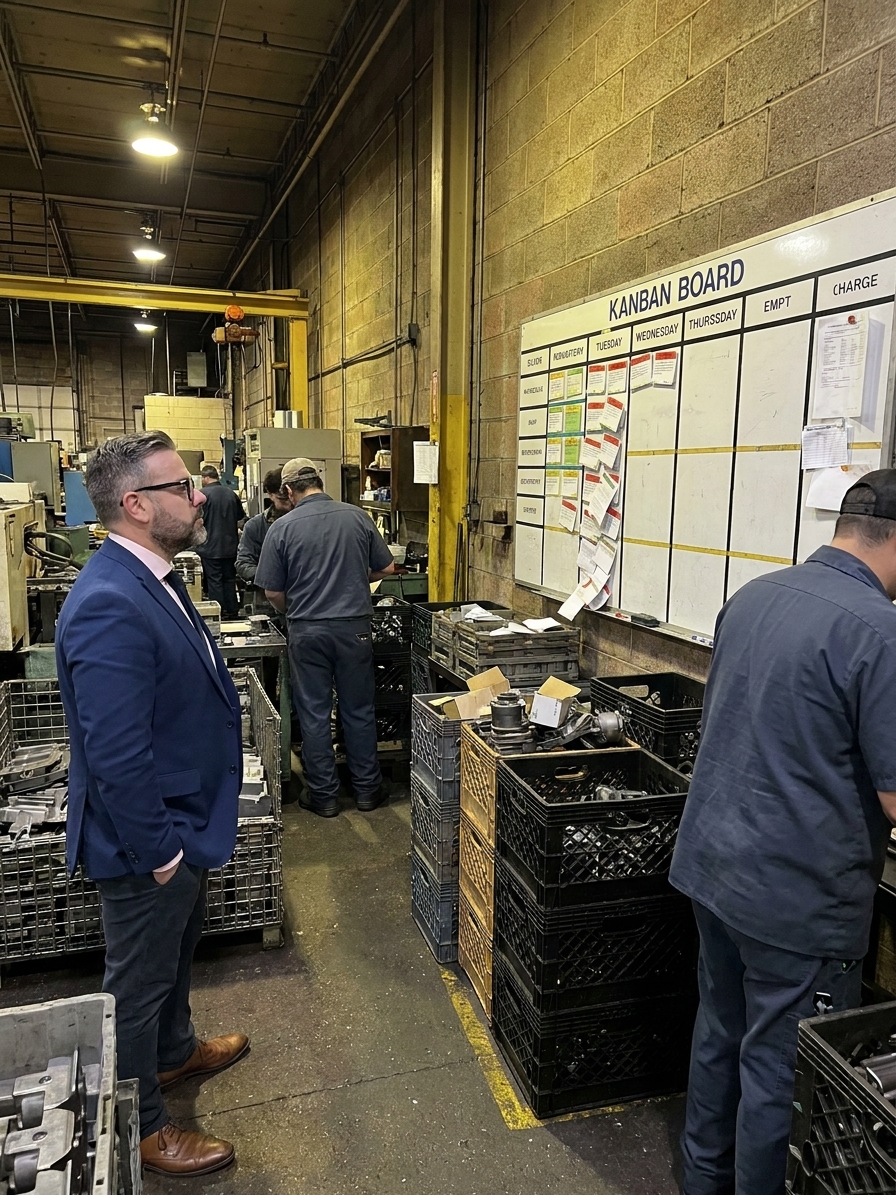
A Kanban system does not fail when operators ignore the visual management board or when suppliers miss a signal. That is merely the visible moment of structural collapse. The failure occurs weeks or months earlier, at the design specification stage, when a process engineer calculates a standard container quantity and selects a batch model without accounting for the true variance of downstream demand or the four-hour machine changeover that makes economic batch production unavoidable.
The downstream chaos is a direct mathematical consequence of design-stage compromises. If the calculation assumes a stable changeover when the actual mean time exceeds ninety minutes, the engineered Kanban loop will starve the assembly line. Planners will bypass the pull system, print supplementary authorisation documents, and flood the production flow with inventory to protect against a shortage the original specification guaranteed. The visual board becomes cosmetic decoration, but the root cause lies in the static engineering model.
Across two decades implementing lean systems in automotive and aerospace manufacturing, I have never rescued a collapsed Kanban system by retraining operators on the shop floor. The recovery always requires returning to the upstream calculation and rewriting the system parameters. Addressing the structural conditions — demand stability, changeover duration, and quality at the source — is the only mechanism that sustains a pull system. Everything else is temporary remediation.
Designing Against Demand Variance
Kanban mathematics assumes a relatively stable consumption rate. The standard formula calculates the number of cards required to cover average demand during the replenishment lead time, multiplied by a safety factor determined by the statistical variance of that demand. If the coefficient of variation is low, the safety factor remains modest and the system functions smoothly. If demand fluctuates wildly, the calculation requires a massive safety buffer that renders the system effectively useless.
Engineers frequently treat the average historical demand figure as a static input rather than a statistical distribution. They input monthly consumption into a Kanban calculator, apply a standard safety multiplier, and generate a card count. The production reality, however, includes promotional volume spikes, end-of-month shipping pushes, and unpredictable customer schedule changes that can swing daily consumption by over fifty percent. The calculated loop cannot absorb this volatility, so the system stockouts, and supervisors begin overriding the rules.
Correct design requires segmenting the product portfolio by volume and variance before selecting the replenishment model. High-volume, low-variance products are suitable candidates for pure Kanban flow. Medium-volume products with moderate variance require a min/max replenishment model that absorbs fluctuation through a defined inventory band. Low-volume, high-variance products belong in a make-to-order queue and should never be forced into a Kanban loop that assumes predictable consumption rates.
When demand variance is engineered out of the Kanban loop through careful product segmentation, the pull system handles only what it is mathematically designed to handle. This boundary specification is the critical design decision. Attempting to place every product in the manufacturing catalogue into a single Kanban system creates a structural conflict between static calculation and dynamic reality that guarantees the eventual emergence of a parallel push system.
The Changeover Constraint and Batch Economics
Every Kanban loop contains an implicit economic batch quantity determined by the cost and duration of machine changeover. The standard container quantity and the total number of containers in circulation must align with this economic batch. If an upstream machine requires three hours to changeover between product variants, the production planner will run large batches to dilute the changeover cost across thousands of units. The Kanban card will signal for a small replenishment quantity, but the physical production reality will deliver a massive batch.
This mathematical mismatch is designed into the system before the first card is printed. The container size dictates the material flow rate, but the machine setup economics dictate the production batch. When these two parameters are fundamentally incompatible, the upstream process produces large batches that immediately overflow the designated Kanban squares. Excess inventory floods the shop floor, the visual management board becomes irrelevant, and the pull system transforms into a batch-and-push operation wearing a Kanban disguise.

Single-Minute Exchange of Die (SMED) methodology is not a post-deployment improvement activity; it is an upstream design prerequisite. The changeover duration must be reduced to a point where the economic batch quantity aligns with the standard container quantity before the Kanban system is specified. If the changeover requires ninety minutes, the system designer must either engineer a smaller container or engineer a faster changeover. Ignoring this constraint and proceeding with incompatible parameters builds the failure directly into the process architecture.
In facilities where changeover reduction is postponed, the Kanban calculation becomes an academic exercise disconnected from operational physics. The system designer must audit the actual changeover capability using time studies and process data, not theoretical machine specifications. The Kanban parameters must be calculated from the verified, demonstrated changeover time, ensuring the production batch and the material flow rate exist within the same mathematical framework.
Signal Design Across the Supplier Interface
The supplier interface represents the most critical design failure point in any Kanban system. Internal manufacturing processes are physically adjacent and can be controlled through direct operational management. A supplier boundary introduces a third-party entity with independent production constraints, independent economic models, and multiple competing customers. The design of the replenishment signal must account for this external complexity, yet engineers routinely treat external suppliers as identical to internal work centres.
A standard Kanban card sent to an external supplier enters an environment the system designer cannot control. The supplier receives the signal, but they also receive MRP-generated purchase orders and forecast schedules from the customer's purchasing department. These multiple signals often contradict each other. The supplier rationally prioritises the signal carrying the highest financial threat or the largest purchase order volume, which is rarely the Kanban card. The pull system breaks at the organisational boundary because the signal design failed to account for the commercial reality of the supplier relationship.
Effective interface design requires translating the Kanban signal into a structured vendor-managed inventory agreement or a formal replenishment contract. The agreement must define the guaranteed demand band, the contracted safety stock held by the supplier, and the financial mechanisms for compensating the supplier for the inventory liability. This contractual architecture replaces the visual Kanban card with a commercial framework both organisations can execute reliably without daily intervention from production planners.
Reconciling MRP Architecture With Pull Logic
Material Requirements Planning (MRP) systems are designed to push material through a factory based on forecasted demand and bill-of-material explosions. Kanban systems are designed to pull material based on actual downstream consumption. These two operational philosophies are diametrically opposed, yet most manufacturing facilities attempt to operate both simultaneously within the same production environment. The integration architecture determines whether the Kanban system survives or becomes subordinate to the MRP engine.
The MRP system generates work orders based on long-term forecasts and pushes them into the manufacturing execution system. The Kanban system generates pull signals based on real-time consumption. Production controllers are left to reconcile two competing authorisation structures. The MRP system almost always wins this conflict because it is integrated with the financial accounting system, the purchasing module, and the inventory valuation database. The Kanban system operates in the operational margins until it is eventually ignored entirely.
The inventory reduction is not the goal. The problem exposure is the goal, and the inventory reduction is simply the side effect.
Designing a functional pull system requires explicitly defining the boundary between MRP-governed material and Kanban-governed material. MRP should handle long-lead purchased components, raw material with high variance, and low-volume custom parts. Kanban should handle high-frequency internal manufacturing flow, standardised sub-assemblies, and consumable components with stable demand. Without this explicit architectural boundary defined at the design stage, the two systems will collide on the shop floor and the pull logic will collapse under the weight of MRP-driven push orders.
The Improvement Loop and Static Parameters
The fundamental design principle that separates Kanban from simple inventory management is the systematic reduction of cards over time. Each card removed from circulation tightens the work-in-process constraint, reduces inventory buffers, and exposes the next operational constraint. The system designer builds this dynamic reduction into the core methodology. When the card count is calculated once during initial deployment and never adjusted, the continuous improvement mechanism is structurally disabled and the system becomes a static inventory management tool.
This stagnation is a design-stage failure because the original system specification rarely includes a formal review cadence or a governance model for card reduction. The engineering team calculates the baseline parameters, deploys the cards, and transfers ownership to operations. No structural mechanism exists to drive the systematic removal of cards, identify the resulting operational failure, and execute the corrective engineering work. The improvement engine requires a designed governance loop, not an assumption that supervisors will spontaneously reduce inventory buffers.
The Kanban Design and Governance Sequence
- 01Segment DemandSeparate products into runners, repeaters, and strangers by statistical variance.
- 02Engineer ChangeoversApply SMED until the economic batch quantity aligns with the container size.
- 03Verify Quality at SourceEnsure defect rates are negligible before material enters the pull loop.
- 04Recalculate CardsDerive the baseline count from demonstrated, not theoretical, operational data.
- 05Lock the SystemRemove override authority and accept short-term stockouts during stabilisation.
- 06Execute ReductionRemove one card, engineer the fix, and repeat as a permanent governance cadence.
The governance model must specify who holds the authority to add or remove cards, under what statistical conditions that authority is exercised, and what engineering response is triggered when a card removal exposes a constraint. Without this accountability architecture, the card count drifts upward as operators and supervisors add buffer stock to mask unresolved process problems. The design must engineer the organisational discipline into the system governance, treating card count adjustments as formal engineering change orders, not operational adjustments.
Engineering the Organisational Architecture
Sustaining a Kanban system requires absolute operational discipline: the moment a pull signal is overridden without consequence, the visual management board becomes decorative theatre and the pull logic collapses into a push system. This discipline cannot be mandated by a laminated card or a shift briefing. It must be engineered into the organisational architecture through governance protocols, escalation triggers, and formal authority boundaries that prevent operational personnel from bypassing the system under schedule pressure.
The design specification must define the boundary conditions for system intervention. When a stockout occurs, the engineered response is an 8D corrective action and a root cause investigation, not the addition of supplementary cards. When a supplier misses a delivery, the response is a formal supplier escalation under the vendor agreement, not a blanket purchase order that bypasses the pull logic. Every operational exception must have a designed countermeasure that protects the integrity of the Kanban calculation rather than undermining it.
Kanban is a discipline system disguised as a material flow tool. It functions not because the physical cards or electronic signals are sophisticated, but because the organisational commitment to the designed rules is absolute. The specification must account for the mathematical reality of demand variance, the physical reality of changeover economics, and the commercial reality of supplier interfaces. When the design stage honours these constraints, the operational stage sustains the pull system indefinitely.
Design-Stage Specification Versus Operational Reality
Common Design Assumptions
- Demand is stable and averages the historical monthly figure.
- Changeover time allows for small, frequent batch production.
- Suppliers will conform to a single replenishment signal without question.
- The card count is calculated once and remains static indefinitely.
Verified Process Physics
- Demand variance exceeds the safety factor, causing chronic stockouts.
- Changeover economics force large batches that overflow the Kanban squares.
- Suppliers respond to the loudest commercial signal, ignoring the pull logic.
- The card count must be systematically reduced to drive continuous improvement.
The most critical question during any Kanban audit is not whether the operators follow the rules, but whether the engineers who specified the system understood the physical constraints of the process they were modelling. Pull systems fail because the design fails. When the upstream mathematics aligns with the downstream operational reality, the Kanban system requires almost no enforcement effort. The discipline becomes a natural consequence of a correctly engineered process, and the continuous improvement engine operates as designed.