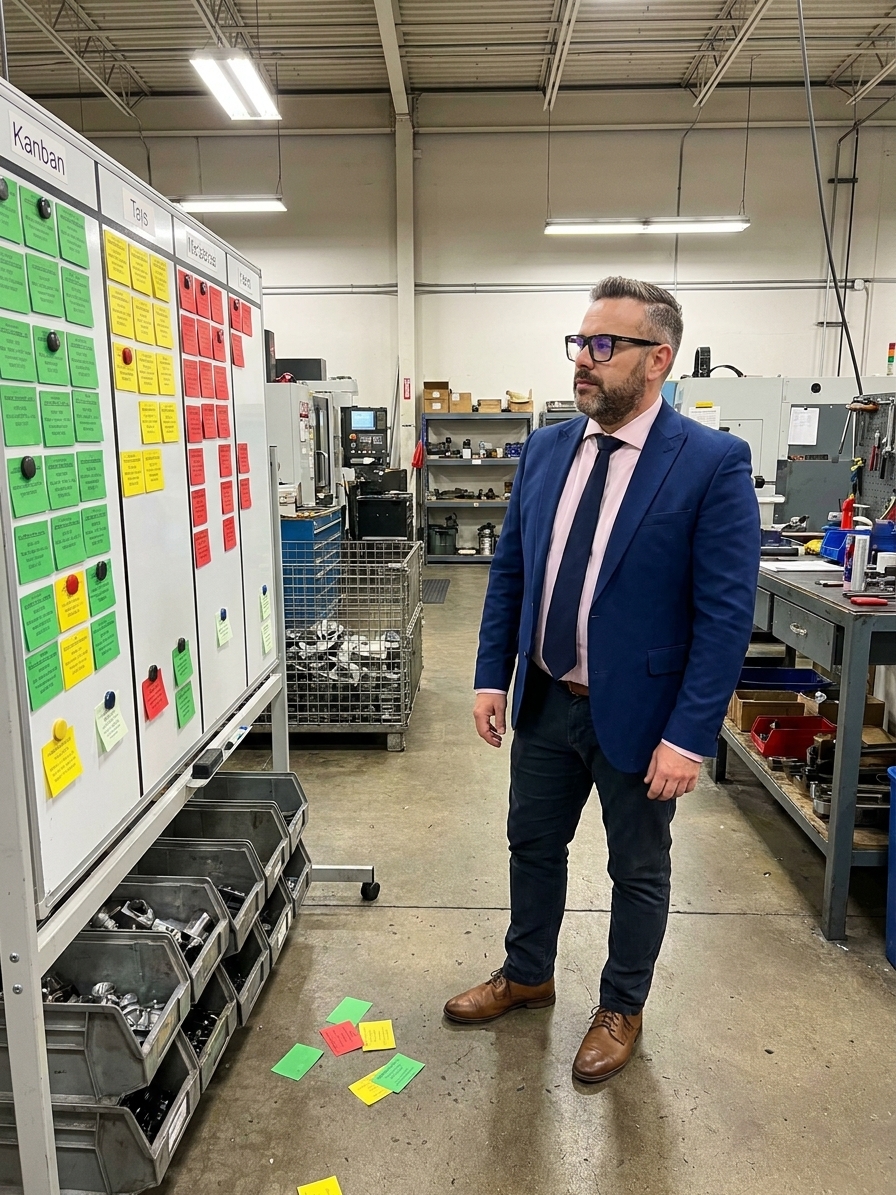
Kanban is a pull-based replenishment system where a visual signal triggers upstream production exactly when downstream consumption occurs. The mechanism is simple: no signal means no production, which bounds work-in-process inventory and prevents overproduction. When implemented correctly, the system shortens lead times and frees up capital.
Yet most implementations degrade into visual theatre within six months. Cards get lost, supervisors run unauthorised batches, and operators bypass the system entirely. The real scheduling reverts to panicked emails and expediters, while the Kanban board remains on the shop floor purely for customer visits.
This degradation happens because organisations adopt the tool without the underlying operational discipline. Kanban does not eliminate problems; it exposes them. If your suppliers are unreliable, your changeovers are long, or your defect rates are high, the pull system will choke. Adding buffer stock to mask these failures turns a diagnostic tool into a decorative process.
The Mechanics of Pull and the Reality of Disruption
A Kanban system functions by replacing forecast-based push scheduling with consumption-based pull. Instead of releasing raw material based on a monthly projection, material moves only when a downstream process signals that it has consumed a container. This signal authorises the upstream process to produce exactly that quantity to replace it.
The constraint is physical and absolute: the number of Kanban cards in circulation strictly limits the maximum work-in-process inventory. If a process produces defects, the downstream station consumes good parts faster than expected to hit its quota. The empty container signals replenishment, but the upstream process must now produce both the replacement parts and the rework for the defective ones.
This is where the theory collides with shop-floor reality. I have audited plants where the formal Kanban board showed perfect compliance, while the actual material flow was managed through an off-the-books safety warehouse. The planners kept the factory running, the operators moved the cards, and the systemic problems festered untouched behind the visual display.
The failure is not mechanical but cultural. Taiichi Ohno designed the system with deliberately tight buffers so that any disruption would immediately halt production. The discomfort of that stoppage forces management to fix the underlying issue. When managers add extra cards to avoid stoppages, they neutralise the system's primary function.

Buffer Inflation and the Death of the Signal
Buffer inflation is the most common and damaging failure mode. A manager gets nervous about a potential stockout and quietly adds extra Kanban cards to the loop. This feels prudent. In reality, it destroys the system's ability to highlight process failures. The extra buffer absorbs days of supplier delays, machine breakdowns, and quality defects without triggering an alert.
By the time the extra buffer is consumed and the alarm finally sounds, the root cause is buried weeks in the past. You cannot run an effective 8D investigation on a supplier failure that happened twenty days ago but was only just noticed. The investigation stalls, the corrective action is guesswork, and the problem recurs.
This inflation usually happens gradually. A customer escalates a late delivery, so a supervisor adds a card. A machine breaks down for an afternoon, so maintenance requests a buffer. Nobody makes a formal decision to abandon pull scheduling. The system simply degrades, one safety card at a time, until the visual board tracks the movement of excess inventory rather than actual demand.
Applying Pull to the Wrong Manufacturing Environment
Kanban requires repetitive manufacturing, relatively stable demand, and predictable lead times. It functions exceptionally well in automotive stamping lines where a press produces the same panel thousands of times a month. The consumption rate is steady, the replenishment lead time is measured in hours, and the math behind the card quantities is reliable.
Applying the same logic to an engineer-to-order job shop produces chaos. In a high-mix, low-volume environment, every order has a unique routing, a custom bill of materials, and an unpredictable lead time. Forcing a two-bin Kanban system onto custom fabrication means you are artificially constraining a process that inherently requires flexible push scheduling based on a dynamic work order.
When the system fights the operational reality, operators develop workarounds. They quickly learn that waiting for a Kanban signal delays their output, so they move material without triggering the cards. The visual board shows a perfectly balanced, low-inventory process. The physical reality is a shop floor held together by informal communication, with the Kanban system bypassed at every station.
Kanban Application: Repetitive vs Custom Manufacturing
Where Kanban Works
- Stable, repetitive demand with predictable takt time
- Standardised routings and short, consistent changeovers
- Low product variety within a defined part family
- Upstream processes capable of immediate replenishment
Where Kanban Fails
- High-mix, low-volume or engineer-to-order production
- Unique bills of material and dynamic, custom routings
- Long, unpredictable machine setup and changeover times
- Genuinely volatile customer demand driven by projects
The Missing Link: Quality Integration and Jidoka
Kanban and quality management are inseparable. If your process generates a 4% defect rate, your Kanban calculations are fundamentally broken before a single card moves. You sized your containers based on the assumption that every part produced is a good part. Because 4% are rejected, downstream consumption accelerates, buffers deplete faster than projected, and the system enters a constant state of artificial shortage.
In the Toyota Production System, this is resolved by Jidoka — built-in quality with a human touch. When a defect occurs, the line stops immediately. The problem is investigated at the source, the root cause is identified, and countermeasures are implemented before production resumes. The Kanban system signals flow problems; the Jidoka mechanism signals quality problems.
A Kanban system tracking both good and bad parts with equal precision is not a control mechanism. It is a ledger of waste.
Most facilities implement the pull system without the quality infrastructure. Defective parts flow downstream, Kanban cards trigger replenishment of components that may be scrapped at inspection, and the buffers collapse. Without automated line stops or robust error-proofing (poka-yoke), the pull system simply accelerates the movement of non-conforming material through the value stream.
To make Kanban viable, process capability must reach a point where defect rates are low, predictable, and measured against strict Cpk targets. If your process cannot reliably hold specification limits, a pull system will only expose that instability. You must fix the PFMEAidentified failure modes, implement statistical process control, and stabilise the process before attempting to constrain inventory.
Rebuilding the System: Sizing, Discipline, and QMS Integration
Rebuilding a broken Kanban system requires a direct connection to your Quality Management System. Your QMS tracks defect rates, scrap percentages, and rework cycles by process, part number, and shift. Your Kanban sizing must be mathematically linked to this data. If a specific station's first-pass yield drops, the Kanban loop must trigger a quality investigation, not a buffer increase.
Calculate card quantities based on actual demand, verified replenishment lead time, and measured variability. If the mathematical formula dictates you need two containers and management insists on six, trust the math. The discrepancy between the calculated number and the comfort number represents specific, unaddressed fears. Identify whether those fears are supplier reliability, machine downtime, or quality defects, and fix the underlying variable.
Pre-Implementation Quality Prerequisites
Every signal disruption must be treated as a diagnostic event, not an inconvenience to be buffered. When an empty container triggers an emergency replenishment, that event must be logged. Determine whether the trigger was caused by demand variability, a late supplier delivery, unexpected machine downtime, or quality loss. Fix the root cause using an 8D methodology, then verify that the corrective action actually reduced the frequency of Kanban disruptions.
Training operators on the mechanics of moving a card is insufficient. They must understand the operational consequences of bypassing the system. Every unauthorised bin movement is a deliberate decision to blindfold the planning function. When an operator grasps that a lost card directly causes downstream stockouts, emergency freight, and customer line-down penalties, their handling of the visual signals shifts from administrative compliance to active process control.
The Mirror Effect: Using Disruption as a Diagnostic Tool
Kanban is not a scheduling system. It is a real-time diagnostic mirror that reflects the actual state of your supply chain, process capability, and management discipline. If your Kanban system requires daily intervention from expediters to function, the system is not failing. It is accurately showing you that your processes are unreliable.
Organisations that succeed with pull scheduling use disruptions as a forcing function for continuous improvement. Every stockout is mapped to a root cause. Every quality defect that ripples through the system triggers a permanent countermeasure. They systematically remove Kanban cards as their processes become more reliable, deliberately tightening the constraints to expose the next layer of waste.
Organisations that fail treat Kanban as a destination rather than a tool. They install the boards, laminate the cards, claim a lean transformation, and then spend years wondering why their inventory carrying costs remain unchanged. The visual signals on the floor are screaming the answers every single shift, but management has structured the system to ensure nobody is listening.
The operational choice is straightforward. You can use the pull system to expose your problems and systematically eliminate them through rigorous quality engineering, or you can use it to hide your problems behind increasingly large buffers. The first path requires discipline and heavy investment in process capability. The second path simply requires a laminator and a tolerance for waste.