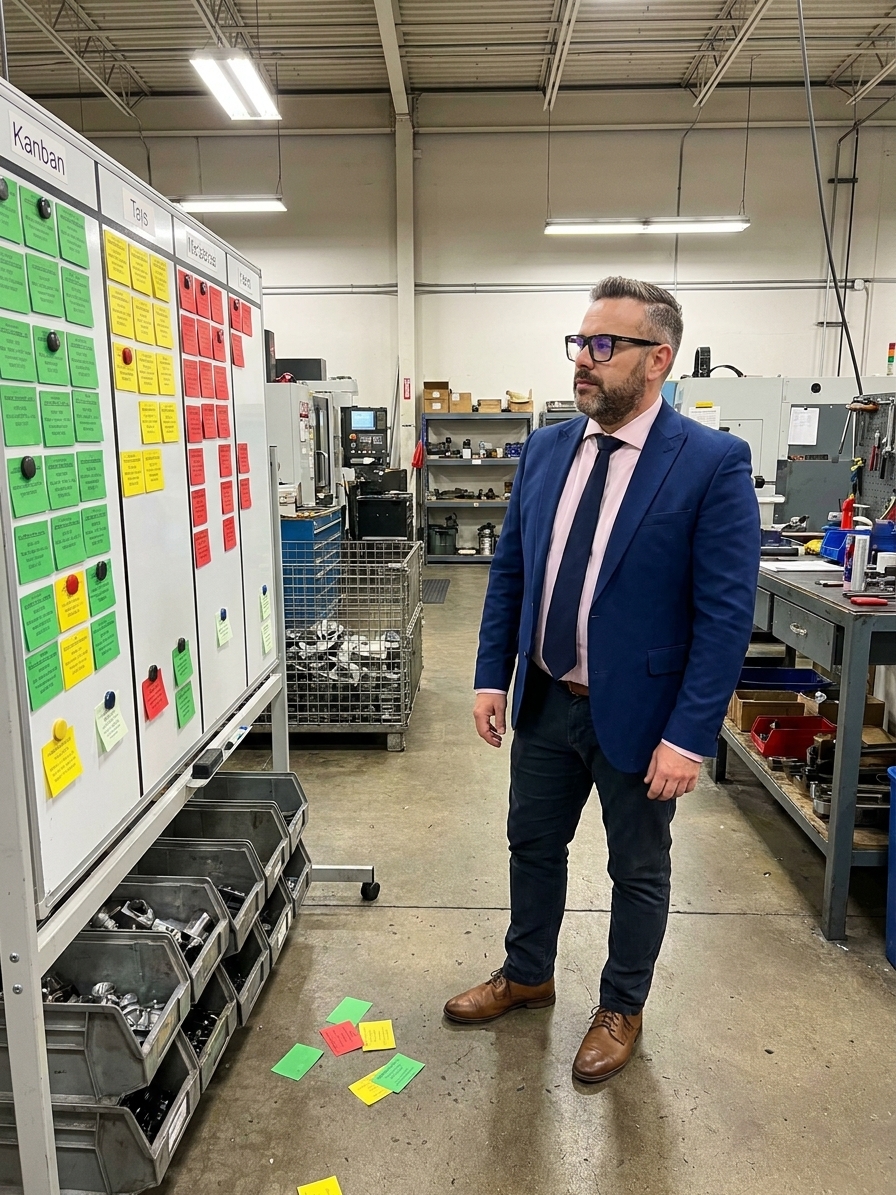
Factories routinely deploy Kanban boards as a standalone lean tool, expecting visual signals alone to resolve deep operational dysfunction. The implementation fails within months because the sequencing is inverted. A pull system cannot stabilise an unreliable process; it merely exposes the instability. Deploying containers and cards before establishing rigorous process capability turns a diagnostic mechanism into a generator of chaos.
Across two decades implementing ISO 9001 and IATF 16949 systems in automotive and aerospace, I have observed that pull scheduling only survives when introduced as the final layer of a mature quality management system. The mechanics of material replenishment are straightforward. The difficulty lies in establishing the operational foundations that allow those mechanics to function without constant human intervention.
The correct implementation sequence demands that you stabilise the process, integrate quality thresholds, and train personnel in signal discipline long before you calculate container quantities. Skipping directly to visual management without these prerequisites guarantees buffer inflation, operator workarounds, and the eventual reversion to forecast-based push scheduling. The pull system becomes nothing more than expensive theatre.
Phase One: Process Stabilisation Before Signal Introduction
Before introducing any pull logic, the upstream process must demonstrate statistical control. If a stamping press produces a 4% defect rate, introducing a Kanban loop guarantees systemic collapse. The downstream station consumes good parts faster than projected to compensate for the scrap. The empty container triggers replenishment prematurely, and the upstream process must now produce both the replacement volume and the rework. The pull system enters a state of permanent artificial shortage.
Process capability is the non-negotiable prerequisite. The target process must sustain a minimum Cpk of 1.33 against established specification limits. Achieving this requires completing the PFMEA, implementing statistical process control, and verifying that identified failure modes carry effective countermeasures. If the process cannot reliably hold tolerances, constraining inventory will only amplify the variability and accelerate the accumulation of non-conforming material.
Equipment reliability must match process capability. Kanban assumes the upstream resource can replenish a container within a predictable lead time. If the machine suffers unplanned downtime, the replenishment signal fires into a void. The downstream buffer depletes, production halts, and the immediate management response is to inflate the buffer. Overall Equipment Effectiveness must reach a sustained threshold before the pull calculation carries any validity.

Phase Two: Establishing the Quality and Error-Proofing Architecture
Once the process is statistically capable, the next step is building the quality architecture that prevents defects from entering the pull loop. In the Toyota Production System, this is the function of Jidoka. When a defect occurs, the line stops immediately. The problem is investigated at the source, the root cause is identified, and countermeasures are verified before production resumes. The Kanban system signals flow problems; the Jidoka mechanism signals quality problems.
Without automated line stops or robust error-proofing, defective parts flow downstream and Kanban cards trigger replenishment of components that will be scrapped at final inspection. The buffers collapse. A pull system tracking both good and bad parts with equal precision is not a control mechanism. It is a ledger of waste. The quality infrastructure must physically prevent non-conforming material from generating a false consumption signal.
This phase requires integrating the future Kanban signals directly into the existing Quality Management System. The QMS tracks defect rates, scrap percentages, and rework cycles by process, part number, and shift. The pull system must be mathematically linked to this data. If a specific station's first-pass yield drops, the Kanban loop must trigger a formal quality investigation, not a buffer increase. Quality data drives the sizing logic, not the other way around.
Phase Three: Sizing Containers Against Mathematical Reality
Only after stabilising the process and building the error-proofing architecture can you calculate the actual card quantities. The formula demands three inputs: actual verified demand, measured replenishment lead time, and quantified variability. The mathematics produce a specific number of containers required to sustain flow. If the calculation dictates two containers and management insists on six, the system is already compromised.
The discrepancy between the calculated number and the comfort number represents specific, unaddressed operational fears. Extra buffer absorbs days of supplier delays, machine breakdowns, and quality defects without triggering an alert. By the time the inflated buffer is consumed and the alarm sounds, the root cause is buried weeks in the past. You cannot run an effective 8D investigation on a supplier failure that happened twenty days ago but was only just noticed.
Pre-Implementation Quality Prerequisites
Identify the exact variables driving the fear. If management wants four extra containers, determine whether the anxiety stems from supplier unreliability, tool wear, or changeover inconsistency. Fix those variables using rigorous quality engineering. Then recalculate the container quantities. The mathematical formula must dictate the inventory level. Management comfort cannot override the calculation without destroying the signal's integrity.
Phase Four: Operator Training and Signal Discipline
With containers sized and deployed, the focus shifts to the human element. Training operators on the mechanics of moving a card is wholly insufficient. They must understand the operational consequences of bypassing the system. Every unauthorised bin movement is a deliberate decision to blindfold the planning function. Operators must grasp that a lost card directly causes downstream stockouts, emergency freight, and customer line-down penalties.
I have audited plants where the formal Kanban board showed perfect compliance while the actual material flow was managed through an off-the-books safety warehouse. The planners kept the factory running, the operators moved the cards, and the systemic problems festered untouched behind the visual display. The visual board tracked the movement of excess inventory rather than actual demand. Operator buy-in requires connecting the abstract signal to concrete shop-floor outcomes.
Every signal disruption must be treated as a diagnostic event, not an inconvenience to be buffered.
When an empty container triggers emergency replenishment, the event must be logged in the QMS. Determine whether the trigger was caused by demand variability, a late supplier delivery, unexpected machine downtime, or quality loss. Launch an 8D investigation, then verify that the corrective action actually reduced the frequency of Kanban disruptions. This transforms the pull system from a passive tracking tool into an active driver of continuous improvement.
Matching the Tool to the Manufacturing Environment
The implementation sequence presupposes a specific operational context. Kanban requires repetitive manufacturing, relatively stable demand, and predictable lead times. It functions exceptionally well in automotive stamping lines where a press produces the same panel thousands of times a month. The consumption rate is steady, the replenishment lead time is measured in hours, and the mathematics behind the card quantities hold firm under daily stress.
Applying the same logic to an engineer-to-order job shop produces immediate dysfunction. In a high-mix, low-volume environment, every order carries a unique routing, a custom bill of materials, and an unpredictable lead time. Forcing a two-bin Kanban system onto custom fabrication artificially constrains a process that inherently requires flexible push scheduling based on a dynamic work order. The tool fights the reality, and the reality always wins.
Kanban Implementation Sequence
- 011. Stabilise the processAchieve statistical control (Cpk 1.33) and eliminate identified PFMEA failure modes.
- 022. Build quality architectureImplement error-proofing and line-stop authority to prevent defective parts from entering the pull loop.
- 033. Size containers mathematicallyCalculate card quantities using verified demand, lead time, and variability. Refuse comfort buffers.
- 044. Train for signal disciplineConnect card movement to concrete consequences. Log every disruption as a diagnostic event in the QMS.
When the system fights the operational reality, operators develop workarounds out of necessity. They learn that waiting for a Kanban signal delays their output, so they move material without triggering the cards. The visual board shows a perfectly balanced, low-inventory process. The physical reality is a shop floor held together by informal communication, with the Kanban system bypassed at every station to meet production targets.
The Management Choice: Diagnostic Mirror or Decorative Board
A correctly implemented Kanban system is a real-time diagnostic mirror that reflects the actual state of your supply chain, process capability, and management discipline. If the system requires daily intervention from expediters to function, the system is not failing. It is accurately showing you that your processes are unreliable. The disruption is the data.
Organisations that succeed with pull scheduling use disruptions as a forcing function. Every stockout is mapped to a root cause within the QMS. Every quality defect that ripples through the system triggers a permanent countermeasure. They systematically remove Kanban cards as their processes become more reliable, deliberately tightening the constraints to expose the next layer of waste. Taiichi Ohno designed the system with deliberately tight buffers so that any disruption would immediately halt production. The discomfort of that stoppage forces management to fix the underlying issue.
The operational choice is straightforward. You can follow the implementation sequence, meet the capability thresholds, and use the pull system to systematically eliminate problems through rigorous quality engineering. Or you can skip the prerequisites, install the boards, laminate the cards, and spend years wondering why your inventory carrying costs remain unchanged. The first path demands discipline and investment in process capability. The second simply requires a tolerance for waste.