
Standardised work is the foundation of any quality management system certified to IATF 16949 or AS9100. We write control plans, we establish PFMEA controls, and we train operators to follow precise work instructions. Yet the supervision and management layers above the shop floor frequently operate without any documented standard at all.
Leadership standard work, or Leader Standard Work (LSW), is a Lean manufacturing practice that defines the minimum daily and weekly tasks a leader must perform to sustain the operating system. The core principle is simple: you cannot demand rigid adherence to quality standards from operators if your own daily routine is improvised.
In my experience auditing and implementing ISO 9001 systems, the maturity of an organisation's quality culture is directly visible in how its leaders spend their first hour on shift. If the Plant Manager's calendar is filled with back-to-back internal meetings, the system relies on luck. If the Shift Supervisor's first action is a documented Gemba walk checking real-time OEE and critical-to-quality (CTQ) parameters, the system relies on discipline.
Defining Leadership Layers in Standard Work
A common failure point is treating LSW as a single, uniform document. It must cascade, with the frequency and focus shifting depending on the organisational level. A Team Leader verifying torque traceability on the line has a fundamentally different mandate than a Value Stream Manager reviewing weekly scrap trends.
The objective is connection. Each layer's standard work must feed actionable data upward, ensuring that systemic quality issues identified on the floor reach the management tier quickly.
The LSW Maturity Cascade
- Plant Manager / DirectorWeekly review of systemic Cpk trends, OEE stability, and verification of tier 1-3 leader standard work adherence.
- Value Stream / Department ManagerDaily verification of tier 1 audits, review of 8D root cause analysis, and weekly escalation resolution.
- Shift Supervisor / Group LeaderHourly verification of safety, quality alerts, and production tracking; owns immediate containment.
- Team LeaderContinuous presence at the line, verifying operator standard work, first-off inspections, and material readiness.
The Mechanics of an LSW Document
Leader Standard Work is not a checklist of meetings. It is a time-based, geographically specific routine focused on verification. A well-designed LSW document specifies what to check, where to check it, the acceptance criteria, and the required escalation trigger if the standard is not met.
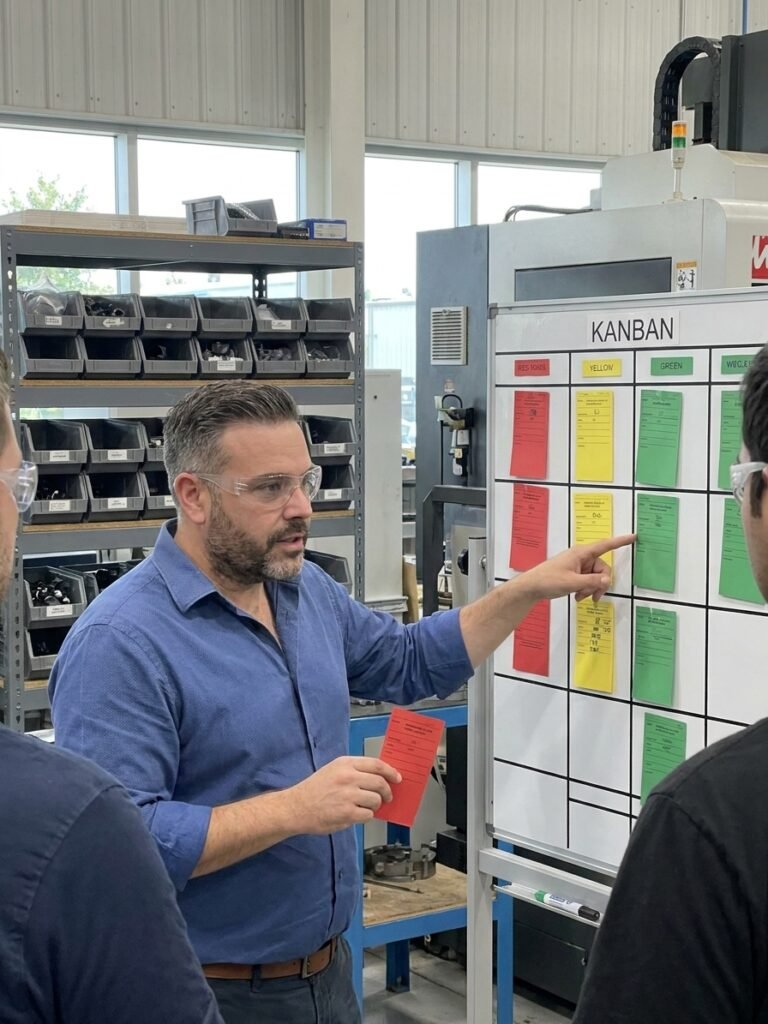
For a Shift Supervisor, the morning routine might mandate a 15-minute walk of the incoming shift's setup. This is not a casual stroll. The LSW dictates specific checks: confirming the correct PPAP-approved components are staged, verifying the latest engineering change level is posted at the cell, and checking that MSA-calibrated gauges are present and within calibration date.
By forcing leadership into the value stream at predictable intervals, LSW acts as an early warning system. It identifies process drift before it generates a nonconformance report.
Connecting LSW to KPI Tracking
At a major aerospace manufacturer, I introduced Routing Verification KPIs that cut internal lead time by 97%. That result was not achieved by the metrics alone; it was achieved by embedding the verification of those KPIs into the daily standard work of the engineering and quality supervisors. We did not wait for a monthly programme review to discover a routing error. The leadership tier verified critical path adherence daily, at the source.
LSW forces the organisation to act on leading indicators. Instead of reviewing yesterday's scrap rate—a lagging indicator—the supervisor's standard work dictates checking process parameters in real-time to prevent today's scrap.
Core Verification Targets for Shift Leadership
Implementation Failure Modes
Most Lean tools fail not because the theory is flawed, but because the implementation is treated as an administrative exercise. When building a greenfield QA/QC department for a 900+ employee plant at SNOP, I saw firsthand how easily LSW degrades into paperwork if the leadership culture does not support it.
A standard is only real if the person who wrote it is physically verifying it on the floor.
The most common failure mode is pencil-whipping. Supervisors sign off on their LSW checklist while sitting at their desks, relying on the MES dashboard instead of walking to the gemba. To counter this, LSW must be designed with physical verification points. Require a signature from an operator, a photograph of a specific gauge reading, or a scan of a material barcode.
Another frequent mistake is making the standard too rigid to survive contact with reality. If a crisis occurs—a line goes down, a critical supplier misses a delivery—the standard work must have a documented exception process. If the routine breaks entirely every time there is an abnormality, the system will be abandoned within weeks.
Sustaining the System
Leader Standard Work is essentially the operating system for your management team. If you want to sustain the gains from your PFMEA, your control plans, and your corrective actions, you must manage the system daily.
The ultimate test of LSW efficacy is auditable consistency. During internal audits, check the LSW logs. If a supervisor's daily log shows zero abnormalities for an entire month, the standard work is failing. The shop floor is never perfect; a healthy LSW system will capture and escalate minor process deviations daily, long before they impact the customer.