A camera tells you what someone wants you to see, and nothing more. When I walk a machining hall in person, my senses work in parallel: burnt hydraulic fluid near a press, a spindle bearing whining at a pitch it should not, vibration in a gantry floor that suggests a foundation problem. A video feed gives me none of that. The lens flattens the factory into a curated two-dimensional stage, and the auditor who pretends otherwise is deceiving their client and themselves.
This is not an argument against remote auditing. It has a legitimate place for document review, process interviews, records sampling and follow-up verification between on-site cycles. What it cannot do is replace physical verification of a manufacturing environment. Across two decades of auditing automotive and aerospace plants, I have settled on a division of evidence that works, and this article draws that boundary section by section.
The stakes are practical. Certification bodies and clients increasingly press for fully remote audits to save cost, and quality directors who schedule them need to know exactly which evidence demands boots on the floor. Silent substitution of video evidence for physical observation is the fastest way to sign a report your method cannot support.
Evidence Sampling: The Records Look Perfect Until You Touch Them
Document sampling remotely is seductively efficient. A shared screen shows calibration certificates, heat treatment charts, torque records, all neatly filed. But in paper-based systems, physical documents carry information a scan conceals. Original ink, correction fluid, torn and re-stapled pages, the faint pencil marks of an operator working backwards through a batch record — these tell you whether the record was written in real time or reconstructed after the fact.
A photograph of a run chart cannot show me that pen pressure changes mid-signature, or that three different "signatures" share the same hesitation pattern. Completeness is equally compromised. In person, I can pull the binder from the shelf myself, watch which drawer a supervisor hesitates before opening, and request documents out of sequence. Remote, the host selects the files, and even an honest host samples unconsciously in their own favour.
My countermeasure is limited but real. I demand unfiltered screen-sharing of the native document management system rather than pre-prepared PDFs, and I ask for live searches by batch number rather than accepting the folder presented first. It narrows the gap; it does not close it. Traceability against physical product — heat numbers on bar stock, revision levels etched on tooling — remains impossible. A camera held by an auditee over a stamping proves only that a stamping exists somewhere in the building. I cannot turn the part over, check the back face, or confirm the item matches the paperwork.
Live Floor Tours: Who Holds the Camera Holds the Audit
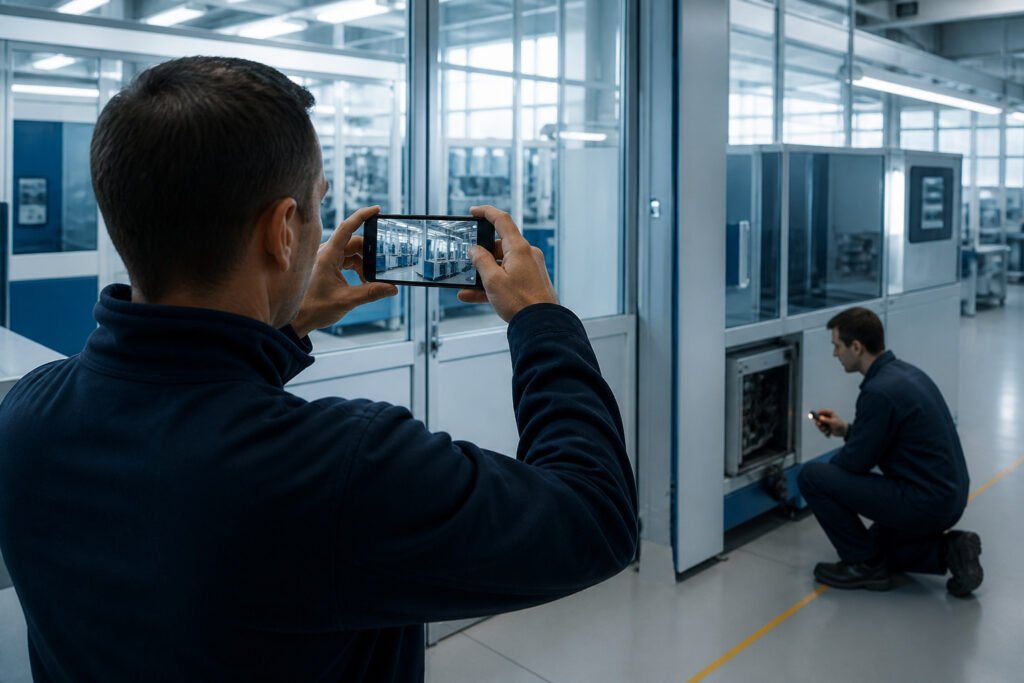
A remote floor tour is, by construction, a guided tour. The host chooses the route, the stopping points, the lighting, the camera angle and the moment the feed begins. I once spent forty minutes on a video walkthrough of a welding cell before realising the operator on shift was working to a paper traveller withdrawn weeks earlier — visible only because the camera operator panned slightly too far and someone rushed to cover a document tacked to the cell wall. In person I would have walked straight to it.
Field of view is the hard technical constraint. A wide-angle camera at head height shows roughly a fifth of what a standing auditor sweeps with eye movement. Overhead cranes, mezzanine storage, the second row of racks, the state of the floor beneath machines — all invisible. Critical safety and process infrastructure lives exactly there: trip hazards around press cells, leak points under coolant systems, uncontrolled rework stashes behind WIP racks.
When I plan a hybrid audit, I list the specific sightlines I need — undersides of machines, gauge storage, containment cages — and require the host to film each deliberately, with a second operator filming the filmer where possible. Lighting betrays the feed constantly. Welding arcs blind the sensor, fluorescent flicker creates banding that hides surface defects, and dark assembly bays compress into grey mush. If surface finish, weld bead profile or coating condition matters to the finding, I refuse camera evidence entirely and mark the item for physical verification. A camera has never once shown me an orange-peel texture or a hairline quench crack reliably.
What a Microphone Cannot Hear and a Sensor Cannot Reveal
Sound is the most underestimated audit instrument I own. Compressed-air leaks sing at ultrasonic frequencies a laptop microphone will never capture. A failing ball screw announces itself with a periodic click long before it appears on any chart. Cavitation in a coolant pump, the slap of a loose conveyor belt, the characteristic change in an air-driven torque tool when its clutch wears — I diagnose these by ear during a walk, and no audio codec preserves them. The feed delivers a noise floor scrubbed by automatic gain control, which flattens the very differences I listen for.
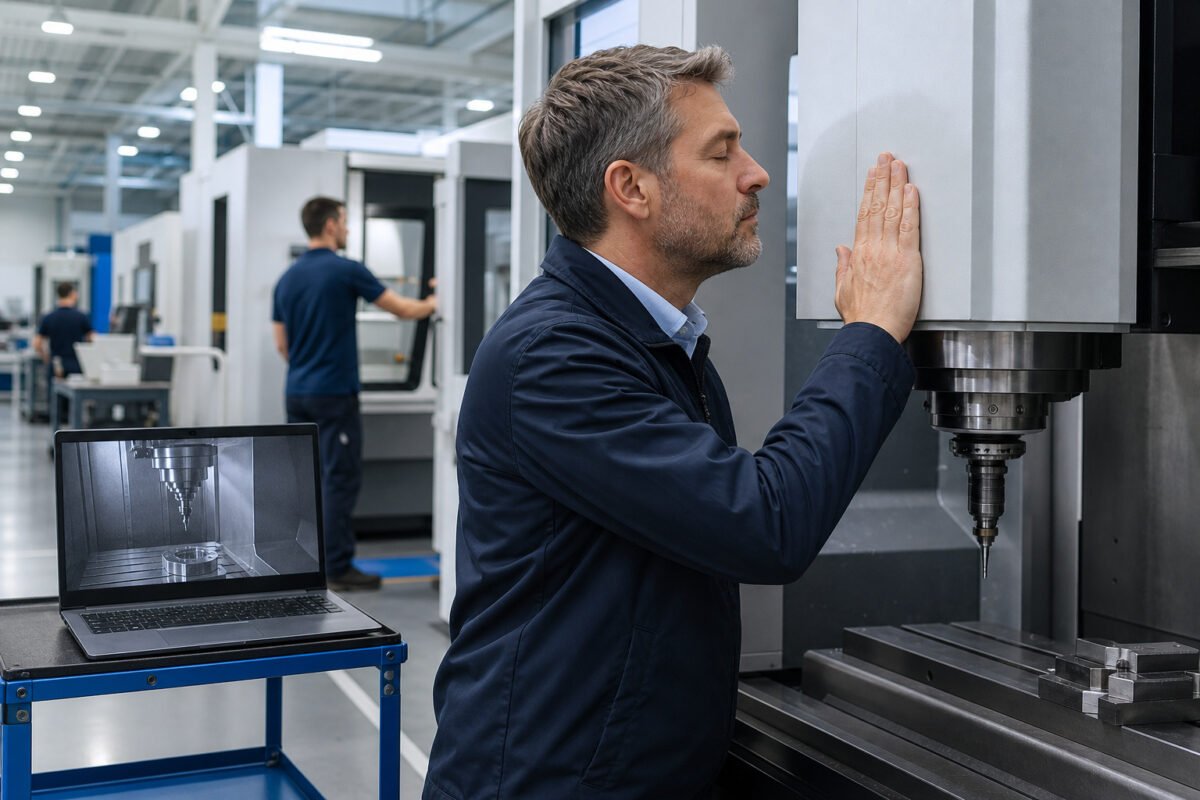
Touch carries equal weight. I press a palm against a spindle housing to judge abnormal heat, drag a finger across a machined face to feel chatter marks no camera resolves at 1080p, and check whether a torque wrench's ratchet action has developed free play. Surface texture, thermal condition and mechanical play are three of the most common objective evidence sources in a process audit, and all three are physically impossible to transmit over a network. Any auditor who closes a finding on vibration, temperature or texture using video alone is writing fiction into the report.
Smell completes the picture. Burnt insulation, sour coolant, ozone from a failing drive, the solvent haze of an unventilated cleaning booth — these are leading indicators of process failure and regulatory non-compliance. I have opened more containment investigations from an odour anomaly than from any dashboard alert. The factory tells you things through the air that it never writes in a record, and every one of those channels is closed on a video call.
Operator Interviews and the Psychology of a Screen
Interviewing operators through a camera changes what they tell you. In person I can pull a machinist aside at the machine, away from their supervisor, and ask them to show me how they actually load the fixture rather than how the work instruction claims they do. On a video call, the supervisor is usually within earshot, the operator is nervous about being recorded, and answers converge towards the official version. The gap between documented process and actual practice — the single richest source of audit findings in manufacturing — narrows to almost nothing, not because the process improved but because the observation method degraded.
Non-verbal cues matter as much. When I ask to see the gauge an operator used at 06:30, I watch their eyes flick to a drawer, a hesitation before answering, a glance exchanged between shifts. A camera pointed at a face shows some of this; a phone held by a colleague shows almost none, and most floor interviews happen exactly that way. Attention also compresses: the operator is being filmed in their workplace, aware of production running behind, and gives ninety seconds where an in-person conversation yields five unhurried minutes.
Practical mitigation exists but has limits. I insist operators are interviewed individually with headsets, that supervisors are explicitly asked to leave the area, and that questions are phrased around physical demonstration — "show me" rather than "tell me". Even then, I weight remote interview evidence lower than on-site interview evidence in my findings, and I say so in the report.
A photograph is a claim about a moment; an audit observation is a claim about a state.
Which Findings Still Belong to the On-Site Cycle
After years of splitting audits between remote and physical phases, the division is clear. Remote work covers document and record sampling from native systems, management interviews, engineering change records, supplier scorecards, CAPA records, training matrices, and follow-up verification of corrective actions already physically confirmed once. Everything involving matter, energy or behaviour belongs to the on-site cycle.
Splitting the audit scope
Genuine remote scope
- Document and record sampling from native systems
- Management and support-function interviews
- CAPA, training matrix and change-record review
- Follow-up on actions already physically verified
On-site only
- First-article and dimensional verification
- Tactile and visual product examination
- Gauge and tooling condition, calibration in use
- Operator observation where behaviour matters
Some verification is binary and cannot be split. Calibration status on gauges physically in use, containment of suspect stock in a quarantine cage, segregation of rejected tooling — either the auditor has seen it or has not. Storage conditions for adhesives and elastomers under shelf-life rules, and environmental controls such as lab temperature and humidity, likewise require instruments and hands in the room.
When certification bodies and clients press for fully remote audits, I make them sign off on this distinction in the audit plan, listing each deferred item for the next physical visit with a target date. Deferral is legitimate. Silent omission is not, and it is the duty of the quality function to make that visible.
Hybrid Scheduling and Honest Reporting
Hybrid scheduling follows logically from the split. I front-load the remote phase to narrow the scope, so the on-site days concentrate on what only a body in the building can do. Done well, this makes the physical audit sharper, not shorter — I arrive with a list of specific items requiring hands, eyes, ears and nose, instead of spending the first day discovering what the documents already told me.
A hybrid audit sequence that preserves evidence integrity
- 01Remote document phaseSample records from native systems, live searches by batch number
- 02Scope definitionBuild the list of items requiring physical verification
- 03On-site verificationProduct, tooling, environment, behaviour — hands and senses
- 04Method-coded reportingEach finding states how it was verified
- 05Deferred-item registerOpen items carried to the next physical visit with dates
The failure mode to avoid is the opposite: organisations that treat remote phases as complete audits and let physical verification drift indefinitely, usually the first casualty of a tight quarter. The report is where that drift becomes visible or invisible. Every audit report I sign states, per finding, the method of verification used: camera observation, live stream, document review, physical examination, operator interview in person or by video. This is not bureaucratic decoration; it tells the reader the evidential weight of each conclusion and protects the auditor when a finding is later challenged.
I also refuse findings the method cannot support. Declaring a surface non-conforming from a compressed video feed, or concluding that a process step "appears effective" from a two-minute clip, writes a conclusion the evidence does not carry. The disciplined position is to record it as an observation pending physical verification. Auditors under pressure to fill quota will find this restraint unpopular; it is nonetheless what separates an audit from a performance, and the profession's credibility rests on knowing the difference.