
Most manufacturing plants operate under the assumption that equipment failure is inevitable. They build elaborate preventive maintenance (PM) schedules, implement Total Productive Maintenance (TPM), and install predictive vibration sensors. Despite these efforts, the same hydraulic power units, pneumatic cylinders, and drive systems continue to fail. The underlying issue is rarely a lack of maintenance effort. The problem is that the equipment was fundamentally designed to require maintenance, and by extension, designed to fail.
I encountered this repeatedly when auditing plants for IATF 16949 and AS9100 compliance. Teams treat maintenance as a necessary operational burden rather than an indicator of design quality. When a component fails, the immediate institutional response is to ask how to repair it faster or replace it sooner. Rarely does anyone ask the engineering question: what specific design modification would make this failure physically impossible?
Maintenance Prevention (MP) is a methodology that shifts the focus from managing degradation to eliminating it. The goal is not better maintenance. The goal is zero maintenance. By altering how equipment is specified, sourced, and modified, organizations can systematically engineer failure modes out of their production lines. This requires a fundamental shift in how quality and engineering teams interact with the manufacturing floor.
The Limits of Reactive, Preventive, and Predictive Maintenance
To understand Maintenance Prevention, you must recognise the limitations of standard maintenance pillars. Reactive maintenance fixes equipment after it breaks. This approach guarantees unplanned downtime, disrupts OEE, and threatens on-time delivery to the customer. It is chaotic and expensive, yet it remains the default mode in underperforming facilities.
Preventive maintenance aims to control chaos by scheduling component replacements based on time or usage. While this stabilises operations, it is inherently wasteful. You routinely discard components that still have useful life remaining. Furthermore, scheduled teardowns introduce human error and infant mortality failures, where newly serviced components immediately fail due to assembly mistakes or handling damage.
Predictive maintenance utilises condition monitoring—vibration analysis, thermal imaging, oil analysis—to intervene just before failure. This optimises component life but still treats failure as an inevitability. You are still replacing parts and interrupting production. None of these traditional methods question whether the failing component needs to exist in its current form at all.
Traditional Maintenance vs. Maintenance Prevention
What plants traditionally do
- Shorten replacement intervals to prevent sudden breakdowns
- Install sensors to predict when a wear part will finally degrade
- Stock critical spare parts to minimise Mean Time To Repair (MTTR)
- Accept component degradation as standard machine behaviour
How Maintenance Prevention works
- Redesign the assembly so the wear mechanism no longer exists
- Specify non-contact or lifetime-lubricated components upfront
- Engineer modular, tool-less changeovers to eliminate repair errors
- Feed failure data directly to design engineering for root elimination
Core Principles of Maintenance Prevention
The first principle is the elimination of wear at the design level. If friction causes a component to degrade, the design must change to eliminate the friction. This means replacing sliding friction with rolling elements, swapping mechanical couplings for direct drives, and replacing dynamic contact seals with non-contact labyrinth designs. If a system degrades because it is open to contamination, the design must enclose it.
When complete elimination is technically or economically impossible, the second principle applies: extending component life beyond the economic lifecycle of the machine. A practical example is specifying ceramic bearings instead of steel bearings in highly corrosive or high-temperature environments. Ceramic bearings cost significantly more upfront, but their service life is exponentially longer. When you calculate the total cost of ownership—including downtime, labour, and spares—the upgrade is an obvious financial decision.
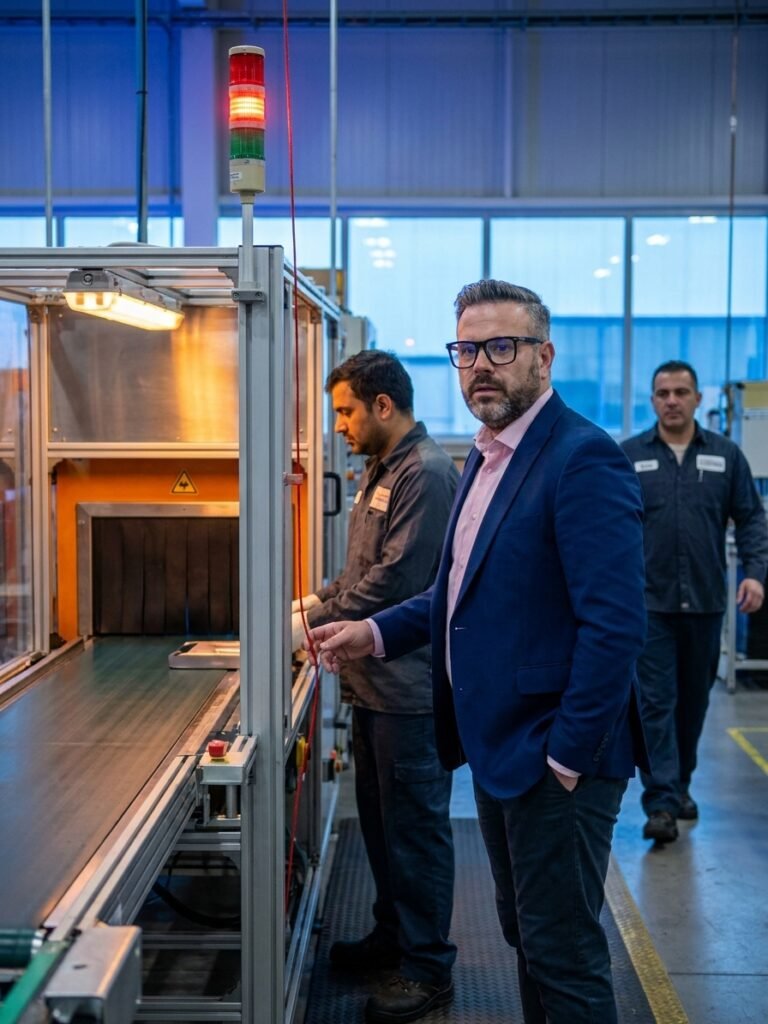
The third principle dictates that when maintenance is unavoidable, it must be engineered for error-proof execution. This concept, strongly related to poka-yoke, means designing assemblies so they can only be repaired correctly. Components should require no specialised tools for replacement. Connectors must be colour-coded and physically keyed so they cannot be wired backwards. Access panels must allow front-facing replacement so mechanics do not have to enter confined spaces, improving both speed and safety.
Building the Maintenance Prevention Feedback Loop
The core mechanism of MP is the feedback loop between the maintenance floor and the design engineering department. In traditional operations, a mechanic replaces a worn pneumatic seal, logs the hours in the CMMS, and moves on. The failure data dies in the maintenance log. In an MP system, every maintenance intervention is treated as a design failure that requires an engineering countermeasure.
I have implemented this transition using a standardised MP Record format, a concept developed within the Japanese TPM framework. When a mechanic completes a repair, they must document the specific physical failure mechanism—not just 'seal failed,' but 'dynamic seal degraded due to thermal expansion mismatch at operating temperature.' They must then propose a design modification that would prevent this failure in future iterations of the equipment.
These MP records become mandatory inputs for the specification of new equipment. When the plant purchases a new line, the engineering team reviews the historical MP records and explicitly writes those hard-won lessons into the supplier requirements. This ensures the organisation never pays for the same design flaw twice. It is a systematic application of the 8D problem-solving methodology applied to equipment lifecycle management.
Targeting the Highest-Impact Failure Modes
Implementing Maintenance Prevention requires strict prioritisation. Organisations cannot redesign every machine simultaneously. The process must begin with rigorous data collection from the Computerized Maintenance Management System (CMMS). You must extract 12 to 24 months of maintenance history and quantify the total cost of failure for every asset. This cost must include replacement parts, maintenance labour hours, and the definitive cost of lost production.
Once the data is cleansed and aggregated, apply the Pareto principle. In almost every manufacturing facility I have assessed, fewer than 20% of the assets drive 80% of the maintenance budget. Identifying these specific machines—often critical path equipment like hydraulic power units, high-cycle pneumatic cylinders, or robotic end-effectors—is the starting point. Targeting trivial failures wastes engineering resources that belong on constraint operations.
Every repair is a design failure. If you are fixing the same assembly twice, you are maintaining a flaw, not a machine.
For the top three to five worst-performing assets, conduct a rigorous root cause analysis. The goal is to move past the mechanical failure and identify the physics of the breakdown. Determine whether the failure can be eliminated through a redesign, or if the maintenance interval can be extended past the machine's depreciation lifecycle. If neither is possible, the design must be modified to make the required maintenance action completely foolproof.
Early Equipment Management in the Procurement Phase
The highest leverage point for Maintenance Prevention is the procurement cycle. Once a machine is bolted to the floor, your ability to alter its fundamental physics is severely limited. The optimal time to implement MP principles is during the specification and sourcing phase. This practice is known as Early Equipment Management (EEM), and it fundamentally shifts the cost of ownership.
During the tendering process, the technical specification must include rigid MP requirements. These include minimum acceptable Mean Time Between Failures (MTBF) metrics, mandated accessibility standards for wear parts, and integrated diagnostic sensor suites. Suppliers must be evaluated not merely on capital cost and throughput, but on an 'MP score' that quantifies the projected maintenance burden over the machine's operational lifecycle.
Key Metrics for Equipment Procurement
Before accepting a new machine, quality and maintenance teams must execute a rigorous Factory Acceptance Test (FAT) that audits maintainability. Verify that guarding can be removed without specialised tooling. Confirm that sensors are networked into the overarching SCADA or IoT architecture, not just wired to a local relay. Demand contractual guarantees from the supplier regarding maximum maintenance costs for the first three years of operation.
Integrating Industry 4.0 Technology into Maintenance Prevention
Digital transformation accelerates Maintenance Prevention, provided the underlying design philosophy is sound. Digital twins allow engineering teams to simulate mechanical stress, thermal expansion, and component fatigue long before steel is cut. AI-driven analytics can evaluate years of CMMS data to identify complex, multi-variable failure patterns that human engineers might overlook, highlighting the highest-value targets for physical redesign.
However, technology is a tool, not a strategy. An AI algorithm can accurately predict that a hydraulic seal will fail every 47 days, allowing you to schedule a replacement and order inventory. This saves you from unplanned downtime, but it does not eliminate the cost of the intervention. Only an engineer applying MP principles will look at that AI prediction and mandate a transition to a non-contact labyrinth seal to drive the failure rate to zero.
The integration of cloud-based MP registers allows multinational organisations to share design flaw resolutions instantly across geographically dispersed facilities. When a plant in one region engineers a successful modification for a robotic welding cell, that design change is automatically pushed to the equipment specifications of every other region. This ensures structural standardization and multiplies the financial return of every engineering intervention.