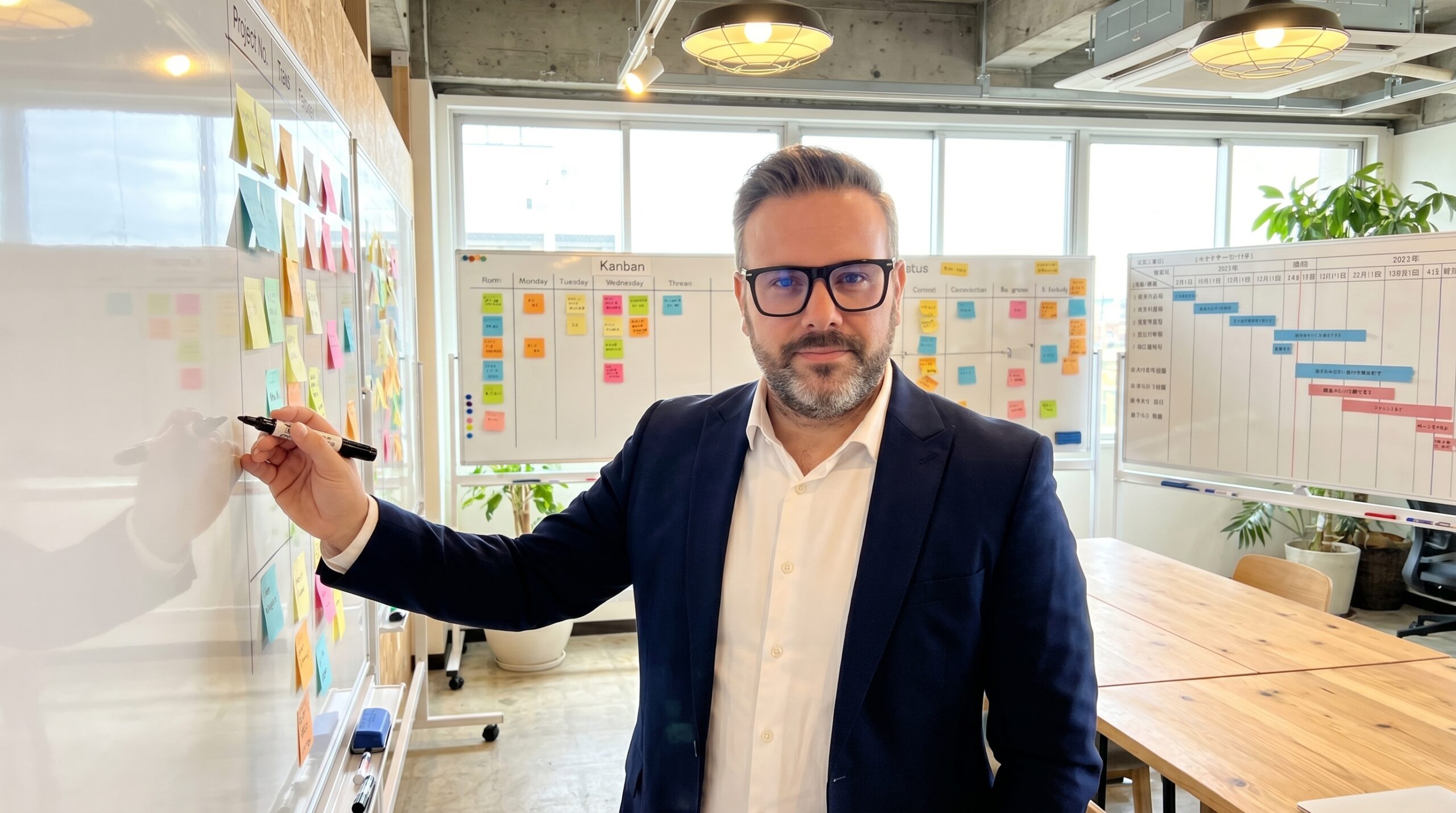
A project sits three months behind schedule. Four departments work the same issue, but nobody knows what the others are doing. Emails pile up, meetings generate follow-up meetings, and decisions wait for approvals that never arrive. This is the standard state of matrixed manufacturing.
Now walk into a room where key metrics hang on the wall. The project timeline is visible at a glance. Open problems are flagged in red. Departmental leaders stand at the wall and solve those problems in real time. A decision that once took five weeks takes five minutes.
This is Obeya. Japanese for 'large room', it is a management practice Toyota developed during the Prius programme in 1994. Chief Engineer Takeshi Uchiyamada needed to align 1,000 people to hit an aggressive launch target. His solution was a physical room where all information was visible, all accountable leaders were present, and decisions happened on the spot.
Obeya Is a Management System, Not Interior Design
Most engineers picture a room covered in sticky notes when they hear the word Obeya. That is a fraction of the truth. Obeya is a structured management system built on four functional pillars: visual transparency, meeting rhythm, cross-functional authority, and decision speed.
The walls display working data, not decoration. Project timelines, KPI dashboards, open issue lists, and responsibility matrices are updated daily. The governing rule is absolute: if a problem is not visualised on the wall, it does not exist. If nobody looks at a metric, it serves no purpose.
Cross-functional presence is mandatory. In an Obeya, production, quality, purchasing, logistics, and engineering sit together as co-owners of the solution. When a manufacturing issue requires a design tweak, the engineer is present. There is no forwarding emails or promising to 'circle back with the team'.
Speed is the output of this setup. In traditional matrix management, a standard decision takes days because it routes through silos. In an Obeya, decisions happen in real time because everyone with authority is in the room. If a representative lacks the mandate to decide, they do not belong in the room.
Obeya vs Traditional Project Meetings
Traditional Meetings
- Status reporting consumes the agenda
- Participants wait days for silo approvals
- Information hides in departmental inboxes
- Action items lack clear accountability
Obeya Sessions
- Decisions and problem-solving drive the agenda
- Approvals happen live at the wall
- Performance data is public and immediate
- Owners are assigned before leaving the room
Building the Pulse: Cadence and Visual Control
Obeya is not a room you visit once a month to check progress. It is a pulsing workspace with a strict meeting cadence. Daily stand-ups of 15 minutes focus on shift output, immediate safety issues, and roadblocks. Weekly deep-dives take 45 to 60 minutes for detailed root cause analysis and project updates.
Monthly reviews take two hours for strategic alignment. The critical distinction from traditional meetings is the format. Obeya sessions are not for reporting. They are for deciding. You walk in with a problem, and you walk out with an action and an owner.
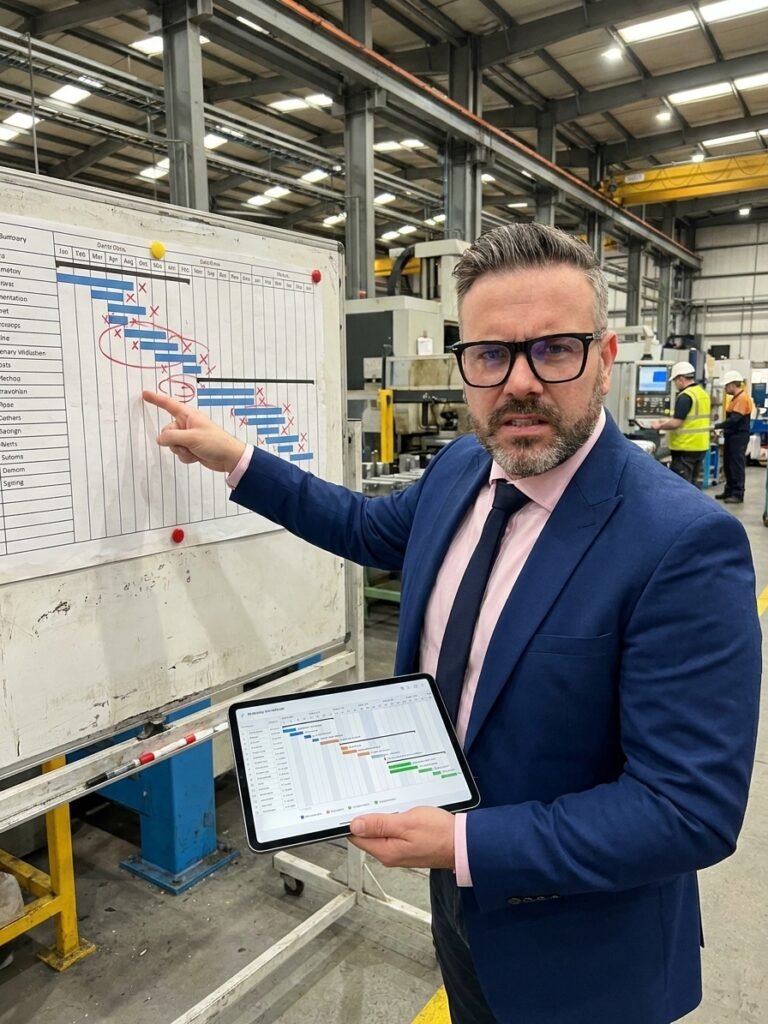
Digital Obeya spaces face the exact same rules. Teams using Miro boards or SharePoint must maintain discipline. Digital boards degenerate quickly into a string of unread links if you abandon live interaction. Even in a remote setup, turn cameras on and enforce the daily stand-up.
Visual smog ruins the space. When 200 outdated sticky notes cover the walls, the team stops looking. Clean the boards weekly. Remove solved issues and stale metrics. Display only what drives the current shift or sprint. Clean walls force focused attention on active problems.
Field Application: Rescuing an Automotive Launch
I was brought into a manufacturing plant during an automotive launch. A new line was four months from start of production, and the team operated in organised chaos. Three shifts, twelve supervisors, and four managers all operated from completely different versions of reality.
In the first week, I cleared an empty room next to the line, hung up flipcharts, and set the rule: daily stand-up at 7:00 AM for 15 minutes. Every supervisor brought three numbers: output, scrap rate, and open safety issues. The resistance was immediate. Nobody wanted another meeting.
It took two weeks for a breakthrough. A supervisor noticed his low output on station 4 matched a problem we saw on station 7 the previous week. The root cause was a machine setting maintenance could fix in 20 minutes. The silos had prevented that connection.
After four weeks, the Obeya reduced scrap rate by a third. We cut average reaction time from 48 hours to 4 hours. The team closed 23 chronic issues. The resistance faded because the system solved real production problems.
If a problem is not visualised on the wall, it does not exist. If nobody looks at a metric, it serves no purpose.
Integrating Obeya with QMS and IATF 16949 Requirements
Obeya is a critical accelerator for Quality Management Systems. It does not replace your IATF 16949 or AS9100 documentation, but it forces those documents into active use rather than letting them gather dust in a compliance binder.
Process FMEAs become living documents. When a risk manifests on the floor, it appears on the Obeya wall. The team evaluates the current controls and updates the PFMEA severity or occurrence ratings on the spot, ensuring the documentation matches reality.
8D problem-solving moves faster. When quality, engineering, and operations sit in the same room, completing D4 (Root Cause) and D5 (Corrective Action) takes days instead of weeks. The accountability matrix on the wall prevents the containment action from stalling.
Obeya 8D Acceleration Cycle
- 01Problem DetectionA red metric appears on the Obeya board during the daily stand-up.
- 02Cross-Functional HuddleQuality, engineering, and operations review the containment action immediately.
- 03Root Cause (D4)The team agrees on the technical root cause and assigns verification tasks.
- 04Corrective Action (D5)Process owners approve and implement the permanent fix on the line.
Designing the Room and Selecting the Team
Obeya fails without a clear purpose. Before booking a room, define the exact target. Is it launching a new product? Cutting scrap by 50 percent? Integrating a new acquisition? Vague goals produce vague meetings. Once the goal is set, assign physical walls to specific functions.
Wall one covers targets and vision, displaying the timeline and milestones. Wall two shows current status, using trend charts and RAG (Red/Amber/Green) traffic-light metrics. Wall three lists open problems, action owners, and deadlines. Wall four maps responsibilities and escalation paths.
Selecting the right people is critical. You need eight people who have the authority to decide, access to data, and the willingness to admit problems. Inviting 25 passive observers turns a decision engine into theatre. Cap attendance at 12 to maintain speed.
Run the stand-up strictly. For 15 minutes, each member states what they finished, what they will start, and what blocks them. If a quality manager says they are waiting on a tooling approval, the tooling representative must answer yes or no before the meeting ends.
Knowing When to Scale Back or Disband
Obeya is not a permanent fixture. It is a tool to achieve a specific outcome, like stabilising a launch or resolving a quality crisis. Keeping the daily pulse alive artificially after a process stabilises wastes engineering hours and breeds apathy.
When the project ends or the process reaches steady state, transition the room. Move to weekly reviews or fold the visual metrics into standard tier meetings. If you leave the Obeya running indefinitely, the team will start going through the motions rather than solving problems.
Start small. Find a room, bring six core leaders, and enforce a 15-minute daily stand-up. When decisions take minutes instead of weeks, the cultural shift happens on its own. The gap between a successful launch and a delayed one is simply the speed of information.