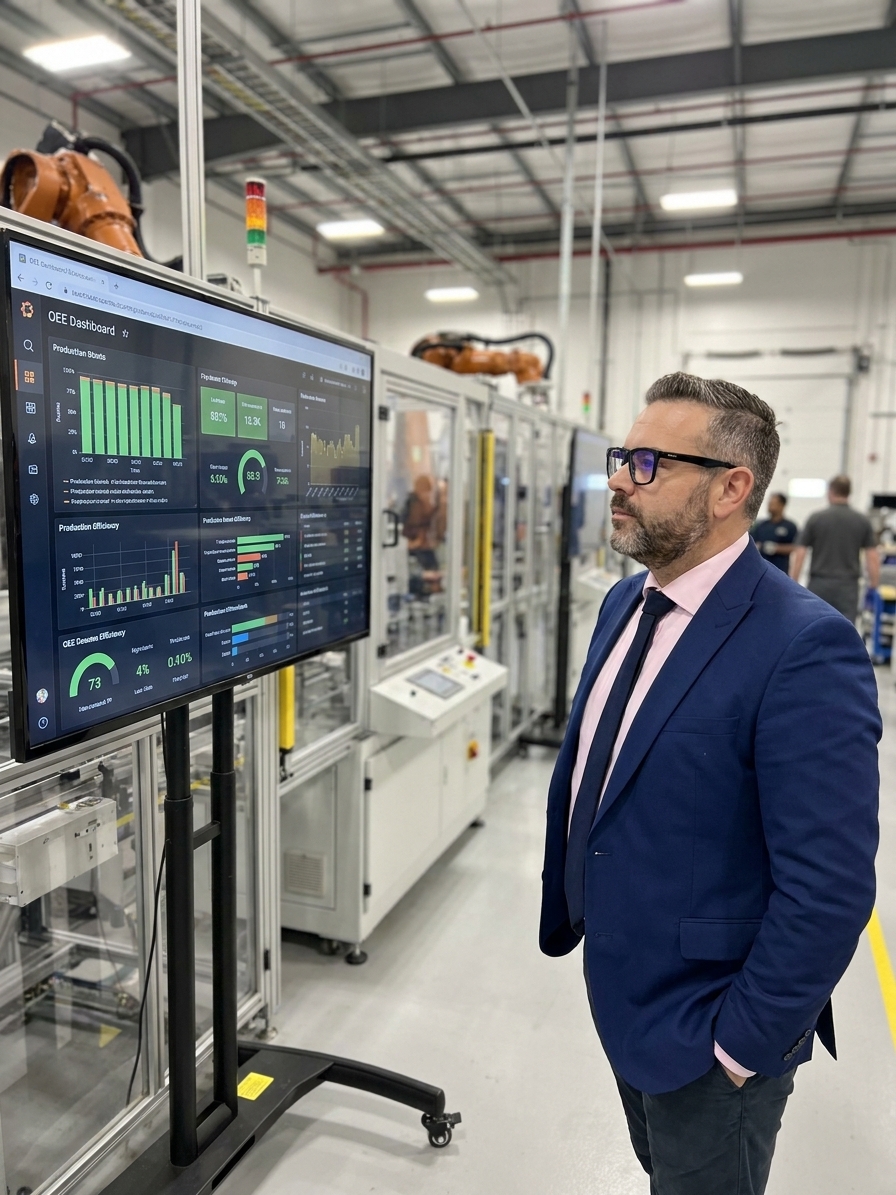
Overall Equipment Effectiveness — OEE — is the most quoted metric in
modern manufacturing. Walk into any plant operating under Lean or TPM
principles and you will find it on a whiteboard, a dashboard, or a
monthly report. Managers quote it in meetings. Consultants benchmark it.
Board members ask for it by name. The formula is elegant in its
simplicity: Availability multiplied by Performance multiplied by
Quality. Three numbers, each between zero and one, multiplied together
to give you a single percentage that is supposed to tell you how well
your equipment is performing.
Except it does not. Or rather, it tells you something — but not what
you think it tells you, and not what you need to know.
This article is not an argument against OEE. The metric has genuine
value when understood and applied correctly. But in the vast majority of
manufacturing organizations, OEE has become what every popular metric
becomes when it is quoted more often than it is examined: a story people
tell themselves about how well they are doing, a story that is often
more fiction than fact.
The Three Lies of OEE
OEE purports to capture three dimensions of equipment performance.
Each one is individually useful. Each one is also individually
vulnerable to manipulation, misinterpretation, and deliberate gaming.
When you multiply three unreliable numbers together, you do not get a
more reliable number. You get a less reliable one.
The Availability Lie
Availability is supposed to measure the proportion of scheduled time
that your equipment is actually running. The formula is simple: Run Time
divided by Planned Production Time. A machine that was scheduled to run
for eight hours and ran for seven gives you 87.5% availability.
The problem begins with the definition of “Planned Production Time.”
Who decides what was planned? In many organizations, the planned time is
adjusted retroactively to account for unplanned downtime events. A
machine goes down for two hours because of a mechanical failure, and
someone decides that the maintenance “should have been scheduled,” so it
gets reclassified as planned downtime. The planned production time
shrinks by two hours, and availability stays artificially high.
This is not always dishonest. Sometimes it is a genuine disagreement
about classification. A die change was supposed to take thirty minutes
but took ninety. Was the extra hour unplanned downtime, or was the
original estimate simply unrealistic? The answer depends on who you ask,
and the person doing the asking is usually the person whose performance
is being measured.
Then there is the question of what counts as “running.” A machine
that is cycling but producing scrap is technically available. A machine
that is running at reduced speed because of a worn component is
available. A machine that is producing parts that will fail inspection
downstream is available. Availability tells you the machine was on. It
does not tell you it was doing anything useful.
The Performance Lie
Performance is supposed to measure how fast your equipment is running
compared to how fast it could run. The formula: Actual Output divided by
Theoretical Output at rated speed. If a machine could theoretically
produce 100 parts per hour and it produced 85, your performance rate is
85%.
The theoretical rate is where the trouble starts. What is the “ideal
cycle time” of your equipment? The manufacturer’s specification? The
best cycle time ever achieved under laboratory conditions? The cycle
time your industrial engineer calculated on paper? The fastest your most
skilled operator has ever run it?
In practice, organizations choose the denominator that gives them the
number they want. If you want a higher OEE, you use a slower “ideal”
speed. If you want to justify a capital purchase, you use a faster one.
The same machine can have dramatically different OEE values depending on
which theoretical speed you choose, and both choices can be defended as
reasonable.
There is also the matter of minor stops. A machine that pauses for
three seconds every minute to clear a jam is not technically down — each
pause is too short to track individually — but over an eight-hour shift,
those three-second stops accumulate to nearly forty minutes of lost
production. Most OEE tracking systems do not capture these
micro-stoppages. They disappear into the performance rate as unexplained
losses, making the number look better than reality warrants.
The Quality Lie
Quality is the most straightforward dimension: Good Parts divided by
Total Parts Produced. But even here, the definitional games are
relentless.
What counts as a “good” part? Parts that pass final inspection? Parts
that pass in-process inspection? Parts that the customer accepts? Parts
that meet specification? Parts that meet specification at the time of
production but fail after aging? Each definition produces a different
quality rate, and each definition can be justified.
Then there is the rework problem. If a part is produced out of
specification and then reworked to meet specification, does it count as
a good part or a defective one? In many OEE calculations, reworked parts
are counted as good — they passed inspection eventually, after all. This
inflates the quality rate and understates the true cost of poor quality,
because rework is not free. It consumes labor, energy, time, and often
material. But the OEE formula does not capture any of that. A reworked
part and a first-pass-good part are numerically identical.
Scrap that is recycled and reused presents a similar ambiguity. If
you melt down defective castings and pour them again, the raw material
is recovered, but the energy, labor, and machine time are gone forever.
OEE, in most implementations, treats the re-poured casting as a fresh
part and the recycled scrap as though it never happened.
The Multiplication Problem
Even if you could solve all three definitional problems — and you
cannot, not completely — there is a mathematical issue that most OEE
users do not think about. When you multiply three numbers together,
small errors in each compound.
Consider a machine with reported availability of 92%, performance of
95%, and quality of 98%. The OEE is 85.7%. This looks like a solid
number. But if availability is actually 88% (because some downtime was
reclassified), performance is actually 90% (because the ideal cycle time
was inflated), and quality is actually 96% (because rework was counted
as good), the real OEE is 76.0%. That is not a small difference. It is
the difference between a world-class operation and one that needs
significant improvement, and it is hidden inside what looks like a
reasonable three-percentage-point error in each component.
The compounding effect works in the other direction too. An
organization that inflates each component by just two percentage points
reports an OEE of 85.7% when the reality is 79.9%. Over a year of
production, that gap represents thousands of lost parts, hundreds of
wasted hours, and a substantial amount of money that nobody accounts for
because the dashboard says things are fine.
World-Class
OEE: The Benchmark That Became a Target
The OEE literature commonly cites “world-class” OEE as 85% — 90%
availability, 95% performance, and 99.9% quality. This benchmark,
originally derived from Seiichi Nakajima’s work on TPM in the 1980s, was
descriptive: it described what the best Japanese plants were achieving
at the time. It was never intended to be prescriptive, and it was
certainly never intended to be a universal target.
But in the decades since, 85% has become a de facto standard.
Organizations set it as a goal. Managers are evaluated against it.
Plants that achieve it celebrate; plants that fall short are pressured
to improve. The result is exactly what you would expect: people find
ways to make the number say 85% without necessarily making the
underlying reality any better.
This is Goodhart’s Law in its purest form: when a measure becomes a
target, it ceases to be a good measure. OEE was a reasonable measure of
equipment effectiveness. Then it became a target. Now it is neither.
Some organizations have made things worse by setting OEE targets
above 85%. A target of 90% or 95% OEE is not aspirational — it is
mathematically hostile to honest reporting. When the target is that
high, the only way to achieve it is to redefine the inputs. Ideal cycle
times slow down. Downtime gets reclassified. Rework disappears from the
quality count. The number looks magnificent. The factory floor tells a
different story.
What OEE Is Actually Good
For
Despite all of this, OEE is not useless. It is useful for exactly one
thing: tracking changes in the same equipment, on the same line, with
the same definitions, over time. If your definitions are consistent and
honest, and if you track OEE for Machine A from January to December
using the same ideal cycle time, the same downtime categories, and the
same quality criteria, then the trend tells you something meaningful. A
rising OEE trend, calculated consistently, probably indicates genuine
improvement. A falling one probably indicates genuine deterioration.
The key word is “probably.” Even with consistent definitions, OEE can
be misleading if the product mix changes, if the batch sizes shift, if
the workforce turns over, or if the maintenance strategy evolves. OEE is
a summary statistic, and like all summary statistics, it compresses
complex realities into a single number. That compression loses
information. Always.
OEE is also useful as a conversation starter, not as a conversation
ender. When OEE drops, it should prompt questions, not conclusions. “Why
did OEE drop?” is a productive question. “OEE dropped to 78%, therefore
availability is the problem” is a dangerous conclusion, because it may
have been performance or quality that actually drove the change, and the
relative contribution of each component depends on where you
started.
The
Alternative: Stop Averaging and Start Looking
The most productive thing most manufacturing organizations could do
with OEE is stop averaging it. Not stop calculating it — stop averaging
it.
A single OEE number for a plant, or even for a production line, is an
average of averages of averages. It tells you almost nothing about what
is actually happening. The OEE of Machine 3 during the overnight shift
running Product B is a meaningful number. The OEE of the entire plant
for the month of March is not, because it combines different machines,
different products, different shifts, different operators, and different
conditions into a single figure that obscures more than it reveals.
Instead of chasing an aggregate OEE target, organizations should
track the three components independently, at the equipment level, with
clear and unchanging definitions, and use them to identify specific
losses. Which machine has the lowest availability? Which shift has the
worst performance rate? Which product has the highest quality loss?
These are actionable questions. “How do we get our OEE to 85%?” is
not.
The best plants do not quote OEE numbers in meetings. They quote
specific losses: “We lost 340 minutes on the forming line last week to
die changes, and 180 minutes to unplanned maintenance.” They quote
specific quality issues: “The CNC cell scrapped 47 parts on Thursday,
all from the same batch of material.” They do not need a composite index
to tell them where their problems are, because they have already looked
at the components and identified the root causes.
OEE is a starting point for investigation. It was never designed to
be a performance grade, a management target, or a benchmark for
comparison between dissimilar operations. The moment you treat it as any
of those things, you have already lost the information it was supposed
to give you.
The Real Cost of the OEE
Obsession
There is a cost to the way most organizations use OEE that goes
beyond inaccurate numbers. The real cost is attention. Every hour that a
management team spends discussing how to improve OEE is an hour not
spent discussing how to improve the specific things that OEE is supposed
to represent.
If availability is the problem, the conversation should be about
preventive maintenance schedules, spare parts inventories, and
changeover reduction — not about how to reclassify downtime to make the
number look better. If performance is the problem, the conversation
should be about process engineering, tooling wear, and operator training
— not about which ideal cycle time to use in the denominator. If quality
is the problem, the conversation should be about process capability,
incoming material inspection, and mistake-proofing — not about whether
rework should be counted.
OEE, used properly, points you toward these conversations. OEE, used
the way most organizations use it, replaces these conversations with
arguments about the number itself. The metric becomes the meeting. The
dashboard becomes the discussion. The target becomes the objective. And
the actual quality, the actual productivity, the actual performance of
the equipment on the factory floor — those things become secondary to
the number that is supposed to represent them.
This is the deepest problem with OEE, and it is the one that no
formula can solve. It is a human problem, an organizational problem, a
problem of management attention and institutional incentives. The metric
is not broken. The relationship with the metric is broken. And broken
relationships with metrics produce broken understanding of reality,
which produces broken decisions, which produce broken outcomes.
Measure OEE. Track it consistently. Use it to ask questions. But
never, ever treat it as the answer.
Peter Stasko is a Quality Architect with over 25
years of experience in manufacturing quality management, process
improvement, and production optimization. He has helped organizations
across automotive, aerospace, electronics, and heavy industry implement
quality systems that focus on substance over metrics — because the
number on the dashboard is only as good as the honesty behind it.