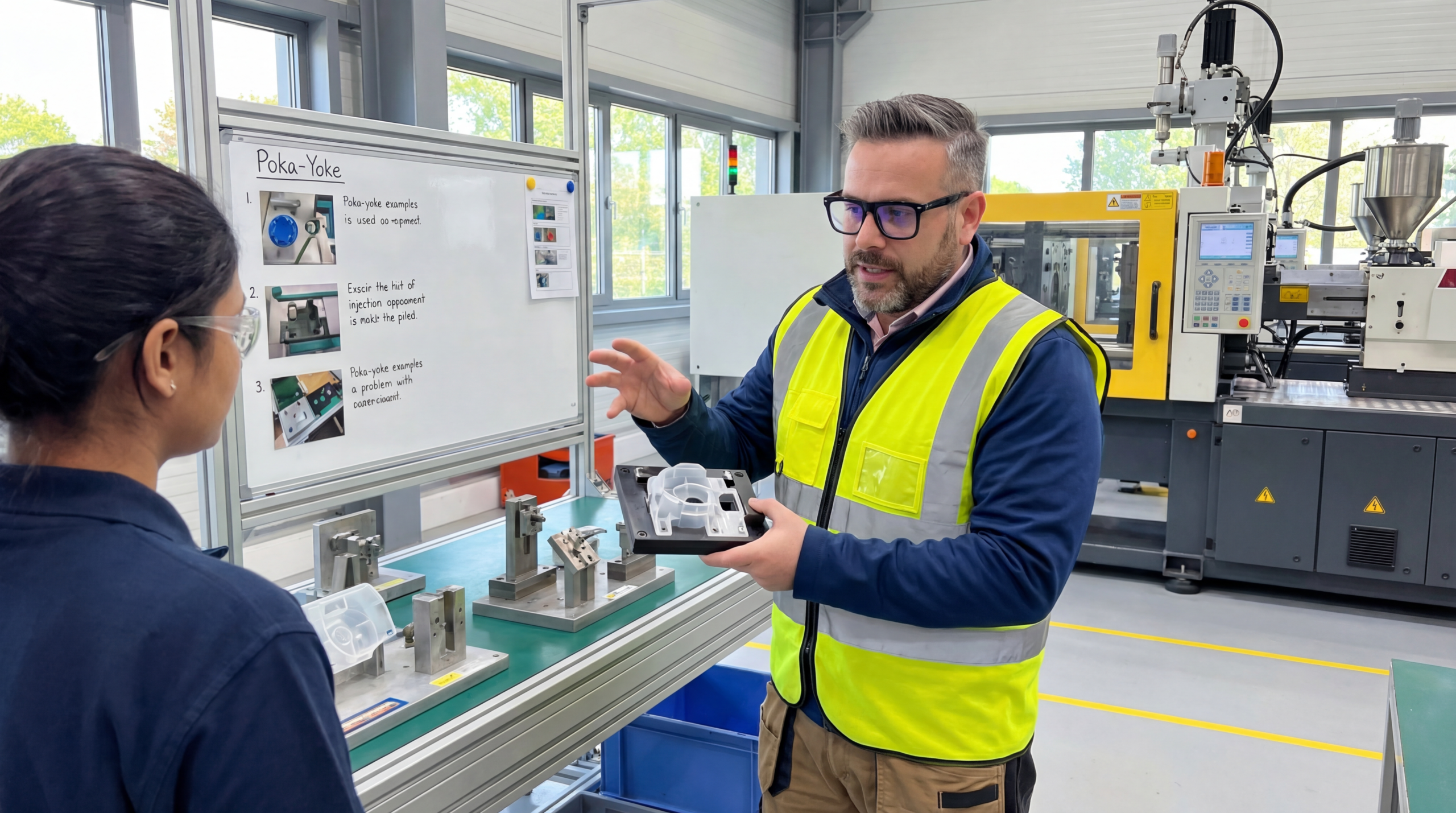
Poka-Yoke is not a theoretical exercise for the design engineering desk. It is a shop-floor mechanism that performs best where the value is actually created—directly on the manufacturing line. When implemented correctly, it physically prevents a process from producing a defect.
During a recent project with a German automotive supplier manufacturing plastic components, the quality target was absolute: zero defects on customer deliveries. Meeting IATF 16949 requirements with traditional end-of-line inspection alone would not achieve this. The existing process relied too heavily on operator vigilance, which introduces inherent, unpredictable variability into cycle times and dimensional accuracy.
To close the gap, I bypassed the initial documentation phase and went straight to the manufacturing line. By engaging shift leaders and machine operators directly, we implemented functional Poka-Yoke systems that targeted the actual mechanical constraints of the equipment. The difference between designing mistake-proofing in a CAD model and welding a jig onto a press is the difference between theory and zero-defect manufacturing.
Control vs. Warning Mechanisms
Effective mistake-proofing falls into two distinct categories defined by their physical interaction with the process. Understanding which one to apply dictates whether you are merely alerting an operator or physically guaranteeing the outcome of the manufacturing step.
A Control Poka-Yoke physically prevents the operator or machine from executing the wrong action. If a part is loaded backwards, the press cycle will not initiate. The mechanism overrides human error by making the incorrect physical geometry impossible to seat in the fixture. This is the gold standard because it requires no human interpretation.
A Warning Poka-Yoke uses sensors, stack lights, or audible alarms to alert the operator before a defect is created. While it does not physically lock the machine, it interrupts the cycle. This approach is highly effective for parameter control—such as monitoring injection pressure or temperature variances—where physical geometry is not the limiting factor.
Approaches to Defect Prevention
Detection and Warning
- Relies on end-of-line quality control checks
- Requires constant operator vigilance during the cycle
- Generates scrap and requires rework after the fact
- Degrades overall equipment effectiveness (OEE) over time
Control and Prevention
- Engineers the failure mode out of the fixture or tooling
- Physically locks the cycle if inputs are incorrect
- Produces zero defects at the source of the process
- Stabilises cycle time and reduces process variability
Integrating Poka-Yoke with PFMEA
In product design, mistake-proofing is driven by DFMEA. On the production line, it is strictly governed by PFMEA (Process Failure Mode and Effects Analysis). The PFMEA identifies where a process can fail; the Poka-Yoke device is the engineered response that drives the Risk Priority Number (RPN) down by eliminating the failure cause.
Consider a plastic moulding operation where a component could shift by 0.5 mm during the pressing cycle. Without adequate fixturing, operators were aligning parts by eye. The PFMEA highlighted this with a Severity of 8. Because the shift caused assembly failures downstream, the only viable solution was a mechanical jig that constrained the component on both the X and Y axes.
When the fixturing device forces the component into the exact datum required, the occurrence of the failure mode drops to zero. The RPN calculation changes fundamentally. You are no longer relying on detection; you are actively managing the mechanical capability of the assembly process to guarantee dimensional stability.
Prototyping and Validating the Device
A common failure in mistake-proofing is over-engineering the solution before validating it on the floor. During the German automotive project, we used rapid 3D printing to build the initial jig prototype using PLA. The goal was not longevity, but immediate functional verification: could the operator seat the component in under two seconds?
The PLA prototype proved the concept but failed under the repetitive stress of the manufacturing environment. We transitioned the design to CNC-machined ALU6061. This secondary prototype was robust, dimensionally stable, and capable of withstanding over 100,000 cycles without degrading the locating surfaces.
Validation requires strict measurement system analysis (MSA) alongside the mechanical build. Before full implementation, we calibrated the aluminium jig with certified gauges, ran a 100-piece test batch, and verified that downstream assembly tolerances remained perfectly within Cpk requirements. If the device alters the process flow, you must prove statistically that it does not introduce new failure modes.
Measuring the Operational Impact
Implementing a Poka-Yoke device must produce measurable returns in process capability and equipment effectiveness. On the plastic moulding line, the manual alignment process was consuming valuable cycle time and generating a 0.5% defect rate. Post-implementation KPIs tracked across 1,500 units provided definitive evidence of success.
The aluminium jig reduced the average cycle time from 2.0 minutes to 1.2 minutes per part—a 40% increase in throughput. The defect rate dropped to absolute zero, and the rework rate dropped to zero, yielding a 15% increase in Overall Equipment Effectiveness (OEE). At a total implementation cost of roughly €500 for machining and materials, the device paid for itself in less than two weeks.
If the operator can still load the part incorrectly, your PFMEA documentation is just expensive fiction.
Moulding Line KPI Shift Post-Implementation
Sustaining Quality Through Operator Engagement
The most robust mechanical fixture will fail if the production culture does not support it. Quality managers often make the critical error of designing jigs in isolation and delivering them to the line as a mandate. If operators are not engaged in the problem-solving phase, they will view the new device as an unnecessary obstacle rather than a tool that simplifies their work.
During the design phase on the moulding line, an operator suggested using a high-strength magnet to hold the alignment bracket instead of a mechanical lock. We tested the suggestion on the aluminium prototype, and it functioned perfectly, reducing the loading force required. Recognising and implementing these shop-floor insights is what separates functional mistake-proofing from discarded engineering projects.
When an operator makes a mistake, the default management reaction is often to mandate retraining. This is a failure of leadership. A defect at the station is a signal of inadequate process engineering. By treating errors as system vulnerabilities rather than personnel failures, you build an environment where operators actively report issues because they know the response will be a process upgrade, not disciplinary action.
Common Failure Modes in Implementation
Applying complex automated systems to simple mechanical problems is a frequent misstep. If an operator is loading a component backwards, the solution is not a machine vision system and a robotic arm. The solution is a physical locating pin that prevents the part from seating incorrectly. Adhering strictly to the KISS principle ensures the device is maintainable and easily understood by shift operators.
Static fixtures on dynamic manufacturing lines create severe bottlenecks. If you design a rigid jig for one specific component variant, and the production schedule shifts to a family of parts with slightly different geometry, the entire mistake-proofing system becomes useless. Modular designs with interchangeable locating blocks provide the flexibility required to maintain quality across mixed-model production runs.
Finally, failing to provide visual management renders the device invisible. Paper PFMEA documents and control plans live in engineering offices. The production floor requires immediate context. Mounting pictograms directly onto the press, displaying step-by-step loading instructions, and posting real-time OEE metrics at the station ensures the mistake-proofing logic is transparent to the people running the cycle.
The most effective Poka-Yoke systems are completely invisible to the operator. The restraint or guidance is simply built into the natural motion of the task. When mistake-proofing becomes an integrated part of the work, rather than an additional quality inspection step, you achieve predictable, stable output and true zero-defect manufacturing.