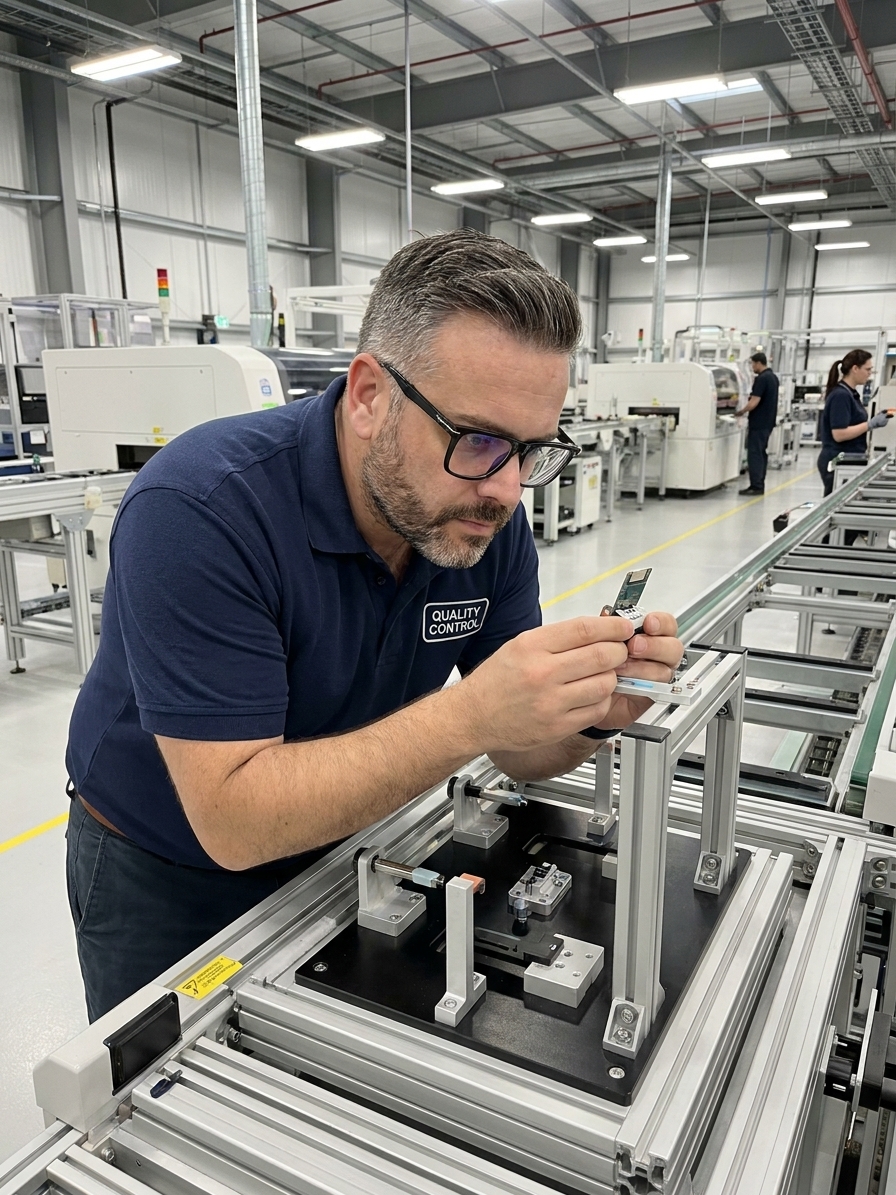
An operator loads the component, cycles the machine, and the part comes out defective. The supervisor raises an 8D. The quality engineer investigates, lists the root cause as 'operator error,' and the corrective action is retraining. Three weeks later, the identical defect emerges on a different shift, produced by a different operator on the same equipment.
I have audited plants across automotive and aerospace that document procedures meticulously, train comprehensively, and post visual aids at every station. Yet their defect rates stagnate. The organization does everything right on paper, fighting human nature instead of designing around it. They hold the workforce accountable for failures that the process virtually guarantees.
Nobody stops to ask the only question that actually matters: why is it physically possible to assemble this part incorrectly? That question is the foundation of poka-yoke. The answer is where most quality management systems discover they have been treating symptoms while actively ignoring the disease.
The Shingo Method: Engineering Out Human Error
Shigeo Shingo developed the poka-yoke concept while studying Toyota's production system, observing that most defects are not born of carelessness or incompetence. They occur because processes allow well-intentioned, fully trained professionals to execute the wrong action. Shingo's core insight was not that people needed to try harder, but that the process itself needed to be structurally smarter.
Shingo classified mistake-proofing devices into two functional categories. Prevention devices make the error physically impossible, such as an asymmetric pin that prevents a connector from mating in the wrong orientation. Detection devices do not stop the initial mistake, but they make it immediately visible before value is added, using sensors or interlocks that halt the line.
Both approaches share a single, uncompromising philosophy: never rely on human vigilance for a problem that engineering can solve. Human attention is finite, variable, and vulnerable to a thousand daily distractions on a noisy production line. A well-designed poka-yoke device never experiences fatigue and never assumes the operator memorized the latest revision of the work instruction.

The True Cost of Writing 'Operator Error'
If poka-yoke is so effective, why does management resist deploying it across every workstation? The answer is cultural and financial discomfort. Most organizations would rather blame the individual than redesign the process. Writing 'operator error' on a corrective action report costs nothing and requires zero engineering effort.
Retraining an operator takes an hour. Designing and validating a robust physical poka-yoke device takes engineering time, prototyping, and capital expenditure. In the myopic calculus of a quarterly budget, retraining always appears to be the better deal. Except it isn't. 'Operator error' is never a root cause; it is a symptom of a process that allowed the deviation and a system that failed to catch it.
Every time you close a corrective action by citing human error and retraining, you guarantee the defect will return. The economics of prevention are counterintuitive because they produce an absence: the non-event of a defect that never reaches the customer. You can clearly see the cost of a fixture, but you cannot easily quantify the hundred escaped defects it prevents.
The Hierarchy of Mistake-Proofing Control
Not all poka-yoke delivers the same level of risk mitigation. There is a strict hierarchy of control, and understanding it is critical for prioritizing engineering effort. Moving up this hierarchy requires greater upstream design work but yields exponentially stronger quality guarantees.
Hierarchy of Poka-Yoke Effectiveness
- 1. EliminationRedesigning the product so the error-prone step no longer exists (e.g. making a part symmetrical).
- 2. PreventionPhysical or logical constraints that make the wrong action impossible (e.g. asymmetric locator pins).
- 3. Detection with Forced StopSensors detect the error and halt the process before the defect propagates to the next station.
- 4. Detection with WarningVisual or audible alarms alert the operator, but the process continues. Weakest form of control.
At the top is elimination, where the step that could go wrong is designed out of the process entirely. If a fastener can be cross-threaded, eliminate the fastener. Below that is prevention, using constraints like fixtures that will not clamp unless the part is correctly seated. Software that disables invalid options is a logical prevention mechanism.
Further down is detection with a forced stop. The operator can make the mistake, but a proximity sensor refuses to allow the next cycle to start until the error is corrected. At the very bottom is detection with a warning. This is the weakest form because it still relies on human response. Under time pressure or fatigue, operators become habituated to alarms and simply bypass them.
Anatomy of a Robust Poka-Yoke Device
Effective mistake-proofing operates seamlessly within the normal flow of work. If your poka-yoke device requires additional effort, creates a bottleneck, or forces operators to perform extra checks, you have not reduced the chance of error. You have merely relocated the failure mode to a different part of the line while frustrating the operator.
The safeguard must also be fail-safe. If the poka-yoke device itself fails, the process must default to a locked, safe state. A sensor failure must stop the line, not silently allow defects to pass. A broken guide pin must physically prevent assembly. The reliability of your process cannot depend on the perfection of the safeguard itself; that is circular logic that inevitably produces escaped defects.
Operators are creative. Under intense takt-time pressure, they will find ways to bypass safeguards that slow them down. If your physical poka-yoke can be defeated with tape, a piece of wire, or a bypassed relay, it will be. You must design the device so that defeating it is measurably harder than using it correctly. The path of least resistance must also be the path of zero defects.
The cheapest defect is the one that is structurally impossible to create.
Implementing Poka-Yoke in Existing Operations
Do not attempt to mistake-proof an entire facility simultaneously. The correct place to start is with the chronic defect your organization has already tried to eliminate three separate times and failed. It shows up in every quality review. It has survived multiple 8D cycles. Retraining has failed. The defect persists because the process actively allows it.
Take that specific defect and apply the Shingo test: what would have to be structurally true for this specific mistake to be impossible? Not unlikely, and not reduced in frequency. Impossible. The answer will invariably involve changing something physical, such as the fixture, the material presentation, the software logic, or the assembly sequence.
Targeted Poka-Yoke Implementation Cycle
- 01Identify the chronic defectSelect a recurring failure that has resisted traditional corrective actions and retraining.
- 02Ask the structural questionDefine exactly what must change in the physical process to make the error impossible.
- 03Engineer and prototype the fixDevelop the physical or logical control, prioritizing elimination or prevention over warning.
- 04Verify it cannot be bypassedStress-test the device under real production pressure to ensure operators cannot easily defeat it.
- 05Track the rate to zeroMonitor the specific defect metric to verify sustained elimination over subsequent production runs.
The answer will almost certainly not involve another training session, an updated standard operating procedure, or a stern conversation with the shift supervisor. Implement the engineering change, lock the new process down, and track the defect rate. When it drops to zero, you will have demonstrated the critical difference between managing human behavior and engineering around human limitation.
Scaling the Philosophy Beyond the Line
The principles of mistake-proofing apply anywhere humans interact with structured processes under variable attention. In document control, automated workflows that prevent a PDF from advancing to approval without all required electronic signatures are pure poka-yoke. In procurement, ERP systems that hard-block purchase orders to unapproved suppliers function identically.
In calibration management, software that automatically locks out a torque wrench or CMM probe past its calibration due date is mistake-proofing. In training administration, databases that prevent a supervisor from assigning an uncertified operator to an IATF 16949-controlled process enforce capability through system logic, not managerial memory.
If your organization still attributes routine defects to 'operator error' on a regular basis, you do not have a workforce problem. You have a process engineering problem. Stop asking people to remember what a system can structurally enforce, and direct your engineering discipline toward the tasks that demand absolute consistency.