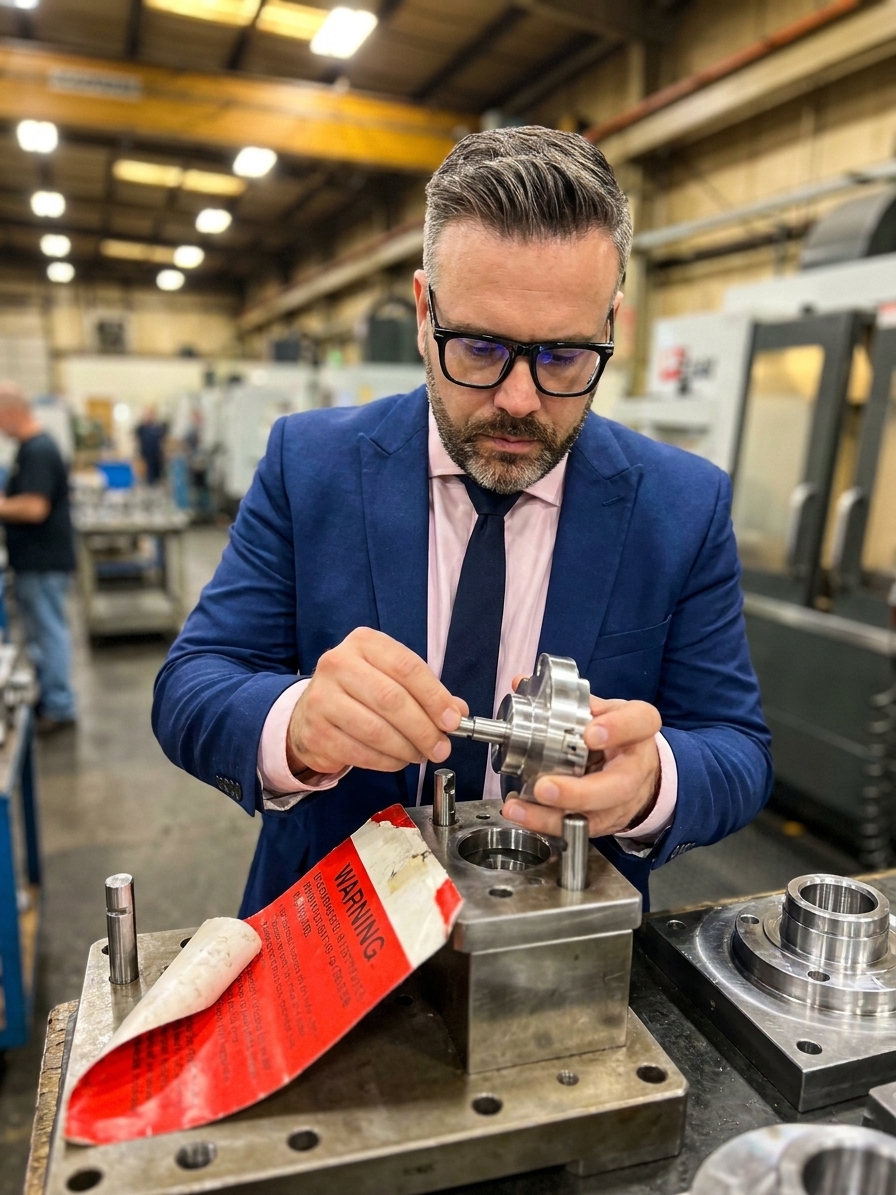
You know the moment. A part comes down the line, and the operator
installs it backwards. It has happened before. Maybe last Tuesday. Maybe
forty times last year. Each time, the response is the same: a corrective
action, a rework order, a team meeting where someone says “we need to be
more careful.” And then someone prints a label that says “THIS SIDE UP”
and sticks it on the fixture.
Problem solved. Until it happens again.
This is the story of Poka-Yoke in most manufacturing plants. Not the
version from the textbooks, where ingenious engineers design elegant
devices that make defects physically impossible. The real version, where
the concept of mistake-proofing gets reduced to a warning label, a
training reminder, and a prayer that the next operator reads the
procedure. The gap between what Poka-Yoke was designed to do and what it
has become in practice is one of the most expensive misunderstandings in
modern quality management. And it is quietly costing you more than any
defect rate on your monthly dashboard.
What Poka-Yoke Actually
Means
The term was coined by Shigeo Shingo, the legendary Japanese
industrial engineer who shaped the Toyota Production System. The
original Japanese term was “baka-yoke,” which translates roughly to
“fool-proofing.” Shingo changed it to “poka-yoke” — meaning
“mistake-proofing” or “inadvertent-error prevention” — after a worker on
the factory floor was offended by the implication that she was a fool.
It was a small linguistic shift with a massive philosophical
implication.
The point was never that workers are stupid. The point was that
humans, regardless of intelligence, experience, or motivation, make
mistakes. They get tired. They get distracted. They get pulled away
mid-task and come back having lost their place. They have bad days. The
genius of Poka-Yoke is that it does not try to eliminate human error
through vigilance, discipline, or training. It acknowledges that errors
are inevitable and designs them out of the process entirely.
Shingo identified two types of Poka-Yoke devices. The first is a
control device, which physically prevents the error from occurring.
Think of a SIM card tray that only fits one way, or a mold fixture with
asymmetric locating pins that make it impossible to load the wrong part.
The second is a warning device, which signals that an error has occurred
or is about to occur — an andon light, a buzzer, a machine interlock
that stops the cycle. Control devices are always preferred because they
eliminate the dependency on human response. Warning devices are a
fallback when full control is not technically feasible.
What Shingo never intended was a third category that has become the
most common implementation in Western manufacturing: the informational
device. A sticker. A work instruction. A reminder in the SOP. These are
neither control nor warning devices. They are wishful thinking formatted
as a label.
The Three Ways Things Go
Wrong
Shingo categorized errors into several patterns, and understanding
them is essential to designing effective countermeasures. The first is
omission — a step is skipped. The operator forgets to tighten a bolt,
apply sealant, or insert a gasket. The second is commission — something
is done that should not be. An extra part is added, a wrong fastener is
used, a process step is performed out of sequence. The third is
selection — the wrong part, tool, or setting is chosen from several
similar options. And the fourth is misalignment — the right part is
installed in the wrong position or orientation.
Each of these error types has a corresponding Poka-Yoke strategy. For
omission, the countermeasure is typically a sequencing device: a kit
with exactly the right number of parts, where leftover components at the
end signal a missing installation. For commission, it is a physical
interference: a fixture that does not close if an extra part is present.
For selection, it is differentiation through design: color-coding,
different geometries, keyed connectors that accept only the correct
component. For misalignment, it is asymmetry: a part that only fits in
the correct orientation because the locating feature is off-center.
Notice what all of these have in common. None of them rely on the
operator being careful. None of them require training to be effective.
None of them can be defeated by fatigue, distraction, or a new hire on
their first day. They work because the process has been redesigned so
that the error is physically impossible, not because a sign asks someone
to pay attention.
Why Your Poka-Yoke Program
Failed
If you have been in manufacturing for any length of time, you have
probably seen a Poka-Yoke implementation. Maybe you even led one. And
there is a good chance it did not survive contact with reality. The
reasons are remarkably consistent across industries.
The first failure mode is the “visible effort” trap. A quality
engineer identifies a recurring defect, designs a Poka-Yoke device,
implements it on the line, and reports the improvement. The defect rate
drops. The engineer gets recognition. Then a few months later,
production volumes increase, the fixture needs modification for a new
product variant, and the Poka-Yoke device is removed because it is “in
the way.” Nobody puts it back. The defect returns. But by then, the
engineer has moved on to another project, and nobody connects the
absence of the device to the resurgence of the defect.
The second failure mode is the “soft countermeasure” addiction. When
faced with a defect problem, the path of least resistance is almost
never to redesign a fixture or modify a machine. It is to add a work
instruction, update the SOP, retrain the operators, or print a new sign.
These are soft countermeasures — they address the psychological or
informational dimension of the error without touching the physical
process. They feel like action. They look like progress in a audit. But
they are fundamentally unreliable because they depend on the very human
factor that caused the error in the first place. Every soft
countermeasure is a bet that a human will be more careful next time,
placed by a system that has already documented dozens of instances where
humans were not careful.
The third failure mode is the audit illusion. Poka-Yoke devices look
fantastic during quality audits. A visiting auditor sees keyed fixtures,
color-coded bins, sensors that detect part presence. They check the box
for mistake-proofing. What the auditor does not see is whether the
sensor is still wired, whether the keyed pin was removed to accommodate
a variant part and never reinstalled, whether the color-coding system
has degraded over three product generations into a meaningless rainbow
of legacy decisions. Poka-Yoke devices are physical objects in a
manufacturing environment. They break, they get modified, they get
bypassed for convenience. Without a systematic verification process,
their presence on a fixture is evidence of nothing except a decision
that was made at some point in the past.
The Real Cost of Soft
Countermeasures
The most insidious aspect of failed Poka-Yoke is that the costs it
generates are invisible. When a hard Poka-Yoke device prevents a defect,
nothing happens. The defect does not occur, the scrap is not generated,
the rework is not performed. The absence of a problem is the desired
outcome, but it is also invisible. Nobody celebrates the fire that did
not happen.
When a soft countermeasure fails — when the operator ignores the
sticker and installs the part backwards — the cost is very real, but it
is absorbed into the overhead of doing business. Rework labor is
budgeted. Scrap rates have a baseline. Customer complaints have a
tolerance. The organization learns to live with a defect rate that
represents the gap between what Poka-Yoke was supposed to eliminate and
what the stickers actually prevented.
This is the “rework you learned to absorb” from the title. It shows
up in your cost of quality model as an acceptable level of internal
failure. It shows up in your OEE as reduced availability during rework
periods. It shows up in your customer satisfaction metrics as the
“normal” complaint rate. And every year, when targets are set, this
absorbed cost is baked into the baseline. The organization does not see
it as a failure of mistake-proofing. It sees it as the cost of
manufacturing.
The mathematics are brutal in their simplicity. If a defect occurs
once per shift and costs fifty dollars to rework, the annual cost is
roughly thirty thousand dollars. A hard Poka-Yoke device that eliminates
it costs ten thousand dollars to design and implement, with minimal
ongoing maintenance. The ROI is obvious. But the soft countermeasure —
the sticker, the training, the SOP update — costs almost nothing upfront
and has a failure rate of, let us be honest, higher than anyone wants to
admit. If it reduces the defect by half, the remaining fifteen thousand
dollars in annual rework becomes part of the operating budget. It is no
longer a problem. It is a number.
Designing Poka-Yoke
That Actually Works
Effective Poka-Yoke follows a design logic that is simple in
principle and demanding in execution. The first principle is that the
countermeasure must act at the source of the error, not downstream. By
the time the defect reaches inspection, the cost has already been
incurred. The ideal Poka-Yoke device prevents the error at the point of
execution — the operator cannot begin the incorrect action because the
process does not permit it.
The second principle is that the countermeasure must be passive, not
active. A passive device works without operator engagement. A keyed
fixture does not require the operator to remember to check orientation.
A missing-part sensor does not require the operator to count components.
An active countermeasure — one that requires the operator to do
something correctly for the device to function — is only as reliable as
the operator’s consistency. This is the difference between a control
device and a warning device, and it is the difference between a solution
and a suggestion.
The third principle is that the countermeasure must be verified. Not
designed, not implemented, verified. On a regular schedule, by someone
who understands what the device is supposed to prevent and how. Is the
locating pin still in place? Is the sensor still functional? Is the kit
still complete? Has a workaround been developed that bypasses the
device? This verification is not glamorous. It does not generate
improvement metrics. But it is the only thing standing between a
functioning Poka-Yoke system and a collection of expensive decorations
on your production line.
The fourth principle is that Poka-Yoke must evolve with the process.
Every engineering change, every new product variant, every process
modification is an opportunity to break an existing Poka-Yoke device.
The change management process must include a Poka-Yoke impact
assessment: does this change invalidate any existing mistake-proofing?
If so, what is the replacement? This is where most programs fail — not
in the initial implementation, but in the maintenance of the system over
time.
The Leadership Test
Here is a simple test for whether your organization takes Poka-Yoke
seriously. Walk the production floor with your quality team. Stop at
each station and ask: what defect does this Poka-Yoke device prevent?
When was it last verified? What happens if it fails?
If you get blank stares, you have your answer. If the answer is “it
is there for the audit,” you have your answer. If the operator cannot
tell you what the device does, it is not a Poka-Yoke device — it is
scenery.
The organizations that get Poka-Yoke right treat it as a living
system, not a project deliverable. They maintain registers of every
mistake-proofing device on every line. They verify functionality on a
scheduled basis. They involve operators in the design of new devices
because operators understand the failure modes better than any engineer
at a desk. They track near-misses — situations where a Poka-Yoke device
caught an error — as a leading indicator, not just defects as a lagging
indicator.
And critically, they do not accept soft countermeasures as
substitutes for hard ones. When a defect investigation ends with “we
added a work instruction and retrained the operators,” the organization
treats it as an incomplete corrective action. The question is not “what
did we tell the operator to do differently?” The question is “what did
we change about the process so that doing it wrong is no longer
possible?”
The Path Forward
If your Poka-Yoke program has degraded into labels and training — and
if you are honest about it, most have — the path back begins with a
single exercise. Take your top five recurring defects, the ones that
show up in every monthly review, the ones that have been “addressed”
multiple times and still occur. For each one, trace the root cause back
to the point of execution. Identify the specific error that creates the
defect. Then ask the hard question: what physical, passive device would
make this error impossible?
Not difficult. Not unlikely. Impossible.
That is the standard Shingo set. Not “less likely if the operator is
careful.” Not “reduced if the training is followed.” Impossible. The
part cannot be installed backwards because it only fits one way. The
fastener cannot be omitted because the fixture will not advance without
it. The wrong component cannot be selected because the bin for the wrong
part is physically blocked.
Some errors are genuinely difficult to mistake-proof at the source.
Assembly errors in complex products, for instance, may involve dozens of
variables that interact in ways no single device can address. But even
in these cases, the principle holds: move the countermeasure as close to
the source as possible, make it as passive as possible, and never accept
an informational solution where a physical one is achievable.
The Bottom Line
Every defect that occurs on your production line is evidence of a
process that permitted it. Not an operator who failed, not a training
gap, not a momentary lapse in attention — a process that was designed in
a way that allowed the error to happen. Poka-Yoke is the discipline of
redesigning those processes so that errors cannot occur. It is not a
label. It is not a training program. It is not a box on an audit
checklist.
The stickers on your fixtures are not Poka-Yoke. The rework stations
in your shipping area are not normal. The defect rate you have learned
to accept is not a baseline — it is the cost of mistake-proofing that
was never implemented or was implemented and then abandoned. And every
day that cost continues to accumulate, silently, in the gap between what
your quality system claims to do and what your production floor actually
experiences.
The question is not whether you can afford to implement real
Poka-Yoke. The question is whether you can afford to keep paying for the
absence of it.
Peter Stasko is a Quality Architect with over 25
years of experience in manufacturing quality management, process
improvement, and production system design. He has implemented Poka-Yoke
systems across automotive, electronics, and heavy industry, and has seen
every possible way a good mistake-proofing program can be undermined by
good intentions. He writes about the gap between quality theory and
manufacturing reality because someone needs to.