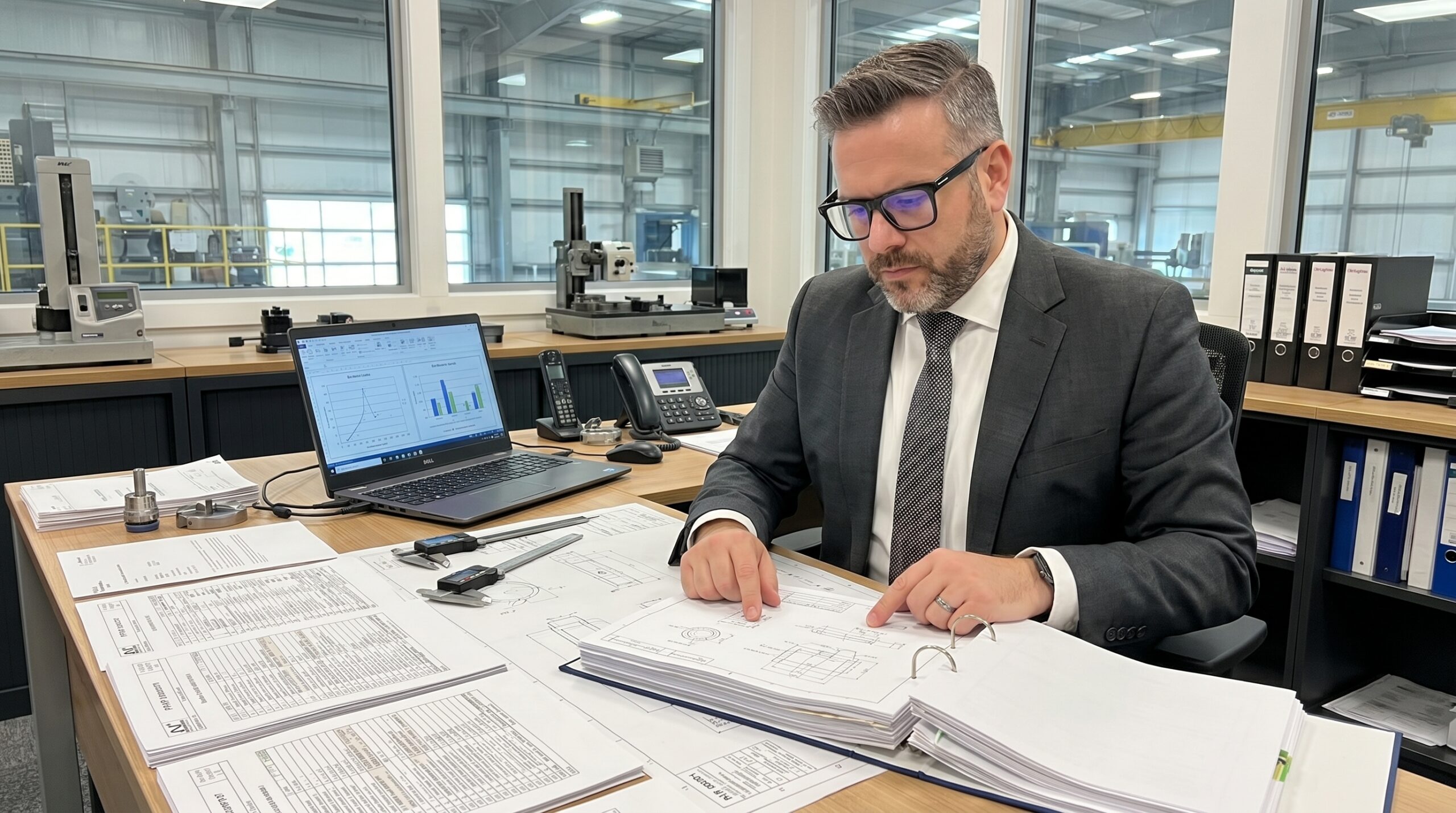
Production Part Approval Process (PPAP) is the mechanism suppliers use to prove their manufacturing process can consistently produce parts to customer specifications. It exists to prevent unproven processes from entering the supply chain. At its core, PPAP validates that the production environment, not just the prototype stage, is fully capable.
However, not every component carries the same risk, and not every engineering change requires the same depth of evidence. Submitting a full 18-element package for a packaging label change wastes supplier resources and delays customer engineering review. Applying a Level 1 warrant to a new critical safety component guarantees a field failure.
The AIAG framework defines five PPAP levels to align the documentation effort directly with the risk of the change. The OEM defines which level applies, usually governed by their Customer Specific Requirements (CSRs). Understanding what triggers each level, and what constitutes a compliant submission, is the difference between first-time approval and a rejected Part Submission Warrant (PSW).
Level 1 and Level 2: Managing Low-Risk Submissions
Level 1 requires only a Part Submission Warrant (PSW). This applies when a change has zero impact on the manufacturing process or part dimensions. Use cases include altering a cosmetic colour, changing packaging materials, or shifting logistics within the tier-2 supply chain. The risk is minimal, and the engineering review should be correspondingly fast.
Suppliers frequently fail Level 1 submissions because they skip internal verification. Before submitting a PSW, engineering must sign off to confirm the change truly does not affect part characteristics. Quality management must verify material certifications are current and unaltered. Without this internal sign-off, the OEM will reject the warrant.
Level 2 demands a PSW, physical sample parts, and limited measurement data. It is standard for a new tool operating within an existing, validated process, or when sourcing an equivalent substitute material. The risk profile shifts from low to low-medium. The customer is already comfortable with the process but requires proof that the specific tool or material change did not alter the output.
A compliant Level 2 submission requires three to five sample parts produced from the production tooling at standard cycle times. Include dimensional measurements for key characteristics, but full capability studies are typically unnecessary. The supplier must document that process parameters remain unchanged, ensuring a baseline of process stability.

Level 3: The Standard Complete Documentation Package
Level 3 is the baseline requirement for most new part launches within the automotive sector. It applies when introducing a new part to an existing process, adding a new tool to a machine, or changing suppliers for critical components. The risk is moderate. The process may be established, but the specific part-tooling interface is new and requires rigorous validation.
A Level 3 package demands the complete 18-element submission outlined in the AIAG PPAP manual. This includes Design Records, Process Flow Diagrams, Process FMEA (PFMEA), and the Control Plan. You must submit Dimensional Results, Material/Test Reports, and Initial Process Studies demonstrating statistical capability. Missing a single element results in an automatic rejection.
Initial Process Studies must demonstrate a minimum Cpk of 1.33 for stable processes. If the characteristic is statistically unstable, a Ppk of 1.67 is typically required. Measurement System Analysis (MSA) results must accompany the dimensional data to prove the gauge variation is acceptable. The study must be conducted on the production environment using production tooling, not prototype parts.
Suppliers often underestimate the rigor of Level 3 submissions by submitting prototype data. A compliant PPAP requires parts made from production tooling, production materials, and at production cycle times. Submitting parts from a soft tool or an engineering prototype invalidates the entire submission. The data must reflect exactly what the customer will receive in series production.
Minimum PPAP Acceptance Thresholds
Level 4 and Level 5: High-Risk and Customer-Validated Submissions
Level 4 applies to new product launches, safety-critical components (CC/SC), and products with multiple critical characteristics. The OEM requires everything from a Level 3 submission plus specific requirements that fall outside the standard AIAG framework. The risk is high. The customer demands proof that the part will survive its service life without failing.
Additional Level 4 requirements are dictated by the OEM's Customer Specific Requirements (CSRs). These often include Run@Rate results to prove full-volume capacity, formal packaging validation, and Finite Element Analysis (FEA) reports. Durability testing and environmental testing results are standard for components exposed to harsh operating conditions. Ignorance of the CSR is the primary cause of Level 4 rejection.
Level 5 demands everything from Level 4, plus an on-site review at the supplier's plant. The OEM physically witnesses the production run. This level is reserved for the highest-risk scenarios: launching a new manufacturing line, opening a new facility, or producing highly critical safety components. The customer's engineering and quality representatives are present on the shop floor to verify the systems in real-time.
During a Level 5 review, the customer audits the entire manufacturing ecosystem. They do not just check the part; they verify machine maintenance logs, operator training records, and logistics flow. A live Run@Rate is conducted with the customer present at the line. Any breakdown in the quality management system during this observation period will halt the approval process immediately.
PPAP is not bureaucracy. It is the evidence that your process is prepared, and the OEM will treat it exactly as a legal contract.
Common Failure Modes in PPAP Submissions
Incomplete documentation is the most frequent failure mode. A PPAP review is a systematic checklist. If a supplier submits a package missing the MSA results or Qualified Laboratory Documentation, the OEM rejects the entire submission. Attempting to expedite approval by leaving elements out, hoping the customer will not notice, always backfires and extends the timeline.
Inadequate statistical capability is the second major failure. Many suppliers assume a Cpk of 1.0 is sufficient to enter production. It is not. Most OEMs require a Cpk of 1.67 or higher for critical characteristics. Submitting a package with a process capability below 1.33 proves the process is incapable. The customer cannot approve it, and running production will yield scrap.
Measurement System Analysis (MSA) failures halt submissions. Suppliers often submit %GRR results in the 20-30% range, arguing it is close enough. The AIAG standard is clear: under 10% is acceptable, 10-30% may be conditionally acceptable based on application and customer approval, and over 30% is unacceptable. If the gauge cannot measure the part accurately, the dimensional data is invalid.
Finally, using incorrect samples invalidates the data. PPAP samples must come from the actual production run at the specified production rate. Submitting parts made during machine setup, slow-cycle debugging, or prototype tooling invalidates the Initial Process Study. The data will not represent series production, and the customer will reject the submission upon discovering the discrepancy.
Supplier Shortcuts vs. PPAP Compliance
What teams try to submit
- Submitting prototype parts from a soft tool.
- Assuming a Cpk of 1.0 is sufficient for approval.
- Accepting a %GRR of 35% to save calibration time.
- Dropping MSA or lab docs to hit a submission date.
What the AIAG standard requires
- Parts must come from production tooling at full rate.
- OEMs mandate Cpk ≥ 1.33, usually 1.67 for CC/SC parts.
- Measurement variation over 30% is strictly unacceptable.
- Missing any of the 18 elements triggers automatic rejection.
Building a System for First-Time Approval
Achieving first-time PPAP approval requires a standardised internal system. The process begins with reading the Customer Specific Requirements before the APQP kickoff, not days before the submission deadline. The CSR defines the boundaries of the submission. If the customer requires a specific format for the PFMEA or additional material testing, the engineering team must know at the design stage.
Validation activities must follow a strict sequence. Conduct MSA before gathering data for the Initial Process Study. If the measurement system is broken, the capability study data is useless. Validate the gauge first, then measure the 30 production parts. This sequence prevents the costly scenario of recalibrating equipment and re-measuring parts because the gauge variation was too high.
Quality management must conduct a rigorous internal review of the entire package before releasing the PSW. Every element must be checked against the AIAG manual and the OEM CSR. This internal gate catches missing signatures, outdated control plans, and inadequate capability data. The goal is to answer every potential customer question inside the submission documentation itself.
I have audited plants that treat PPAP as a paperwork exercise to be rushed at the end of a project. Those plants consistently experience launch delays and customer chargebacks. Treat the PPAP package as the definitive proof of process capability. When the data proves the process is stable, the documentation simply communicates that fact, and approval becomes a formality.