You know the ritual. Your customer sends you a PPAP requirements list
— eighteen elements for Level 3, maybe all nineteen for Level 4. Your
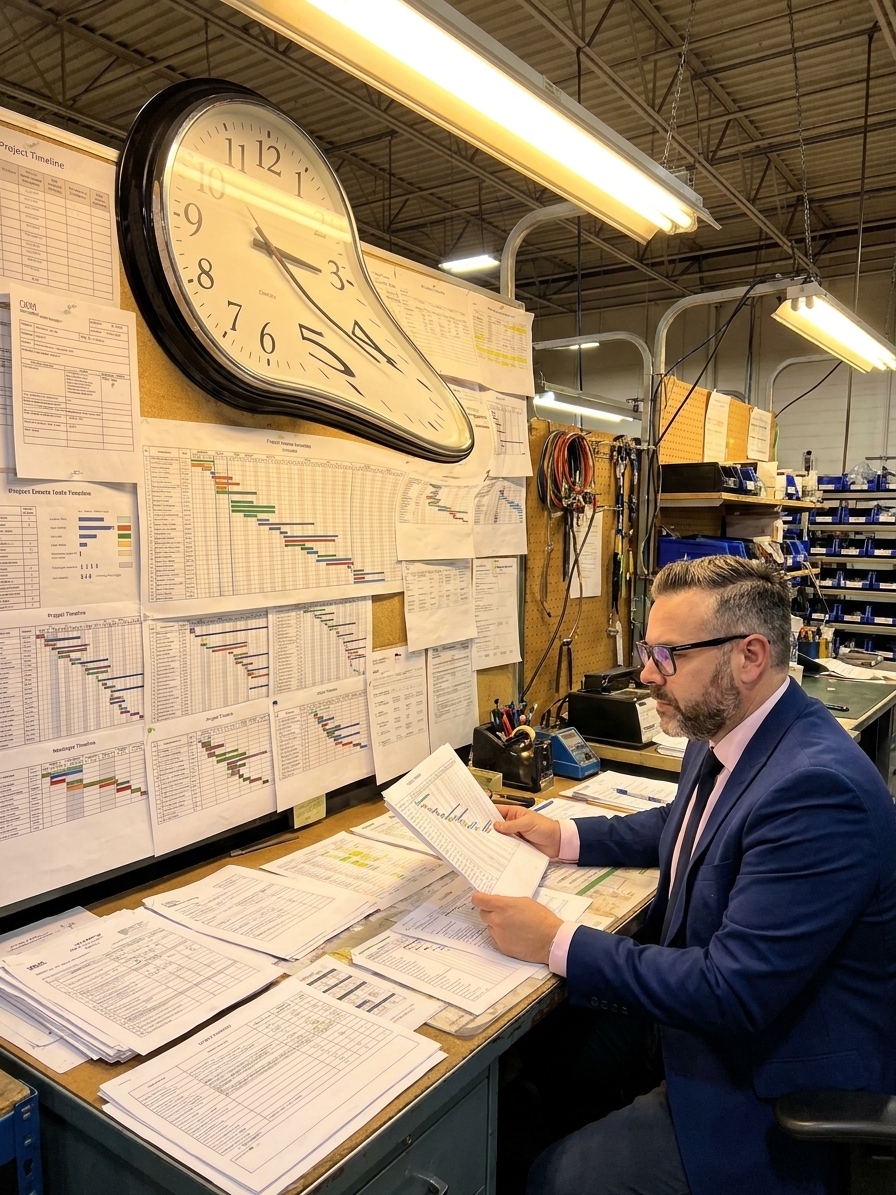
quality engineer scrambles for two weeks pulling together design
records, process flow diagrams, FMEAs, control plans, measurement
results, material certificates, and appearance approvals. You submit a
three-inch binder or a zip file bloated past the email limit. Your
customer’s supplier quality engineer flips through it in fifteen
minutes, stamps it “Approved,” and everyone moves on.
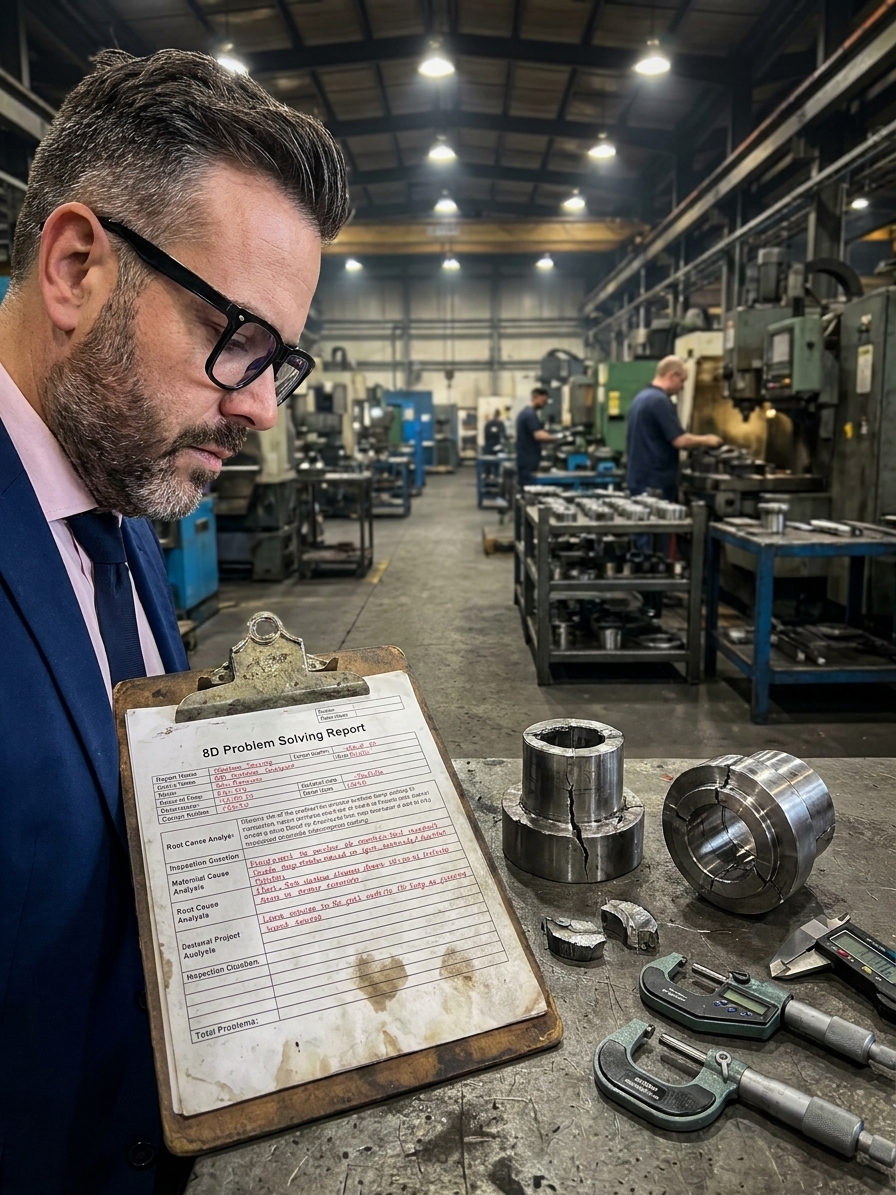
Six months later, you’re in a containment meeting. Parts that passed
PPAP are failing on the assembly line. The dimensional results in the
submission were from prototype tooling — production tooling was “close
enough.” The process flow diagram described the process you planned, not
the process you actually run. The control plan listed inspections that
happen sometimes, when there’s time, when someone remembers. The FMEA
identified risks that nobody mitigated because the occurrence rating was
arbitrarily set to 2 to keep the RPN below the threshold.
The PPAP passed. The parts didn’t. And somewhere in the gap between
what you submitted and what you produce lies the entire story of why
your quality system produces paperwork instead of quality.
This is the PPAP paradox: an approval process designed to prove
production readiness that instead proves your ability to produce
convincing documentation. And it’s not a failure of the PPAP framework
itself — it’s a failure of the organizations that turned a verification
tool into a compliance exercise.
What PPAP Was Supposed to Do
The Production Part Approval Process was developed by the automotive
industry (Chrysler, Ford, GM through AIAG) with a straightforward
purpose: prove that your production process — not your prototype
process, not your lab process, your actual production process —
consistently produces parts that meet all design and engineering
requirements at the quoted production rate.
The logic is sound. Before a customer commits to receiving thousands
or millions of parts from your production line, they want evidence
that:
- You understand every requirement on the drawing
- Your process can produce parts that meet every dimension, material
specification, and performance requirement - Your process is capable — not just that you got five good samples,
but that your process inherently produces good parts within statistical
limits - You have a plan to maintain that capability over time (control
plan) - You’ve thought about what could go wrong and what you’ll do about it
(FMEA) - Your measurement system can actually detect good from bad (MSA)
PPAP at its best is a conversation between supplier and customer
about production readiness. It’s a structured way to ask: “Are you
ready? Prove it.” And if done honestly, it catches problems before they
reach the assembly line.
What PPAP Actually Became
Here’s what happens in practice.
Element 2: Process Flow Diagram — You create a
process flow diagram that describes the ideal process. Never mind that
you’ve already planned two shortcuts because the ideal process takes too
long. Never mind that the flow shows an inspection after heat treatment
that you plan to skip for small batches because “we’ve never had a
problem with heat treatment.” The flow diagram represents the process
you wish you had.
Element 4: Design FMEA — You copy the DFMEA from the
last similar part, change the part numbers, adjust a few ratings, and
call it done. The failure modes specific to this part’s geometry,
material, or application go unexamined because the DFMEA was treated as
a documentation requirement, not an engineering analysis.
Element 5: Process FMEA — The PFMEA is where the
real theater happens. Your team sits in a room and assigns occurrence,
severity, and detection ratings. The severity ratings are usually honest
— a cracked bracket is severe, a cosmetic scratch is not. But the
occurrence ratings are negotiated downward. “We’ve never seen that
failure” becomes “occurrence = 2” even though you’ve never run this
exact process before. The detection ratings assume every inspection on
the control plan happens perfectly, every time, with no exceptions. The
resulting RPNs are comfortably below the customer’s threshold, and no
corrective actions are needed. The PFMEA confirms that your process is
safe — not because you analyzed it rigorously, but because you rated it
into compliance.
Element 6: Control Plan — The control plan inherits
the PFMEA’s optimism. It lists inspections that match what the customer
expects to see. Some of these inspections are feasible. Some require
equipment you don’t have, so you list them and plan to “qualify the
measurement system later” — a later that never comes. Some inspections
are listed at frequencies that sound responsible (every 50 parts) but
that your production schedule can’t sustain. The control plan is a
promise you won’t keep.
Element 8: Measurement System Analysis — You run a
gage R&R on a fixture that’s similar to the one you’ll use in
production but not identical. Or you run it on three parts that
represent the best-case scenario for measurement clarity. Or you run it
with your best inspector, not the operator who will actually perform the
measurement. The MSA results look acceptable because you engineered the
study to produce acceptable results. Whether your measurement system can
reliably detect the difference between a good part and a bad part on a
Tuesday afternoon with a new operator remains unknown.
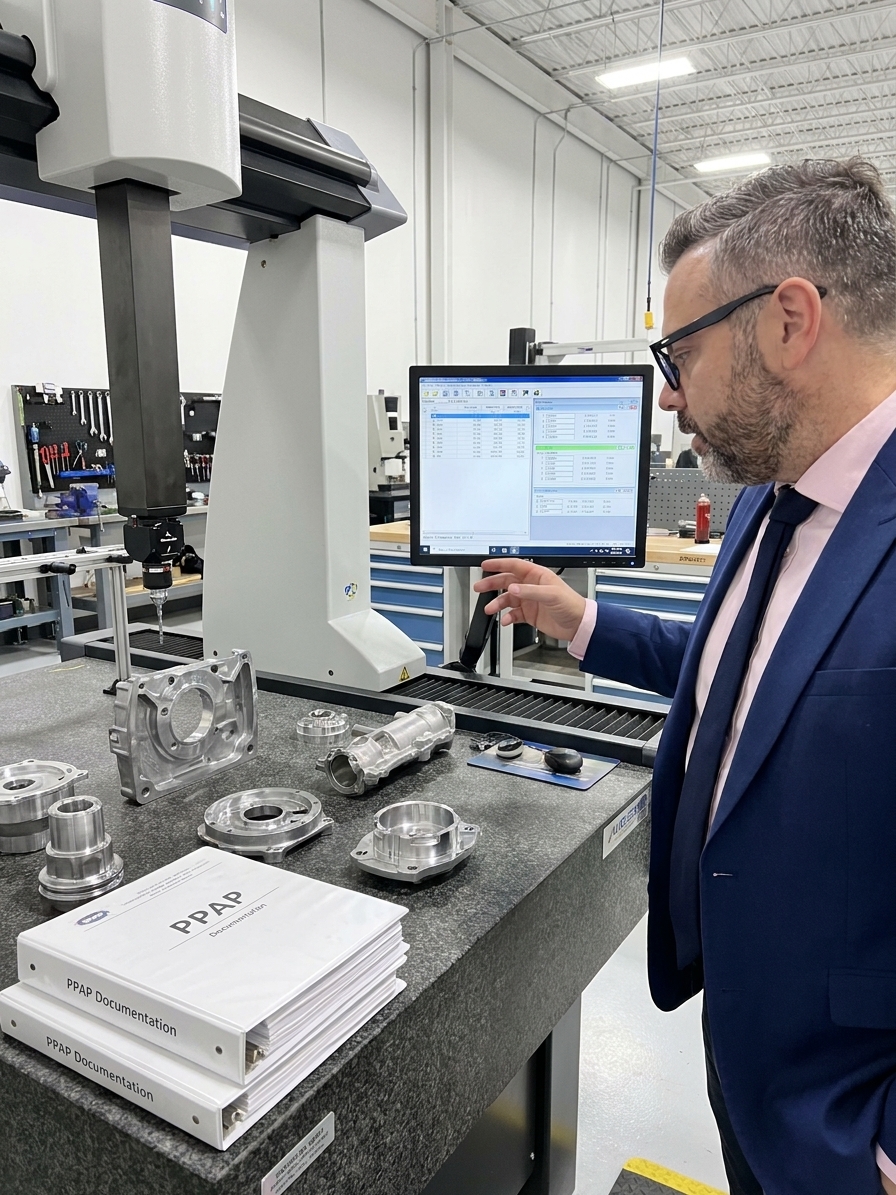
Element 9: Dimensional Results — This is the
centerpiece. You measure the required number of samples (typically 3 to
300 depending on the level) and report the results. Here’s the thing:
you measured them. You know which ones passed and which ones didn’t. If
sample #2 has a dimension that’s 0.002 mm over the limit, what do you
do? Do you report it honestly and trigger a deviation request? Or do you
remeasure it, apply a slightly different fixturing approach, use the
other CMM probe, and get a result that’s 0.001 mm inside the limit? The
pressure to submit conforming results is enormous. Your customer expects
approval. Your sales team promised it. Your production team is waiting.
And the difference between “pass” and “fail” might be within your
measurement uncertainty — which you never properly quantified because
Element 8 was also optimized.
Element 11: Process Capability — You calculate Cpk.
If the initial results show Cpk < 1.67 (the typical automotive
requirement), you adjust the process, remeasure, or select a different
sample size. The Cpk in your submission reflects your process at its
best, under the most favorable conditions, with the most favorable
samples. It does not reflect your process on a normal Tuesday when the
operator is covering two machines and the ambient temperature swings
five degrees.
Element 13: Appearance Approval — If applicable, you
submit a part that looks perfect. It was handled with gloves,
photographed under ideal lighting, and packaged like a museum piece. The
parts your customer will receive in production will be handled by
operators, stored in racks, and shipped in bulk. The appearance approval
proves you can make one beautiful part, not that your production process
consistently produces aesthetically acceptable parts.
You submit the package. Your customer’s SQE reviews it. The SQE has
twenty other submissions to review this week. They check that all
elements are present, that the forms are filled out correctly, that the
dimensional results show conformance, and that the Cpk numbers meet the
threshold. They don’t visit your floor. They don’t watch your process
run. They don’t interview your operators. They approve the submission
based on documentation integrity, not process integrity.
The PPAP is approved. Everyone celebrates. And the gap between the
document and reality begins its slow, inevitable work.
Why This Happens: The
Structural Problem
The PPAP failure isn’t a people problem. It’s a structural problem
with several reinforcing causes:
The customer created it as a gate, not a
conversation. When PPAP becomes a checklist that must be
completed rather than a dialogue about readiness, suppliers optimize for
completion, not honesty. The customer gets what they asked for: a
completed checklist. They don’t get what they need: verified production
readiness.
The submission deadline drives the process. PPAP
submissions are tied to production launch dates. When the launch date is
fixed and the process development is running late, the PPAP deadline
doesn’t move. The submission gets assembled under time pressure, and
time pressure optimizes for “done” over “accurate.”
The customer’s SQE doesn’t have the bandwidth for
verification. Most supplier quality engineers are responsible
for dozens of suppliers and hundreds of part numbers. They can’t visit
every supplier’s floor for every PPAP. They review documentation because
documentation is what they can assess remotely. But documentation is
exactly what’s easiest to manipulate.
There are no consequences for a dishonest PPAP — until there
are. If your PPAP says you inspect a critical dimension every
50 parts, but you actually inspect it every 500 parts or every shift or
whenever someone remembers, nobody will know until a defect escapes. And
by then, the PPAP is six months old, the submission has been filed, and
the connection between the documentation failure and the field failure
is buried in bureaucracy.
The cost of an honest PPAP is higher than the cost of a
dishonest one. An honest PPAP might reveal that your process
isn’t ready. That means delays, additional development, lost revenue,
and an unhappy customer. A dishonest PPAP gets approved on time. The
cost of the dishonesty — defect escapes, warranty claims, lost customers
— arrives later, attributed to “production issues” rather than
“submission issues.”
The Levels of Self-Deception
PPAP has five levels of submission, from Level 1 (warrant only, for
minor changes) to Level 5 (full submission with all elements, reviewed
at the supplier’s plant by the customer). In practice, most submissions
are Level 3 or Level 4, and the depth of review rarely matches the
level. A Level 3 submission might contain all eighteen elements, but if
the reviewer only checks for presence and conformance without assessing
the underlying engineering integrity, the level designation is
meaningless.
Level 5 — where the customer visits your plant and reviews everything
on-site — is the most honest version of PPAP. It’s also the rarest,
because it requires the most customer resources. Ironically, the
submissions that need on-site verification the most (new suppliers, new
processes, complex parts) are the ones where customers most rely on
remote documentation review to save resources.
What Real PPAP Looks Like
Organizations that use PPAP effectively share common traits:
They separate PPAP from launch pressure. The PPAP
submission date is driven by process readiness, not by the production
launch calendar. If the process isn’t ready, the submission waits. This
requires organizational courage and a customer relationship built on
trust rather than compliance.
They verify, not just review. The customer visits
the supplier’s floor. They watch the process run. They ask operators
about the control plan — not whether it exists, but whether they follow
it and what happens when something goes wrong. They look at the actual
measurement system, not just the MSA report. They verify that the
process in the flow diagram is the process on the floor.
They build PPAP into the development process, not bolt it on
at the end. The process flow, FMEA, and control plan are living
documents that evolve as the process develops. By the time the PPAP
submission is due, these documents accurately reflect the production
process because they’ve been updated throughout development — not
assembled in a two-week scramble.
They use dimensional results to understand the process, not
just to prove conformance. A capable process doesn’t just
produce parts within specification — it produces parts that are
consistently centered and have minimal variation. The dimensional
results in a meaningful PPAP tell you about process behavior, not just
pass/fail status.
They treat PPAP as the beginning, not the end. PPAP
approval is the starting point for production monitoring, not the finish
line. The control plan transitions from a PPAP artifact to an active
production document. The process capability indices are tracked over
time, not just reported once.
The Cost of Fake PPAP
The costs of a dishonest PPAP accumulate over time:
Warranty and field failure costs that dwarf the cost
of an honest submission. When a defect escapes because the process
wasn’t actually ready, the cost of sorting, containing, replacing, and
compensating can be orders of magnitude higher than the cost of delaying
the submission.
Customer relationship damage that compounds. Your
customer might approve your PPAP, but they’ll remember the defect
escapes. The next submission gets more scrutiny, not less. The
relationship shifts from partnership to policing, and every interaction
becomes adversarial.
Internal cynicism that corrodes the quality culture.
When your engineers know that PPAP is theater, they stop taking it
seriously. The FMEA becomes a copy-paste exercise. The control plan
becomes fiction. The entire quality system becomes a paper factory that
produces documents instead of assurance. Once this cynicism takes root,
it affects everything — not just PPAP.
Lost opportunity for genuine improvement. The most
valuable output of an honest PPAP process isn’t the approved submission
— it’s the understanding you gain about your own process. Every honest
FMEA reveals risks you hadn’t considered. Every honest capability study
reveals variation sources you didn’t know existed. Every honest control
plan forces you to think about how you’ll maintain quality when
conditions change. When PPAP is dishonest, you lose all of this
learning.
Fixing What’s Broken
If your organization treats PPAP as a paperwork exercise, here’s how
to start fixing it:
Audit your last three submissions against reality.
Pull the PPAP packages for three parts currently in production. Walk the
floor. Compare the process flow to the actual process. Check whether the
inspections on the control plan are actually being performed at the
stated frequencies. Look at the Cpk data you submitted versus the Cpk
data from the last month of production. The gap between your PPAP and
your reality is the size of your problem.
Make the PFMEA honest. The single most impactful
change is making the PFMEA a genuine risk assessment rather than a
rating optimization exercise. Set the severity ratings honestly. Set the
occurrence ratings based on actual data from similar processes, not on
“we haven’t seen it.” Set the detection ratings based on the actual
inspection system, not the theoretical one. Accept that this will
produce RPNs that require action — because that’s the point.
Verify your measurement systems before trusting your
dimensional data. If your MSA was optimized, your dimensional
results are suspect. Re-run the MSA honestly, under realistic
conditions, with the actual operators and equipment that will be used in
production. The cost of a proper MSA study is trivial compared to the
cost of making decisions based on measurement data you can’t trust.
Invite your customer to your floor. Don’t wait for
Level 5. For any significant submission, invite the SQE to review the
process on-site. Show them the reality, not just the documentation. This
feels risky — what if they see something they don’t like? But the
alternative is hiding problems that will surface anyway, at much greater
cost, after production starts.
Live the control plan. The control plan in your PPAP
should be the same control plan your production team follows. If it’s
not, either the control plan is wrong or your production process is
wrong. One of them needs to change. Treat the control plan as a living
document that your team updates when reality diverges from the plan —
not a historical artifact from the PPAP submission.
The Uncomfortable Truth
PPAP works when organizations use it as a mirror — a structured way
to examine their own readiness and honestly report what they see. It
fails when organizations use it as a mask — a way to present a carefully
curated version of their process that hides the gaps, shortcuts, and
uncertainties that everyone knows exist but nobody wants to
document.
The difference between a good PPAP and a bad one isn’t the quality of
the documentation. It’s the quality of the process the documentation
describes. And no amount of polished binders, perfectly formatted forms,
or approved warrants can compensate for a process that wasn’t ready to
produce good parts when the submission said it was.
Your PPAP is a promise. The question is whether you intend to keep
it.
Peter Stasko is a Quality Architect with over 25
years of experience in manufacturing quality management, process
optimization, and quality system implementation across automotive,
electronics, and industrial sectors. He has managed PPAP submissions
from both sides of the table — as a supplier quality engineer building
submissions and as a customer SQE reviewing them — and has seen the best
and worst of what the process can produce.