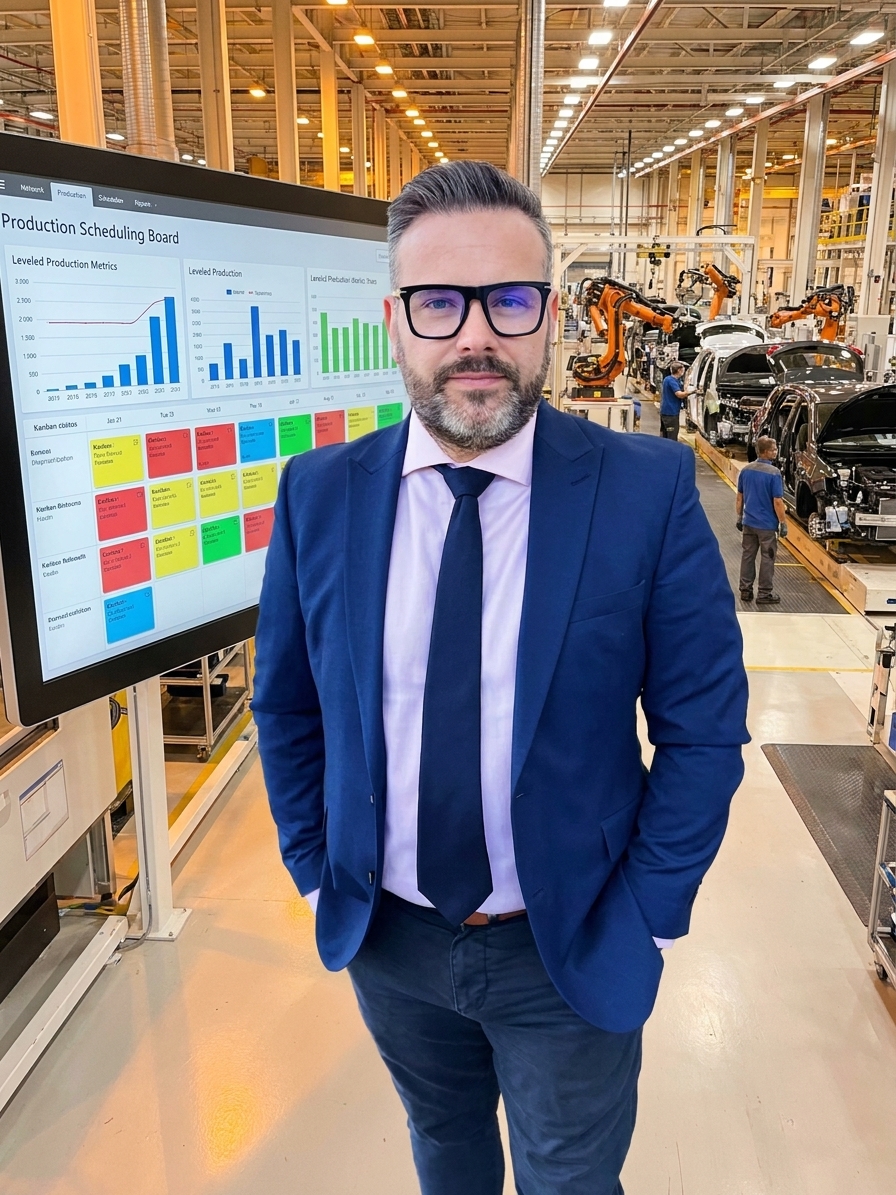
Plots that chase customer demand invariably manufacture quality failures. The emergency orders, mid-shift specification changes, and constant operator reassignments create variability. This instability guarantees that by the end of the shift, internal scrap rates rise, first-pass yield drops, and the 8D correction reports pile up. Plants tolerate this volatility because they label it flexibility or responsiveness.
This operational chaos is actually the largest preventable destroyer of quality in your system. In the Toyota Production System, leveling production volume and mix over time prevents the conditions that cause defects. Instead of running massive batches of a single product, you produce smaller, predictable quantities of multiple products in a steady sequence. This predictable rhythm is the prerequisite for maintaining process control at scale.
Organizations resist production leveling because large batches appear efficient on a spreadsheet. Running ten thousand units of a single part maximizes machine utilization and eliminates changeover time. However, this logic optimizes one variable while ignoring operator psychology and equipment drift. The result is a system perfectly designed to hide defects until they become massive failures.
The Hidden Quality Cost of Batch Production
When operators run ten thousand identical parts consecutively, they enter a state of automated repetition. Psychologists call this vigilance decrement — a measurable decline in the ability to detect anomalies over time. The operator's brain adapts to the unchanging product and stops actively inspecting. The defect in unit eight thousand looks identical to the acceptable part in unit one.
By the time visual inspection catches the drift, you have often produced two thousand additional defective parts. Your statistical sampling plan fails here because it assumes a constant defect rate across the batch. In reality, the defect rate increases predictably the longer the operator runs the same part without interruption. You designed a system that forces human attention to fail.
Batch production also obscures root cause analysis. When you discover a defect after running a massive batch, the trail is cold. The operator does not remember what happened three hours ago. The machine parameters have drifted, and the material lot has been fully consumed. The 8D investigation becomes inconclusive because too many variables changed between the start of the run and the discovery of the failure.
I have audited plants where the entire monthly scrap budget was lost in a single weekend batch run. The failure was never identified because the conditions that caused it were buried under thousands of subsequent cycles. Production leveling prevents this obscurity by shrinking the timeframe between cause and effect.
Breaking the Autocorrelation of Defects
There is a mathematical reality beneath production leveling that directly impacts Cpk. Every system experiences variation in material quality, machine performance, and environmental conditions. Batch production bets that all these variables remain stable for the duration of a massive run. The longer the batch, the less likely that bet becomes.
Consider an injection molding machine with a heating element that degrades slowly. Within a single batch, the temperature drift is negligible. But between batch one and batch five thousand, the drift causes dimensional variation that pushes parts out of specification. In a batch system, you discover this when five thousand nonconforming parts are already finished.
Production leveling reduces the autocorrelation of defects — the tendency of defects to cluster because the causal conditions persist uninterrupted. By forcing a changeover after five hundred units, you cool the machine down. You break the chain. You give the process a mechanical reset before small drifts become large, systemic failures.
The Leveling Reset Mechanism
- 01Short Production RunManufacturing limited quantities to prevent operator vigilance decrement.
- 02Mandatory ChangeoverInterrupting the run to break equipment drift and defect clustering.
- 03Setup VerificationOperator re-engages with work instructions and verifies the new first article.
- 04Process ResetEquipment parameters recalibrate, clearing accumulated mechanical drift.
How Leveling Exposes and Stabilizes Processes
Leveling production does not immediately improve quality. In the first weeks of implementation, defect rates often rise because changeovers increase and operators adjust to multiple products. An impatient manager will look at the initial data and declare the transition a failure. The short-term instability is the price of long-term process control.
The immediate benefit is traceability. When you run a small batch and discover a defect, the operator remembers what happened. The machine parameters are recent. The material lot is identifiable. Heijunka does not prevent defects, but it makes them visible, traceable, and solvable in a way that batch production structurally cannot support.
Leveled production also stabilizes your downstream processes. Quality does not stop at the production station; it flows to inspection, packaging, and shipping. When production is unleveled, inspectors are overwhelmed with one product type on Monday and starved for work on Tuesday. Leveling the workload across every function removes the spikes that lead to inspection errors and shipping misses.
Every changeover acts as a hard quality checkpoint. It forces operators to verify the setup and confirm the first article. Batch production systematically eliminates these inspection gates. The switch itself is the mechanism that resets human vigilance and ensures the process is running correctly before another hundred parts are committed.
The Non-Negotiable Prerequisites for Implementation
You cannot level production if your changeovers take two hours. Heijunka increases the frequency of changeovers. The sequence is critical: you must reduce changeover times first, then implement leveling. Implementing them the other way around guarantees failure, and you will blame the leveling strategy for what was actually a SMED failure.
Single Minute Exchange of Die (SMED) is the technical prerequisite. You must separate internal setup from external setup, and convert as much internal setup to external as possible. Only when changeovers are measured in single-digit minutes can you afford the mathematical cost of frequent switching required by a leveled schedule.
You must also standardize the process for every product in the mix. If each part requires a unique, artisanal approach, leveling becomes impossible. Products that cannot run on a standardized process must be redesigned or reclassified. Heijunka forces standardization, which ultimately results in a simpler, more predictable system that is easier to control.
Asking planners to abandon batch-optimized ERP logic is not a technical challenge; it is an identity problem.
Overcoming Organizational Resistance
Every implementation faces pushback, primarily from three departments. Production planners resist because their ERP systems use MRP algorithms designed to maximize machine utilization by minimizing changeovers. Telling them to switch to Heijunka asks them to abandon the mental models they built their careers around.
Sales departments push back because they want the ability to call the factory with emergency orders and get an immediate yes. They do not see that the overtime, expediting, and quality escapes are the direct result of their unpredictability. Leveling demand requires a partnership between sales and operations to establish realistic lead times and forecasting.
Finance departments resist because Heijunka requires a small buffer of finished goods to absorb demand variation. Finance sees tied-up capital. What they fail to see is the invisible capital currently lost to rework, scrap, overtime, and warranty claims. Making these quality costs visible is essential to gaining financial approval for a leveled system.
Batch Optimization vs. System Optimization
What batch logic optimizes
- Individual machine utilization percentages
- Setup time elimination per work center
- Units produced per continuous shift
- Local throughput independent of demand
What leveling optimizes
- Total system cost including scrap and rework
- First-pass yield through forced verification
- On-time delivery through stable rhythms
- Defect traceability and root cause clarity
Metrics That Support Production Leveling
If you continue measuring your factory by machine utilization and units per shift, Heijunka will look like a step backward. The local efficiency of a single station is irrelevant if it produces scrap that downstream functions must sort. You must align your KPIs with the actual goals of the business: on-time delivery, defect rate, lead time, and total cost.
Leveling requires operators who are multi-skilled. They cannot be single-product specialists. They must be able to set up, run, and inspect multiple product variations, which requires significant investment in cross-training. This takes time and money, but it produces a workforce that is more capable of identifying anomalies and maintaining process stability.
Every defect has a cause, and every cause has a context. In most plants, the context is an unleveled schedule that creates the conditions for inevitable failure. Heijunka solves the conditions that create quality problems. It reduces variation, interrupts monotony, and exposes hidden defects by changing the rhythm of production itself.
Organizations that commit to this hard, unglamorous work discover that quality was never a problem to be inspected. It is a rhythm to be established, and the rhythm that produces quality is the same rhythm that produces predictable, profitable manufacturing.