Quality
and A3 Thinking: When Your Organization Stops Solving Problems With
Opinions and Starts Solving Them With Structure — and the One-Page
Document Nobody Wanted to Write Became the Problem-Solving Discipline
That Transformed Your Entire Organization
The Meeting That Changed
Nothing
Picture this: Tuesday morning, 9:15 AM. Conference room B. The
defects from Line 4 have been piling up for three weeks. Twelve people
sit around the table. The plant manager wants answers. The quality
engineer has a theory. The production supervisor has a different theory.
The maintenance lead has a third theory that conveniently points the
finger at operators.
For ninety minutes, they debate. Opinions fly. Someone pulls up a
spreadsheet. Someone else contradicts it with anecdotal evidence from
last Thursday. The meeting ends with an action item: “Investigate
further.” Next Tuesday, they’ll have the same meeting. Same room. Same
problem. Different theories.
If you’ve worked in manufacturing for more than six months, you’ve
lived this meeting. You’ve probably lived it dozens of times. It’s the
problem-solving equivalent of a hamster wheel — enormous energy, zero
forward motion.
Now imagine a different approach. Same problem. Same twelve people.
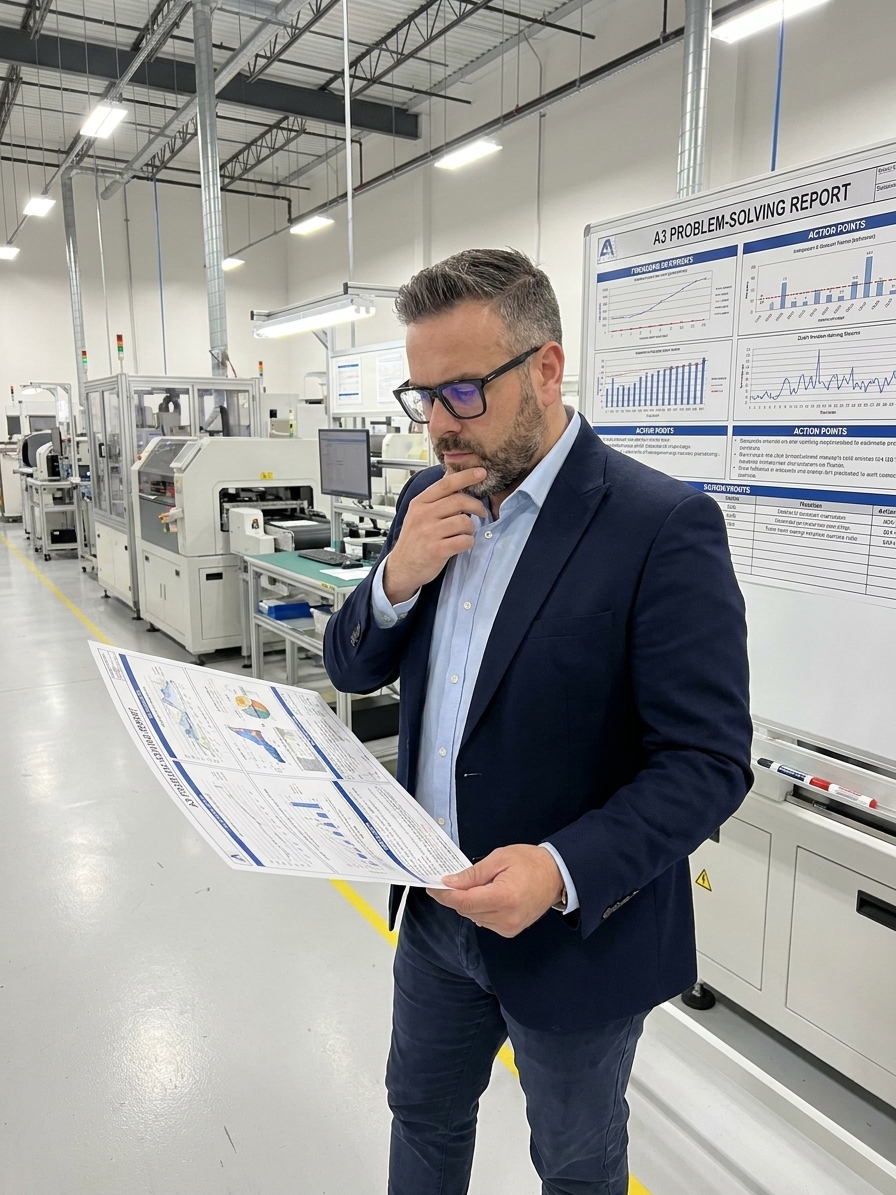
But this time, the quality engineer walks in with a single sheet of
paper — A3 size, 11×17 inches. On it, the story of the problem is told
in nine structured sections. The current condition is mapped. The root
cause is identified with evidence. The countermeasure is specific,
measurable, and time-bound. The follow-up plan is clear.
The meeting lasts twenty minutes. The decision is made. The
countermeasure is implemented that afternoon.
That single sheet of paper is A3 thinking. And it might be the most
powerful problem-solving tool your organization has never seriously
used.
What A3 Thinking Actually Is
A3 thinking takes its name from the paper size — A3, roughly
equivalent to 11×17 inches or tabloid size in the United States. But the
paper is the least important part. A3 thinking is a structured
approach to problem-solving and communication that forces
clarity, demands evidence, and eliminates the verbal ping-pong that
passes for problem-solving in most organizations.
The method originated at Toyota as part of the Toyota Production
System. It was never a formal tool with a trademark and a certification
body. It was simply how Toyota engineers and managers communicated about
problems — on one page, with structure, with data, and with a clear
chain of logic from problem to solution to verification.
An A3 report typically follows this structure:
- Background — Why does this problem matter? What’s
the business context? - Current Condition — What’s happening right now?
Show me with data, charts, process maps. - Goal / Target Condition — What does success look
like? Be specific and measurable. - Root Cause Analysis — Why is this happening? Use
structured analysis (5 Whys, fishbone, Pareto), not opinions. - Countermeasures — What will we do about it? List
specific actions, owners, and timelines. - Implementation Plan — When and how will we execute?
What resources are needed? - Follow-Up — How will we verify the countermeasures
worked? What metrics will we track? - Results — What actually happened? Did we hit the
target? - Lessons Learned — What did we learn? What would we
do differently?
Nine sections. One page. A complete story that takes the reader from
“we have a problem” to “here’s what we did about it and here’s the proof
it worked.”
Why Most
Organizations Fail at Problem-Solving
Before we go deeper into A3 thinking, let’s understand why it’s
necessary. Most organizations don’t solve problems — they
manage them. They contain them, work around them, and
develop elaborate coping mechanisms. Here’s why:
Opinion-driven decisions. In the absence of
structured analysis, the loudest voice in the room wins. Or the most
senior voice. Or the most confident voice. None of these correlates with
being right.
Context-free solutions. Someone read about a
solution at a conference or saw it at another plant. They bring it back
and apply it without understanding whether the root cause is the same.
It’s like prescribing medication without a diagnosis.
Root cause amnesia. Teams jump from symptom to
solution without ever understanding why the problem occurred. The
result: the same problem returns in a different form, and everyone acts
surprised.
No verification loop. Countermeasures are
implemented, and everyone moves on. Nobody checks whether the
countermeasure actually worked. Six months later, the problem is back,
and nobody remembers the original solution well enough to understand why
it failed.
Knowledge trapped in heads. When problem-solving
happens through conversation and email threads, the organizational
learning dies with the meeting. New team members start from scratch. The
same mistakes get repeated by different people across different shifts,
different lines, and different plants.
A3 thinking addresses every one of these failures systematically.
The Discipline Behind the
Document
Here’s the thing that surprises people: the A3 document is not the
point. The thinking process is the point. The document
is merely the output — the visible evidence that structured thinking
occurred.
A3 thinking enforces a discipline that most problem-solvers
resist:
Go and see. You cannot write an accurate current
condition from your desk. A3 thinking demands that you go to the gemba —
the actual place where the work happens — and observe. Not interview.
Not survey. Observe. Watch the process. Time the steps. Count the
defects. Map the flow. The current condition section of an A3 should be
based on direct observation, not secondhand reports.
Separate symptoms from causes. The current condition
describes what you see. The root cause analysis explains why it’s
happening. These are fundamentally different questions, and confusing
them is the most common problem-solving error in manufacturing. “We have
too many defects” is a symptom. “The fixture alignment drifts after 200
cycles because the locking mechanism wears unevenly” is a root
cause.
Think in systems. A3 thinking forces you to consider
the entire system, not just the immediate point of failure. When a
defect appears at final inspection, the root cause might be at incoming
material, at process setup, at operator training, or at equipment
maintenance. The structured analysis prevents you from stopping at the
first plausible explanation.
Make the logic visible. Anyone should be able to
read your A3 and follow your chain of reasoning from problem to cause to
solution. If they can’t, your thinking has a gap. The one-page
constraint is not arbitrary — it’s a forcing function for clarity. If
you can’t tell the story on one page, you don’t understand it well
enough yet.
Commit to verification. The follow-up plan is not
optional. It’s the commitment that turns a good idea into a validated
solution. Without it, you’re just hoping.
The A3 in Practice: A
Real-World Story
Let me tell you about a real situation. An automotive parts
manufacturer was experiencing a persistent defect — a dimensional
variation on a machined aluminum housing that affected the seal
integrity of the final assembly. The defect rate was hovering around
3.2%, which doesn’t sound catastrophic until you do the math: 8,000
units per month, 256 defective housings, each requiring rework that cost
$47 per unit. That’s $12,032 per month in rework alone, plus the
customer was threatening a line stoppage if the defect rate didn’t drop
below 1%.
For six months, the team had been “working on it.” They adjusted
machine parameters. They changed tooling more frequently. They added an
inspection step after the machining operation. The defect rate
fluctuated between 2.8% and 3.5% but never sustainably improved.
Then a newly hired quality engineer proposed an A3 approach. Here’s
what happened:
Background: The dimensional variation on housing
part number AH-447 was causing seal failures at the customer’s assembly
plant. Three customer complaints in the last quarter. Potential line
stoppage risk. Monthly rework cost: $12,000+.
Current condition: The engineer went to the line.
She measured 50 consecutive parts. She mapped the process. She
discovered something the previous investigations had missed: the
variation wasn’t random. Parts machined in the morning shift were
consistently more variable than parts machined in the afternoon. She
plotted the data. The pattern was unmistakable.
Root cause analysis: Using 5 Whys, she traced the
pattern: – Why is there more variation in the morning? → The first 15-20
parts of each shift show higher variability. – Why do the first parts
show higher variability? → The machine is cold at startup. – Why is the
machine cold at startup? → It’s shut down overnight and takes
approximately 45 minutes to reach thermal equilibrium. – Why don’t we
let it warm up? → No warm-up procedure exists. Production starts
immediately at shift change. – Why was this never identified? → Previous
investigations aggregated data by day and week, washing out the
within-shift pattern.
Countermeasure: Implement a 30-minute machine
warm-up cycle before production starts. During warm-up, run practice
parts (non-production) to bring the machine to thermal equilibrium.
Adjust shift start times by 30 minutes. Total cost: zero dollars and
zero capital expenditure.
Result after 30 days: Defect rate dropped from 3.2%
to 0.6%. Rework cost dropped from $12,032/month to $2,256/month.
Customer complaints stopped. The entire solution cost nothing but a
schedule adjustment and a procedure change.
The previous six months of adjusting parameters, changing tooling,
and adding inspections were solutions in search of a problem. A3
thinking forced the engineer to find the actual problem first.
Common Mistakes
When Implementing A3 Thinking
Organizations that try A3 thinking often fail. Not because the tool
is flawed, but because they misuse it. Here are the most common
failures:
The decorated report. Some teams spend more time
formatting the A3 than doing the thinking. Beautiful charts,
professional layout, perfect typography — and shallow analysis. The A3
should look functional, not pretty. If the thinking is sound, a
hand-drawn A3 on graph paper is more valuable than a glossy PowerPoint
printout.
The shortcut A3. “We already know the root cause, so
let’s just fill in the countermeasure section.” No. If you already knew
the root cause, the problem would already be solved. The discipline of
walking through each section is the point. Skip it, and you’re just
writing a memo with extra steps.
The blame A3. An A3 that concludes “the operators
need more training” or “maintenance didn’t do their job” has failed at
root cause analysis. Blaming people is the opposite of systems thinking.
If your A3 points to a person instead of a process, start over.
The museum piece. Some organizations create
beautiful A3 reports, mount them on the wall of the conference room, and
never look at them again. An A3 is a living document. It should be
updated as countermeasures are implemented, results are measured, and
learning accumulates. The follow-up section is not decorative — it’s the
most important part.
The solo A3. A3 thinking is inherently
collaborative. The best A3 reports are developed through conversation,
challenge, and iteration. When one person writes an A3 in isolation, it
reflects one perspective. When a team develops it together — debating
the current condition, challenging the root cause analysis,
pressure-testing the countermeasures — the result is exponentially
stronger.
A3 Thinking as a Leadership
Tool
Here’s something most people miss: A3 thinking is not just a
problem-solving tool. It’s a leadership development
tool.
At Toyota, the A3 process is how managers coach their people. A
junior engineer brings a draft A3 to their manager. The manager doesn’t
solve the problem for them. Instead, they ask questions:
- “Did you go and see this yourself, or are you reporting what someone
told you?” - “What evidence supports this root cause?”
- “What other explanations did you consider and reject, and why?”
- “How will you know if your countermeasure is actually working?”
- “What happens if this doesn’t work? What’s your backup plan?”
Through this coaching dialogue, the junior engineer develops critical
thinking skills. They learn to distinguish observation from assumption,
correlation from causation, and solutions from countermeasures. Over
time, they become the kind of problem-solver who doesn’t need coaching —
they internalize the discipline.
This is why A3 thinking is more powerful than any root cause analysis
tool in isolation. 5 Whys, fishbone diagrams, Pareto charts — these are
techniques. A3 thinking is a framework that organizes
these techniques into a coherent problem-solving narrative. It’s the
difference between having a toolbox and being a craftsman.
The ROI of Structured
Thinking
Let’s talk about the business case, because someone in your
organization will ask.
The cost of implementing A3 thinking is essentially zero. No software
to buy. No consultants to hire (though they can help with initial
training). No capital equipment to purchase. The investment is time —
time to learn the discipline, time to practice it, and time to coach
others through it.
The return on that time investment is substantial:
Faster problem resolution. Organizations that adopt
A3 thinking typically see a 40-60% reduction in the time from problem
identification to effective countermeasure. Not because people work
faster, but because they stop working on the wrong things.
Sustainable solutions. A3 thinking produces
solutions that last. When you understand the root cause and verify your
countermeasure, the problem stays solved. Compare this to the typical
firefighting approach, where the same problems reappear with depressing
regularity.
Organizational learning. Every completed A3 is a
case study. Over time, your organization builds a library of solved
problems that new employees can study. Instead of losing knowledge when
people leave, you capture it in a format that’s immediately
accessible.
Better meetings. This alone might justify the
investment. When teams use A3 reports as the basis for problem-solving
discussions, meetings become shorter, more focused, and more productive.
Opinions are replaced by evidence. Debate is replaced by dialogue. And
the action items that emerge are specific, owned, and time-bound.
Getting Started: Your First
A3
If you’ve read this far, you’re probably thinking about trying A3
thinking in your organization. Here’s my advice: start small. Don’t
launch a company-wide A3 initiative. Don’t create a training program.
Don’t form a committee.
Pick one real problem. Not a strategic initiative. Not a
cross-functional challenge. One operational problem that matters to
someone. Write the A3. Coach the person through it. See what
happens.
The problem should be specific enough to address in 2-4 weeks. It
should have measurable outcomes. It should be important enough that
solving it matters, but not so critical that the pressure destroys the
learning process.
Some ground rules for your first A3:
-
Use pencil and paper. Seriously. The temptation
to jump to PowerPoint or Excel is the temptation to focus on formatting
over thinking. Hand-write your first few A3s. Feel the constraint of the
page. Let the discipline of fitting your story onto one page force you
to be clear. -
Go to the gemba. Do not write the current
condition section from your desk. Go to where the work happens. Watch.
Measure. Take notes. Draw a process map on the back of a napkin if you
need to. Direct observation is non-negotiable. -
Show your work. The root cause analysis section
should show your reasoning. If you used 5 Whys, write out all five
levels. If you used a fishbone diagram, sketch it. Let the reader follow
your logic. If there’s a gap in your reasoning, you want it to be
visible so someone can help you find it. -
Get coached. Find someone who has experience
with A3 thinking and ask them to review your draft. Not to judge it, but
to ask you the questions you haven’t asked yourself. The coaching
dialogue is where the real learning happens. -
Follow up. This is the section most first-timers
skip. Write a specific follow-up plan: what you’ll measure, when you’ll
measure it, and who’s responsible. Then actually do it. Update the A3
with the results. This is what transforms an A3 from an exercise into a
problem-solving tool.
The Deeper Truth
Here’s what I’ve learned after twenty-five years of watching
organizations try to solve problems: the quality of your solutions is
limited by the quality of your thinking. Tools, techniques, and
methodologies are necessary but not sufficient. What separates
organizations that solve problems from organizations that manage them is
how they think.
A3 thinking is not the only way to develop disciplined
problem-solving. But it’s one of the most accessible, most proven, and
most effective approaches I’ve seen. It works because it addresses the
real barriers to good problem-solving: unclear thinking, unexamined
assumptions, unverified solutions, and unshared learning.
The one-page constraint is not a limitation. It’s a liberation. It
says: you don’t need a forty-slide deck to solve a problem. You need
clear eyes, honest data, structured reasoning, and the discipline to
verify that your solution actually worked.
In a world that rewards speed and confidence, A3 thinking rewards
patience and accuracy. It’s not glamorous. It won’t impress anyone at a
conference. But it will solve your problems — sustainably,
systematically, and in a way that makes your organization smarter over
time.
That conference room full of opinions? It can become a room full of
evidence. That recurring defect that nobody can explain? It can become a
solved problem with a documented root cause. That frustrated quality
engineer who’s tired of having the same meeting every Tuesday? They can
become the person who walks in with one page and changes everything.
The question is whether you’re willing to trade the comfort of
opinion for the discipline of structure. Your defects — and your
organization — are waiting for your answer.
Peter Stasko is a Quality Architect with 25+ years
of experience transforming organizations across automotive, aerospace,
and pharmaceutical industries. He has implemented A3 thinking in
organizations ranging from fifty-person suppliers to multinational OEMs,
and he’s never seen a problem that couldn’t be improved with clearer
thinking and a structured approach. His philosophy is simple: the
quality of your solutions is determined by the quality of your thinking
— and most organizations are thinking about their problems in exactly
the wrong way.