You have seen it happen a hundred times. The quality manager pulls up
the defect tracking dashboard, scrolls past three pages of red flags,
and homes in on the one chart trending green. “See? Our first-pass yield
is holding steady at 98.6%.” The meeting moves on. Nobody mentions that
customer returns have tripled in the same period, that two key suppliers
have been flagged for nonconformance, or that the last internal audit
uncovered seven major findings. The dashboard showed all of it. But the
team saw what it expected to see.
That is confirmation bias in action, and it is arguably the single
most dangerous cognitive trap in quality management. Not because it is
rare — it is ubiquitous — but because it operates invisibly. Unlike a
broken gauge or a miscalibrated instrument, confirmation bias does not
announce itself. It does not trigger an alarm. It simply shapes what
your organization notices, what it investigates, and what it dismisses,
all while convincing everyone involved that they are being perfectly
objective.
What Confirmation Bias
Actually Is
Confirmation bias is the tendency to search for, interpret, favor,
and recall information in a way that confirms or supports one’s prior
beliefs or values. First systematically described by Peter Wason in
1960, it has since been replicated across hundreds of studies in
psychology, behavioral economics, organizational behavior, and decision
science.
In a manufacturing and quality context, confirmation bias manifests
in specific, recurring patterns:
- Selective attention: noticing data that supports
the prevailing hypothesis while ignoring contradictory evidence - Selective interpretation: interpreting ambiguous
data as supportive of the existing position - Selective recall: remembering past events in ways
that reinforce current beliefs - Selective investigation: designing tests, audits,
and inspections that are more likely to confirm than to challenge
assumptions
The bias is not a character flaw. It is a feature of human cognition
— a mental shortcut that served our ancestors well when quick pattern
recognition meant survival. But in a quality system that depends on
objective evidence, it is a systematic source of error that no amount of
good intentions can fully eliminate.
How
Confirmation Bias Infiltrates Quality Systems
During Root Cause Analysis
A production line produces an elevated scrap rate. The engineering
team, convinced that the problem is material-related, directs all
testing toward incoming raw material specifications. They find a slight
deviation in one batch — just enough to confirm their hypothesis. The
investigation closes. Two weeks later, the scrap rate spikes again, this
time with a different material batch. The real cause was a worn tooling
insert that had drifted out of tolerance, but the team never checked the
tooling because they already “knew” the answer.
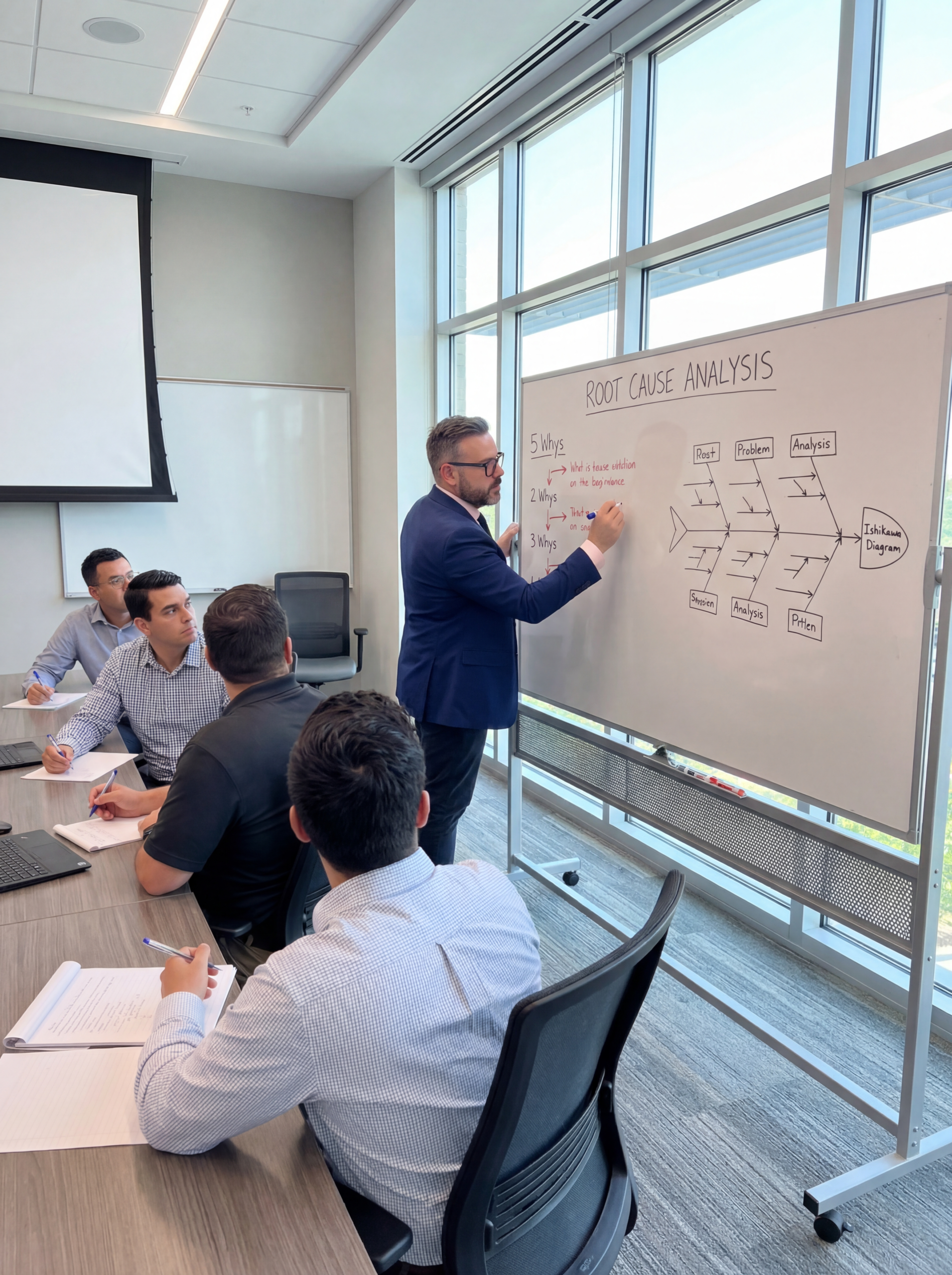
This scenario plays out constantly in 8D investigations, corrective
action teams, and failure analysis boards. The moment a plausible
hypothesis emerges — especially one from a senior engineer or a trusted
data source — the investigation narrows. Questions that might challenge
the hypothesis go unasked. Tests that might disprove it go unrun. The
team does not consciously reject alternative explanations; they simply
never consider them.
During Process Validation
Validation protocols are supposed to challenge a process, proving it
can consistently produce conforming product. But confirmation bias
shapes the protocol design from the start. Engineers set acceptance
criteria based on what they believe the process can achieve, not what it
should achieve. They select challenge conditions that push the process
to the edge of its comfort zone but not beyond it. They interpret
marginal results as passing because the process “should” work — it
worked in development, after all.
The result is a validated process that has never truly been stressed.
When real-world variation hits — different operators, different material
lots, different environmental conditions — the process fails in ways the
validation never explored because the validation was designed to confirm
rather than to discover.
During Supplier Audits
An auditor arrives at a supplier facility with a pre-existing
relationship and a history of acceptable audit scores. The auditor knows
this supplier. They have been auditing them for years. The walkthrough
is familiar, the documentation is in order, and the nonconformances are
minor — the kind of findings that look thorough without being
threatening.
Meanwhile, a different auditor — one with no history — visits the
same facility and finds systemic failures in change control, incomplete
training records, and a calibration program that has been lapsing for
months. The facility did not change between audits. The auditors changed
what they saw.
This is not about auditor competence or integrity. It is about the
cognitive framework that says “I know this place” and the corresponding
tendency to see evidence that confirms that knowledge rather than
evidence that challenges it.
During Management Reviews
Management review meetings are designed to provide oversight. But the
data presented is curated — not necessarily dishonestly, but through the
lens of what the presenting team believes leadership wants to hear.
Quality metrics that look good are displayed prominently. Metrics that
look troubling are buried in appendices, qualified with explanations, or
presented with contextual narratives that minimize their
significance.
Leadership, in turn, asks questions about the data that confirms
their strategic priorities and glosses over data that does not. The
review becomes a mutual confirmation exercise rather than a genuine
examination of quality system performance.
The Structural Enablers
Confirmation bias does not operate in a vacuum. Several structural
features of quality management systems amplify its effects:
Silos of expertise. When subject matter experts
dominate investigations, their specialized knowledge becomes a lens that
focuses attention on familiar patterns. The metallurgist sees material
problems. The process engineer sees parameter drift. The maintenance
technician sees equipment wear. Each is right some of the time. None is
right all of the time. But each is more likely to find the cause they
are already looking for.
Metric fixation. When organizations tie performance
evaluations, bonuses, and career advancement to specific quality
metrics, they create powerful incentives to see those metrics in the
best possible light. The data does not need to be manipulated. It simply
needs to be interpreted favorably, presented selectively, or
contextualized in ways that minimize negative implications.
Historical precedent. “We have always done it this
way” is not just a resistance to change. It is a confirmation framework.
When a process has produced acceptable results historically, the
assumption becomes that it will continue to do so. Deviations are
dismissed as anomalies. Trends are ignored until they become crises. The
past confirms the present, and the present confirms the future — until
it does not.
Authority gradients. When the most senior person in
the room states a conclusion, confirmation bias cascades through the
team. Junior members are less likely to challenge. Peers are less likely
to offer alternatives. The group converges on the authority figure’s
hypothesis not because it is correct but because the social dynamics of
the room reward agreement.
Real-World Consequences
The Boeing 737 MAX tragedies offer a stark illustration of
organizational confirmation bias at scale. Internal communications later
revealed that engineers and test pilots raised concerns about the MCAS
system, but those concerns were filtered through a framework that
assumed the system was safe because it had been designed to be safe.
Contradictory evidence — simulator results, pilot feedback, aerodynamic
analyses — was interpreted within the context of the prevailing
assumption rather than used to challenge it. The result was not a single
oversight but a systematic pattern of seeing what the organization
expected to see.
In pharmaceutical manufacturing, confirmation bias has contributed to
some of the most significant consent decree actions in FDA history.
Companies that received warning letters often had quality data that, in
retrospect, clearly signaled problems — elevated out-of-specification
rates, increasing complaint trends, deviations that clustered around
specific processes. But each individual data point was explained away
within a narrative that confirmed the company’s self-image as a
quality-driven organization.
In automotive manufacturing, the Takata airbag crisis followed a
similar pattern. The company had data indicating propellant degradation.
It had field reports. It had test results that showed anomalies. But the
prevailing belief — that the propellant was stable, that the design was
proven, that the manufacturing process was controlled — shaped how all
of that data was interpreted. Each warning sign was explained as an
exception rather than a symptom.
Detection and Mitigation
No organization can eliminate confirmation bias entirely. But quality
systems can be designed to detect and mitigate its effects.
Structured Analytical
Techniques
Red teaming. Assign a dedicated team the explicit
role of challenging the prevailing hypothesis. Give them license to ask
“what if we are wrong?” and the resources to pursue alternative
explanations. The red team is not adversarial — it is a structured
mechanism for counteracting the tendency toward premature consensus.
Premortem analysis. Before implementing a corrective
action or process change, ask the team to imagine that the action has
failed. Then work backward to identify why it failed. This technique
forces the team to consider failure modes that confirmation bias would
otherwise suppress.
Disconfirming evidence protocols. In root cause
analysis, require teams to document at least three alternative
hypotheses and the specific tests or data that would disprove each one.
The goal is not to generate a list for paperwork — it is to ensure that
the investigation actively seeks evidence that might contradict the
leading hypothesis rather than only evidence that supports it.
Process Design
Countermeasures
Blind analysis. Where possible, strip identifying
information from data sets before analysis. Remove batch numbers,
supplier names, operator identities, and time stamps from initial data
reviews. Force analysts to evaluate patterns without the contextual cues
that trigger confirmation bias.
Randomized inspection. Instead of inspecting the
same features in the same sequence, randomize inspection protocols. This
prevents inspectors from developing expectations about what they will
find — expectations that confirmation bias would then fulfill.
Rotating auditors. Ensure that no auditor audits the
same process, supplier, or department more than twice in succession.
Fresh eyes see things that familiar eyes have stopped seeing. This is
not about auditor independence in the conflict-of-interest sense — it is
about cognitive freshness.
Organizational Culture
Reward disconfirmation. Create explicit recognition
for team members who identify evidence that contradicts the prevailing
view. In most organizations, the person who challenges consensus is
penalized — not formally, but through social dynamics, performance
reviews, and career consequences. Reversing those incentives is one of
the most powerful countermeasures against confirmation bias.
Normalize revision. When new evidence contradicts an
earlier conclusion, treat revision as a sign of intellectual rigor, not
weakness. The corrective action that gets reopened because new data
invalidates the original root cause is not a failure — it is a quality
system working as intended.
Diverse teams. Build investigation teams with
diverse expertise, experience levels, and organizational perspectives.
Diversity is not just a human resources initiative — it is a cognitive
countermeasure. People with different backgrounds notice different
things, ask different questions, and interpret the same data
differently. That diversity of perspective is the natural enemy of
confirmation bias.
The Paradox of Awareness
Here is the uncomfortable truth about confirmation bias: knowing
about it does not make you immune to it. Studies consistently show that
people who are aware of confirmation bias are just as susceptible to it
as those who are not. Awareness is necessary but insufficient. What
matters is the structural environment — the processes, protocols,
incentives, and cultural norms that make it harder to see only what you
expect and easier to see what is actually there.
The quality professionals who understand this do not try to eliminate
their own bias through willpower. They design systems that assume bias
is present and build in the checks, balances, and countermeasures that
catch it before it leads to wrong conclusions and wrong decisions.
The Bottom Line
Every quality system is built on evidence. But evidence is not
self-interpreting. It passes through human cognition before it becomes a
conclusion, a corrective action, or a strategic decision. Confirmation
bias is the filter that shapes that passage — amplifying confirming
evidence, attenuating contradictory evidence, and producing a distorted
picture of reality that feels perfectly clear.
The organizations that manage quality best are not the ones whose
people are least biased. They are the ones whose systems are most robust
to bias — the ones that assume their people will see what they expect to
see and build in the structural countermeasures to ensure that what they
expect is not the only thing they find.
Your dashboard shows 98.6% first-pass yield. Your returns have
tripled. Both are true. The question is not which number is right. The
question is which number your organization is willing to see.
Peter Stasko is a Quality Architect with over 25
years of experience in manufacturing excellence, process optimization,
and quality system design. He writes about the intersection of human
psychology and operational performance because he believes that the
biggest quality problems are never on the production line — they are in
the minds of the people managing it.