Quality
and the Flywheel Effect: When Your Organization Pushes for Months and
Nothing Seems to Move — and Then One Day the Wheel Starts Spinning on
Its Own
The Heaviest Push Is the
First One
There is a piece of equipment that every quality professional knows
intimately but never finds in any catalog. It has no part number. It has
no calibration sticker. It appears on no preventive maintenance
schedule. Yet it determines more about your organization’s quality
trajectory than any gage or gauge you will ever buy.
It is the flywheel.
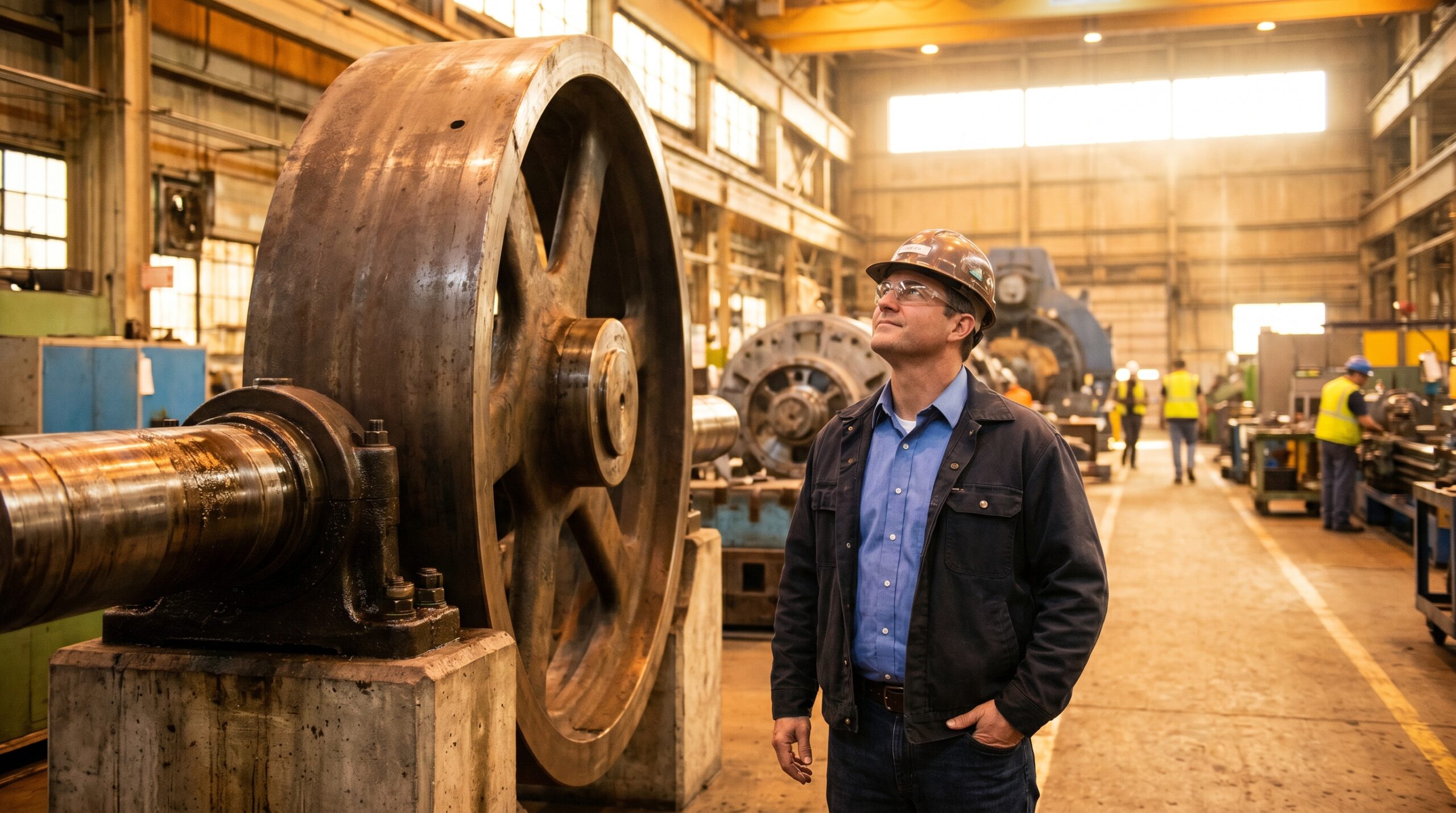
Imagine a massive iron wheel — five meters in diameter, mounted on a
rusted axle, sitting in the middle of your shop floor. It weighs tons.
It does not want to move. Your job is to make it spin.
You push. Nothing happens. You push harder. The wheel rocks slightly.
You get your team together, and everyone pushes. The wheel moves an
inch. Then two. You keep pushing. After a full day of effort, the wheel
completes one rotation. It is agonizing. It is thankless. Everyone is
exhausted, and the results are invisible to anyone not standing right
next to the axle.
But you keep pushing.
On the second day, the wheel completes three rotations with the same
effort. On the third day, ten. By the end of the second week, you are no
longer pushing the wheel — you are jogging alongside it, keeping pace.
By the end of the first month, the wheel is spinning fast enough that
stopping it would require serious effort.
This is the flywheel effect, and it is the most honest description of
how quality transformation actually works in real organizations. It is
also the reason most organizations abandon their quality programs too
early.
Why
Quality Improvements Stall in the First Six Months
Every quality initiative follows the same emotional arc. There is
excitement at launch — new tools, new training, maybe a consultant who
paints a compelling vision of zero defects and world-class performance.
Leadership makes speeches. Posters go up on the walls. The first few
weeks feel electric.
Then reality arrives.
The first FMEA takes three times longer than anyone expected because
the team has never done one properly before. The control plan reveals
gaps nobody wanted to acknowledge. The SPC charts show a process in
worse shape than anyone admitted. The corrective action from last
month’s customer complaint stalls because the root cause turned out to
be in a different department that does not report to the same manager.
The supplier scorecard reveals that three of your top five suppliers
have been quietly degrading for a year.
This is the point where most organizations make a critical decision —
and most of them make the wrong one.
They look at the effort going in and the results coming out, and they
conclude that the initiative is not working. The charts have not
improved dramatically. The defect rate is still where it was. The
customer is still complaining. The finance department asks for ROI, and
the quality manager cannot point to a single number that justifies the
investment.
So they pivot. They rename the program. They bring in a different
framework. They hire a different consultant. They switch from Six Sigma
to Lean, or from Lean to Agile, or from whatever they were doing to
whatever the conference speaker last month was selling. The flywheel,
which was just beginning to move, grinds to a halt. All the accumulated
momentum dissolves.
And then they start over. From zero. With a new wheel that is just as
heavy as the last one.
The Physics of
Organizational Momentum
What most organizations fail to understand about quality improvement
is that it obeys a kind of organizational physics — and the most
important law in that physics is the law of momentum accumulation.
When you train your operators in statistical thinking, you are not
just transferring knowledge. You are building neural pathways. You are
changing how people see the world. But that change does not show up in
your defect rate on day one. It shows up six months later when an
operator notices that a dimension is drifting before it crosses the
control limit, and adjusts the process proactively instead of waiting
for the alarm.
When you implement a proper root cause analysis process, you are not
just filling out 8D forms. You are training an organization to stop
blaming people and start interrogating systems. But that cultural shift
does not appear in your audit scores immediately. It appears a year
later when a team faced with a major nonconformance instinctively
reaches for data instead of reaching for a scapegoat.
When you establish layered process audits, you are not just adding
checks. You are teaching every level of management to see the shop floor
as it actually is, not as the report says it is. But the impact of that
visibility compounds slowly — one audit at a time, one conversation at a
time, one correction at a time.
Each of these actions is a push on the flywheel. Individually, each
push produces barely measurable results. But they accumulate. They
compound. And eventually, they reach a tipping point where the
organization’s quality culture becomes self-reinforcing — where the
system generates its own momentum because the people inside it have
fundamentally changed how they think and act.
The Three Phases of
the Quality Flywheel
Phase One: The Push (Months
1–6)
This is the hardest phase. You are investing heavily — in training,
in tools, in process changes, in people’s time — and the return is
minimal. Your defect rate might improve by ten or fifteen percent, but
nobody throws a party for fifteen percent. Your customer satisfaction
score might tick up slightly, but it is within the margin of error. Your
audit findings might decrease, but you still have enough nonconformances
to keep everyone humble.
The key to surviving Phase One is having the right expectations and
the right measurements. Do not expect dramatic results. Expect to feel
like you are pushing a boulder uphill. And measure the right things —
not just outcomes, but leading indicators. Are people attending the
training? Are they applying the tools? Are the audits happening on
schedule? Are corrective actions being completed on time? These process
metrics are the only honest indicators during Phase One, because the
outcome metrics have not had time to catch up.
The organizations that survive Phase One are the ones with leadership
that understands the difference between a bad strategy and a slow
strategy. A bad strategy produces no leading indicators. A slow strategy
produces plenty of leading indicators — they just have not translated
into lagging results yet.
Phase Two: The
Acceleration (Months 6–18)
If you survive Phase One, something remarkable begins to happen. The
individual improvements start to compound. The operator who learned SPC
six months ago is now teaching a colleague. The control plan that seemed
like bureaucratic overhead is now the reference document everyone
reaches for when something goes wrong. The corrective action system that
felt like a paperwork exercise has produced a library of solved problems
that teams reference before starting new investigations.
This is where the flywheel begins to accelerate. You are no longer
pushing as hard, but the wheel is spinning faster. Your defect rate
drops by thirty or forty percent — not because of any single
intervention, but because dozens of small improvements have stacked on
top of each other. Your customer complaints decrease because the
problems that used to escape are being caught earlier and earlier in the
process. Your internal scrap rate falls because the process is becoming
more predictable.
The danger in Phase Two is complacency. The results start looking
good, and leadership begins to redirect resources elsewhere. “Quality is
under control,” they say. “We can dial back the investment now.” This is
exactly the wrong conclusion. Phase Two is not the time to stop pushing
— it is the time to push harder, because the flywheel is finally gaining
speed, and the compounding returns of sustained effort are about to
become extraordinary.
Phase Three:
The Momentum (Months 18–36 and Beyond)
This is where quality becomes culture. The flywheel is spinning on
its own. New hires are socialized into a quality mindset within their
first week because everyone around them models it. Problems are raised
without fear because the organization has a track record of responding
constructively. Data is used reflexively because everyone has seen it
lead to better decisions. Continuous improvement is not a program — it
is just how things are done.
In Phase Three, the organization’s quality performance does not
require heroic effort. It requires maintenance. The systems, habits, and
culture that were painstakingly built over the previous eighteen months
are now self-reinforcing. The flywheel does not need you to push it — it
needs you to keep the bearings greased and the rust off the axle.
Organizations in Phase Three have a distinctive feel. There is a calm
confidence on the shop floor — not arrogance, but the quiet assurance of
people who know what they are doing and trust the system around them.
Problems are treated as information, not emergencies. Audits are
welcomed, not feared. Customers are partners, not adversaries. And the
quality metrics are consistently excellent — not because anyone is
gaming them, but because excellence has become the natural output of the
system.
The
Restart Trap: Why Starting Over Costs More Than Continuing
Here is the cruel mathematics of the flywheel effect: stopping the
wheel costs you everything, and starting a new one costs even more.
Every time an organization abandons a quality initiative midway and
replaces it with a new one, it pays three times. First, it pays the sunk
cost of the original investment — all the training, all the tools, all
the organizational energy that went into something that was never given
time to mature. Second, it pays the switching cost — the disruption of
introducing a new framework, the confusion of mixed signals, the
cynicism of employees who have seen this movie before and know how it
ends. Third, and most insidiously, it pays the trust cost — the slow
erosion of organizational confidence that any improvement effort will
ever be seen through to completion.
The trust cost is the most expensive because it is self-reinforcing.
When people believe that the current initiative will be abandoned in six
months, they invest accordingly. They go through the motions. They
attend the training but do not change their behavior. They fill out the
forms but do not embrace the thinking. And their prediction becomes
self-fulfilling — the initiative fails because nobody committed to it,
which confirms the belief that these things always fail, which reduces
commitment to the next one, which fails even faster.
Breaking this cycle requires leadership that is willing to make an
unpopular commitment: to stay the course when the results are not yet
visible, to resist the temptation of the shiny new framework, to trust
the physics of the flywheel even when the physics feels broken. This is
not stubbornness. This is the discipline to distinguish between a
strategy that is failing and a strategy that is compounding.
How to Tell the Difference
Not every struggling quality program is a flywheel waiting to spin.
Some are genuinely broken. Here is how to tell the difference.
A compounding flywheel shows these signs: – Leading
indicators are improving even when lagging indicators are not – People
are changing behavior voluntarily, not just under mandate – Problems are
being caught earlier in the process than before – Knowledge is spreading
organically between teams – The first response to a defect is
increasingly data-driven rather than emotional – New hires are
socialized into quality thinking by peers, not just by training
programs
A broken program shows these signs: – Activity is
high but nothing is actually changing on the shop floor – People are
going through the motions without understanding why – The same problems
keep recurring despite repeated corrective actions – Root cause analyses
consistently point to “operator error” and stop there – Quality is still
seen as the quality department’s job – Leadership asks for results but
does not participate in the process
If you see the first set of signs, keep pushing. The flywheel is
moving, even if you cannot feel it yet. If you see the second set, you
have a different problem — you are not pushing a flywheel. You are
pushing a rock, and rocks do not accumulate momentum.
The Flywheel in
Practice: A Real-World Pattern
I have watched this pattern play out dozens of times across
organizations of every size and industry. The specifics differ, but the
arc is remarkably consistent.
A mid-sized automotive supplier I worked with launched a
comprehensive quality transformation program that included SPC
deployment across all critical characteristics, layered process audits
at every level, structured problem-solving training for every team
leader, and a redesigned corrective action system with mandatory
verification of effectiveness.
For the first four months, the results were underwhelming. The defect
rate barely moved. Customer complaints continued at their historical
rate. The plant manager was getting pressure from the parent company to
show results. The quality director was defending the program in weekly
meetings with charts that showed leading indicators improving but
outcomes flat. It was uncomfortable. It was unpopular.
But the leading indicators were genuine. Audit completion rates were
above ninety percent. SPC charts were being maintained and interpreted
correctly. Corrective actions were being verified, not just closed.
Problem-solving teams were using data instead of intuition.
At month six, the defect rate began to drop — not dramatically, but
consistently. At month nine, it had fallen by thirty percent. At month
twelve, it had fallen by fifty percent. By month eighteen, the plant had
achieved a defect rate that was less than a quarter of where it had
started, and it was sustaining that performance without the intensive
effort that characterized the early months.
The flywheel was spinning.
The plant did not switch frameworks. It did not rename the program.
It did not bring in a new consultant with a new methodology. It simply
continued doing what it had started, trusting that the compounding
effect of consistent effort would eventually produce compound
results.
It did.
Practical
Steps for Building Your Quality Flywheel
Measure leading indicators religiously. During the
early phases, outcome metrics will not tell you whether you are making
progress. Track process adherence, training completion, audit findings
closed on time, and the quality of root cause analyses. These are your
early warning system.
Set expectations with leadership before you start.
Explain the flywheel effect explicitly. Show them the three-phase
timeline. Get their commitment to a minimum of twelve months before
judging results. If you cannot get that commitment, you are better off
not starting.
Celebrate process victories, not just outcome
victories. When a team completes their first proper root cause
analysis, celebrate it — even if the defect rate has not moved. When an
operator correctly interprets an SPC chart for the first time, recognize
it. These are the individual pushes on the flywheel, and they deserve
acknowledgment.
Document the journey. Keep a record of what changes,
when, and why. When the flywheel finally spins, you will want to trace
back and understand which pushes contributed most to the momentum. This
documentation also becomes your best argument the next time someone
suggests starting over.
Resist the restart. When results are slow and the
pressure is high, the temptation to pivot is enormous. Before you do,
ask yourself: are my leading indicators improving? If yes, the flywheel
is moving. Keep pushing. The results are coming.
The Final Rotation
The flywheel effect teaches a lesson that most organizations learn
too late: quality transformation is not an event. It is not a project.
It is not a program you can launch, measure, and declare complete. It is
a physics — slow to start, powerful once moving, and devastating to
interrupt.
The organizations that achieve lasting quality excellence are not the
ones with the best tools or the smartest consultants. They are the ones
with the discipline to keep pushing when the wheel feels immovable, the
patience to trust the process when the numbers do not cooperate, and the
wisdom to recognize that the heaviest push is always the first one — and
every push after that is slightly easier than the one before.
Your quality flywheel is out there. It is heavy. It is waiting. And
the only question that matters is whether you will still be pushing six
months from now when it finally starts to spin.
Peter Stasko is a Quality Architect with 25+ years
of experience transforming manufacturing organizations across
automotive, industrial, and electronics sectors. He specializes in
building quality systems that compound over time — because the best
quality investment is the one you never stop making.