Quality
and the Kano Model: When Your Organization Discovers That Not All
Quality Improvements Create Equal Customer Satisfaction — and the
Features You Invested In Most Became the Ones Your Customers Noticed
Least
The Expensive Surprise
Nobody Saw Coming
The engineering team had spent eleven months perfecting a sealing
gasket on an automotive HVAC housing unit. They ran DFMEA sessions,
conducted accelerated life testing across three temperature extremes,
and validated the design through four rounds of prototype iterations.
The final gasket exceeded the specification by a factor of seven. The
project cost upward of $400,000 in engineering hours, tooling
modifications, and testing.
Six months after launch, the customer satisfaction scores came back.
The gasket — that masterwork of polymer engineering — was never
mentioned. Not once. Not in a single survey response, not in a single
warranty claim, not in a single dealer feedback report.
What did show up, repeatedly, was a complaint about the fit
and finish of a cosmetic trim clip. The clip rattled at highway speeds.
It cost $0.03 per unit. It had been flagged during design review as
“non-critical” and deprioritized in favor of the gasket work.
This is not a hypothetical story. Variations of it play out in
manufacturing organizations every quarter. And the reason it happens is
not incompetence. It is a systematic failure to distinguish between the
types of quality that matter to customers and the types that simply do
not register.
The framework that prevents this failure was developed in 1984 by a
Japanese professor named Noriaki Kano. It is called the Kano Model, and
it may be the most underused quality tool in your organization’s
arsenal.
What the Kano Model Actually
Is
The Kano Model is a theory of customer satisfaction that classifies
product and service attributes into five categories based on how they
influence the customer’s experience. It was originally presented at a
conference of the Japanese Society for Quality Control and has since
been validated across industries ranging from automotive and aerospace
to healthcare and software.
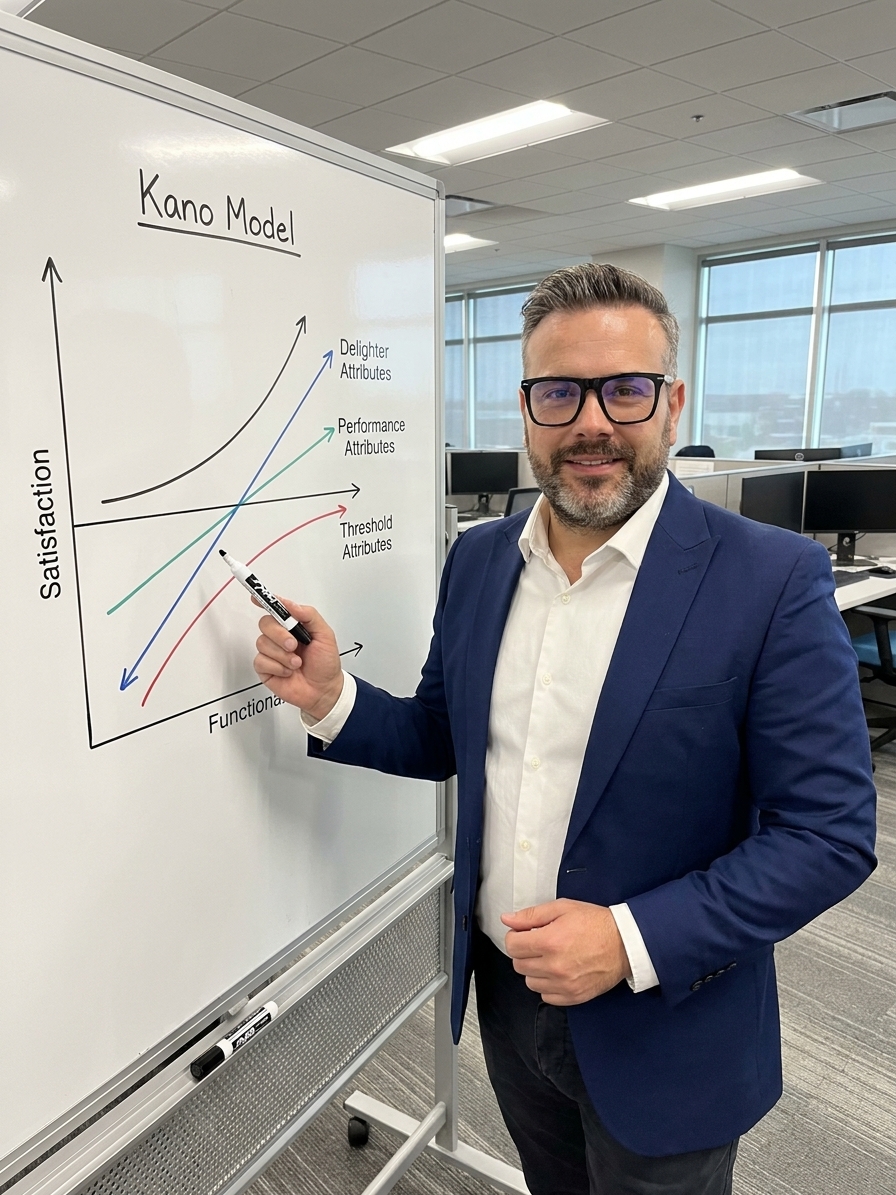
At its core, the model plots two dimensions: the degree of
achievement (how well a feature is implemented) on the
horizontal axis, and the degree of customer
satisfaction on the vertical axis. The relationship between
these two dimensions is not linear — and that is the critical
insight.
Here are the five categories:
1. Must-Be (Threshold)
Requirements
These are the features the customer assumes will be there. They do
not generate satisfaction when present, but they generate massive
dissatisfaction when absent. Think of brakes on a car. You do not
celebrate that your car has brakes. But if they fail, the relationship
is over — permanently and possibly catastrophically.
In manufacturing, must-be requirements are things like dimensional
conformance, material integrity, and basic functionality. They are table
stakes. Your customer does not thank you for them. Your customer
expects them.
2. One-Dimensional
(Performance) Requirements
These features create satisfaction in proportion to their degree of
achievement. More is better. Fuel efficiency, processing speed, battery
life — these are one-dimensional attributes. The better you perform, the
more satisfied the customer.
In quality terms, these are your measurable specifications. Tighter
tolerances, longer mean time between failures, faster cycle times. The
customer notices improvement. The customer notices degradation. The
relationship is linear and predictable.
3. Attractive (Delighter)
Requirements
These are the features the customer did not expect. When present,
they generate outsized satisfaction. When absent, they generate no
dissatisfaction at all — because the customer never knew they could
exist.
The first time a car had heated seats, that was an attractive
feature. Nobody was dissatisfied that their car lacked heated seats in
1990. But the first time they experienced them on a cold February
morning, the satisfaction was disproportionate to the cost of
implementation.
Attractive features are your competitive differentiators. They are
the innovations that make customers switch, recommend, and stay
loyal.
4. Indifferent Requirements
These are features where the degree of achievement has no meaningful
impact on customer satisfaction. The internal gasket in our opening
story was likely in this category — as long as it met the basic
threshold, additional improvement was invisible to the customer.
Indifferent features are where organizations waste the most money.
Engineering effort that produces technically superior results but no
perceptible difference in the customer’s experience.
5. Reverse Requirements
These are features where more achievement actually
reduces satisfaction. Over-engineering can fall into this
category. A product that is too complex to use, a surface finish that is
so glossy it creates glare, a notification system that alerts so
frequently it becomes noise.
Reverse requirements are dangerous because organizations often
implement them believing they are performance or attractive features,
only to discover that customers actively resent them.
The Lifecycle That
Changes Everything
Here is the most powerful and most frequently overlooked aspect of
the Kano Model: features migrate over time.
Every attractive feature eventually becomes a one-dimensional
feature, and then a must-be feature. Heated seats delighted in 1995,
performed competitively in 2005, and are now simply expected in any
premium vehicle. Backup cameras followed the same path. USB charging
ports followed the same path.
This lifecycle has a direct implication for your quality strategy:
the features you invest in for differentiation today must be maintained
as basic expectations tomorrow. The innovation budget must constantly
seek new attractive features while the operational budget must
relentlessly deliver on must-be features.
Organizations that fail to understand this lifecycle find themselves
spending innovation money on features that have already become must-be
requirements — competing on table stakes instead of differentiators, and
wondering why their customers seem perpetually unimpressed.
How to
Apply the Kano Model in a Quality Organization
Step 1: Identify Your
Quality Attributes
List every quality characteristic of your product or service. Include
dimensional specs, functional performance, cosmetic appearance,
reliability metrics, service responsiveness, packaging — everything the
customer experiences or that influences what the customer
experiences.
Step 2: Conduct Kano Surveys
For each attribute, ask two questions:
- Functional question: “If this feature were present
(or performed at this level), how would you feel?” - Dysfunctional question: “If this feature were
absent (or performed poorly), how would you feel?”
Responses are captured on a five-point scale: I like it, I expect it,
I am neutral, I can tolerate it, I dislike it.
The combination of functional and dysfunctional responses classifies
each attribute into one of the five Kano categories.
Step 3: Analyze and
Prioritize
Map your attributes on the Kano matrix. You will typically discover
that a significant portion of your engineering and quality investment is
going toward indifferent features. This is your waste — and your
opportunity.
Prioritize investment based on category:
- Must-be features: Invest enough to guarantee
reliable delivery. No more, no less. Over-investment here is waste. - One-dimensional features: Optimize competitively.
These are where marginal improvements create proportional returns. - Attractive features: Pursue aggressively but
selectively. These are your highest-leverage investments. - Indifferent features: Minimize investment. Meet the
threshold and redirect resources. - Reverse features: Eliminate or reduce
immediately.
Step 4: Track Migration
Re-run the Kano analysis periodically — annually for mature products,
quarterly for fast-moving markets. Track which features are migrating
from attractive to one-dimensional to must-be. Anticipate the next wave
of customer expectations before your competitors do.
The Manufacturing Reality
Check
Let me be direct about what I have seen in 25 years of quality work
across three continents.
Most manufacturing organizations do not have a Kano problem. They
have a prioritization problem. They treat every specification
as equally important. They allocate engineering resources based on which
problem is loudest, not which problem matters most to the customer. They
spend six figures optimizing a characteristic that the customer
classifies as indifferent while ignoring a $0.03 trim clip that falls
into the one-dimensional category and directly drives satisfaction
scores.
The root cause is almost always a disconnect between the engineering
function and the voice of the customer. Engineering teams work from
technical specifications. Customers experience the product holistically.
The gap between these two perspectives is where competitive advantage is
either created or destroyed.
I worked with an automotive supplier that was spending 60% of its
continuous improvement budget on reducing dimensional variation on
internal components that were never visible to the end user and had no
functional impact on performance. When we ran a Kano analysis, every
single one of those characteristics was classified as indifferent or
must-be with no room for competitive advantage.
We redirected that budget toward three attractive features that had
been sitting on the wish list for two years. Within one product cycle,
the company moved from a Tier 2 supplier to a preferred supplier for two
major OEMs. The technical excellence had always been there. The
prioritization had not.
The Leadership Implication
The Kano Model is not just a quality tool. It is a strategic tool. It
forces leadership to answer a question most organizations never
explicitly ask: Are we investing our quality resources in the
things that actually drive customer decisions?
This question requires courage because the answer is often
uncomfortable. It may reveal that your most prestigious engineering
achievement — the one your team presented at the industry conference,
the one that won the internal innovation award — is classified by your
customers as indifferent. The realization can bruise egos. But it is
infinitely better than the alternative: continuing to invest in
excellence that nobody notices while your competitors invest in
excellence that everyone does.
Leaders who embrace the Kano Model create organizations that are
ruthlessly efficient in their quality investment. They protect the
must-be baseline, compete aggressively on one-dimensional performance,
innovate continuously on attractive features, and eliminate spending on
indifferent and reverse characteristics.
Common Pitfalls
Pitfall 1: Assuming you know the classification without
asking. Engineering teams frequently assume that a feature is
one-dimensional when customers classify it as indifferent. The only
reliable classification comes from direct customer research. Internal
assumptions are the enemy of effective prioritization.
Pitfall 2: Treating Kano as a one-time exercise. The
migration of features across categories is continuous. A Kano analysis
that is 18 months old is already outdated. Build it into your periodic
review process.
Pitfall 3: Ignoring the must-be category.
Organizations focused on innovation sometimes underinvest in must-be
features, assuming they are unimportant because they do not generate
satisfaction. This is catastrophically wrong. Must-be features generate
dissatisfaction when they fail. The penalty for
underperformance is disproportionate to the investment required to
prevent it.
Pitfall 4: Confusing internal metrics with customer
satisfaction. Your internal defect rate on a characteristic may
be world-class, but if that characteristic is indifferent to the
customer, the achievement is technically impressive and strategically
irrelevant.
The Bottom Line
Every dollar you spend on quality is a dollar you chose not to spend
somewhere else. The Kano Model gives you a framework for making that
choice intelligently. It replaces gut feeling with customer data,
replaces equal treatment with strategic prioritization, and replaces the
assumption that all quality is good quality with the understanding that
only customer-perceived quality creates competitive
advantage.
Your gasket may be seven times better than specification. But if your
trim clip rattles, that is what your customer will remember. That is
what they will tell their colleagues. That is what will determine
whether your next quote wins or loses.
The Kano Model ensures you hear that rattle before your customer does
— and that you invest in silencing it before your competitor does.
Peter Stasko is a Quality Architect with 25+ years
of experience transforming organizations across automotive, aerospace,
and pharmaceutical industries. He specializes in bridging the gap
between technical excellence and customer perception — because the best
quality system in the world is worthless if it optimizes for the wrong
things.