Quality
and the Kübler-Ross Change Curve: When Your Organization Grieves the
Process It’s Leaving Behind — and the Emotional Journey Nobody Prepared
For Becomes the Reason Your Quality Transformation Either Survives or
Collapses
The Death Nobody Mourned
The email arrived at 4:47 PM on a Friday. “Effective Monday, all
production lines will transition to the new quality management system.
Training begins at 6:00 AM.” The plant manager hit send and went home,
satisfied that he’d communicated the change clearly and given people the
entire weekend to prepare.
By Monday morning, three inspectors had called in sick. Two shift
supervisors were openly refusing to use the new digital checklists,
arguing that the paper forms they’d used for fifteen years were
perfectly adequate. The quality engineer who’d spent six months
designing the new system sat in the conference room staring at her
laptop, wondering what had gone wrong.
What had gone wrong was not the system. The system was excellent.
What had gone wrong was that nobody had accounted for the fact that
change — even positive change — triggers grief.
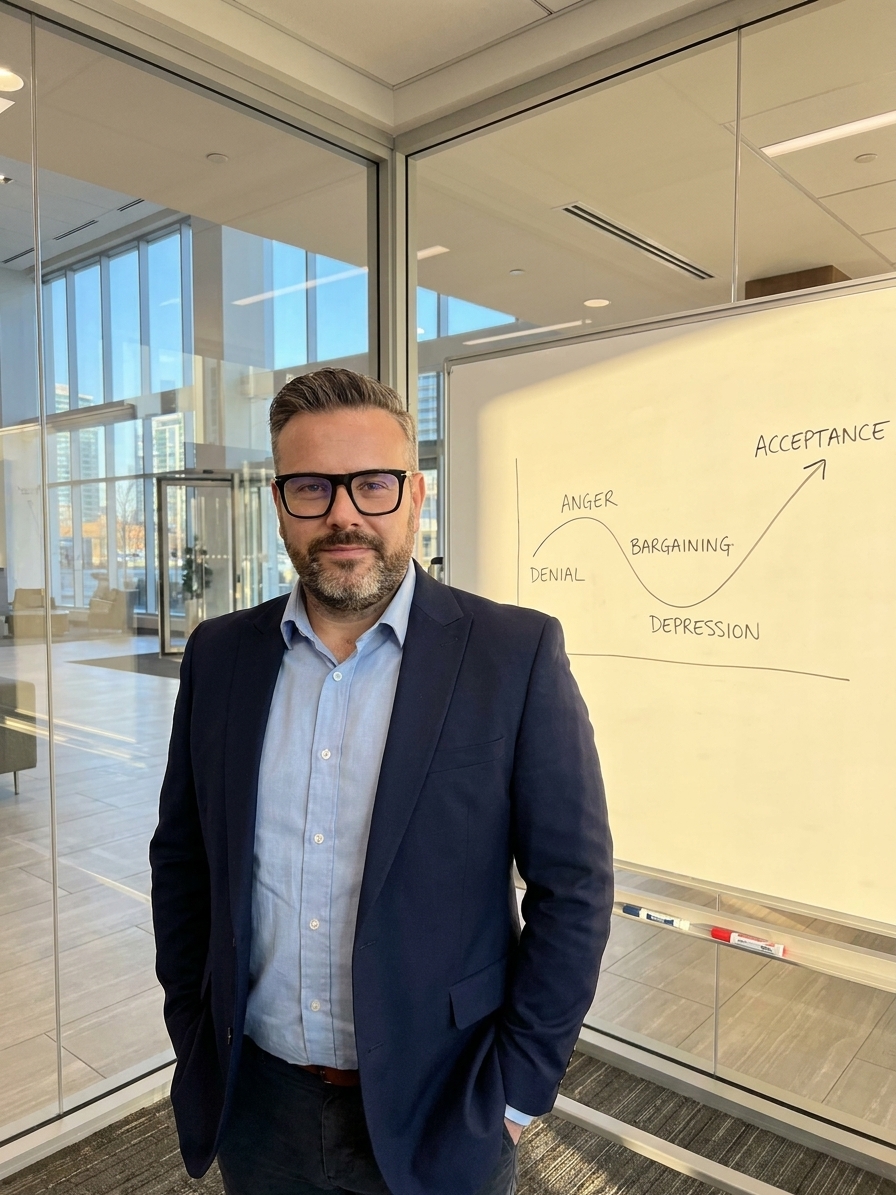
Elisabeth Kübler-Ross described five stages of grief that people
experience when facing loss: denial, anger, bargaining, depression, and
acceptance. She was writing about terminal illness and bereavement, but
her framework applies with unsettling precision to organizational
change. When you ask people to abandon processes they’ve used for years
— processes that feel like extensions of their hands, their judgment,
their professional identity — you are asking them to let go of
something. And letting go, for human beings, is never just a logical
exercise.
This is the story that most quality transformation playbooks skip.
They cover the technical architecture, the training schedule, the
milestone reviews. They map the Gantt charts and the risk registers. But
they don’t map the emotional journey that your people will travel
between “this will never work” and “I can’t imagine doing it any other
way.” And because they skip it, they are consistently blindsided by
resistance that looks like stubbornness but is actually grief.
Denial: “This Won’t Last”
In 2019, a mid-sized automotive parts supplier in Slovakia
implemented a new SPC system. The old system involved operators writing
measurements on paper cards at the end of each shift. The new system
required real-time data entry into tablets mounted at each station.
For the first three weeks, operators entered the data into the
tablets and then, when nobody was looking, wrote the same numbers on
paper cards. Not because they distrusted the technology. Not because
they couldn’t use the tablets. But because they didn’t believe the
change would last. They had seen four quality initiatives come and go in
the past decade. Each one arrived with fanfare, consumed weeks of
training, and gradually faded back to the way things had always been
done.
Denial in organizational change doesn’t look like people lying on the
floor refusing to move. It looks like compliance without commitment. It
looks like people going through the motions of the new process while
maintaining the old one in parallel, like a patient who starts a new
medication but keeps the old prescription in the bathroom cabinet just
in case.
The quality manager noticed the dual-entry pattern when he compared
the tablet timestamps to the paper cards. The operators weren’t being
difficult. They were being rational — based on their experience. Their
denial wasn’t ignorance. It was a prediction based on a pattern they’d
observed repeatedly: management announces transformation, everyone
complies temporarily, management loses interest, things revert. Why
invest emotionally in a change that history suggests won’t stick?
The fix wasn’t more training. The fix was consistency. The quality
manager committed publicly to a twelve-month timeline and gave weekly
updates on the system’s usage. By month four, the paper cards started
disappearing from the workstations — not because anyone confiscated
them, but because the operators themselves stopped feeling the need for
a backup.
Denial dissolves not when you argue against it, but when you outlast
it.
Anger: “You’re Taking Away
What Works”
A pharmaceutical company in Central Europe decided to replace its
manual visual inspection process with an automated vision system. The
inspectors — many of whom had twenty-plus years of experience — were
furious. Not politely concerned. Furious.
“You’re telling me a machine can do what I’ve spent my career
learning to do?” one inspector said in the town hall meeting. “You’re
saying my eyes, my judgment, my twenty-three years of catching defects
that your engineers never even imagined — that’s all replaceable by a
camera?”
The project team was caught off guard. They had expected pushback on
the technology, questions about reliability, concerns about calibration.
What they got was rage — raw, personal, existential rage. And it wasn’t
really about the camera system. It was about identity.
When you implement a quality change that alters how people work, you
are not just changing their workflow. You are challenging their sense of
competence, their professional narrative, their belief that what they’ve
spent years mastering still matters. Anger in the Kübler-Ross model is
the moment when the reality of loss becomes impossible to deny, and the
emotional response is to fight the source of that loss.
The mistake most quality leaders make during this stage is trying to
rationalize the anger away. They present data showing the new system is
more accurate. They share benchmarking results from other plants. They
explain the business case. And the angry person across the table hears
none of it, because the anger isn’t about accuracy or benchmarks. It’s
about mourning.
What worked at the pharmaceutical company was acknowledgment. The
quality director stood in front of the inspectors and said: “I
understand that this feels like we’re telling you your expertise doesn’t
matter. That is not what we’re saying, and I want to tell you why.” Then
he explained that the vision system would handle the routine inspections
— the thousands of repetitive checks that caused fatigue and eye strain
— while the inspectors would be trained to handle the complex,
judgment-intensive cases that the system couldn’t touch. Their expertise
wasn’t being replaced. It was being elevated.
The anger didn’t disappear overnight. But it shifted from existential
fury to operational skepticism — a form of engagement that,
paradoxically, is far more productive because it means people are now
engaging with the change rather than fighting its existence.
Bargaining: “Can We Keep
Just This Part?”
An aerospace manufacturer implemented a new document control system
that required all work instructions to be reviewed and approved through
a digital workflow. Previously, engineers had maintained their own
copies of instructions, made handwritten annotations, and informally
shared updates across cubicles.
Within weeks of the go-live, the engineering team proposed a
compromise: “Can we keep our personal copies as a reference? We’ll use
the formal system for official documents, but we want to maintain our
annotated versions for day-to-day work.”
This is bargaining — the third stage of the Kübler-Ross curve.
Bargaining is the mind’s attempt to negotiate with reality, to find a
middle ground that softens the loss. In quality transformations,
bargaining takes very specific forms:
- “Can we phase this in gradually?” (Translation: Can we delay the
part that scares us?) - “Can we keep the old form as a backup?” (Translation: Can I maintain
my safety net?) - “Can this department go first and we’ll learn from their mistakes?”
(Translation: Can someone else absorb the pain?) - “Can we customize the system to work more like our old process?”
(Translation: Can the new thing be disguised as the old thing?)
None of these requests are unreasonable on their surface. Some of
them are genuinely good ideas. But the quality leader needs to
distinguish between productive adaptation and covert resistance. The
aerospace manufacturer allowed annotated personal copies for a
ninety-day transition period, after which all annotations had to be
incorporated into the formal system. It was a genuine compromise — not a
capitulation — and it worked because it had a clear endpoint.
Bargaining fails when it becomes permanent. The worst outcome is a
hybrid system where the new process runs alongside the old one
indefinitely, creating two sources of truth, double the work, and half
the compliance. This is how organizations end up with quality systems
that are technically deployed but functionally ignored.
Depression: “I Used to Be
Good at This”
This is the stage that catches quality leaders most off guard,
because it doesn’t look like resistance. It looks like withdrawal.
A medical device company transitioned from manual assembly to
semi-automated workstations. The operators, who had been among the
fastest and most accurate in the plant, suddenly found themselves
struggling. The new stations required different motor skills, different
timing, different mental models. Operators who had been top performers
for years were now making basic errors, asking questions they would have
been embarrassed to ask a month earlier, and watching their productivity
metrics tumble.
Their confidence collapsed. Several operators confided to their team
leader that they felt stupid. One said, “I used to be the person
everyone came to with questions. Now I’m the one who can’t figure out
how to load a fixture.”
In the Kübler-Ross model, depression is the stage where the reality
of loss is fully felt. The bargaining has failed, the anger has burned
out, and what remains is a quiet, heavy awareness that the old world is
gone and the new one hasn’t yet become comfortable. For experienced
workers going through quality transformations, this stage is deeply
personal. Their competence — the thing that defined their professional
identity — feels like it has been taken from them.
What these operators needed was not more technical training. They
understood the new stations mechanically. What they needed was
permission to be beginners again. The team leader organized peer
pairing, where each experienced operator was matched with a younger
colleague who was more comfortable with the technology. The pairs
learned from each other — the veterans contributed their deep
understanding of quality standards and defect patterns, the newer
workers helped with the digital interfaces and automation sequences.
Within six weeks, the veterans weren’t just competent on the new
stations. They were the best operators, because they combined their
years of quality instinct with the new technology’s capabilities. But
the organization nearly lost them during the depression phase — two had
requested transfers, and one had mentioned retirement — because nobody
had prepared them for the emotional valley that lies between old mastery
and new mastery.
Acceptance: “I Can’t
Imagine Going Back”
Acceptance in the Kübler-Ross model does not mean happiness. It means
that the person has integrated the new reality and stopped fighting it.
In quality transformations, acceptance looks deceptively ordinary:
- Operators use the new system without commenting on it.
- Engineers stop comparing the new process to the old one.
- People start suggesting improvements to the new system — a sure sign
they’ve adopted it as their own. - When someone from another plant visits and asks about the
transition, the response is a shrug and “It’s just how we work
now.”
But here’s the critical insight that most quality leaders miss:
acceptance is not the end of the curve. It is the beginning of the next
one. Because the moment people accept the new quality system, they start
developing the same attachment to it that they had to the old one. They
build expertise around it, create workarounds for its limitations,
develop tribal knowledge about its quirks. And when the next
transformation comes — and it will come — they will grieve this system
just as deeply as they grieved the last one.
This is not a flaw. It is a human feature. Understanding it is what
separates quality leaders who drive sustainable transformation from
those who drive it once and then wonder why it never works again.
The Curve Is Not Linear
One of the most dangerous misconceptions about the Kübler-Ross model
is that people move through the stages in order, one at a time, never
looking back. In reality, people cycle through the stages repeatedly,
sometimes within the same afternoon. An operator might accept the new
inspection protocol during morning training, feel angry about it during
the afternoon shift when it slows them down, bargain for exceptions the
next morning, and feel genuine grief about their lost efficiency by
lunch.
Quality leaders who understand this don’t panic when someone who
seemed to have accepted the change suddenly reverts to anger. They
recognize it as a normal oscillation, not a failure. They respond with
patience and consistency — the two interventions that are most effective
at every stage of the curve.
Building the
Map Your Transformation Is Missing
If you’re leading a quality transformation, the Kübler-Ross model
gives you something your Gantt chart doesn’t: a prediction of what your
people will feel, and when. Here’s how to use it:
Before the change: Tell people what’s coming and
why. Don’t sugarcoat it. Acknowledge that the transition will be
difficult. Naming the difficulty in advance doesn’t eliminate the grief,
but it removes the secondary shock of feeling blindsided.
During denial: Don’t argue. Demonstrate. Show the
new system working. Share early wins. Be consistent. Deny dissolves in
the presence of evidence, not in the presence of persuasion.
During anger: Listen. Don’t defend. Don’t explain.
Listen until the person feels heard. Then — and only then — engage with
their concerns. Anger that is acknowledged transforms into energy. Anger
that is dismissed hardens into resistance.
During bargaining: Set clear boundaries with defined
timelines. Allow temporary compromises that have expiration dates.
Distinguish between productive adaptation (“Can we customize this
field?”) and covert resistance (“Can we just not use it?”).
During depression: Normalize the struggle. Create
safe spaces for people to express frustration without judgment. Pair
experienced workers with supportive colleagues. Celebrate small wins
aggressively. And above all, don’t rush it. Competence is the cure for
the depression phase, and competence takes time.
During acceptance: Reinforce. Recognize. And start
preparing for the next curve.
The Leader’s Own Grief
There’s one more thing the Kübler-Ross model reveals about quality
transformations that most leaders prefer not to discuss: the leaders
themselves go through the curve. The plant manager who championed the
new QMS may experience denial when the rollout hits its first major
obstacle (“This is just a bump, it’ll be fine”), anger when the board
questions the investment (“They don’t understand what we’re building”),
bargaining with the timeline (“Maybe we can extend the pilot by three
months”), and depression when the early results disappoint (“Maybe I was
wrong about this”).
If the leader is stuck in their own grief cycle while trying to guide
others through theirs, the transformation is in trouble. The most
effective quality leaders are those who do their own emotional
processing first — who acknowledge their own attachment to the old ways,
their own anxiety about the new ones, and their own fear of failure. Not
in a therapy session, but in honest conversation with a peer, a mentor,
or a coach.
You cannot guide people through a valley you refuse to acknowledge
you’re also walking through.
The Cost of Ignoring the
Curve
Organizations that ignore the emotional dimension of quality change
pay a specific, measurable price. The new system gets implemented
technically but never adopted culturally. Compliance exists on paper but
not in practice. People follow the letter of the new procedure while
violating its spirit in a thousand small, undetectable ways. The quality
metrics improve temporarily and then plateau below their potential,
because the system was deployed to people who never truly accepted
it.
The alternative is to treat the emotional journey as a legitimate
project dimension — as real as the IT infrastructure, as critical as the
training curriculum, as measurable as the defect rate. Because it is.
The organizations that master quality transformation are not the ones
with the best technology or the most rigorous procedures. They are the
ones that understand that behind every process change is a person who is
being asked to let go of something familiar and reach for something
unknown.
And reaching is always harder than holding on — until, one day, it
isn’t.
Peter Stasko is a Quality Architect with 25+ years
of experience transforming organizations across automotive, aerospace,
and pharmaceutical industries. He has guided dozens of companies through
the human side of quality transformation — and learned that the
technical system is usually the easy part.