Quality and the Law of Requisite Variety: When Your Quality System Discovers That Rigidity Is Fragility — and the Flexibility You Feared Becomes Your Strongest Defense
The Quality System That Knew Exactly One Answer
There was a plant in central Europe — automotive tier-one, high-volume, zero-tolerance specs — that had a quality system so thorough it could have been framed and hung in a museum. Every process had a control plan. Every control plan had a reaction plan. Every reaction plan said the same thing: stop the line, notify the supervisor, contain the suspect product.
For three years, that system worked beautifully. The defects it was designed to catch showed up, the system caught them, and the line stopped. Customers were protected. Scrap was measured. Lessons were logged. The plant won an award from its OEM customer for “exemplary quality response discipline.”
Then came the Tuesday that broke everything.
A supplier changed a lubricant without notifying anyone — not maliciously, not negligently, just a substitution buried in a routine purchase order that nobody flagged because the part number didn’t change. The new lubricant didn’t cause an immediate defect. It didn’t trigger a control limit. It didn’t set off any alarm. Instead, it created a condition that the control plan had never anticipated: a slow, intermittent, temperature-dependent variation in surface finish that appeared only during the third shift, only on Tool 7, only when the ambient humidity exceeded 68%.
The control plan had one response: stop, notify, contain. But the defect didn’t show up consistently enough to trigger the control chart. The reaction plan assumed a clear signal. What it got was a whisper — a ghost in the data that appeared and vanished depending on conditions nobody was tracking.
The plant shipped defective parts for eleven days before a customer line worker noticed a finish inconsistency during assembly. By then, 14,000 parts had entered the customer’s supply chain. The containment cost €2.3 million. The root cause investigation took six weeks. And when it was over, the quality manager sat in a conference room staring at a control plan that had performed exactly as designed — and failed completely.
The problem wasn’t the control plan. The problem was that the control plan only knew how to do one thing.
The Principle That Explains Everything
In 1956, a British psychiatrist and cybernetician named W. Ross Ashby published a book called An Introduction to Cybernetics. In it, he articulated a principle so fundamental that it applies to every system ever designed — from immune systems to air traffic control to your shop floor’s quality management system.
The Law of Requisite Variety states: For a system to be stable, the variety of its responses must be at least as great as the variety of disturbances it faces.
In plain language: you need at least as many answers as the world has questions.
Ashby’s insight was mathematical, not metaphorical. “Variety” in his framework means the number of possible distinct states a system can be in. If your environment can produce 1,000 different problems, your control system needs at least 1,000 different responses. Not one response repeated 1,000 times. Not a general policy that covers “most cases.” 1,000 specific, differentiated, appropriate responses.
If your variety of responses is lower than the variety of disturbances, the system will fail. Not might fail. Will fail. It is a mathematical certainty. You cannot cheat this law any more than you can cheat gravity.
What This Means for Quality Management
Most quality systems are built on a seductive assumption: if we write enough procedures, we can anticipate every problem and prescribe every response. This is the ISO 9001 dream — a documented, controlled, predictable system that handles everything the same way every time.
But Ashby’s law reveals the flaw. The variety of possible disturbances in a manufacturing environment is, for all practical purposes, infinite. Raw material variation, tool wear, operator fatigue, humidity changes, supplier substitutions, software glitches, measurement drift, vibration from the fork lift in the next bay, the new operator who started last Tuesday and didn’t read procedure 4.2.3 because nobody printed it yet — the combinations are combinatorial.
No procedure manual can match that variety. No control plan, no matter how thick, can enumerate every possible failure mode. The FMEA tries — and it’s valuable — but every FMEA is a snapshot of what the team could imagine at the time they wrote it. The failures that hurt you are the ones nobody imagined.
This means that rigid quality systems are inherently fragile. Not because rigidity is bad, but because rigidity has insufficient variety. A system that always responds the same way will be correct sometimes, suboptimal often, and catastrophically wrong exactly when it matters most.
The Three Strategies for Matching Variety
Organizations that understand requisite variety don’t abandon procedures. They build systems with three layers of response capability, each adding variety:
Layer 1: Procedural Variety — The Known Responses
This is your control plan, your work instructions, your reaction plans. It handles the problems you’ve seen before and can anticipate. Most organizations stop here, which is why most organizations are perpetually surprised.
The key to maximizing procedural variety isn’t writing more procedures — it’s writing smarter ones. Instead of a single reaction plan per process, build branching reaction plans that account for different types of signals:
- Clear signal, known cause: Execute standard containment.
- Clear signal, unknown cause: Contain, then escalate to structured investigation.
- Weak signal, intermittent: Enter enhanced monitoring mode with increased frequency.
- No signal, but conditions changed: Trigger a verification audit before production resumes.
Each branch adds variety. Each branch is a different response to a different kind of disturbance. You’ve gone from one answer to four — and you’ve already doubled your system’s resilience.
Layer 2: Adaptive Variety — The People Who Think
This is where human intelligence becomes your quality system’s greatest asset. People are the highest-variety elements in any organization. A skilled operator doesn’t just follow the procedure — she reads the situation, synthesizes information the procedure can’t capture, and improvises a response that no document could have prescribed.
The plant in our opening story had operators who noticed something was off during third shift. They mentioned it informally. But the system had no mechanism to capture and act on their observations because the reaction plan only recognized control chart violations. The operators’ variety was there; the system just couldn’t use it.
Organizations that leverage adaptive variety:
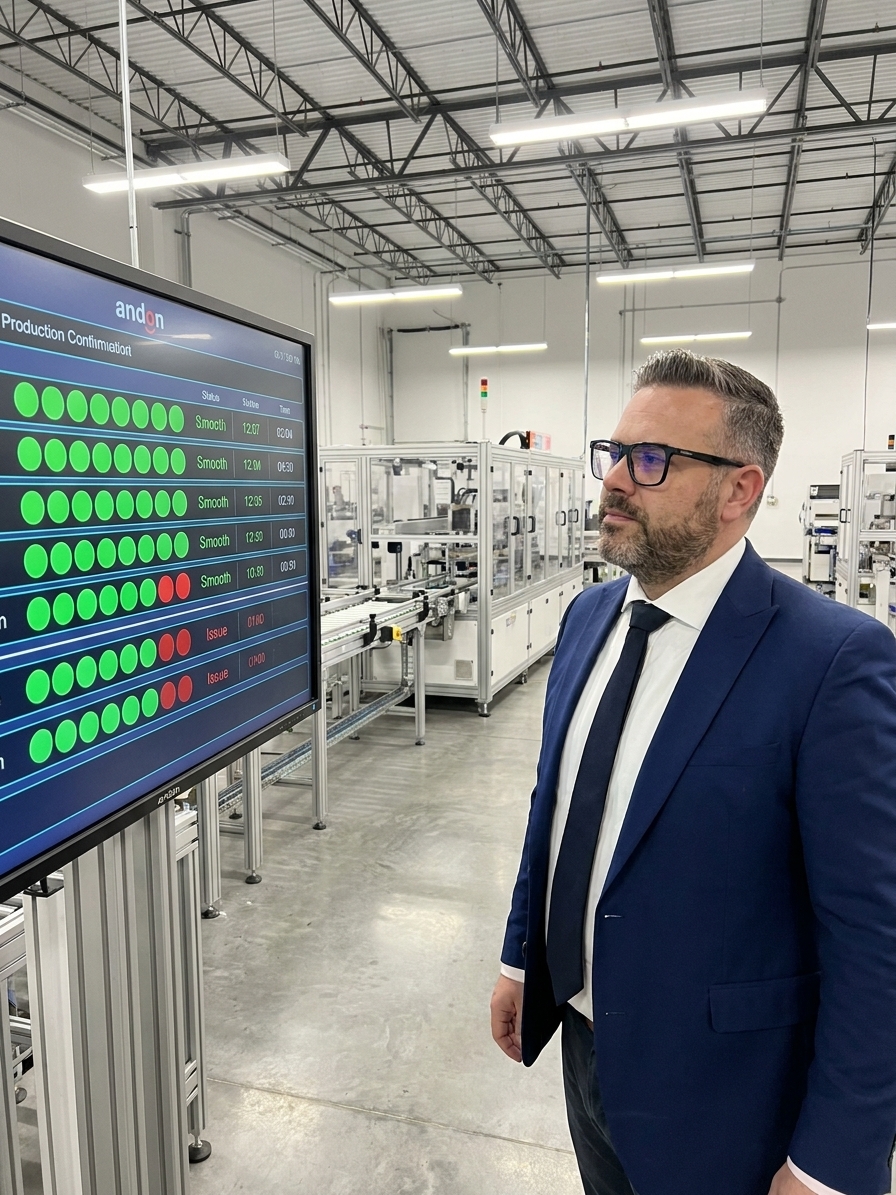
- Empower operators to stop the line for any reason — not just control limit violations. This is the Andon principle, and it’s pure requisite variety in action.
- Create structured escalation paths for “I don’t know what this is, but something’s wrong.” Not every signal needs a clear specification limit to be valid.
- Build cross-functional rapid response teams that can be assembled ad hoc to address novel problems. The team composition itself becomes a variable response.
- Conduct regular “what would we do if…” scenario exercises that expand the organization’s repertoire of imagined responses.
Layer 3: Evolutionary Variety — The System That Learns
The highest level of requisite variety isn’t having all the answers — it’s having a system that generates new answers when it encounters new questions.
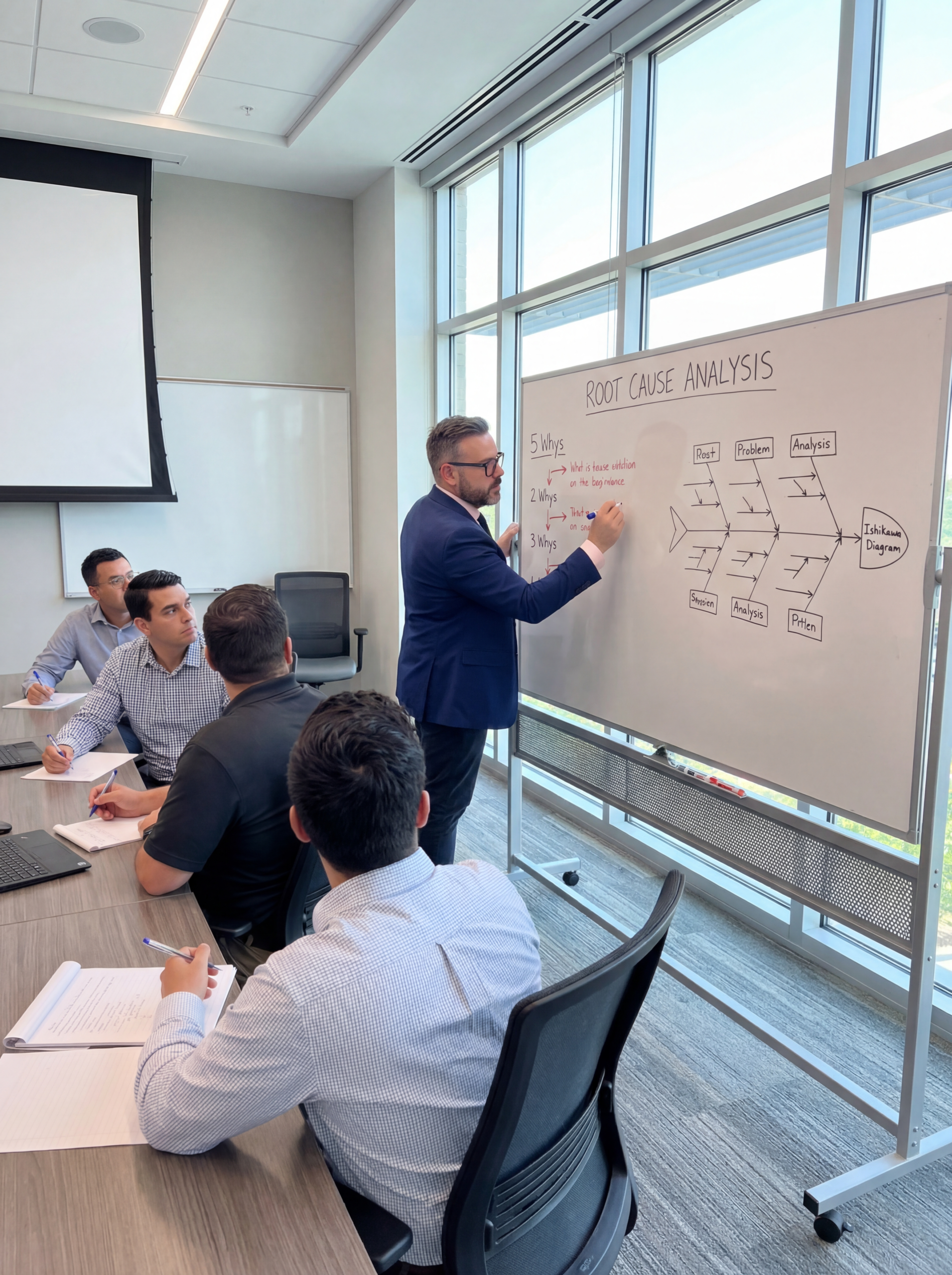
This is where continuous improvement transforms from a buzzword into a survival mechanism. Every defect investigation, every root cause analysis, every corrective action isn’t just fixing a problem — it’s adding variety to the system’s response repertoire.
Organizations that build evolutionary variety:
- Close every corrective action with a question: “What would have caught this earlier, and how do we build that capability?”
- Maintain a living failure mode library that grows with every incident — not as a bureaucratic exercise, but as an actively consulted resource during FMEA updates and control plan reviews.
- Rotate quality professionals through different processes, plants, and even industries to cross-pollinate response strategies. Variety in experience creates variety in response.
- Invest in simulation and scenario planning to experience failures virtually before they happen physically.
The Requisite Variety Audit
Here’s a practical exercise. Take your most critical process and conduct a Requisite Variety Audit:
Step 1: Map the Disturbance Space List every type of variation, failure, and unexpected condition that process has experienced in the past two years. Then list every type you can imagine happening but haven’t seen yet. Don’t stop at twenty. Push to fifty. Push past the comfortable answers.
Step 2: Map the Response Space For each disturbance, what is your system’s actual response? Not what the procedure says. What actually happens, at 2 AM, when the supervisor is on break, and the operator has been on shift for nine hours?
Step 3: Count the Gaps Where are the disturbances that have no appropriate response? Where does the system fall back on its one-size-fits-all default because it has nothing better?
Step 4: Build the Missing Responses This is where the real work begins. Every gap you identified is a vulnerability. Close it with a new procedure, a new escalation path, a new trigger, or a new capability.
The Paradox of Standardization
Here’s the uncomfortable truth that trips up most quality professionals: standardization reduces variety. That’s its purpose. Standard work exists to reduce the variation in how a process is performed. Control plans exist to reduce the variety of responses to a manageable, documented set.
This is good — up to a point. Standardization eliminates undesirable variety. But if you standardize so thoroughly that you eliminate ALL variety, you’ve created a system that can only handle the problems it was designed for. The moment it faces something new, it has no response.
The art of quality management is not maximizing standardization or maximizing flexibility. It’s finding the optimal balance where procedural consistency handles the known world and adaptive capability handles the unknown one.
Think of it like an immune system. Your innate immunity handles the common threats automatically — that’s your procedural layer. Your adaptive immunity generates new antibodies for novel pathogens — that’s your people and learning layer. You need both. An organization with only innate immunity can fight yesterday’s infections but not tomorrow’s. An organization with only adaptive immunity spends all its energy fighting things that a simple procedure could have prevented.
The Supplier Variety Problem
Requisite variety doesn’t stop at your factory walls. Every supplier in your chain represents a source of disturbance variety that your quality system must be able to absorb.
Most supplier quality management systems have exactly three responses: approve, reject, or escalate. That’s three responses for an infinite variety of supplier-related disturbances — late deliveries, specification drift, batch-to-batch inconsistency, unauthorized process changes, raw material substitutions, labelling errors, certificate falsification, and on and on.
The organizations that survive supply chain disruptions are the ones that build variety into their supplier management: different levels of approval, different monitoring frequencies based on risk, different intervention strategies for different types of supplier failure, and — critically — the ability to respond differently to a supplier who makes an honest mistake versus one who’s systematically cutting corners.
From Fragile to Antifragile
Nassim Nicholas Taleb’s concept of antifragility — systems that get stronger from stress — is really requisite variety in disguise. An antifragile quality system doesn’t just survive disturbances; it uses them to expand its response repertoire.
Every failure is a gift of new variety — if you have the system to capture it. Every near-miss is a free data point about a disturbance you haven’t fully characterized. Every complaint, every return, every audit finding is information about the variety of the real world that your system hasn’t yet matched.
The question isn’t whether your quality system will face disturbances it wasn’t designed for. It will. The question is whether your system has the variety to respond appropriately when it does.
The Practical Implementation Roadmap
If you want to build requisite variety into your quality system, start here:
Month 1: Baseline Assessment – Conduct the Requisite Variety Audit on your top three critical processes. – Identify the response gaps — the disturbances with no appropriate response. – Document the informal responses that operators already use but aren’t captured in the system.
Month 2: Quick Wins – Build branching reaction plans for your highest-risk processes. – Create a “signal escalation” pathway for observations that don’t meet traditional trigger criteria. – Start a weekly “near-miss huddle” where operators share what almost went wrong.
Month 3: Structural Changes – Redesign your corrective action process to explicitly capture new response variety. – Implement cross-training rotations for quality professionals. – Build scenario planning into your management review process.
Month 4 and Beyond: Continuous Expansion – Make requisite variety thinking part of every FMEA, every control plan review, and every process audit. – Track the ratio of “novel disturbances successfully handled” as a leading indicator of system resilience. – Celebrate the teams that handle new problems well — not just the ones that follow procedures perfectly.
The Deeper Lesson
That plant in central Europe — after the €2.3 million containment event — didn’t just add a new line to their control plan for lubricant changes. They redesigned their entire approach to response variety. They built a three-tier response system. They empowered operators to flag anything unusual without needing a control limit violation. They created a rapid response team that could be activated for any unexplained pattern, no matter how weak the signal.
Three years later, they caught a similar ghost-in-the-data situation — this time caused by a temperature-sensitive adhesive that was performing differently in a newly constructed section of the plant with different HVAC characteristics. The signal was weaker than the first time. But the system had more variety. An operator noticed, the enhanced monitoring protocol kicked in, the rapid response team assembled, and they caught it in 36 hours instead of 11 days.
Containment cost: €47,000. Customer impact: zero.
The disturbance was new. The response was new. And that’s exactly the point.
Your quality system will never be smarter than the variety of responses it can deploy. The world will always produce problems you didn’t anticipate. The question is whether your system has the variety to produce responses you didn’t anticipate too.
Peter Stasko is a Quality Architect with 25+ years of experience transforming manufacturing organizations from reactive compliance to proactive excellence. He specializes in building quality systems that don’t just survive reality — they get stronger from it.