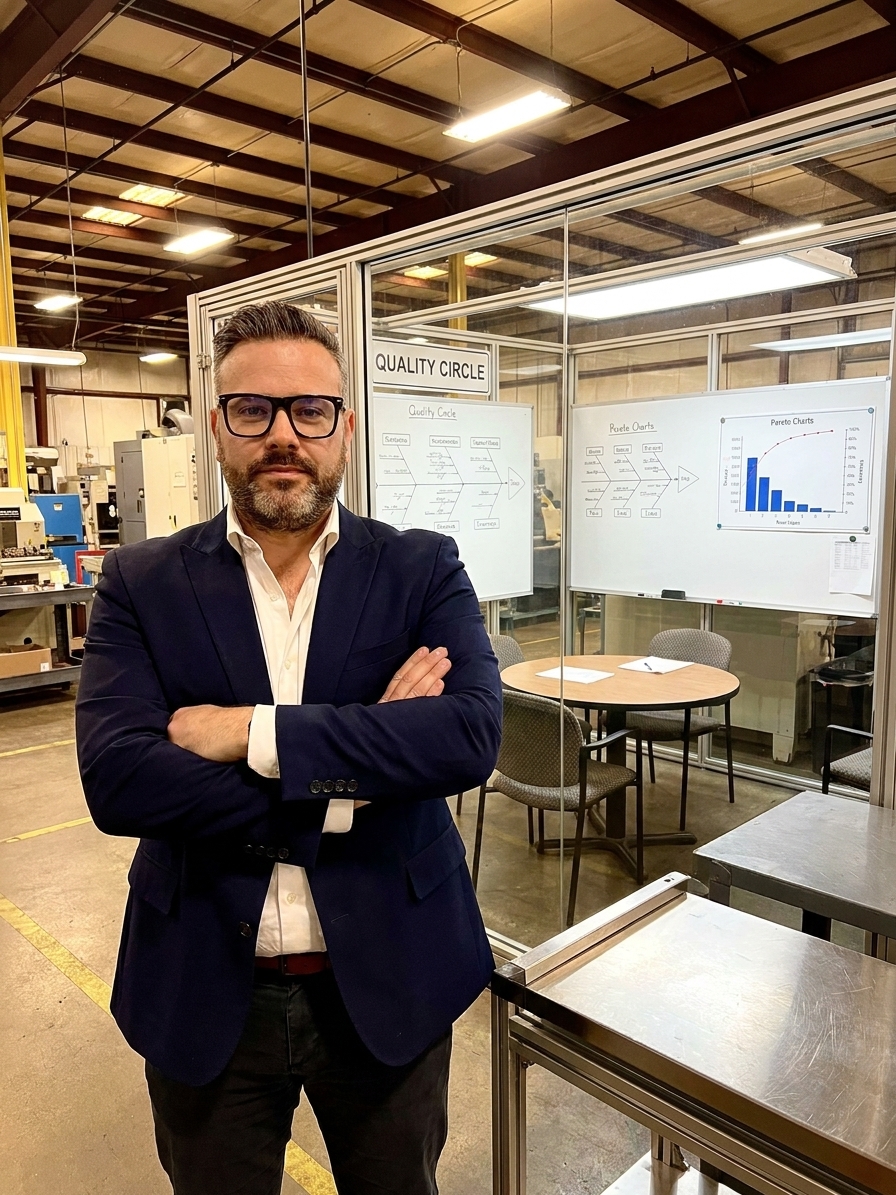
Quality Circles were designed to unlock the collective intelligence of frontline workers. The concept is structurally elegant: small voluntary groups meet regularly, apply basic problem-solving tools to their own processes, and implement solutions. In the Japanese manufacturing context of the 1960s, where Kaoru Ishikawa formalised the practice through JUSE, the results were transformational.
In Western implementations, the pattern is predictable. A circle launches with enthusiasm, survives three or four meetings on momentum, and degenerates into a mandatory gathering where people stare at their phones while a supervisor fills out a form. The presentation to management happens once, polite applause follows, and the circle quietly disbands before the next quarter.
The failure is not in the concept. It is in the implementation architecture surrounding it. I have audited plants across automotive and aerospace where well-intentioned circle programs collapsed under identical, identifiable structural defects — defects that can be diagnosed and removed if leadership is willing to confront them honestly.
What the Japanese Model Actually Built
Ishikawa's circles rested on a foundational assumption that the operator is the foremost expert on their process. In post-war Japanese manufacturing culture, the person running the machine was not viewed as a pair of hands executing instructions. They were the person closest to the work, the first to notice drift, and the best positioned to propose corrections.
The structure was deliberate. A circle consisted of six to ten volunteers from the same work area. They received training in the seven basic tools of quality: check sheets, histograms, Pareto charts, cause-and-effect diagrams, scatter diagrams, control charts, and stratification. They met on company time — typically one hour per week — selected their own problems, applied the tools, and often implemented the solutions themselves.
The secondary effect proved more valuable than any individual improvement. When frontline workers experienced their own agency — when they identified a problem, analysed it, and watched their solution eliminate it — the cultural shift was permanent. By the 1970s, Japanese organisations were registering millions of circle proposals annually, ranging from cycle-time tweaks to fundamental defect elimination.

The Western Translation Error
When Western manufacturers discovered Quality Circles in the late 1970s, they saw the results and wanted them immediately. What they failed to understand was the cultural infrastructure that made those results possible. The typical implementation followed a pattern: an executive visited a Japanese plant, returned with a mandate, and launched a program with coordinators, training materials, and a kickoff event.
What was missing was the foundational belief that workers had valuable insights. In many Western organisations — including many I have audited today — the prevailing management philosophy remains fundamentally Taylorist. Workers follow instructions; they do not generate ideas. Suggestion boxes exist, but challenges to management assumptions are quietly buried.
Workers perceived the circles as performative within months. They attended because supervisors expected attendance, not because they believed their ideas would be heard. When they proposed solutions, those proposals entered a bureaucratic review staffed by engineers who had not participated in the analysis and held different agendas. Most proposals died there. The few that survived were diluted beyond recognition.
Three Defects That Destroy Circle Ownership
The first structural defect is mandated voluntarism. Quality circles are supposed to be voluntary. When performance reviews implicitly reward attendance or supervisors nominate participants, the dynamic inverts. Members participate for optics, not for problem ownership. The quality of analysis degrades immediately and permanently. Test it simply: if you abolished the program tomorrow, would any member continue meeting voluntarily?
The second defect is management-selected problems. In a genuine circle, members choose what matters in their work area. When management provides a list of suggested topics or directly assigns problems, the circle becomes a task force. Management does not pick bad problems — the selection process itself strips away the ownership that makes circles effective. A worker solving their own identified problem brings fundamentally different energy than one solving an assigned issue.
The third defect is tool worship. Training programs spend disproportionate time teaching workers to construct fishbone diagrams and Pareto charts. These tools are valuable, but they are means, not ends. When the tool becomes the focus, meetings revolve around completing templates rather than understanding problems. A circle member saying "we need a Pareto chart for our presentation" has inverted the purpose — the chart now serves the presentation, not the analysis.
Three Defects That Destroy Circle Outcomes
The fourth defect is the presentation cult. In many organisations, the culmination of a circle project is a presentation to management where the circle justifies its existence and competes against other circles for awards. This distorts everything preceding it. Problems are selected for presentability. Solutions are chosen for visual impact. I have seen circles win awards for projects never implemented and lose for projects that eliminated an entire defect category but lacked innovation.
The fifth defect is the absence of implementation authority. A circle that can analyse a problem but cannot implement a solution without management approval is not a quality circle — it is a recommendation committee. Frontline workers who watch their carefully developed solution sit in an approval queue for months learn one lesson: their contributions do not matter.
A quality circle that cannot implement its own solution without management approval is not a circle. It is a recommendation committee.
Organisations with sustained circle programs share a common structural feature: explicit boundaries within which circles implement changes without further approval. The boundary is documented: anything within the work cell that does not change product specification, does not affect safety, and costs less than a defined threshold can be implemented directly. Beyond that boundary, a fast-track review with a defined turnaround applies.
The sixth defect is resource starvation. Circles cost money — modest but real. Members need time away from production. A facilitator needs training. Solutions require materials: a new fixture, a modified tool, a training update. When a circle develops a solution requiring modest investment and is told no budget exists, the program is over. The meetings may continue for months on inertia, but the credibility is gone.
Genuine Circle vs Bureaucratic Shell
Bureaucratic shell
- Management assigns problem topics to each circle
- All solutions require engineering review before any trial
- Presentation to leadership is the primary deliverable
- Participation tracked via attendance and form completion
Genuine circle
- Members identify and select their own process problems
- Pre-approved implementation boundary for defined changes
- Implemented improvement is the primary deliverable
- Outcome measured by defect reduction and process metrics
Building the Structural Foundation
Despite the catalogue of failure modes, circles can work — not as a bolt-on program but as an integrated element of a broader quality culture built on IATF 16949 or AS9100 foundations. The organisations where they thrive share identifiable structural characteristics that can be replicated if leadership is committed.
Leadership must genuinely believe in frontline expertise. This is demonstrated through behaviour, not posters. Leaders visit work areas, ask questions rather than giving directives, and publicly acknowledge when a circle corrects a problem that management failed to solve. This single behaviour does more to sustain a program than any training curriculum.
Circles must have documented authority within defined boundaries. The boundary is negotiated and recorded. A circle knows exactly what it can change without approval and what requires a fast-track review measured in days, not months. Circle members are included in the review decision for anything exceeding their boundary.
Training must be contextual, not curricular. Quality tools are introduced when a specific problem demands them. A circle working on a defect issue learns Pareto analysis because they need to prioritise defect types — not because the training schedule says it is week three. The learning is immediately applied, which is how adults actually retain skills.
Measuring Outcomes, Not Activity
The most important diagnostic question for any circle program is not "How many active circles do we have?" but "What changed because these circles existed?" The answer requires honest measurement of process outcomes — defect rates, cycle times, rework percentages in active areas — and human outcomes: engagement scores, voluntary retention, and the percentage of members who choose to participate again.
A program with twenty active circles and no measurable process improvements is failing. A program with three circles that have collectively eliminated three defect categories and reduced rework by fifteen percent is succeeding. The raw activity numbers look impressive in a quarterly report; the outcome numbers are what actually matter to the business.
Metrics That Separate Real Programs from Reporting Exercises
If your organisation has an existing program, assess which of the six structural defects are present. Most programs exhibit at least three. These defects can be corrected — but only through structural changes to authority boundaries, implementation processes, and measurement systems. Programmatic adjustments like better training or refreshed materials will not fix structural problems.
If you are considering launching a program, the first question is not about structure or tools. It is whether leadership genuinely believes that people closest to the work have insights that management lacks — and whether leadership will act on those insights when they challenge assumptions. If the answer is anything other than unequivocal, the training budget is better spent elsewhere.
Quality Circles are not a technique. They are a manifestation of a belief system about who in the organisation is capable of creating value. If the belief is genuine, the circles flourish despite imperfections. If the belief is absent, no amount of structure, training, or exhortation compensates.