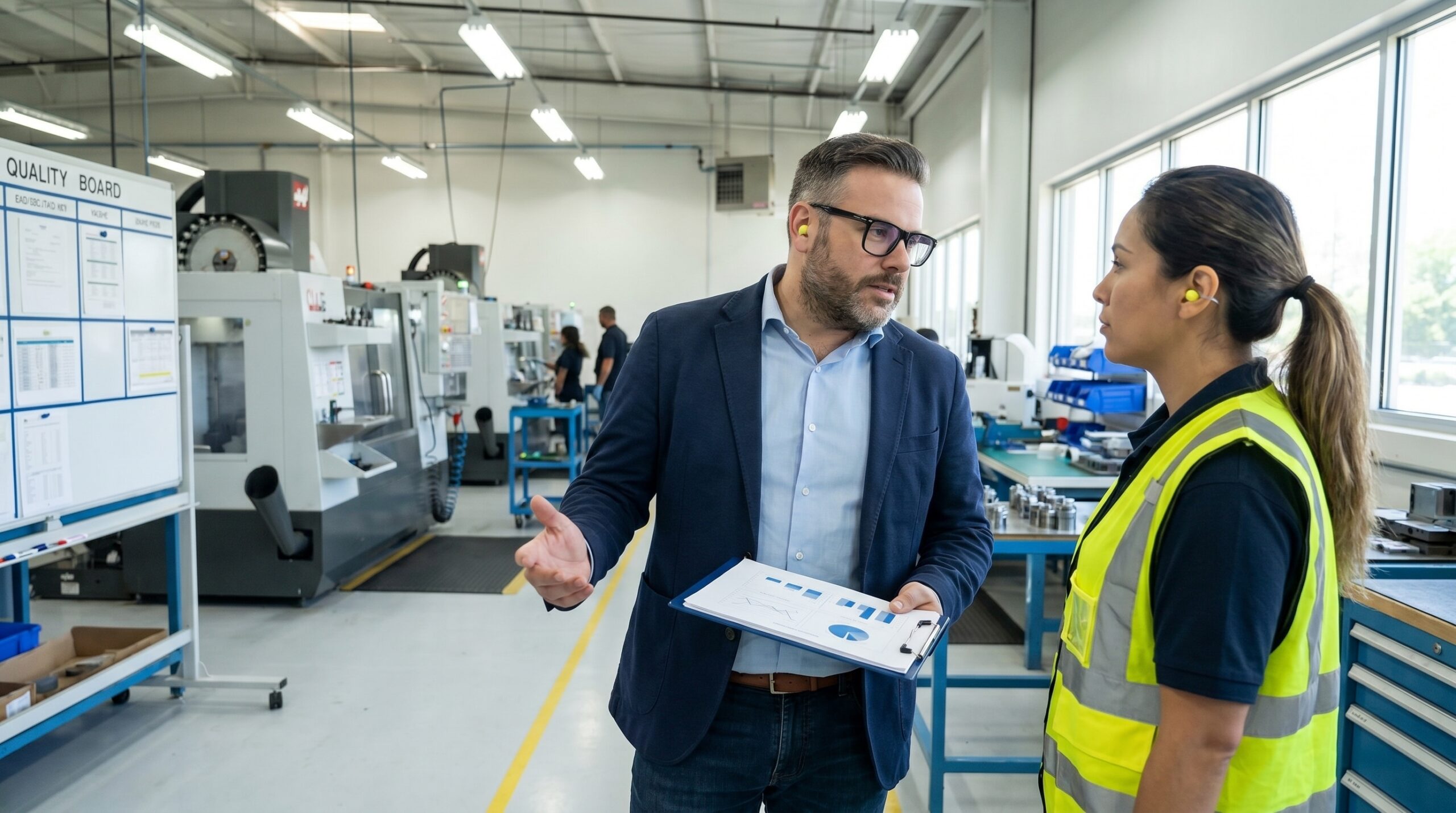
Most manufacturing plants operate a quality system that is technically compliant and culturally bankrupt. The quality manager knows every clause of IATF 16949, maintains meticulous PFMEAs, and writes precise nonconformance reports. Yet when this manager walks onto the shop floor, operators stiffen. Problems are hidden rather than escalated. The harder the quality department audits, the lower the actual visibility becomes.
I have audited plants across automotive and aerospace where this dynamic is entrenched. The quality function has become a policing operation, catching defects after they are produced. The metric being optimised is compliance, not prevention. Every nonconformance written reinforces the idea that quality is something done to the production team, rather than something built into the process by the people running it.
The way out is shifting the quality professional's role from cop to coach. Coaching is not soft. It is the systematic development of defect-prevention capability in operators. It requires teaching statistical thinking, root-cause analysis, and process ownership to the people closest to the work. A coaching model scales quality across a facility in a way that an inspection schedule never can.
The Audit Trap and the Limits of Inspection
The Audit Trap is a predictable cycle. A quality engineer joins a facility, finds incomplete documentation, and starts writing corrective actions. Production teams respond defensively. They learn to route work around the quality function to avoid delays and reprimands. The quality engineer, finding fewer reported problems, assumes tighter surveillance is required and doubles down on auditing.
Visibility decreases while reported metrics might temporarily improve. The system has not improved; the reporting pipeline is blocked. The quality department becomes a bottleneck, and the cost of poor quality does not drop. Finding a defect during final inspection is the most expensive way to learn about a process failure. Every escalation costs time and material that prevention would have saved.
Auditing finds nonconformances. Coaching builds the capability to prevent them. This is not a semantic difference. It is the structural difference between a quality department that consumes overhead and an operational culture that minimises the cost of poor quality at the source. Relying solely on detection guarantees that defects will continue to be produced.
Policing versus Coaching in Quality Management
Quality Cop Approach
- Primary action is writing nonconformances and issuing corrective actions.
- Relies on final inspection and downstream audits to catch defects.
- Owns the quality system, creating a single point of dependence.
- Production hides deviations to avoid bureaucratic delays or blame.
Quality Coach Approach
- Builds defect prevention capability directly into the production line.
- Asks diagnostic questions to reveal systemic root causes.
- Teaches operators to own and monitor their own process parameters.
- Operators escalate near-misses immediately because it is psychologically safe.

Building Quality Capability at the Source
Prevention requires transferring specific analytical tools to the shop floor. I have implemented greenfield QA departments where the goal was not to hire more inspectors, but to push root cause analysis upstream. Operators must understand why a critical dimension matters to the customer, why the tolerance is set at 0.05mm, and why a parameter shift predicts a failure several steps later.
Teaching the 'why' transforms compliance into actual quality. An operator who monitors a parameter strictly because a procedure demands it will eventually deviate under production pressure. An operator who understands that the same parameter prevents a downstream scrap event will defend the tolerance. They understand the physical consequence of the deviation, not just the administrative rule.
The mechanism for this transfer is the coaching conversation. When a deviation occurs, the coach asks what the operator observed versus what they expected to see. This diagnostic questioning uncovers tacit knowledge about machine drift or raw material variations that no control plan can fully capture. Telling an operator to follow a rule shuts down this critical feedback loop.
Establishing Quality Champions Across Shifts
A single quality manager cannot cover a 900-employee plant operating across three shifts. To scale quality, you must build a network of champions. These are not necessarily senior operators, but the individuals others naturally consult when a process drifts. Selecting these individuals and investing thirty minutes a week in their development creates a decentralised quality network.
Champions need functional training in basic quality tools. Teach them how to read a control chart, execute a 5-Why analysis, and distinguish between common cause and special cause variation. This targeted training gives them the diagnostic vocabulary to solve issues at the source. They intercept deviations before they escalate into formal 8D investigations and nonconformance reports.
The success metric for a quality department should shift. Instead of measuring the volume of nonconformances caught, measure the volume of problems solved outside the quality department. When champions handle the majority of minor process deviations, the formal quality engineers are freed to focus on systemic issues, PFMEA updates, and advanced corrective actions.
Deploying a Shift Quality Champion Network
- 01Identify the InfluencerSelect the operator on each shift that peers naturally approach during process interruptions.
- 02Train Basic DiagnosticsProvide targeted training in reading SPC charts and executing basic 5-Why root cause analysis.
- 03Intercept at SourceEmpower champions to resolve common cause variations before they trigger formal nonconformances.
- 04Measure DecentralisationTrack the percentage of quality issues resolved entirely within the production team.
Replacing Judgment with Systemic Curiosity
When a defect escapes to the customer, the standard reaction is to find out who deviated from the procedure. A quality coach asks a different question: what systemic condition made it easy for this error to occur and hard to detect? This approach forms the basis of a just culture. It is not blame-free, but it ensures the first target of investigation is the process, not the person.
If a defect can be produced by one operator error with zero downstream detection, your process design is the nonconformance.
Investigate the conditions that made the failure possible. Determine if the work instruction was ambiguous, if the tooling was worn beyond its maintenance interval, or if environmental factors induced fatigue. These are design flaws in your operational system. Blaming the operator for a systemic vulnerability guarantees the defect will recur on the next shift.
Operators must be rewarded for reporting defects and near-misses. If an operator brings a deviation to the quality team and faces interrogation or blame, the reporting pipeline closes permanently. The immediate response must be functional recognition. The defect exists because the process allowed it; the operator simply provided the critical data needed to fix the system.
Making Quality Learning Visible
In most facilities, quality lessons disappear into an 8D database that production teams never access. A corrective action is formally approved, a box is checked, and the specific operational learning is lost. The knowledge remains locked in the quality department's digital files rather than reaching the operators who need it to prevent recurrence.
Quality coaching makes learning physically visible on the shop floor. Implement lesson-learned boards at the machine where the failure occurred. Detail what went wrong, the identified root cause, and the specific process change implemented. Start shift handovers with a two-minute review of a recent near-miss or process correction to transfer that tacit knowledge across all teams.
When a process correction is visible, operators learn from each other. The operator on shift A who caught a subtle drift in a welding parameter becomes the teacher for the operator on shift B running the same job. This cross-shift knowledge transfer is how standardised work actually stabilises. Relying on a memo or an updated SAP notification does not change shop-floor behaviour.
The Financial Mechanics of Prevention
The financial argument for quality coaching is driven by the economics of defect detection. A defect caught by an operator at the source costs only the scrap of that specific component. A defect caught by a quality inspector further down the line adds the cost of accumulated value-added labour. A defect that reaches the customer triggers warranty claims, logistics reversals, and potential IATF 16949 concession penalties.
Coaching scales capability, while auditing only scales overhead. A quality engineer who coaches ten shift champions creates a multiplier effect across the entire plant. An auditor who increases the inspection rate by twenty percent simply adds labour cost to the same bottleneck. The cost of poor quality in a coaching model drops as operator capability rises.
Implementing a coaching model requires a deliberate transition. Quality managers must stop issuing punitive nonconformances, spend their first thirty days observing the shop floor, and begin asking diagnostic questions. The ultimate test of a quality system is simple. If the quality manager leaves tomorrow, does the plant's quality degrade? If the answer is yes, the system is one of dependence, not prevention.