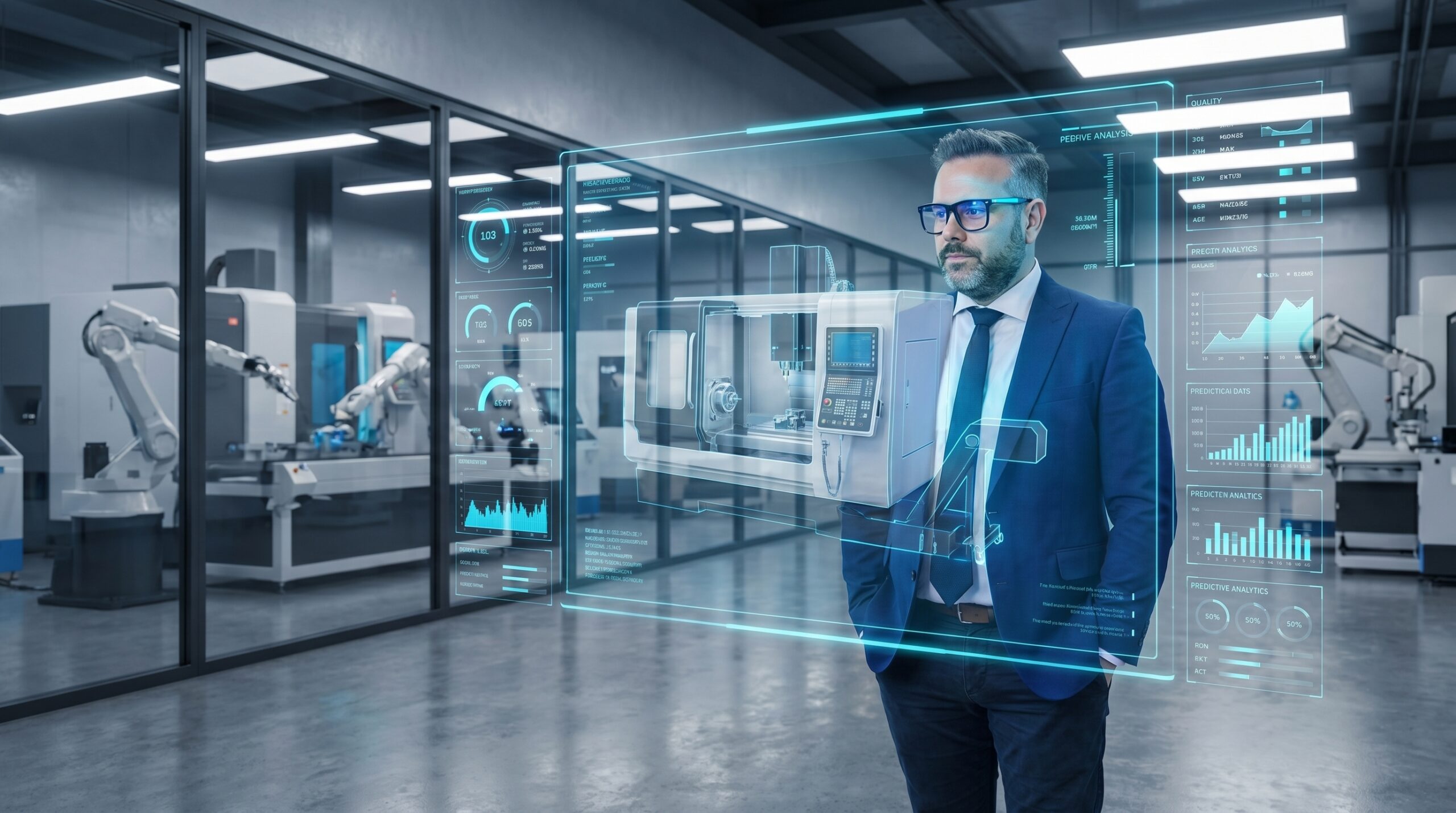
SPC tells you what has happened. FMEA tells you what might happen. A quality digital twin tells you what is about to happen, and prescribes the exact process adjustment to prevent it. This is not a 3D CAD rendering for board presentations. It is a dynamic, physics-based simulation updating in near-real-time from physical sensors and inspection data.
I stood in a Tier 1 automotive plant recently, watching a CNC machining center produce crankshaft housings. The quality engineer pulled up a control chart showing a Cpk of 1.67. By the book, the process was stable. Then he switched to his digital twin simulation running five minutes ahead of the physical machine.
The simulation, having absorbed six months of thermal data, tool wear patterns, and spindle vibration signatures, flagged an impending tool drift the physical sensors could not yet detect. The twin calculated the exact minute an out-of-spec bore would appear. They swapped the tool proactively. The control chart never flinched, and the scrap bin stayed empty. Traditional quality tools hit a ceiling here. The digital twin broke through it.
Why Traditional Quality Tools Hit a Ceiling
I have built my career implementing ISO 9001 and IATF 16949 systems, relying on SPC, FMEA, control plans, and DOE. These tools are foundational and mandatory. But they have strict functional limits, and those limits become critical constraints as manufacturing complexity and cycle times increase.
SPC is inherently reactive. By the time a control chart detects a trend or triggers a Western Electric rule violation, the process has already shifted. You are catching the wave after it breaks. Control charts answer whether the process is stable right now. They do not answer whether it will be stable in two hours given the current thermal trajectory.
FMEA is theoretical. Your failure mode analysis is limited by the team's brainstorming scope. You document what you think can go wrong. But a failure mode emerging from the interaction of three specific process parameters—parameters you never thought to connect—will not appear in your PFMEA. DOE is powerful but physically expensive, requiring production interruptions, material consumption, and scrap risk.
The quality digital twin does not replace these tools. It amplifies them. It takes the process knowledge captured in your FMEA, the statistical rigor of your SPC, and wraps them in a simulation engine that runs a thousand scenarios in seconds without consuming a single gram of raw material.
Core Architecture of a Quality Digital Twin
Building a functional digital twin requires a disciplined, four-layer architecture. Skipping a layer guarantees failure. Each layer builds on the computational fidelity of the one beneath it, moving from theoretical process modeling to live prescriptive action.
The foundation is a mathematical or physics-based model of how your process transforms inputs into outputs. For machining, this means modeling how cutting speed, feed rate, tool geometry, and thermal expansion interact. For injection molding, it requires mapping melt temperature, injection pressure, and cooling time against material flow. I have seen response surface models derived from historical DOE data outperform elaborate finite element simulations simply because they were tightly calibrated to actual production data.
The Four-Layer Digital Twin Architecture
- Layer 4: Prescriptive AnalyticsOptimisation algorithms output actionable parameter adjustments to prevent the predicted defect.
- Layer 3: Simulation and PredictionRuns the process model forward in time, forecasting dimensional drift and Cpk degradation under varying conditions.
- Layer 2: Real-Time Data IntegrationIngests live sensor data (force, vibration, temperature), material certificates, and in-process gauging.
- Layer 1: Process ModellingThe mathematical foundation mapping how inputs (speed, pressure, geometry) dictate quality outcomes.
Once the model exists, it needs live context. A model without live data is a textbook. The twin must ingest process parameters, material batch properties, equipment state, and quality measurements. The technology for data collection is straightforward. The real challenge is data context—a temperature reading without a precise timestamp, sensor ID, and process state is noise, not information.
With a live data feed, the twin simulates forward. It forecasts what the bore diameter distribution will look out at the end of the shift based on current tool wear rates. The final layer is prescription: running optimization algorithms to calculate the exact parameter adjustments required to maximize the probability of conformance.
Predictive Quality and Process Optimization
The highest return on a digital twin investment comes from process optimization without production disruption. Every quality engineer knows the frustration of knowing a process can be improved, but being unable to justify shutting down a running line to run experiments. The twin allows you to execute the DOE virtually, identify the optimal processing window, and then validate it with minimal physical runs.
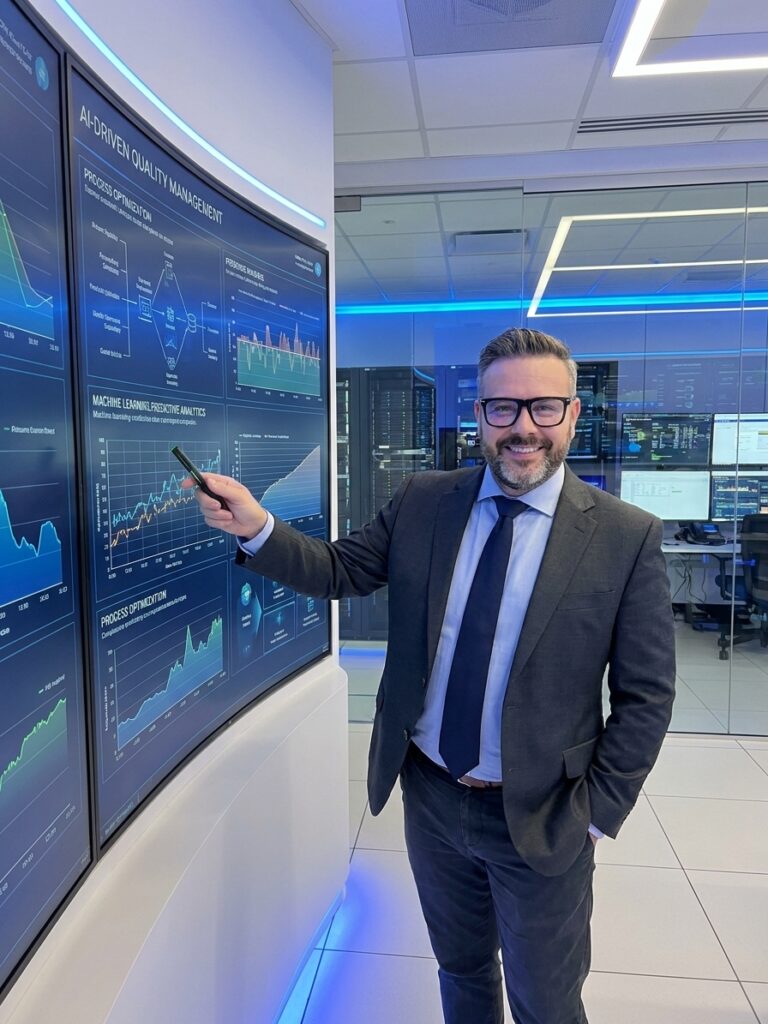
In New Product Introduction, digital twins dramatically compress ramp-up curves. A medical device manufacturer building a digital twin for a new sterile packaging line simulated over 500 parameter combinations virtually. They identified the optimal sealing window and validated it with a 30-run physical DOE. They achieved a first-pass yield of over 98% on day one of full production, bypassing the typical 85-90% ramp-up phase.
Predictive quality shifts the paradigm from defect detection to defect prevention. Instead of relying on automated inspection systems to catch nonconformances after the fact, the twin predicts quality outcomes based on current process conditions. It flags potential failures before the product is even finished. Inspection does not disappear, but the probability of the inspection finding an actual defect drops significantly.
Inspection catches defects after they are made; simulation prevents them from being made at all.
Extending the Twin to Supplier Quality Management
If your organization struggles with incoming material variation, supplier-side digital twins offer a massive advantage. By integrating your suppliers' process data—or helping them build simplified models—you can simulate how a specific batch of material will perform in your process before the truck even arrives.
An automotive OEM I advised uses incoming tensile and thickness data from their steel supplier to pre-adjust stamping parameters. The digital twin predicts the springback behavior for each specific coil based on its material certificate. Press parameters are calculated and set before the coil is loaded into the line. Springback variation dropped significantly, eliminating hours of rework.
This requires breaking down the silo between supplier quality management and internal production. Incoming inspection data must flow directly into the process model. The days of relying on a static COC (Certificate of Conformance) on a piece of paper are over. The digital twin requires live, digital material properties to drive its simulations accurately.
Why Digital Twin Projects Fail
The technology does not cause these projects to fail; organizational behavior and culture do. The most common failure mode is the Excel trap. Quality engineers are deeply comfortable with spreadsheets. A computational simulation feels like black-box magic. If they cannot see the calculation and validate it against their own experience, they will quietly reject it and revert to manual control chart reviews.
The solution is to build the twin transparently. Show every formula. Let the engineers validate the twin's predictions against reality for weeks before relying on them. Trust is not demanded; it is earned through accurate prediction. The perfection trap kills just as many projects. Teams spend years trying to build a flawless, comprehensive model before deploying anything. The process changes, the organization loses patience, and the project is cancelled.
Ship a useful twin, not a perfect one. Iterate. The set-and-forget trap is the final killer. A digital twin is a living model that requires continuous calibration. Tooling ages, machines drift, and material lots change. If you do not continuously feed the model new boundary conditions and update its physics, it becomes a liability, confidently making predictions based on an outdated reality.
A Six-Month Implementation Roadmap
Start with a scoped, six-month deployment focused on a single chronic issue. Do not select your most complex process; select your most painful one. The process where quality problems are chronic, expensive, and resistant to traditional root cause analysis is where the twin will earn its credibility fastest.
Six-Month Digital Twin Deployment Sequence
- 01Months 1-2: Process ModellingSelect one painful quality characteristic and build a mathematical model predicting it from historical DOE and engineering data.
- 02Months 2-3: Live Data ConnectionIdentify the 5-10 parameters most influencing the target characteristic and connect them via existing IoT or SCADA infrastructure.
- 03Months 4-5: Shadow PredictionRun the twin alongside production. Do not act on predictions. Record them and compare against physical reality to build accuracy trust.
- 04Months 5-6: Prescriptive ActionUse the validated twin to inform live decisions: tool change timing, parameter tweaks, and batch prioritization. Measure the scrap reduction.
During months one and two, focus entirely on building the mathematical model mapping your process inputs to the critical quality output. Validate this model purely against historical data. In months two and three, connect live data. Identify the specific process parameters driving variation and link them to the model using your existing data infrastructure.
Do not act on the twin's predictions immediately. For months four and five, run the simulation in shadow mode. Let it predict outcomes and log the accuracy. Once the model reliably forecasts the process trajectory, begin prescribing actions in month six. Adjust tool change intervals, tweak parameters proactively, and measure the direct impact on your scrap rate.