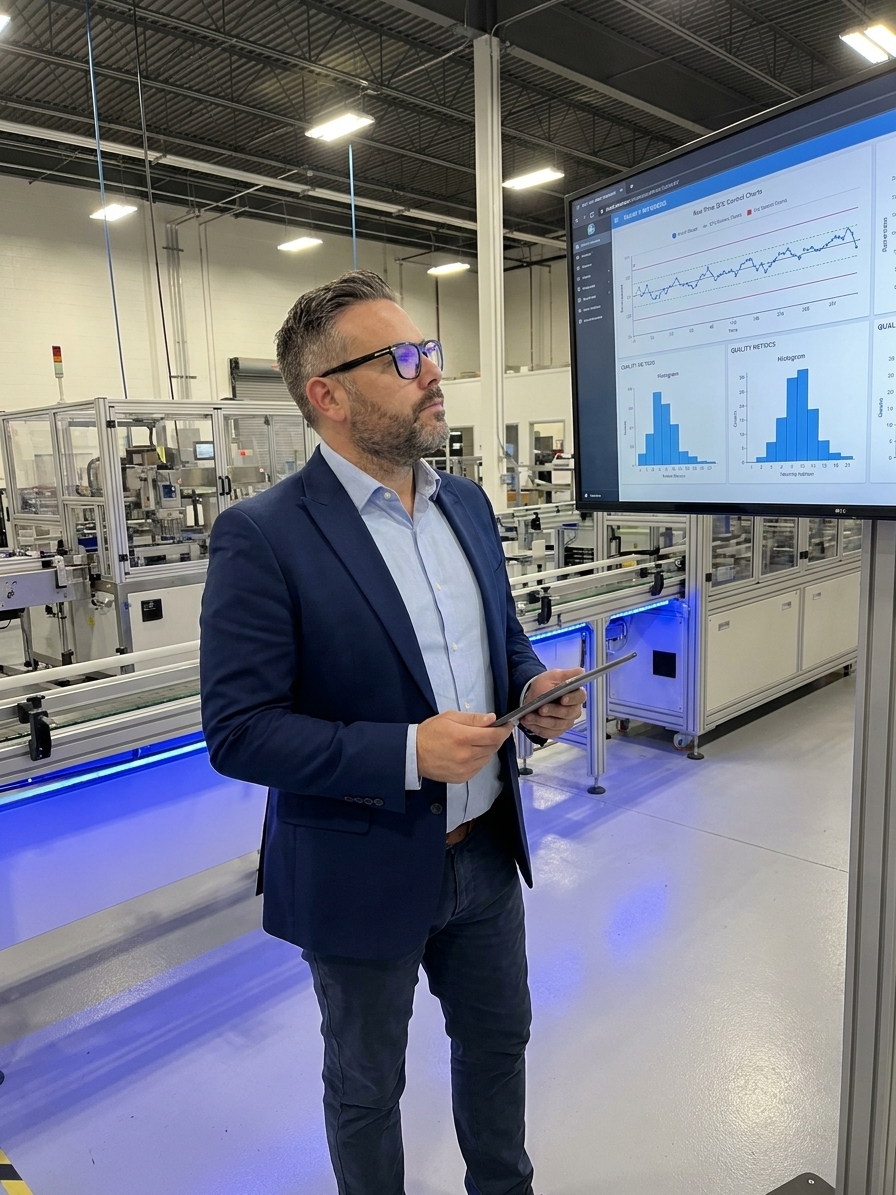
There is a moment in every manufacturing operation where a defect is born, and a separate, much longer moment before anyone knows about it. The gap between those two moments is where organizations lose margins, customers, and certifications. The technology to catch these deviations is usually already in place. The people are competent, and the procedures are documented.
What is missing is velocity: the speed at which information about a quality event travels back to the people who can act on it. I have watched CNC operators produce out-of-tolerance parts for nearly an hour because the SPC chart was only updated once per shift. I have seen assembly lines ship hundreds of defective units because the feedback loop was measured in weeks instead of minutes.
In every case, the root cause was not a lack of technology or operator skill. It was an unplanned, unmeasured information delay. If your quality system does not deliberately engineer feedback loops for speed, you are operating on feedback hopes. The difference between catching a drift at part twelve and discovering it at part twelve thousand is purely a function of loop design.
The anatomy of a closed-loop system
A feedback loop in a manufacturing quality system is a closed circuit with four distinct components. First, a signal is generated: a measurement is taken, a limit is breached, or a parameter drifts. Second, the signal is transmitted from the point of generation to a decision-maker, whether human or automated.
Third, the signal is interpreted and a decision is made. The current state is compared to the desired state. Finally, corrective action is taken and its effect is verified against the process. If any of these four steps is slow, unreliable, or missing, you do not have a feedback loop. You have a passive data collection exercise.
Most plants operate with broken circuits. The signal is generated but dies at the source because the reporting system takes too long. Or the signal is transmitted but sits in an inbox, aging like produce. The decision might be made, but execution gets trapped in a purchasing bottleneck. In these environments, the volume of quality activity creates an illusion of control, masking a total lack of learning velocity.
The mathematics of feedback delay
Feedback latency directly dictates your maximum defect escape rate. If your process produces a nonconformance at a rate of one per hundred, and your feedback loop detects it within one cycle, your maximum escape is one unit. The containment radius is effectively zero.
Apply a feedback delay of fifty cycles to that same process. The process capability has not changed. The operator skill has not changed. But your maximum defect escape is now fifty units, and your average escape is twenty-five. The cost of the resulting quality failure just multiplied by a factor of twenty-five purely because of information velocity.
Now multiply that across every machine in your plant, every shift, every day. The cumulative cost of feedback delay is staggering. It is almost never tracked because the accounting system lacks a line item for information velocity. But your scrap report, your 8D backlog, and your warranty budget are directly measuring the tax of your slow loops.
Operating across three loop speeds
Not all feedback loops need to operate at the same speed, but every quality system requires three distinct tiers to function. Most organizations have only one tier operating effectively, and it is almost always the slowest and most expensive.
The Three Tiers of Quality Feedback
Real-time feedback lives inside the machine logic. It is the vision system that rejects a part before the operator touches it. If your cycle time is under ten seconds and you rely on human inspection to catch deviations, you are running without a net. Every process that can produce defects faster than a human can respond needs automated, binary feedback.
Near-real-time feedback involves human interpretation but operates within the same shift. This is where SPC control charts and quality alert boards catch process drift. Strategic feedback—customer complaints, warranty data, supplier scorecards—catches systemic issues that faster loops miss. If the first time you learn about a defect is when the customer tells you, you are running an apology system, not a quality system.
Designing loops: a practical framework
To close the gap between what happens and what you know, you must engineer feedback loops deliberately. Start by mapping your critical-to-quality (CTQ) parameters. Not every process parameter needs a high-speed loop, but the ones tied to safety, regulatory compliance, and key customer requirements do. Document the current time between deviation and detection.
Next, classify each parameter by its maximum acceptable feedback latency. If a deviation can produce a safety-critical defect in ten cycles, the loop must operate in fewer than ten cycles. Make this classification explicit in your PFMEA. Do not leave detection speed to chance or operator habit.
Accelerating the Feedback Loop
- 01Map parametersIdentify CTQ characteristics and document current detection latency.
- 02Classify speedDefine maximum acceptable cycles between deviation and containment.
- 03Attack bottleneckAutomate data flow, build decision rules, or push authority to the floor.
- 04Measure velocityTrack loop cycle time from detection to verified action.
For every parameter where current latency exceeds acceptable latency, attack the bottleneck. If transmission is slow, automate the data flow directly from the gauge. If interpretation is slow, build decision rules so common deviations do not require a quality engineer. If action is slow, empower operators to stop the line and adjust without managerial approval.
Finally, measure your loop cycle time. Track the duration from deviation detection to corrective action to verified effectiveness. This metric should sit right next to your defect rate on the daily board. Loop velocity determines your defect rate; therefore, it demands the same visibility.
The cultural and cognitive cost of delay
The fastest engineered feedback loop will fail if the culture penalizes the people who activate it. If the operator who reports a deviation gets blamed for the resulting downtime, the signal will be suppressed. Quality engineers will stop issuing corrective action requests if every 8D becomes a political battle with production.
Designing feedback loops is an engineering problem. Operating them effectively is a cultural one.
When someone in your organization detects a deviation, what happens to them? If they are punished for being the messenger, your feedback loops will always run slower than your defects. Information will flow only when the pressure becomes unbearable, at which point containment is no longer an option.
Beyond culture, feedback delay destroys cognitive learning. When an operator makes an adjustment and sees the result within seconds, the connection between action and outcome is cemented. They refine their mental model. When the feedback arrives three days later in a shift handover log, the learning moment is dead. The corrective action is applied mechanically, and the response to the next deviation is no faster than the first.
The maturity hierarchy: from reactive to predictive
As manufacturing operations mature, their feedback loops evolve. Moving up this hierarchy reduces scrap, rework, and warranty costs exponentially. However, you cannot skip steps. Attempting predictive analytics on a plant floor that cannot reliably execute near-real-time SPC is a waste of capital.
Feedback Loop Maturity Hierarchy
- Level 4: PredictiveVibration signatures and historical data detect patterns indicating a future deviation. Action taken before the defect occurs.
- Level 3: PreventiveProcess drift is detected via SPC alarms. The operator or machine makes a correction. Defects are prevented, not just filtered.
- Level 2: DetectiveDefects are caught at inspection. Expensive, but better than escape. You are filtering, not preventing.
- Level 1: ReactiveThe defect reaches the customer and triggers a complaint. The organization investigates weeks after the failure.
Level 1 is reactive. The defect reaches the customer, the complaint triggers an investigation, and corrective action takes weeks. Level 2 is detective. Defects are caught at final or in-process inspection, but after the value has already been added to a nonconforming part. You are filtering defects, not preventing them.
Level 3 is preventive. The process parameter drifts, and the SPC chart triggers an alarm before a defect is produced. Level 4 is predictive. Data analytics detect patterns—like a vibration signature preceding tool failure—and the loop closes before the deviation occurs. Most plants have a few Level 2 loops, a handful of Level 1 loops they would rather not admit to, and aspirations of Level 4. Secure Level 3 first.