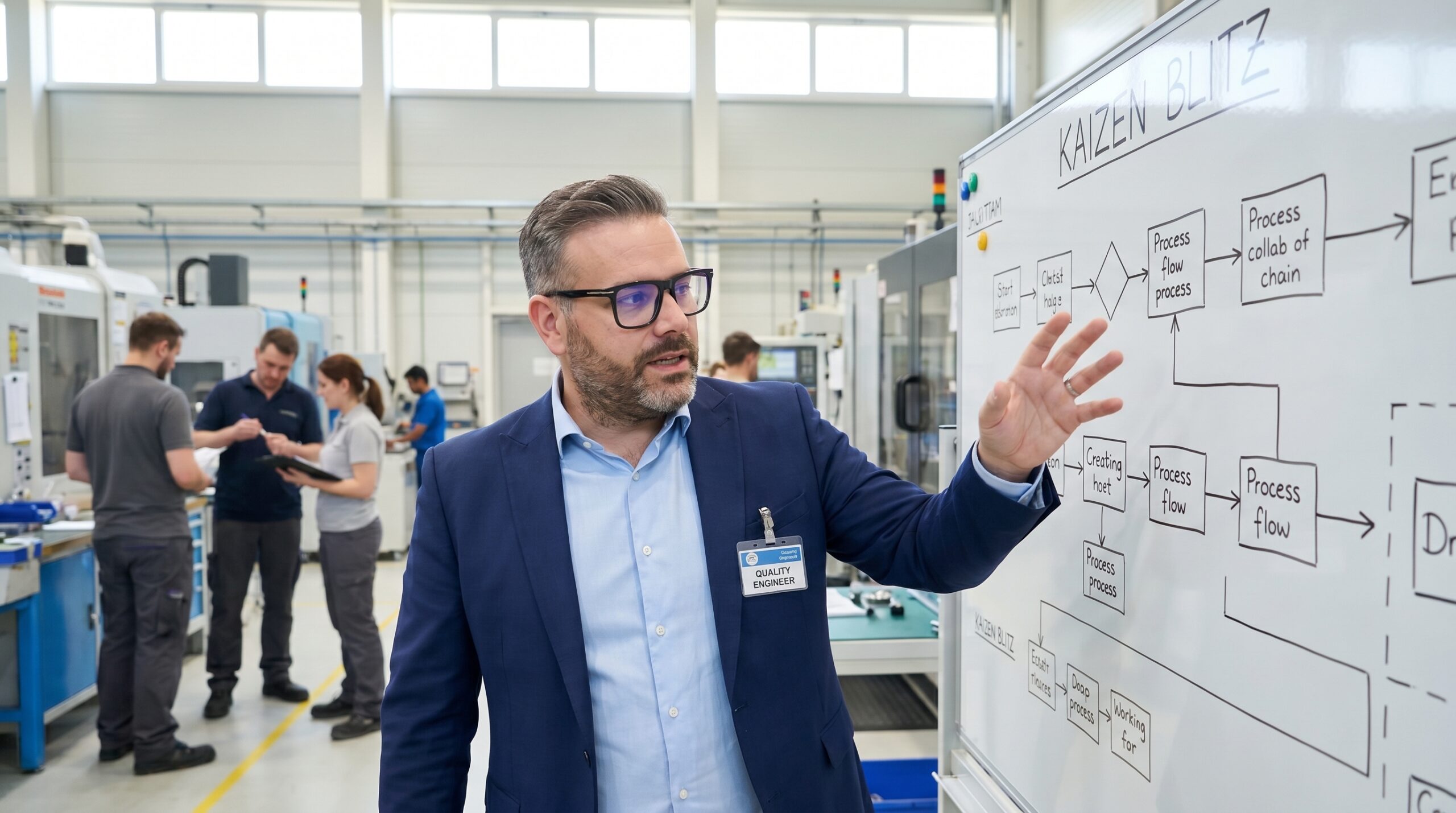
Most organisations have hollowed out the concept of kaizen, reducing it to sticky notes on a suggestion board or a buzzword in a quarterly presentation. A true kaizen event operates with entirely different mechanics. It is a concentrated, time-bounded workshop—typically three to five days—where a cross-functional team focuses on a single, bounded process to eliminate waste and verify the improvements before the week ends.
This is not a theoretical exercise. The team observes the actual work, implements physical countermeasures on the spot, and establishes a new baseline. The event happens at the gemba—the real place where value is created—and it requires the active participation of the operators who run the process daily, not just the engineers who designed it.
In my experience transitioning quality systems at large automotive and aerospace plants, the gap between planned improvements and executed improvements is where most quality initiatives fail. A structured Gemba Kaizen Event bridges that exact gap, turning analysis into immediate, measurable physical change.
Securing Scope and Authority Before Day One
A kaizen event fails before it begins if the scope is unbounded or the authority is ambiguous. The ideal target is a specific production cell, a changeover sequence, or a material flow between two defined operations. It must be large enough to impact key metrics like defect rates or cycle time, but narrow enough to tackle in a single week. Use your existing Pareto charts and customer complaint logs to select the target.
Team composition dictates the quality of the solutions. You need five to eight people: two or three operators from the target line, a quality or process engineer, a maintenance technician who knows the equipment intimately, and one outsider with no preconceived assumptions. Larger teams fragment; smaller teams lack the technical breadth to solve physical problems on the fly.
Before the event commences, secure explicit commitments from plant management. The team must have pre-authorised permission to modify the workspace, relocate tooling, and adjust the process sequence within defined boundaries during the week. If leadership will not grant this authority and promise to attend the Friday results presentation, postpone the event. Without empowerment, the exercise is merely theatre.
Finally, document the baseline. Record the exact cycle times, defect percentages, walking distances, and work-in-process inventory. Capture video of the current state. This data is not just for the final ROI calculation; it anchors the team’s root cause analysis and prevents subjective debates about what actually happens on the floor.
Anatomy of a Five-Day Kaizen Event
- 01Day 1: Current StateWalk the process, time operations, and map physical movement. Identify waste.
- 02Day 2: Root CausePrioritise failures via Pareto, drill to root causes, and design countermeasures.
- 03Days 3-4: ImplementationBuild fixtures, relocate equipment, update standard work, and test iteratively.
- 04Day 5: VerificationMeasure new metrics, train all operators, and present results to leadership.
Mapping Reality Instead of Reading Documentation
Monday is dedicated entirely to observing reality. The team starts at the gemba, walking the process from the raw material drop to the finished goods queue. They observe every handoff, every moment of waiting, and every unnecessary motion. Official SOPs often omit the workarounds operators have developed to keep the line running; those undocumented steps are where the most significant waste hides.

Conduct a structured waste walk using the eight wastes of lean—overproduction, waiting, transport, overprocessing, inventory, motion, defects, and unused human creativity. The team marks these instances on a physical floor plan and times specific operations with a stopwatch. They create a spaghetti diagram showing the actual physical path of materials and operators.
The operators on the team must be prompted to share their daily frustrations. Where do mistakes happen most frequently? What tasks take excessive effort? Their hands-on knowledge, gained through thousands of hours of repetition, provides the critical context that engineers miss. This information only surfaces when the facilitator creates an environment where operators feel safe speaking plainly about process failures.
Diagnosing Root Causes and Designing Countermeasures
Tuesday shifts the focus from observation to targeted problem-solving. The team reviews Monday's data and applies Pareto analysis to isolate the vital few problems causing the majority of the defects or delays. Trying to fix everything in one week guarantees failure; prioritisation is a mandatory discipline.
For each priority problem, the team uses Five Whys or cause-and-effect diagrams to bypass symptoms and identify the mechanical or systemic root cause. Once the root cause is isolated, the team designs pragmatic countermeasures. The criteria for these solutions are strict: they must address the root cause directly, and they must be implementable with the materials and budget available by Thursday night.
Before physical implementation begins, the team sketches the future state. They draw the new layout, define revised work sequences, and design simple visual controls or poka-yoke (mistake-proofing) devices. They simulate this future state using cardboard and tape on the shop floor, walking through the new physical movements to catch spatial flaws before committing actual resources.
Physical Implementation and Rapid Iteration
Wednesday and Thursday are where traditional improvement initiatives die, but where a kaizen event delivers its ROI. The team moves equipment, reorganises workstations, installs simple fixtures, and paints floor markings. These are practical, immediate modifications made with available materials—not permanent engineering change orders that require weeks of approval.
As the physical layout changes, the team drafts new standardised work documents. These are highly visual, one-page instructions co-authored by the operators who will actually use them. If the operators help write the standard, they own the standard. This prevents the common failure mode where a newly designed process is abandoned within a week.
Improvement is not something done to operators by engineers; it is a capability they build themselves.
The improved process is then run live. The team observes the new flow, identifies friction points missed in the paper design, and adjusts in real-time. This rapid cycle of implement, test, and adjust is the core advantage of a concentrated event. By Thursday evening, every operator in the area is trained on the new procedure.
Realistic Outcomes from Documented Events
Verification, Presentation, and the 30-Day Audit
Friday is dedicated to proof. The team measures the new state using the exact metrics recorded during the Monday baseline. They compare cycle times, defect counts, walking distances, and scrap costs. The direct comparison between Monday's baseline and Friday's verified results is the most powerful tool for securing ongoing leadership support.
The team documents the changes with before-and-after photos, updated standard work, and revised spaghetti diagrams. On Friday afternoon, operators and engineers present these results directly to management. The presentation must include a specific ask for the resources required to sustain the improvement and a public acknowledgement of the team's effort.
The event is not complete until a sustainability plan is locked in. Before the team disbands, assign a specific owner to monitor the new metrics daily for the next 30 days. Schedule a mandatory 30-day follow-up audit on the calendar. Without this rigorous follow-up mechanism, the process will inevitably drift back to its previous state within six weeks, breeding cynicism across the floor.
Scaling from a Single Event to an Improvement System
A single Gemba Kaizen Event is a successful project. A program of regular events—scheduled monthly or quarterly—transforms the organisation's quality culture. To scale effectively, maintain a rolling calendar of events planned six to twelve months in advance, driven by your IATF 16949 or ISO 9001 nonconformity data and strategic cost objectives.
Dependency on a single external or internal facilitator is a scalability bottleneck. You must train a pool of three to five facilitators. Standardise the event template so any trained leader can deploy the methodology consistently. Build a centralised results database to log the metrics, lessons learned, and 30-day sustainability status of every event.
Organisations that run these programs systematically do not just fix isolated processes; they build an operational muscle. Operators begin identifying waste and proposing solutions continuously because they have experienced the direct link between their observations and immediate, management-supported change. This daily vigilance is the ultimate defence against quality decay.