Quality
Gemba Walk: When Your Organization Stops Managing Quality From Behind a
Desk and Starts Walking to Where the Work Actually Happens
And the Most Valuable Quality Data Is the Kind You Can’t Get
From a Spreadsheet
You know the routine. Monthly quality review. Conference room.
Projector humming. A slide deck with 47 charts showing defect trends,
capability indices, and cost-of-quality breakdowns. The Quality Manager
walks the executive team through the numbers. Everyone nods. Someone
asks about the spike in customer complaints on Line 3. The Quality
Manager says they’ll look into it. The meeting ends. Nothing
changes.
Here’s what nobody in that room did: walk to Line 3.
Not after the meeting. Not during the investigation. Not ever. The
data was discussed, the trend was noted, the action item was assigned —
and the actual place where the defects were being created remained as
invisible as it was before the meeting started. The conference room
became a substitute for the factory floor. The spreadsheet became a
substitute for reality. And the quality system, for all its
sophistication, became an elaborate mechanism for being precisely
informed about things nobody had actually witnessed.
This is the pathology of modern quality management. We have more data
than ever. More dashboards. More real-time monitoring. More statistical
tools. And somehow, we keep missing the things that matter most —
because we keep looking for them in the wrong place.
The Gemba Walk is the antidote. Not because it’s complicated. Not
because it’s a new framework or a certification requirement. But because
it does the one thing that no dashboard, no report, and no meeting can
do: it puts you in physical contact with the actual work.
What Gemba Actually Means
The word is simple enough. Gemba (現場) means “the actual
place” in Japanese. In manufacturing, it means the factory floor. In
healthcare, it means the operating room. In software, it means the code
review. In any industry, it means wherever the actual value-creating
work is happening — the place where rubber meets road, where metal meets
machine, where process meets reality.
The concept comes from Toyota, like so many of the tools that
transformed modern quality management. But unlike kanban or andon or
heijunka, the Gemba Walk wasn’t really a “tool” in the traditional
sense. It was more of a practice — a habit, a discipline, a way of
being. Taiichi Ohno, the architect of the Toyota Production System, was
famous for drawing a chalk circle on the factory floor and making
managers stand in it for hours. Their only job was to observe. Watch the
work. See what was actually happening. Not what the report said was
happening. Not what the standard said should be happening. What was
actually happening.
Ohno understood something that most organizations still haven’t
grasped: the distance between the decision-maker and the work is the
distance between the quality system’s theory and its reality. Every
layer of abstraction — every report, every summary, every aggregated
metric — is a filter that removes context. And context, in quality, is
everything.
Why Reports Lie (Without
Meaning To)
Let’s be clear about something. Your reports aren’t deliberately
deceptive. Your data isn’t fake. Your SPC charts are probably accurate.
The problem isn’t the data. The problem is what the data leaves out.
Consider a weld operation that shows a sudden increase in porosity
defects. The SPC chart catches it. The investigation begins. The team
reviews welding parameters — amperage, voltage, travel speed, wire feed
rate. Everything is within specification. The material certificates are
checked. The shielding gas composition is verified. The operator’s
certification is current. Everything checks out. The defect rate remains
elevated.
Then someone walks to the floor. And they notice that the shielding
gas nozzle is partially blocked by spatter buildup. The operator has
been meaning to clean it but hasn’t had time because the production
schedule is tight and there’s no standard for nozzle maintenance
frequency. The blocked nozzle reduces gas coverage, which causes
oxidation, which causes porosity. Simple. Observable. Invisible in every
report.
This is the Gemba advantage. Not that the floor has secrets that data
can’t capture — although it often does. But that the floor has
context that data strips away. The data tells you what
happened. The floor tells you why. And the why is almost always more
useful than the what.
The Three Enemies of
Effective Gemba
Most organizations that try Gemba Walks fail. Not because the concept
is difficult, but because they sabotage it before it has a chance to
work. There are three patterns I see repeatedly.
The Audit Disguised as a Gemba Walk. This is the
most common failure mode. A manager walks the floor with a clipboard,
checking whether people are following procedures. They stop at each
station, scan for non-conformances, note deviations, and file a report.
This is not a Gemba Walk. This is an audit. And everyone on the floor
knows it. The moment people sense they’re being evaluated, they change
their behavior. They hide problems. They perform. They show you what
they think you want to see. The Gemba Walk is about observation, not
inspection. The moment you bring a checklist, you’ve killed it.
** The Solution Delivery System.** Some managers use floor walks as
opportunities to dispense wisdom. They see something they don’t like and
immediately prescribe a fix. “Why don’t you reorganize this station?”
“Have you tried adjusting the fixture?” “At my last company, we solved
this by…” Every solution delivered from the outside teaches the people
on the floor that their role is to listen, not to think. The Gemba Walk
should generate questions, not answers. If you’re solving problems while
you walk, you’re not observing. You’re directing. And you’re probably
solving the wrong problems, because you don’t have enough context to
prescribe solutions yet.
The Drive-By. The manager walks through the floor in
five minutes, glances around, nods at a few operators, and returns to
their office. They’ve “done Gemba.” They can check the box. Nothing was
observed, nothing was learned, nothing will change. The Gemba Walk
requires time and patience. It requires standing still. It requires
watching one operation long enough to see the variation, the
frustration, the workarounds, and the small failures that operators have
learned to compensate for so smoothly that they don’t even think about
them anymore.
How to Actually Do It
The practice itself is straightforward. The discipline is hard.
Go to the place where the work happens. Not the
office adjacent to the floor. Not the viewing gallery. The actual place.
Stand where the operator stands. See what the operator sees. Reach for
the things the operator reaches for. Experience the layout, the
lighting, the noise, the physical reality of the work.
Observe before you ask. This is critical. The
temptation is to arrive and start questioning. Don’t. Watch first. Watch
for at least fifteen minutes before you say a single word. Let your eyes
adjust. Notice the rhythm of the work. See where the operator hesitates.
See where they improvise. See where they reach for something that isn’t
where it should be. See where they skip a step because the step doesn’t
add value or because the step is genuinely impractical.
Ask questions, not directions. When you do speak,
ask. “What’s the hardest part of this operation?” “If you could change
one thing about this station, what would it be?” “What happens when
[specific condition] occurs?” The people doing the work know more about
the work than anyone else in the organization. They’ve just never been
asked in a way that felt safe to answer honestly.
Look for the workarounds. The unofficial fixes. The
tape holding the fixture together. The wedge propping up the gauge. The
extra inspection that was added after the last customer complaint and
never removed. These are the artifacts of a process that doesn’t work as
designed. Every workaround is a signal that the standard process has a
gap. And the workaround itself is usually more informative than any
formal process documentation.
Follow the material. Don’t just watch one station.
Follow the product through the entire value stream. Watch the handoffs.
See where material waits. See where it gets moved, stored, retrieved,
moved again. Each movement is an opportunity for damage,
misidentification, or delay. Each handoff is an opportunity for
information loss.
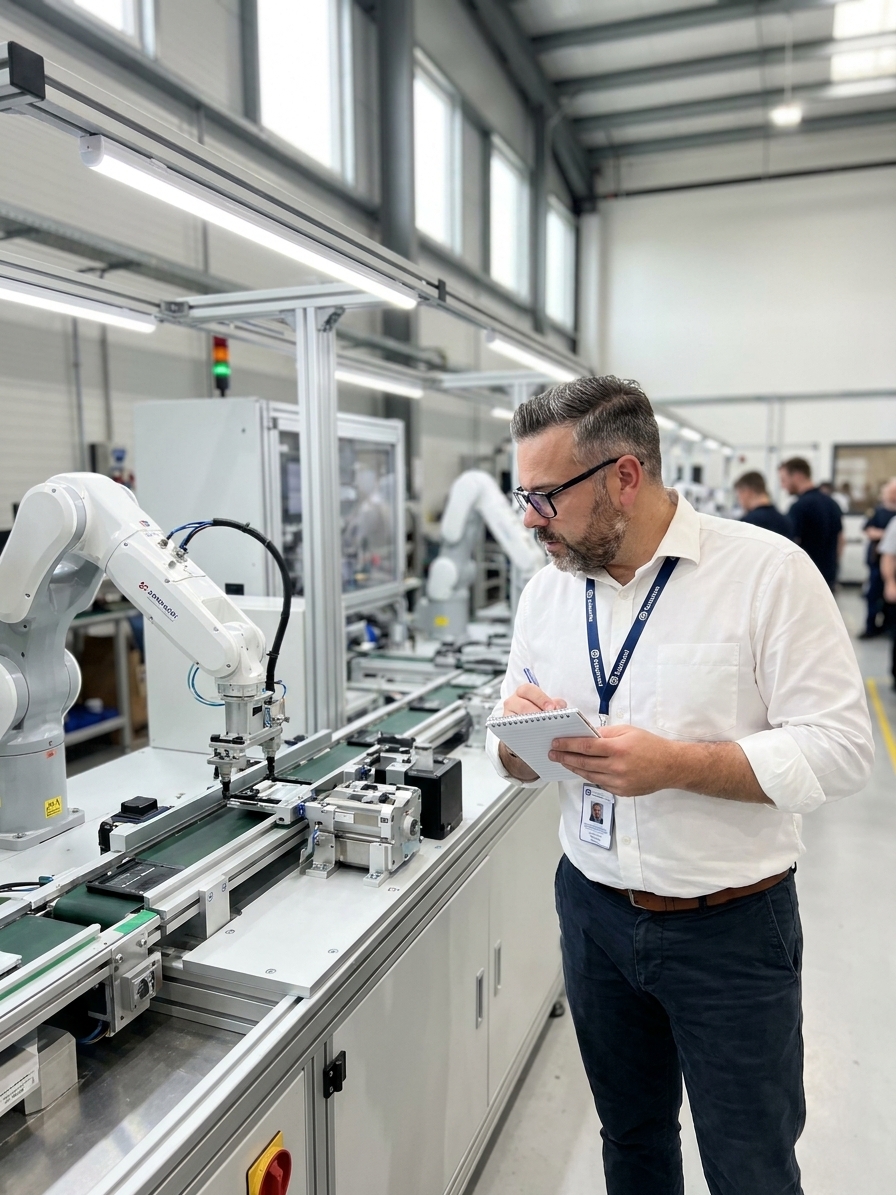
Write down what you saw. Not a formal report. Just
notes. Observations. Questions that emerged. Things to follow up on. The
act of writing forces you to be specific about what you observed, and
specific observations are infinitely more valuable than vague
impressions.
The Deeper Purpose:
Building Quality Culture
Here’s what most organizations miss about the Gemba Walk. It’s not
really about finding problems. It’s about building relationships.
When a manager walks the floor regularly — not to audit, not to
solve, but to genuinely understand — something changes in the social
fabric of the organization. The people doing the work start to believe
that their work matters to the people managing it. They start to believe
that their observations and insights are valued. They start to believe
that problems are things to be discussed, not hidden.
This is quality culture. Not a poster on the wall. Not a slogan in
the break room. Not a quarterly speech from the CEO about the importance
of quality. Quality culture is the lived experience of whether it’s safe
to tell the truth about what’s happening on the floor. And that lived
experience is built, one walk at a time, through the accumulated
evidence that someone with authority cares enough to show up, listen,
and act on what they hear.
I’ve seen organizations where the Gemba Walk transformed their
quality performance more than any tool, technique, or methodology ever
did. Not because the walks uncovered magical insights that were
previously invisible — although they often did. But because the walks
created a dynamic where problems could be discussed openly, where the
people closest to the work felt empowered to raise concerns, and where
solutions emerged collaboratively from genuine understanding rather than
being imposed from above.
The Data Grows Legs
There’s a specific phenomenon that happens when leaders start walking
the floor. The data they’ve been reviewing in conference rooms suddenly
starts making sense. The scatter plot that looked random resolves into a
pattern once you’ve seen the physical layout of the machines. The trend
that seemed inexplicable becomes obvious once you’ve watched the shift
change and seen the informal handoff process. The outlier that everyone
dismissed as a fluke takes on new meaning once you’ve observed the
specific condition that produces it.
Data without context is just numbers. The Gemba Walk provides the
context. And once you have both — the quantitative rigor of your
measurement system and the qualitative richness of direct observation —
you have something far more powerful than either one alone. You have
understanding.
This is why Toyota’s executives were expected to spend significant
time on the production floor. Not because they didn’t have data — Toyota
had some of the most sophisticated production data systems in the world.
But because they understood that data is a supplement to observation,
not a replacement for it. The dashboard tells you where to look. The
Gemba Walk tells you what you’re looking at.
Making It Sustainable
The biggest challenge with Gemba Walks isn’t starting them. It’s
sustaining them. Every organization I’ve worked with has gone through a
phase where management commits to regular floor walks. And most of them
have let the practice fade within three months. The usual suspects:
competing priorities, schedule conflicts, the urgent crowding out the
important.
The organizations that sustain the practice share a few common
traits.
They schedule it like it matters. Not “when I have
time.” Not “maybe this week.” It goes on the calendar as a recurring,
non-negotiable commitment. Because it is. The message to the
organization is clear: this is important enough that it gets priority
over other things.
They vary their focus. Walking the same route and
watching the same process gets stale. Rotate through different areas,
different shifts, different operations. Each walk should have a loose
theme or question, even if it’s as simple as “I want to understand how
material flows between Department A and Department B.”
They involve others. Gemba Walks shouldn’t be a solo
activity limited to senior management. Cross-functional teams walking
the floor together — quality, engineering, maintenance, production —
create shared understanding that no email or report can replicate. When
the quality engineer and the maintenance technician observe the same
phenomenon together and discuss what they’re seeing in real time, the
quality system gets smarter.
They close the loop. When someone on the floor
shares an observation or raises a concern during a walk, follow up. Not
three months later. Within a week. Even if the answer is “we looked into
it and here’s what we found.” The follow-up is what proves the walk
wasn’t performative. It’s what demonstrates that the observation
mattered. And it’s what ensures the next walk will produce even more
honest, valuable input.
The Uncomfortable Truth
The Gemba Walk is uncomfortable for most managers. Not physically —
although standing on a concrete floor for an hour can be a reminder of
how different the floor’s reality is from the office’s. But
intellectually and emotionally uncomfortable. Because when you walk the
floor with open eyes, you see things you’ve been ignoring. You see
workarounds that have become permanent. You see risks that were always
there but never made it into a report. You see the gap between what your
quality system says is happening and what is actually happening.
This discomfort is not a bug. It’s the feature. The Gemba Walk works
precisely because it confronts you with reality. And reality, in quality
management, is the one thing you can’t afford to avoid.
The organizations that embrace this discomfort — that use it as fuel
for improvement rather than retreating to the safety of their dashboards
— are the ones that achieve genuinely world-class quality. Not because
they have better tools. Not because they have better people. But because
they have the courage to look directly at the work and accept what they
see.
Taiichi Ohno drew a chalk circle and said: stand here and watch.
Don’t analyze. Don’t optimize. Don’t solve. Just watch. And when you
finally see what’s actually happening — not what you expected, not what
the standard describes, but what is real — that’s when
improvement becomes possible.
The chalk circle is waiting. The floor is right there. All you have
to do is walk.
Peter Stasko is a Quality Architect with 25+ years
of experience transforming organizations across automotive, aerospace,
and pharmaceutical industries. He has led quality system implementations
on three continents and believes that the most powerful quality tool
ever invented is a pair of comfortable shoes and the willingness to use
them on the production floor.