Quality Hanedashi: When Your Organization Discovers That the Two Seconds Nobody Automates Are the Two Seconds That Kill Your Flow — and the Forgotten Lean Principle That Makes One-Piece Flow Actually Work
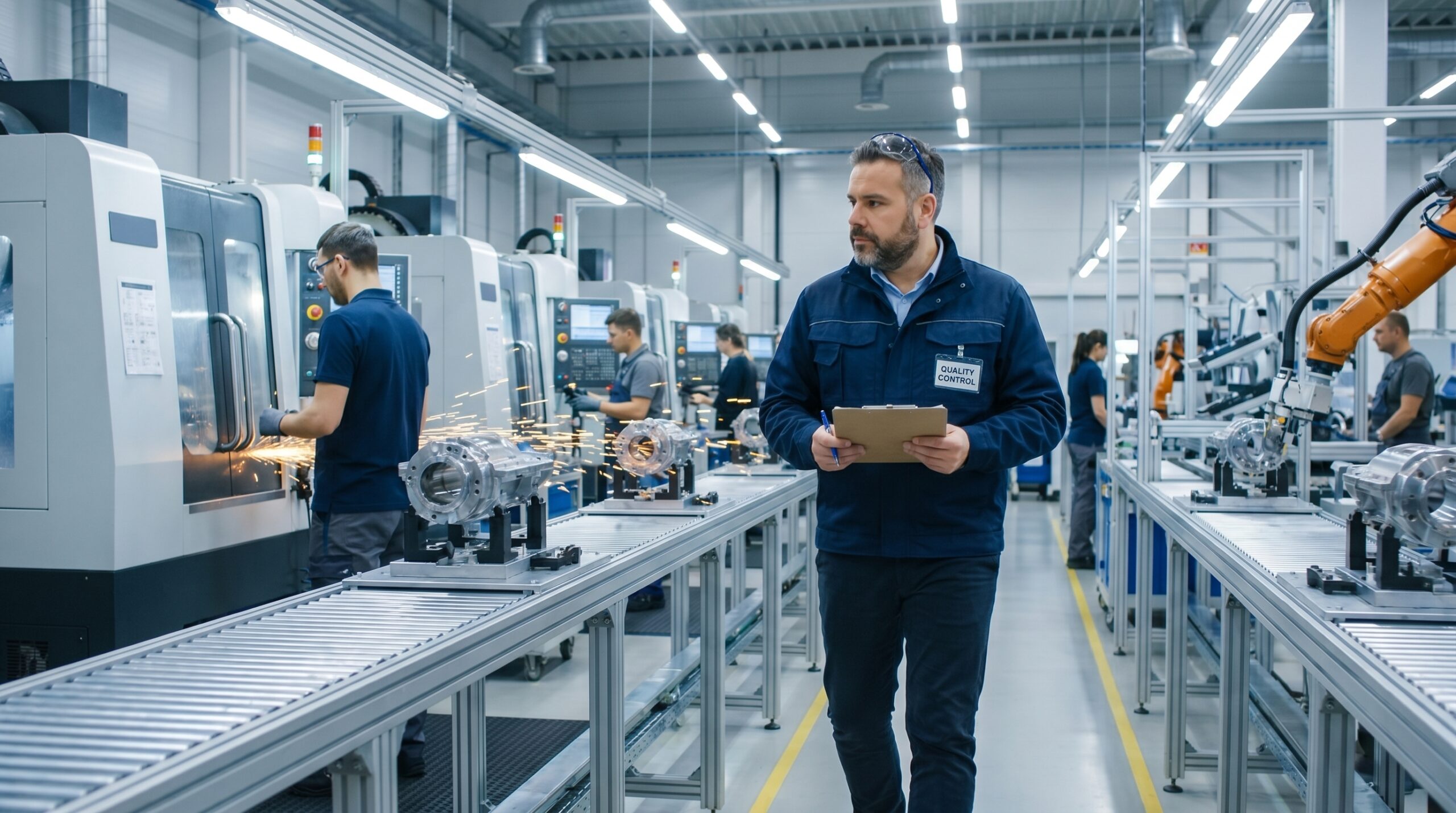
Peter was standing at the end of an assembly cell in a Tier 1 automotive plant when he noticed something that would change how he saw lean manufacturing forever.
The cell was beautiful on paper. Six stations, U-shaped, one-piece flow, takt time of 42 seconds. The engineering team had spent three months designing it. The simulation showed 98.7% efficiency. The launch had gone well — for the first week.
But now, three months in, Peter watched something the simulation never captured. At Station 4, the operator finished her work, picked up the completed subassembly, turned around, walked three steps to Station 5, set it down, walked back to her own station, and repositioned herself to receive the next part. The whole transfer took between six and nine seconds depending on how tired she was.
Six to nine seconds. On a 42-second takt time.
That transfer — the manual handoff of work from one station to the next — was eating 14% to 21% of the available cycle time. And it wasn’t just Station 4. Every station in the cell had a similar transfer. The cumulative effect was devastating. The cell that was supposed to produce 86 units per hour was averaging 61. The math was right. The engineering was right. But the two seconds nobody had automated — the ejection of the finished part and the presentation of the next one — were quietly destroying everything.
Peter wrote one word in his notebook: Hanedashi.
What Is Hanedashi — And Why Has Nobody Heard of It?
Hanedashi is a Japanese term that translates roughly to “auto-ejection” or “automatic unloading.” It refers to a device or mechanism built into a machine or workstation that automatically ejects a finished part and presents the next one for processing — without any human intervention.
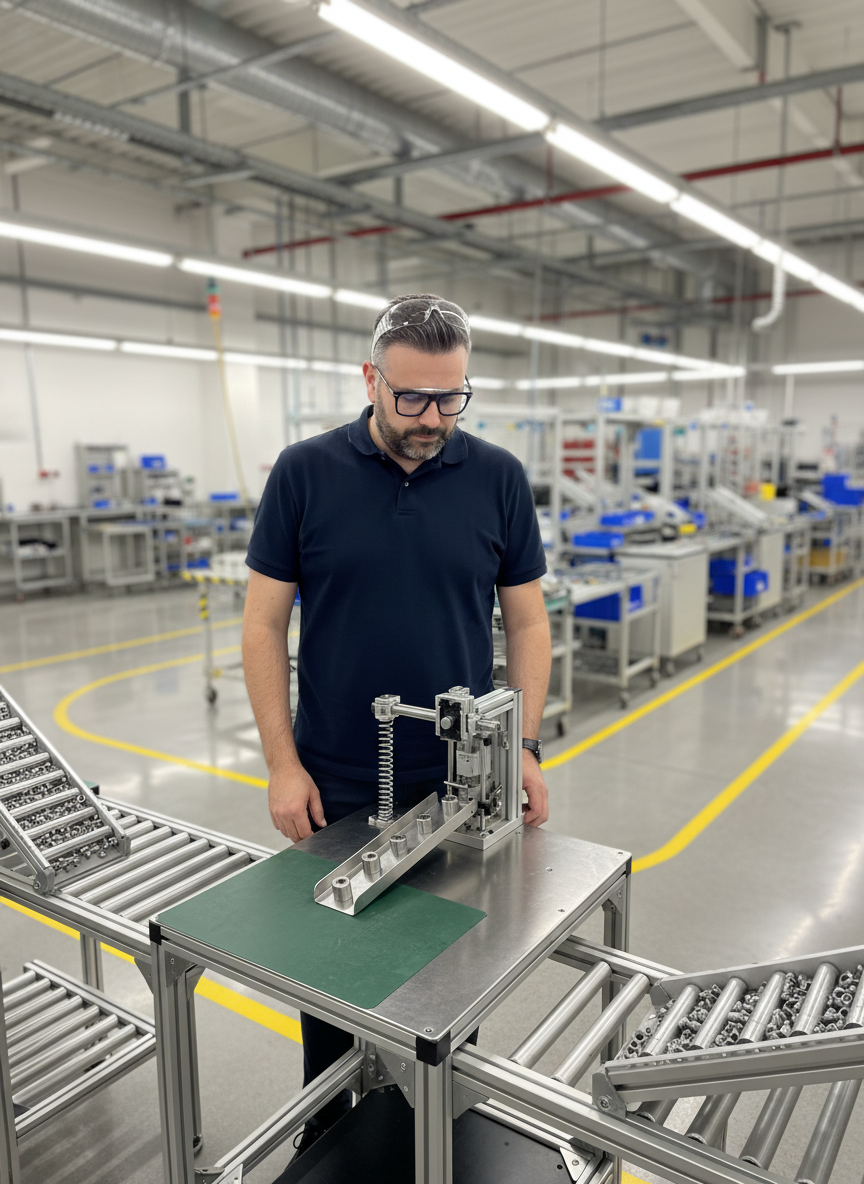
If that sounds simple, it’s because it is. Hanedashi is one of the most elementary mechanical concepts in lean manufacturing. A spring-loaded fixture that pops the part out when the cycle completes. A gravity chute that catches the finished workpiece and slides it to the next station. A pneumatic cylinder that pushes the completed assembly onto a transfer conveyor. A simple lever mechanism activated by the machine’s own motion.
Nothing exotic. Nothing expensive. Nothing that requires a robotics engineering degree or a capital expenditure request.
And yet, Hanedashi might be the single most overlooked principle in modern lean implementation. While organizations invest millions in kanban systems, heijunka boards, SMED setups, and sophisticated andon networks, they ignore the fundamental mechanical prerequisite that makes all of those systems work: the seamless, automatic transfer of work between process steps.
Without Hanedashi, you don’t have one-piece flow. You have one-piece flow interrupted by a human being who has to pick things up, carry them, set them down, and reposition themselves — every single cycle, hundreds of times per shift.
The Mathematics of the Missing Two Seconds
Let’s do the math, because the numbers tell a story that most organizations refuse to believe.
Consider a production cell with five stations, each with a designed cycle time of 40 seconds. Takt time is 40 seconds. Theoretical output is 90 units per hour.
Now add manual transfer. Each operator spends an average of 5 seconds physically moving the part to the next station and repositioning. That’s 5 seconds × 5 stations = 25 seconds of non-value-added time per unit.
The effective cycle time is now 40 + 25 = 65 seconds. But it’s worse than that, because those 5 seconds aren’t consistent. They vary based on fatigue, part weight, ergonomics, and whether the operator had to wait for the next station to be clear. In practice, the transfer time at this cell averages 7.2 seconds with a standard deviation of 2.1 seconds.
Actual output: approximately 52 units per hour. That’s 58% of theoretical capacity — lost to something the simulation didn’t model and the engineers didn’t design for.
Now multiply this across a factory with 30 cells. The plant is losing 42% of its theoretical output to manual part transfer. That’s not a quality problem. That’s not a maintenance problem. That’s a fundamental process design problem — and most organizations don’t even know it exists because they’ve never measured transfer time as a separate category.
The Quality Connection Nobody Makes
Here’s where it gets interesting for quality professionals, because Hanedashi isn’t just a productivity issue. It’s a quality issue — and a significant one.
When operators manually transfer parts, several quality risks emerge simultaneously:
Handling damage. Every time a human picks up a finished component and moves it, there’s a risk of dropping it, scratching it, misorienting it, or applying force to a sensitive surface. Peter has seen cells where the downstream scrap rate was 3% higher than the upstream rate — purely because of transfer damage. The process was producing good parts, and the transfer was destroying them.
Inconsistent orientation. Hanedashi devices present the part to the next station in a precise, repeatable orientation. Manual transfer relies on the operator’s judgment. When a part arrives at the next station in a slightly different position — rotated 15 degrees, shifted 20 millimeters — the next operator has to reposition it before starting their work. Sometimes they get it right. Sometimes they don’t. And when they don’t, the defect that results isn’t traced back to the transfer. It’s attributed to “operator error” at the station where it was discovered — which means the root cause is never addressed.
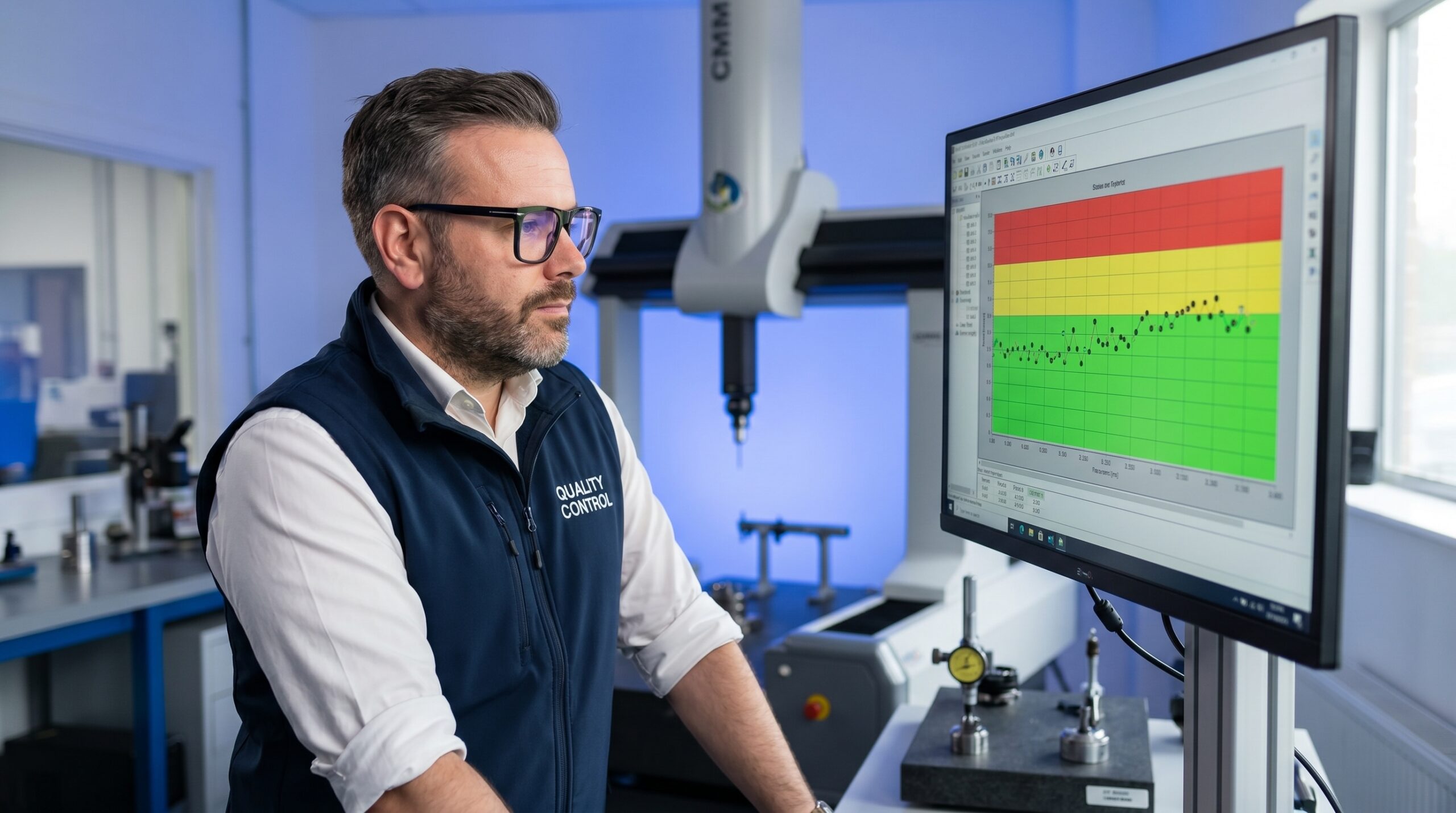
Cycle time variation. Quality systems are built on the assumption of stable, repeatable processes. When cycle times vary by 10-20% because of manual transfer, the process isn’t stable. Tool wear happens at unpredictable rates. Temperature profiles shift. Adhesive cure times compress. All of these variations create quality risks that your control charts will detect as special cause variation — but your root cause analysis will struggle to trace back to “the operator took six seconds to move the part instead of four.”
Cognitive switching. Every time an operator finishes their work and has to think about transferring the part, they’re performing a task switch. Cognitive science tells us that task switching degrades performance on both tasks. The operator isn’t fully focused on the quality of their last step because they’re already thinking about the transfer. And when they return to receive the next part, they’re not fully focused on the incoming quality check because they’re still mentally completing the transfer. Hanedashi eliminates the task switch. The operator does their work. The machine handles the rest. Focus is preserved. Quality improves.
The Three Levels of Hanedashi
Hanedashi isn’t a binary concept — you either have it or you don’t. Peter has found it useful to think about three levels, each with progressively greater impact.
Level 1: Mechanical Auto-Ejection
The most basic form. A spring, a gravity chute, a pneumatic pusher. The machine or fixture ejects the finished part automatically when the cycle completes. The operator’s hands never touch the part during transfer.
This level alone typically recovers 60-70% of the transfer time loss. It’s cheap, simple, and can often be implemented with off-the-shelf components and a few hours of fabrication work.
A spring-loaded fixture for a small assembly might cost $200 in materials and two hours of a toolmaker’s time. The payback is measured in days, not months.
Level 2: Oriented Transfer
The part isn’t just ejected — it’s delivered to the next station in the exact orientation required for the next operation. This might involve a chute with guide rails, a transfer mechanism with locators, or a conveyor with fixtures.
Level 2 eliminates the repositioning time at the receiving station and dramatically reduces the risk of orientation-related defects. It’s the level where quality improvements become most visible, because the incoming part presentation is now as consistent as the process itself.
Level 3: Synchronized Flow
The highest level. Parts move between stations in a synchronized, timed sequence that matches the takt time. Each station completes its cycle, the part is automatically ejected and transferred, and the next part arrives precisely when the operator is ready. No waiting. No rushing. No variation.
This is what one-piece flow was always supposed to be. It’s not a kanban system. It’s not a scheduling algorithm. It’s a physical, mechanical reality where the material flows through the process like water through a pipe — smoothly, continuously, without interruption.
A Real-World Transformation
Peter once worked with a medical device manufacturer that assembled insulin pump housings. The cell had seven stations, each performing a critical sealing operation. The product required 100% visual inspection at three points in the process.
Before Hanedashi, the cell produced 240 units per shift with a first-pass yield of 91.3%. The transfer between stations was entirely manual — operators picked up the delicate housings and carried them to the next station in plastic trays. Handling damage accounted for approximately 40% of all scrap.
The engineering team’s first instinct was to automate the entire cell with robots. The proposal was $2.4 million with a 14-month implementation timeline.
Peter suggested they try Hanedashi first.
Over four weeks, the team designed and installed simple ejection mechanisms at each station. Gravity chutes with soft-surface guides carried the housings between stations. Locator features at each receiving station ensured correct orientation. The total investment was $18,000 in materials and 160 hours of labor.
The results after stabilization:
- Throughput: 240 → 341 units per shift (+42%)
- First-pass yield: 91.3% → 97.8% (+6.5 percentage points)
- Handling damage: Reduced by 89%
- Operator ergonomic complaints: Eliminated (previously the #1 grievance on the line)
The $2.4 million robot proposal was quietly shelved.
Why Organizations Resist Hanedashi
If Hanedashi is so simple, cheap, and effective, why doesn’t every factory use it? Peter has identified three consistent barriers.
“It’s too simple.” Engineers are trained to design complex solutions. A spring-loaded ejector doesn’t feel like engineering. It feels like a hack. There’s no simulation to run, no FEA model to build, no specification sheet to review. It’s just a spring and a chute. And for many engineers, that simplicity is suspicious. They’d rather propose a $50,000 robotic transfer system than a $500 gravity chute — because the robotic system feels like real engineering, and the gravity chute feels like something they should be embarrassed to put on a drawing.
“We’ll get to it later.” During cell design, transfer mechanisms are always on the “Phase 2” list. Phase 1 is getting the stations running. Phase 2 — the Hanedashi — will be added once the cell is stable. But Phase 2 never comes, because once the cell is running, there’s always a more pressing problem. The manual transfer becomes the normal way of working. Operators adapt. Supervisors adapt. Engineers move on to the next project. And the 15-20% productivity loss becomes permanent — invisible because nobody measures what they’ve never had.
“Our operators can handle it.” This is the most insidious barrier, because it’s true — operators can handle manual transfer. They do it thousands of times per shift. They develop routines, shortcuts, and tricks to make it faster. They compensate for the missing mechanism with skill and effort. And because they compensate, the problem doesn’t look like a problem. It looks like normal work. But it’s not normal work. It’s waste wearing a disguise.
How to Implement Hanedashi: A Practical Guide
For organizations ready to take the plunge, Peter recommends a structured approach that starts with observation and ends with standardization.
Step 1: Measure the Invisible
Before you can fix transfer time, you have to see it. Go to your production floor with a stopwatch. Stand at each station for 30 cycles. Measure two things: the time from “work complete” to “part presented to next station” (transfer time), and the time from “part received” to “work begins” (repositioning time). Add them together. That’s your Hanedashi gap.
Plot it. You’ll find it’s larger and more variable than anyone in your organization believes.
Step 2: Identify the Highest-Impact Stations
Not every station needs Hanedashi with equal urgency. Use your data to find the stations where transfer time is longest, most variable, or most likely to cause quality issues (heavy parts, delicate parts, parts that require precise orientation). Start there.
Step 3: Design the Simplest Possible Solution
The best Hanedashi device is the one with zero moving parts. Gravity chutes. Spring ejectors. Angled surfaces. If you need a pneumatic cylinder, use one — but only if you’ve ruled out every passive option first. Complexity is the enemy of reliability. Every moving part is a maintenance item. Every sensor is a failure point.
Step 4: Prototype in Cardboard
Before you fabricate anything, build it in cardboard and duct tape. Test it with real parts. Watch how operators interact with it. You’ll learn more in 30 minutes of cardboard prototyping than in three weeks of CAD design. The operators will tell you what works and what doesn’t — if you listen.
Step 5: Iterate to Standard
Once the design works, document it. Build it in proper materials. Make it part of the standard work for that station. Include it in your TPM schedule. Add it to your process FMEA as a control mechanism. When the next person designs a similar cell, make sure Hanedashi is on the checklist — not as an option, but as a requirement.
The Deeper Lesson: Design for the Invisible
Hanedashi teaches something that extends far beyond part transfer. It teaches us to look for the invisible work in our processes — the small, repetitive, non-value-added actions that are so embedded in daily operations that nobody sees them anymore.
Every process has its own version of the missing ejector. The quality inspector who walks 40 meters between the measurement station and the data entry terminal. The technician who spends three minutes searching for the right torque wrench because they’re not stored at point of use. The supervisor who manually transcribes data from a paper form into a spreadsheet because the two systems aren’t connected.
None of these are dramatic problems. None of them will trigger an andon call or generate a customer complaint. But collectively, they represent an enormous tax on your organization’s capacity, quality, and morale.
Hanedashi is the antidote — not just as a mechanical device, but as a philosophy. It says: if a human is doing something repetitive, predictable, and non-judgmental, engineer it out. Not with complexity. Not with expense. But with the simplest possible mechanism that makes the work flow.
The two seconds you save may not sound like much. But multiplied across a thousand cycles per shift, a hundred shifts per month, twelve months per year — those two seconds become the difference between a factory that struggles and a factory that soars.
Your operators already know where the friction is. They’ve been working around it for years. Go to the gemba. Watch. Measure. And then build the simplest thing that makes the part fly from one station to the next without a single human thought.
That’s Hanedashi. And it might be the most powerful quality tool you’ve never used.
Peter Stasko is a Quality Architect with 25+ years of experience transforming manufacturing operations across automotive, medical device, and industrial sectors. He specializes in making the invisible visible — finding the hidden friction points that kill quality and productivity, and eliminating them with the simplest possible solutions.