Quality Heijunka: When Your Organization Stops Chasing Demand and Starts Leveling Excellence — and the Chaos Everyone Accepted Became the Stability Nobody Thought Possible
How production leveling eliminates the invisible waste that lurks between your schedule and your actual output — and why the manufacturers who stopped chasing volume spikes discovered a quality rhythm their competitors could never match.
The Factory That Ran on Adrenaline
Picture a manufacturing plant that has just landed its biggest order of the year. The celebration lasts exactly one shift. By the second shift, overtime has been authorized. By the third, the maintenance team has been pulled from preventive work to keep up with breakdowns. By the end of the week, the quality team is drowning in nonconformance reports, the warehouse is overflowing with partially completed subassemblies, and the customer — the one whose order triggered all of this — has already called twice asking why their first shipment is late.
This is not a hypothetical. This is Tuesday in thousands of factories around the world.
The pattern is so common that most organizations consider it normal. Demand spikes, production surges, quality suffers, people burn out, and then demand drops and the same factories send workers home early while managers wring their hands over idle capacity. The cycle repeats. The organization becomes addicted to its own chaos, confusing urgency with productivity and firefighting with management.
Toyota saw this same pattern in the mid-20th century. And then they did something that seemed counterintuitive, even irrational: they deliberately chose to produce less than they could during peak periods and more than they needed during slow ones. They leveled their production. They called it Heijunka (平準化), and it became one of the foundational pillars of the Toyota Production System.
What Toyota understood — and what most organizations still miss — is that the unevenness in production is not just a scheduling problem. It is a quality problem. And it may be the most expensive quality problem you have never measured.
What Is Heijunka?
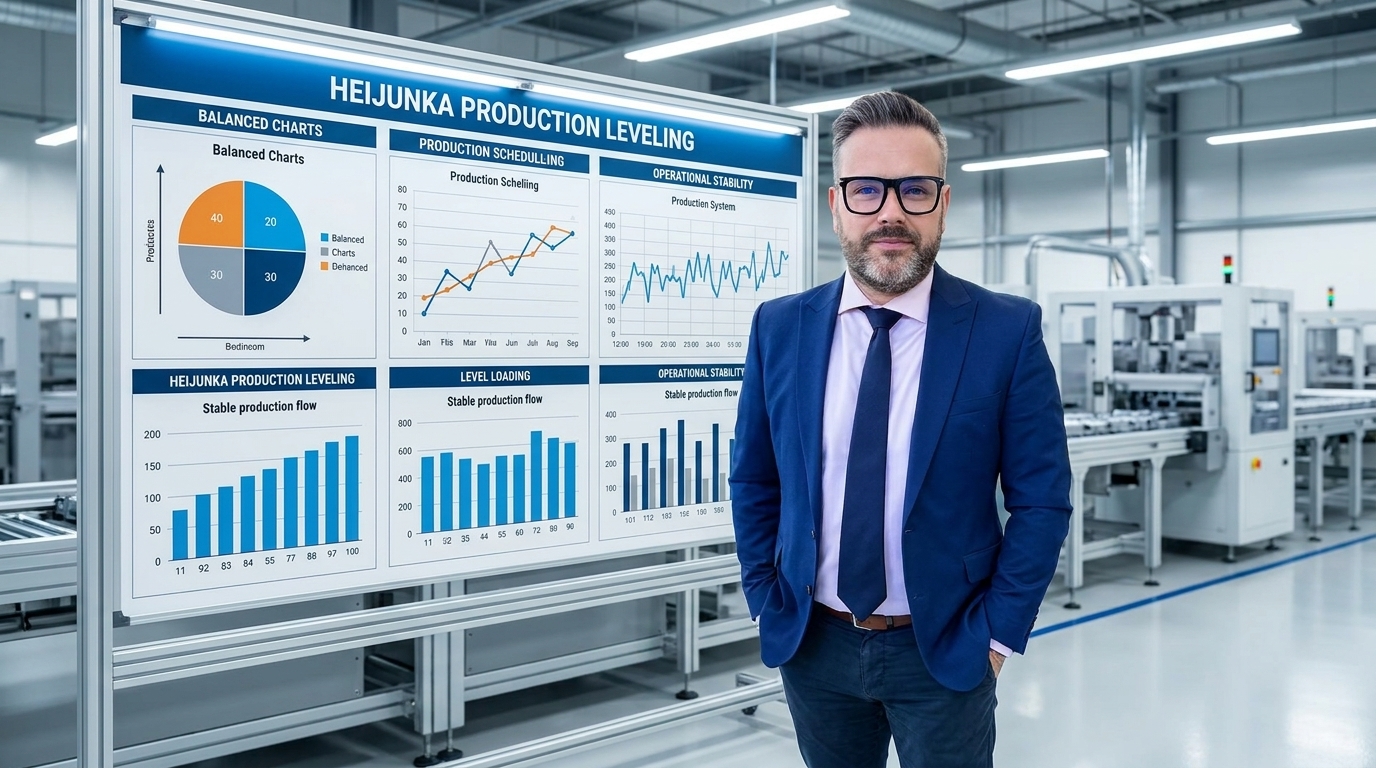
Heijunka translates roughly to “leveling” or “balancing.” In the context of manufacturing, it means producing goods at a steady, consistent rate rather than in large batches driven by immediate demand. The goal is to smooth out the fluctuations — in volume and product mix — so that every day looks roughly like every other day.
There are two dimensions to Heijunka:
Volume leveling means producing the same total quantity of units each day, each shift, each hour. Instead of building 1,000 units on Monday and 300 on Tuesday, you build 650 on both days.
Mix leveling means distributing different product variants evenly across the schedule. Instead of running all of Product A on Monday and all of Product B on Tuesday, you interleave them — A, B, A, B — so that the production system stays flexible and no single variant starves the others.
Together, these two dimensions create a production rhythm that is predictable, sustainable, and — here is the part most people overlook — far more conducive to consistent quality.
The Quality Cost of Unevenness
The connection between production leveling and quality is not immediately obvious. Most quality professionals think in terms of process capability, inspection effectiveness, and defect rates — not in terms of scheduling. But the relationship is profound.
Changeover chaos. When you produce in large batches, every changeover between products is a quality event. Operators must recalibrate equipment, switch tooling, adjust parameters, and verify that the first articles from the new setup meet specification. The more dramatic the changeover — and large-batch scheduling makes changeovers dramatic by definition — the more opportunities for error. Leveling production with smaller, more frequent batches means smaller, more manageable changeovers. The risk per transition drops.
Resource overload. When production surges, every resource is stretched: people, equipment, inspection stations, material handling, suppliers. Stretched resources make mistakes. The operator who normally runs two machines is now running four. The inspector who normally has five minutes per part now has two. The supplier who normally delivers weekly is now being asked to deliver daily. Quality degrades not because anyone decided to lower standards, but because the system exceeded its capacity to maintain them.
The bullwhip effect on your supply chain. Uneven production creates uneven demand signals that propagate upstream through your supply chain. Your supplier’s supplier is suddenly ramping up and shutting down based on your scheduling chaos. Each oscillation introduces variability in raw materials — different lots, different lead times, different storage conditions — and that variability shows up in your process as new sources of variation you never planned for.
Hidden inventory waste. Large-batch production requires large-batch inventory — work-in-process that sits between operations, consuming space, tying up capital, and aging. Components that sit too long can degrade, become contaminated, or simply get mixed with newer batches. When you finally consume them, you are processing material of uncertain vintage through a process that assumes consistency.
People exhaustion. The most underappreciated quality cost of uneven production is the toll it takes on the workforce. Overtime fatigue is not an abstract concept. Research consistently shows that accident rates, error rates, and defect rates increase significantly during extended shifts and consecutive overtime days. Your people are your most sophisticated quality instruments — and uneven production blunts them.
The Mathematics of Leveling
Consider two plants producing the same 10,000 units per week.
Plant A produces according to demand: 3,000 on Monday, 2,500 on Tuesday, 1,500 on Wednesday, 1,000 on Thursday, and 2,000 on Friday. The peak-to-trough ratio is 3:1. On Monday, every resource is maxed out. On Thursday, people are standing around.
Plant B produces 2,000 units every day. Same total output. But the peak-to-trough ratio is 1:1. Every resource runs at a consistent rate. staffing is stable. Maintenance is predictable. Inspections are paced. Suppliers know exactly what to deliver and when.
Which plant do you think has lower defect rates? Which plant has more consistent process capability? Which plant has operators who are more likely to notice when something is slightly off because their rhythm gives them the mental bandwidth to pay attention?
The answer is obvious — and yet most manufacturers operate closer to Plant A than Plant B. They do this because they believe they are being responsive to customer demand. They are not. They are being reactive. And reactivity is the enemy of quality.
Heijunka and Changeover Quality
One of the most compelling quality arguments for Heijunka comes from the relationship between batch size and changeover quality. In traditional large-batch scheduling, changeovers are infrequent but high-stakes events. The organization invests heavily in setup verification, first-article inspection, and process qualification — because an undetected changeover error can produce an entire batch of defects before anyone notices.
Heijunka, by creating smaller, more frequent batches, forces more changeovers — but each one is lower risk because the batch at risk is smaller. And here is the paradox: the more you practice changeovers, the better you get at them. Organizations that implement Heijunka often discover that their changeover quality improves dramatically, not because they changed the procedure, but because they did it so often that it became routine rather than exceptional.
This is the same principle behind Single-Minute Exchange of Die (SMED), another Toyota innovation. Heijunka and SMED are natural companions. Leveling creates the need for fast changeovers; SMED provides the method. Together, they transform what was once a disruptive, quality-threatening event into a smooth, standardized operation that takes minutes instead of hours.
The Pacemaker of Production
In lean thinking, Heijunka serves as the pacemaker of the entire production system. Just as a cardiac pacemaker sends regular electrical signals to maintain a steady heartbeat, Heijunka sends regular production signals that maintain a steady flow through the value stream.
Without a pacemaker, the system fibrillates — erratic bursts of activity followed by periods of inactivity. Materials arrive in clumps. Equipment alternates between overload and idle. People oscillate between panic and boredom. And quality — which depends on consistency, predictability, and the ability to detect variation against a stable baseline — becomes impossible to maintain.
With Heijunka as the pacemaker, the entire value stream breathes in a regular rhythm. Suppliers deliver at a constant rate. Materials flow through operations at a constant rate. Finished goods emerge at a constant rate. And quality — which is fundamentally about reducing variation — benefits from every reduction in scheduling variation that Heijunka provides.
Implementing Heijunka: The Practical Path
Implementing production leveling is not a scheduling exercise. It is an organizational transformation. Here is how to approach it:
Start with data, not opinions. Analyze your actual demand patterns over the past 12 months. Identify the true average demand, the variability, the seasonal patterns, and the customer-mandated spikes. You cannot level what you do not understand.
Establish your takt time. Takt time — the rate at which you need to produce to meet customer demand — is the foundation of Heijunka. It tells you how many seconds or minutes you have per unit. Everything else builds from this number.
Create a leveled schedule. Distribute your total demand evenly across available production time. If your takt time says you need one unit every four minutes, schedule one unit every four minutes. Not three in the first minute and nothing for the next eleven.
Reduce changeover times. If your changeovers take four hours, you cannot level your mix. SMED is prerequisite. Get changeovers under ten minutes — yes, it is possible — and leveling becomes feasible.
Build a small finished-goods buffer. Heijunka requires a buffer between your steady production rate and your variable demand rate. This is not the same as the massive inventories that traditional batch production creates. A Heijunka buffer is small, deliberate, and managed — typically a few days of finished goods that absorb demand variation without disrupting production rhythm.
Level the mix first, then the volume. It is easier to level the product mix — distributing variants evenly — than to level total volume. Start there. Once your mix is stable, smoothing the volume becomes a natural next step.
Train your people on why, not just how. Heijunka feels wrong to operators who are accustomed to running as fast as possible during peaks and coasting during troughs. Explain the quality logic. Show them the defect data from peak periods versus steady periods. Let them discover the connection between leveled production and fewer headaches.
The Counterarguments — and Why They Fail
Every time Heijunka is proposed, the same objections emerge. Let us address them directly.
“We cannot level because our customers demand variable quantities.” Yes, they do. But your internal production schedule does not have to mirror their demand pattern. That is what the finished-goods buffer is for. You produce at a steady rate and ship from the buffer. The customer gets what they want, when they want it. Your production system gets the stability it needs.
“Leveling will increase our inventory.” It will increase your finished-goods inventory slightly. But it will dramatically decrease your work-in-process inventory, your raw-material inventory (because your suppliers can also level), and your defect inventory (the hidden cost of uneven production that nobody puts on a balance sheet). The net effect is almost always a reduction in total inventory.
“Our product mix is too complex to level.” The more complex your mix, the more you need leveling. Complexity without structure is chaos. Group your products into families. Level within families. It does not have to be perfect. A roughly leveled schedule is infinitely better than a completely reactive one.
“We do not have time for this — we are too busy fighting fires.” You are too busy fighting fires precisely because you have not implemented Heijunka. The fires you are fighting are symptoms of the unevenness that leveling would eliminate. This is not a time-management problem. It is a priority problem.
The Quality Dashboard That Tells the Truth
Here is a simple test: plot your defect rate against your production volume over the past six months. If your defect rate rises and falls with your production rate — if the peaks in production correspond to peaks in defects — then you have a Heijunka problem masquerading as a quality problem.
Most organizations will see exactly this correlation. They will also see that their best quality weeks — the weeks with the lowest defect rates — are the weeks when production was most stable. Not the slowest weeks. Not the fastest weeks. The most stable weeks.
This is not a coincidence. It is the fundamental truth that Heijunka exploits: quality thrives in stability and suffocates in chaos.
Beyond Manufacturing: Heijunka in Knowledge Work
The principles of Heijunka are not limited to factories. Any environment with variable workload can benefit from leveling.
In software development, teams that level their sprint commitments — taking on a consistent volume of work each iteration — produce fewer bugs than teams that swing between feast and famine. In healthcare, hospitals that level patient flow through scheduled procedures have lower infection rates and fewer medication errors than those that batch procedures. In quality laboratories, testing facilities that maintain a steady throughput of samples produce more reliable results than those that rush through backlogs in periodic bursts.
The principle is universal: consistent pace produces consistent quality. Every time.
The Long Game
Heijunka is not a quick fix. It requires patience, discipline, and the willingness to produce differently than your customers order. It requires investment in changeover reduction, buffer management, and workforce training. It requires leadership that understands the difference between being busy and being productive.
But the organizations that commit to production leveling discover something remarkable: their quality improves not because they added inspection or tightened specifications, but because they created the conditions in which quality is natural. Defects do not decrease because you catch more of them. They decrease because fewer of them are created. And fewer are created because the system is no longer generating the stress, overload, and variation that produce defects in the first place.
Heijunka is the most underrated quality tool in existence — because it does not look like a quality tool at all. It looks like a scheduling technique. But beneath the schedule lies a profound insight: the best way to improve quality is not to improve how you detect defects. It is to improve how you organize work so that defects are less likely to occur.
Level your production. Level your quality. It really is that simple — and that difficult.
About the Author
Peter Stasko is a Quality Architect with over 25 years of experience in manufacturing excellence, lean systems, and continuous improvement. He has helped organizations across automotive, aerospace, electronics, and medical device industries transform their quality systems from reactive firefighting into proactive, data-driven operations. His work focuses on the intersection of human behavior, organizational psychology, and process engineering — because the best quality systems are the ones people actually use. Peter writes regularly about the behavioral dimensions of quality at iaec.online.