A quality team spends four months developing a new statistical monitoring method for a critical process. The pilot results are extraordinary: defect rates drop significantly and false alarms plummet. The operators who tested it say they will never go back to the old way. The presentation to leadership gets a standing ovation.
Six months later, you walk the production floor and find that three out of four lines are still using the old method. The new system lives on one line, the pilot line, where the original champions still work. Everyone else nodded approvingly in the meeting and went back to doing exactly what they were doing before.
This is not a story about a failed improvement. This is a story about a good improvement that died of loneliness. It happens in organizations every day. We treat adoption as an afterthought, something that happens automatically once the technical brilliance of our PFMEA or SPC system is revealed. It does not.
What Everett Rogers Understood About IATF 16949 Rollouts
In 1962, sociologist Everett Rogers published Diffusion of Innovations. It explains more about why ISO 9001 transitions, Six Sigma programs, and Lean manufacturing initiatives fail than any textbook on statistical methods. Rogers identified five attributes that determine whether an innovation gets adopted by a population.
Relative advantage asks if the new method is perceptibly better than the current state in daily work, not just theoretically better in a controlled study. Compatibility asks if it fits how people already work, or if it requires them to become a different person. Complexity measures how hard the person at the station perceives the system to be, regardless of what the engineers claim.
Trialability asks if operators can experiment with the new tool without committing their entire line to it, make mistakes, and revert if necessary. Observability asks if they can see other people using it successfully. Most quality initiatives score brilliantly on relative advantage in a PowerPoint presentation and catastrophically on every other dimension where it actually matters.
Mapping the Adoption Curve in Your Plant
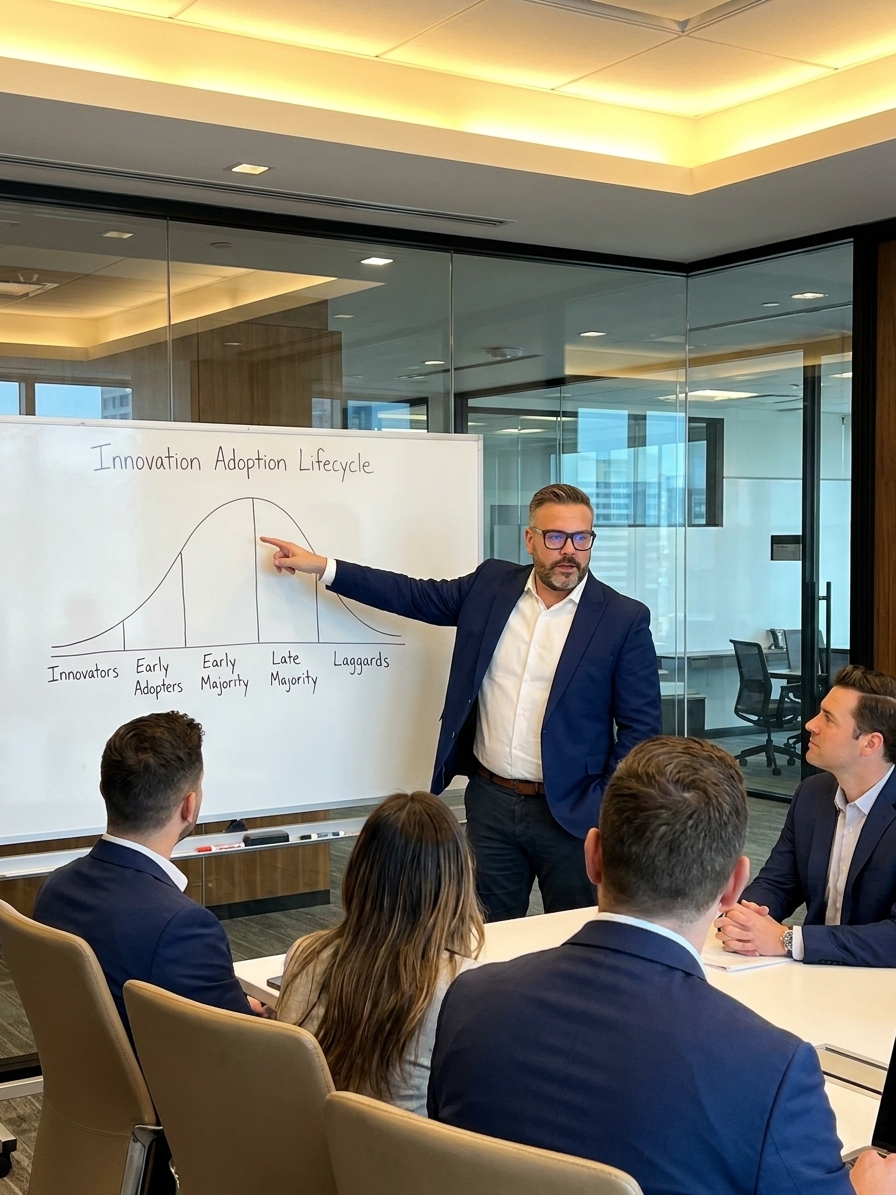
Rogers did not just identify attributes of innovations. He identified types of adopters. Understanding these types is the difference between an IATF 16949 transformation that takes root and one that decorates your break room walls. Innovators, roughly 2.5% of your workforce, are your quality engineers who volunteer for every pilot. They are also terrible at convincing anyone else to follow them because they speak a language most operators do not understand.
Early adopters make up about 13.5% of the plant. These are your respected team leads and experienced operators. Others watch them to see if something is real. In a quality transformation, these are the most important people in your organization. The early and late majority, representing 68% of the workforce, need proof that the new MSA or Cpk tracking method works for someone like them.
Most quality rollouts fail because they are designed for innovators and then thrown at the late majority, who need more convincing than any rollout provides. The late majority adopts because they have no choice. They are not enemies of improvement; they are people who have seen too many management fads come and go.
Adopter Categories on the Shop Floor
- Innovators (2.5%)Quality engineers who read journal articles for fun. They will try anything but cannot convince operators to follow.
- Early Adopters (13.5%)Respected team leads. When they adopt, the majority pays attention. Your primary target for diffusion.
- Early & Late Majority (68%)Need peer proof and observable results. They will not adopt based on engineering specifications alone.
- Laggards (16%)Will adopt only when forced. In quality, you need their compliance, not their enthusiasm.
The Five Attributes Test in Practice
Before your next SPC rollout or PPAP revision, run it through Rogers' five attributes. Be brutally honest. Ask the people who will actually use the system, not the people who designed it. I learned this lesson early in my career when leading a new SPC implementation at a major automotive plant.
The system was objectively superior: real-time data collection, automated control chart calculations, instant alerts when a process drifted. We trained everyone, installed terminals at every station, and printed laminated quick-reference cards. Adoption after three months was 23%.
When I finally asked operators why they were not using it, the answers were humbling. The relative advantage was real but invisible in daily work. The compatibility was zero because they had to keep the old paper logbook for their supervisor. The complexity was high because the interface had seventeen buttons when they only used three.
Trialability was non-existent because we mandated the rollout. Observability failed because nobody else was using it either. Five honest conversations revealed five fatal flaws. We had designed a system that was technically brilliant and organizationally stillborn.
The Informal Network That Determines Everything
The diffusion of an innovation through an organization is not a function of the innovation's technical quality. It is a function of the social network through which it travels. In every plant, there are informal networks that carry information faster than any official communication channel. Conversations in break rooms matter more than presentations in boardrooms.
I once worked with a plant manager who understood this intuitively. Before rolling out a new AS9100 quality management system, she identified three operators, one on each shift, who were respected by their peers, known for good judgment, and connected to large informal networks. She invited them to help design the rollout and gave them early access.
A change agent's primary task is not to create innovations, but to create the conditions under which they spread.
When the system went live, these three operators became the primary support network for their peers. Not the quality engineers. Not the IT helpdesk. Three operators who spoke the language of the people who actually had to use the system. Adoption at 90 days reached 78%, and at six months it hit 94%. Same system, same organization, different diffusion strategy, radically different result.
Designing Quality Improvements for Adoption
To make quality improvements spread, you must design for adoption, not just for technical excellence. Making the advantage visible means showing operators how a new gauge reduces their daily friction, not just telling them it lowers the cost of scrap. Designing for compatibility means building systems that use existing forms and locations, rather than forcing people to walk to a different terminal.
Reducing complexity means stripping the improvement down to its essential function. Every additional step or decision point adds friction. The operators on your floor are not less intelligent than the engineers who designed the system. They are busier. Respect that difference by removing anything that exists because it is impressive rather than necessary.
Create safe trials instead of mandatory rollouts. A one-week trial period where both the old and new SPC methods run in parallel is worth more than a month of training sessions. When someone chooses to switch because they have seen it work with their own eyes, you have won an adopter for life. When they switch because they were told to, you have won compliance at best and quiet sabotage at worst.
The Adoption-Focused Rollout Sequence
- 01Identify Early AdoptersMap the social network to find respected team leads on every shift.
- 02Run Parallel PilotLet operators use the new method alongside the old one without risk.
- 03Make Success ObservableLet the early adopters demonstrate peer results, not engineering charts.
- 04Measure Diffusion RateTrack how many people use the system, not just the Cpk or OEE results.
The Cultural Cost of Failed Diffusion
Every time a good improvement fails to spread, something corrosive happens to your organization's culture. People learn that this too shall pass. They learn that the smart move is to wait out the initiative, because in six months there will be a new one and this one will be forgotten.
I have walked into plants where operators could name seven different quality programs that had come and gone in the past decade. Seven rounds of excitement, training, posters, and abandonment. Seven proofs that management's attention span is shorter than the improvement cycle. After the third or fourth round, people stop engaging. They are not resistant to change. They are experienced at watching change fail.
The cost of failed diffusion is a hardened organization that becomes progressively more difficult to improve. Every abandoned 8D methodology or MSA study makes the next initiative suspect. Over time, the plant develops an immune response to improvement. The only defense is to measure adoption as rigorously as you measure process capability, and to treat diffusion as a core engineering task rather than a hope.